

You know that hollow feeling when you’ve poured time, money, and ideas into a campaign… and it just flops? You’re staring at numbers that don’t move, wondering why that last-minute, off-the-cuff post outperformed your hero ad by a mile.
Yeah. Been there.
And here’s what a lot of folks miss: it’s probably not creative. It’s probably the audience.
Because out here in the loud, lightning-fast world of digital marketing, the “audience” isn’t just one faceless blob. It’s dozens, maybe hundreds, of mini-worlds. Little clusters of people who think, act, and react differently. Finding the right one? That’s everything. It’s the difference between guessing your way through budget or watching returns roll in while you sleep.
So how do you actually find the right segment? The group that just gets it and acts like your campaign was made for them?
Let’s talk through it.
Step 1: Get Intimate With Your Product or Service
Before diving into who’s buying, let’s rewind and ask—what exactly are you selling?
No really. What is it?
Not just the product specs or taglines. Dig past that. What’s the real-life impact of what you’re offering?
Start with two things:
- List the benefits, not just the features. Maybe your service helps freelancers save two hours a week. Or your planner helps moms feel less scattered before school drop-off. Keep it real. Skip the fluff.
- Define the problem you’re solving. Is it daily stress? A clunky checkout experience? A drawer full of expired beauty samples? Nail that down and you’re halfway to knowing who actually needs, wants, and will pay for your thing.
When you’re crystal clear on what your product does for someone’s real life, it gets way easier to find the people who’ll actually care enough to listen.
Step 2: Pull Together a Full Picture of Your Audience
Once you know what you’re offering, time to zero in on who actually wants it. And this is where a lot of people oversimplify.
A basic profile like “working moms” or “Gen Z gamers” won’t cut it. You need layers. Rich, messy, complicated data. The kind that helps ideas start clicking.
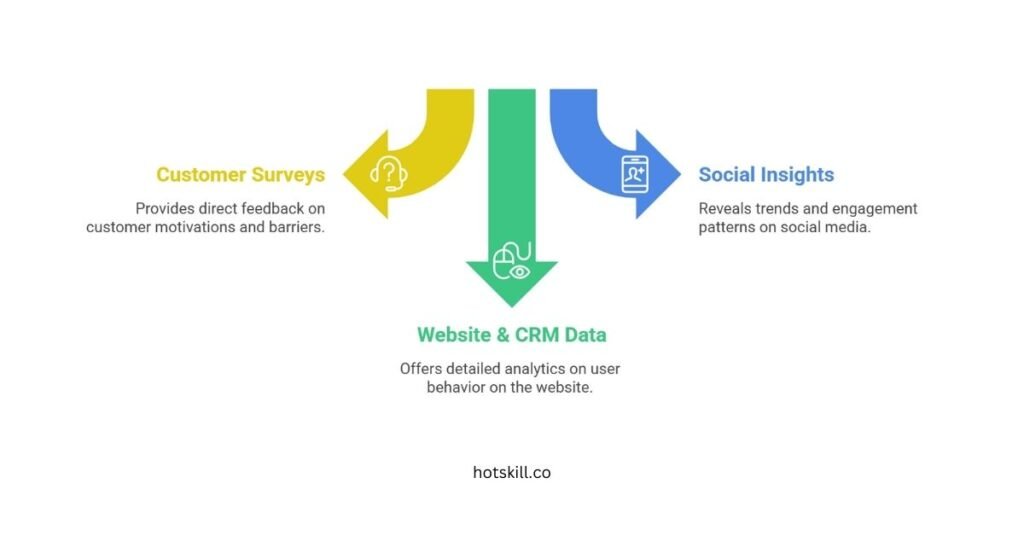
Where to look?
- Surveys & interviews: Your current customers are a goldmine. Ask them open questions. What brought them to you? What almost made them not buy? Their words matter more than anything you’d brainstorm in a campaign brief.
- Social insights: Scroll through your Instagram analytics, check TikTok discovery patterns, explore who’s DM’ing and why. These small signals point to big truths.
- Website & CRM data: Look at bounce rates, time on page, and what content people linger on. Did they skim your FAQs and disappear or dive into three blog posts and subscribe?
What to gather:
- Demographics: Age, income, zip code, job titles. Good start, but not enough on its own.
- Psychographics: Beliefs, motivations, fears, and desires. This is the glue of human behavior.
- Behavioral data: What triggers a cart abandonment? Who’s always the first to open an email? Who only buys with a discount? Watching behavior lets you spot the difference between interest and action.
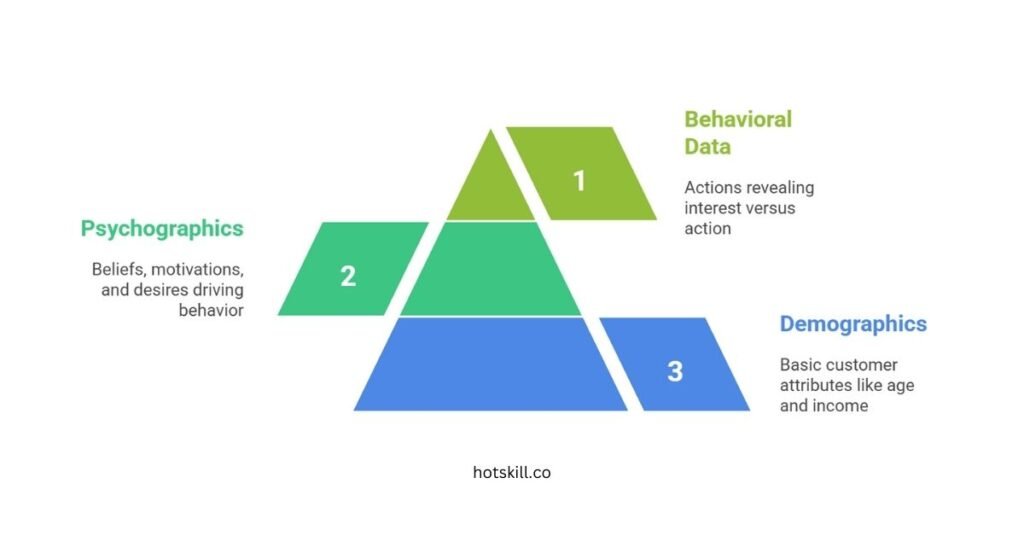
Pull this all into one space. Patterns will pop. That’s your real audience beginning to take shape.
Step 3: Don’t Just Analyze—Understand
Now you’ve got your mountain of data. Cool. But don’t fall into the trap where it becomes just rows and charts and slides no one reads.
Segmentation isn’t a spreadsheet exercise. It’s about seeing stories. People. Motivations.
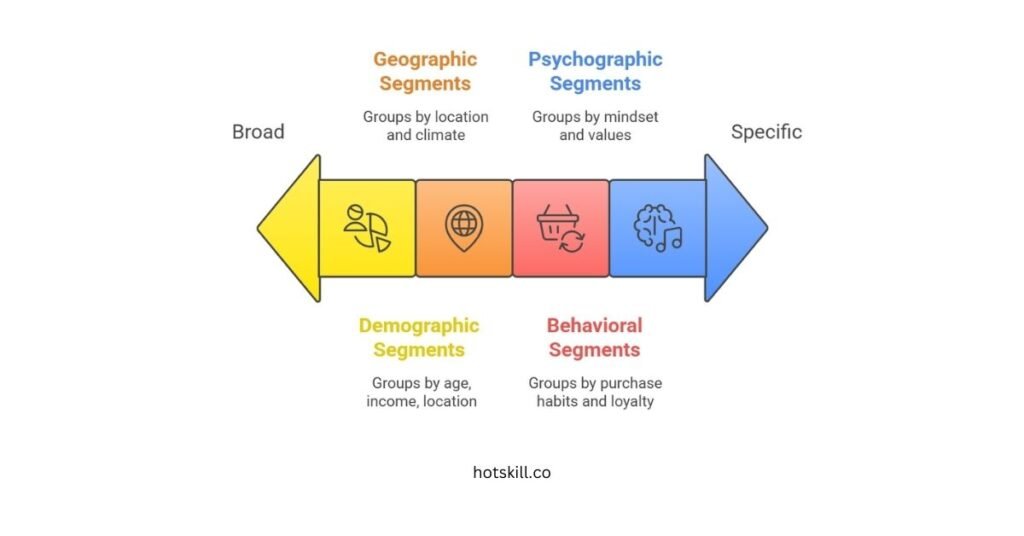
Here’s how to start slicing:
- Demographic segments: Say you’ve got a high-end skincare line. Maybe 35 to 50-year-olds with mid-to-high income in coastal cities are your sweet spot. But don’t stop there.
- Psychographic segments: Look deeper. What if you grouped based on mindset instead of just age? “Holistic wellness explorers” or “fix-it-fast problem solvers.” One wants clean ingredients and sustainability. The other wanted results yesterday. See the difference?
- Geographic segments: Geography can shift habits. Someone in Minneapolis shops differently during winter than someone in Miami. Adjust accordingly.
- Behavioral segments: Who buys once, loves it, but never returns? Who refers to friends like crazy? Group based on habits not just hopes.
These segments make everything sharper copy, offers, timing. You’re no longer speaking to “the crowd.” You’re speaking to that specific person scrolling at 8:45 PM in sweatpants, sipping tea, annoyed but ready to buy if something clicks.
Step 4: Bring Your Segments to Life With Personas
This is the part that turns data into something human. Something real. Personas take your segments and let you breathe life into them.
Not avatars. Not cardboard cutouts. Real-ish people.
Here’s how.
Julia, 34, Freelance Designer
- 📍Portland OR
- 🛍️ Chooses brands with strong eco-values
- 📲 Prefers texts over emails
- 🛒 Shops around 10 AM on weekdays
- 🤯 Feels overwhelmed by too many choices
Raj, 42, Financial Analyst
- 📍Chicago
- 🧠 Driven by logic, ROI, and professionalism
- 💬 Reads detailed reviews before buying
- ⏰ Shops online between 8–9 PM
- 😤 Gets turned off by vague messaging
These personas act like shortcuts for your whole team. Design knows who they’re creating for. Copy has a voice in mind. Ads get tailored. No more guessing or committee-created blandness.
Honestly? Personas are kinda the cheat code to building smart campaigns fast.
Step 5: Test Your Segments in the Real World
Now it’s go-time. You’ve got your tidy segments and sharp personas. Are they good?
Only one way to find out.
You test. And not just once.
Here’s how to keep it flexible and real:
- A/B test entire campaigns by audience: Change more than just subject lines. Test different copy, visuals, CTAs, and even timing. See which lands stronger.
- Run persona-specific pilots: Maybe Julia responds to an image-heavy email with a clean product grid and SMS reminder. Raj? He might need a CTA that leads to a longer-form breakdown on ROI.
- Gather constant feedback: Post-purchase emails, review prompts, chatbot convos—this stuff tells you if you’re hitting the mark or swinging wide.
And when something flops? That’s not failure. That’s a direction not to chase and it saves you from wasting budget and headspace later.
👉 Pro tip: Sometimes what doesn’t work teaches more than what does. Lean into those surprises.
Step 6: Use Tools That Actually Make This Work Easier
You don’t need to hire a data scientist or buy enterprise tools your team can’t operate. You just need tools that connect and keep things flowing.
Here are solid go-tos:
- Google Analytics: Great for watchlist metrics like demographics, bounce rate, and device type.
- Meta Insights (Facebook & Instagram): Helps uncover which interests and patterns are hitting across various groups.
- CRM platforms like HubSpot or Salesforce: These let you track lifecycle stages and automate messaging specific to each one.
- Email tools like Klaviyo or Mailchimp: Built-in segmentation and automation features make testing manageable.
Main thing? Make sure your tools talk to each other. If you’re hopping between apps that don’t sync, cool insights get lost. And your audience? They feel that disconnect.
### Real Examples: How Brands Nail Segmentation
Let’s look at some real-world magic.
Healthcare – Calm App
They ask users about stress levels via intake surveys. High-anxiety folks get served relaxation content fast. Sleepier types get bedtime stories. It worked. Chill app = 28% more people sticking around a week later, especially young adults.
Online Education – Coursera
They track how long someone spends on a lesson, quiz scores, patterns over time and then update what course you see next. If you stalled on a coding topic, they give you review tracks. It lifted course completion by 15%. That’s big in online learning.
Retail – Sephora’s Loyalty Program
Sephora doesn’t just group shoppers by age. They track who spends what, what kind of products they love, and then tailor launches. Skincare folks get serum previews. Lipstick lovers? Limited palette drops. It’s why they have an 80% return rate on VIPs.
Music – Spotify Personas
Spotify breaks users into types like “Loyal Fans” or “Mood-Driven Listeners.” They feed each group different experiences, wrapped playlists, discovery nudges, mood-based cues and saw a 20% boost in monthly active users after those campaigns.
None of this is guesswork. This is knowing your audience with razor-sharp clarity.
Why This Matters More Than Ever
Look, the market is loud. Too loud. People scroll past generic in a blink.
- Weak targeting burns money
- Vague campaigns don’t move hearts or sales
- Data sitting in a spreadsheet is just background noise
But you take that data, soften it into personas, test like crazy, and adjust every move based on real reactions? Now you’re not chasing trends. You’re building performance.
And here’s the kicker: the best segment is rarely the cheapest or the broadest. It’s the one that clicks with your offer like it was custom-made.
That’s the sweet spot. That’s where results start compounding.
Coming Next: Deeper Personalization Is the Future
Segmentation is just the front door. Beyond it? Hyper-personalization.
We’re not just talking dynamic CTAs or product recs. Think of experiences that shift mid-scroll. Emails that pick up where the last session left off. Interfaces that morph based on mood, urgency, or even silence.
Like a healthcare portal that notices someone’s skipped three check-ins and gently nudges with mental health support content. Or a finance app that notices you’re worried about retirement and adjusts your dashboard to highlight long-term planning tips.
The line between “audience” and “individual” is fading fast. And that’s not scary. It’s real connection, finally.
Start segmenting today. But get ready to personalize tomorrow. One leads to the other.
Because knowing someone’s name is nice. Seeing them, understanding them, and delivering what matters before they ask?
That’s what turns attention into action. And that’s when your campaigns don’t just work they perform.