

You know that feeling when feature requests are piling up, ideas are flying, and feedback is coming from every direction? Building the right product can feel like playing Whac-A-Mole in a thunderstorm.
Every customer wants something different—but your time, budget, and development bandwidth are limited. So the real question is:
What should you build next?
The answer is simple (but not easy):
Prioritize features based on what customers genuinely need, not what sounds flashy or trendy.
Get this right, and your product gains momentum. Users rely on it, recommend it, and stick around. Get it wrong, and weeks disappear into features no one uses.
Let’s break it down step by step.
Understand What Your Customers Truly Need
You can’t build something useful for people you don’t understand. Obvious? Yes. Commonly ignored? Also yes.
This step is about stepping into your customers world—messy, nuanced, and real.
How to Truly Listen to Customers
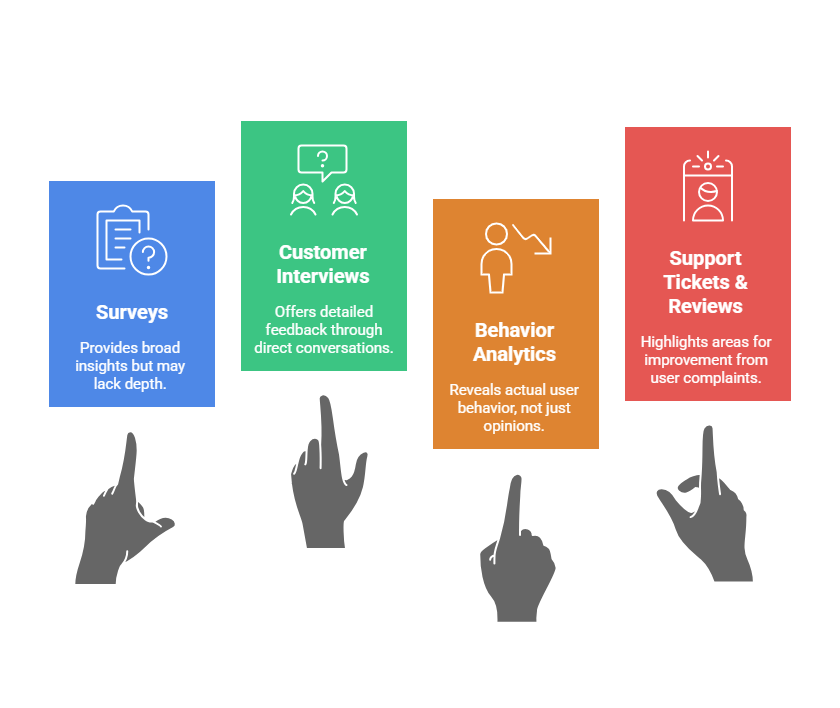
A suggestion box alone won’t cut it. Real listening means combining multiple inputs:
- Surveys
Keep them short and pointed.
Ask:- “What’s the most frustrating part of our product?”
- “If we fixed one thing tomorrow, what should it be?”
- Customer Interviews
Five honest conversations often reveal more than hundreds of survey responses. Ask follow-ups. Dig deeper. - Behavior Analytics
Tools like Hotjar or Google Analytics reveal what users do, not just what they say.- Where do users drop off?
- What pages cause friction?
- Where do they get stuck?
- Support Tickets & Reviews
Complaints are disguised opportunities. If users complain, they care enough to want improvement.
Example:
A healthcare patient portal may show high login numbers, but if users abandon tasks midway, something critical is broken—no five-star rating will reveal that.
Segment Users Before Feedback Overwhelms You
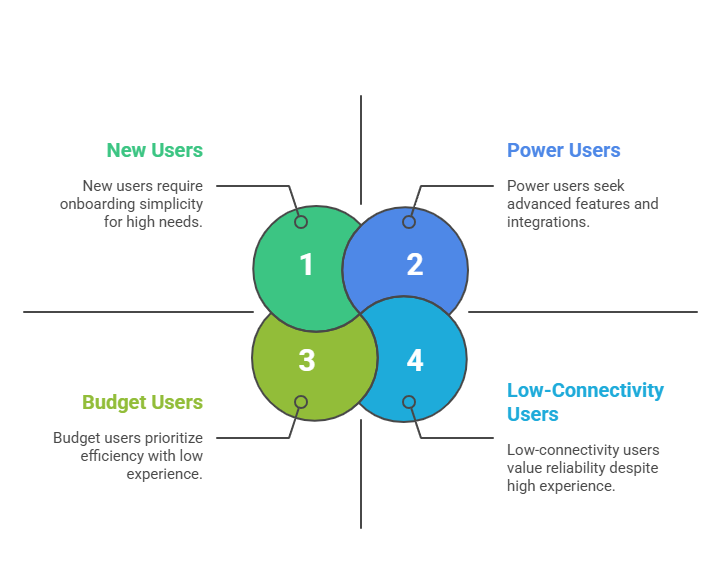
Not all customers want the same thing.
- New users → onboarding simplicity
- Power users → advanced features & integrations
- Budget users → efficiency
- Low-connectivity users → reliability
Segment users by:
- Experience level
- Use case
- Geography
- Pricing tier
- Behavior patterns
Create lightweight personas—just enough detail to guide decisions without overthinking.
Identify the Pain—and the Desired Outcome
Find the frustration point:
“Why is this still so hard?”
Then define the win:
- Faster workflows
- Fewer clicks
- Reduced cognitive load
- Time saved
When pain and payoff are clear, prioritization becomes much easier.
Set Clear Objectives (So You Don’t Build for Noise)
Every team has more good ideas than execution capacity.
So you must ask:
“Does this feature meaningfully move us forward?”
Align Features With Business Strategy
Every feature is an investment. Define the return before building.
Examples:
- Compliance features → unlock regulated industries
- Faster search → reduce support tickets
- Better analytics → improve renewals
Tie every feature to one primary outcome:
- Growth
- Retention
- Revenue
- Cost reduction
- Experience improvement
If you can’t articulate the value, pause.
Define Success Before Development Starts
Ask upfront:
- Will this increase retention?
- Will it reduce churn or friction?
- Will it speed up onboarding?
- Will it lower operational costs?
Attach a metric—even if it’s an educated estimate:
- Reduced setup time
- Increased activation rate
- Higher feature adoption
Assumptions are fine—as long as you plan to validate them.
Choose a Feature Prioritization Framework
Frameworks remove bias and opinion-driven decisions. Use one—or combine a few.
MoSCoW Method (Fast & Practical)
Categorize features into:
- Must-Have – Non-negotiable
- Should-Have – Important, but not urgent
- Could-Have – Nice to include
- Won’t-Have (for now) – Parked intentionally
Example:
For an online learning platform:
- Video classes → Must-Have
- Student leaderboard → Could-Have
Best used during sprint planning and MVP definition.
RICE Scoring (Data-Driven Decisions)
Score features using:
- Reach – How many users it affects
- Impact – Degree of improvement
- Confidence – Certainty of assumptions
- Effort – Time/resources required
Formula:(Reach × Impact × Confidence) ÷ Effort
High score = high priority
Be honest about confidence—don’t inflate it.
Kano Model (Emotion-Focused)
Classifies features into:
- Basic Expectations – Must work
- Performance Features – Better = happier users
- Delight Features – Unexpected wins
Best for UX-heavy industries like healthcare, fintech, and consumer apps.
Value vs Effort Matrix (Visual & Collaborative)
Plot features on a grid:
- High value, low effort → Do first
- Low value, high effort → Avoid
- High value, high effort → Plan carefully
Excellent for workshops and team alignment.
Validate Features Against Real User Pain
Not every request deserves implementation.
Trace Every Feature to Its Root Problem
Ask “why” until you reach the real issue.
Users ask for dashboards—but do they want:
- Better insights?
- Fewer reports?
- Simple summaries?
Often the real solution is much simpler than the request.
Ask: Does This Make Someone’s Day Easier?
Evaluate impact from the user’s perspective:
- Teachers grading faster
- Business owners managing invoices quicker
- Clinics reducing scheduling errors
If yes → strong candidate
If it’s only “nice to have” → reconsider
Assess Feasibility Honestly
Some great ideas require heavy infrastructure work.
That doesn’t mean never—it means not now.
Bring engineering in early to validate effort and constraints.
Bring Your Team Into the Process
Customers define the what. Your team understands the how.
Cross-Team Insight Matters
- Sales: Knows why deals fail
- Support: Feels daily friction
- Product: Sees roadmap tradeoffs
- Engineering: Understands technical cost
Gather input intentionally—Slack threads, meetings, or roadmap reviews.
Conflicting Opinions Are Normal
Sales wants exports.
Marketing wants referrals.
Engineering wants stability.
Customers want everything fixed yesterday.
Prioritization is about balance—not perfection.
Ship, Measure, Learn, Repeat
Shipping is the beginning—not the end.
Start Small and Validate Early
- MVPs
- Betas
- Prototypes
Get features into real hands quickly and observe behavior.
Track Adoption After Launch
Ask:
- Are users actually using it?
- Did it solve the intended problem?
- Where are they dropping off?
Low usage isn’t failure—it’s feedback.
Update the Roadmap Transparently
Good roadmaps evolve.
- Review priorities regularly
- Share reasoning with stakeholders
- Communicate changes clearly
Transparency builds trust.
Best Practices for Long-Term Success
- Review backlog regularly
- Document decision reasoning
- Share “why,” not just “what”
- Let data guide instinct
- Build continuous feedback loops
Feature prioritization improves with repetition.
Final Thoughts
You’ll never build everything your users ask for.
But you can build what matters most.
Prioritizing features isn’t really about features—it’s about making meaningful choices for people on the other side of the screen.