

Marketing in 2026 doesn’t really look like what it did even two or three years ago. It’s faster, more data-driven, and honestly, a bit overwhelming at times. There’s just so much happening all at once. But if there’s one thing that’s made life easier for marketers, founders, and growth teams, it’s AI.
The right tools can completely transform how you acquire customers, optimize campaigns, and scale revenue. And I’m not talking about small improvements. I mean the kind of shifts where what used to take a week now takes a few hours.
That’s where AI Growth Marketing Tools come into play.
They’re not just “nice to have” anymore. They’re becoming foundational to how modern businesses grow. Whether you’re running paid ads, building funnels, or trying to improve retention, these tools are quietly doing a lot of heavy lifting behind the scenes.
In this guide, we’ll go deep into the most powerful AI-driven marketing tools you should be paying attention to in 2026. Not just listing them, but actually understanding how and when to use them. And maybe more importantly, how they fit into a real growth system.
What Are AI Growth Marketing Tools and Why They Matter in 2026
Let’s break this down simply.
Growth marketing is about experimenting across the full funnel. From awareness to retention to revenue. It’s not just about getting traffic, but about making that traffic convert and stick.
Now layer AI on top of that.
AI Growth Marketing Tools use machine learning, automation, and predictive analytics to help marketers make better decisions faster. They analyze massive datasets, identify patterns, and often suggest or even execute optimizations automatically.
And honestly, that changes everything.
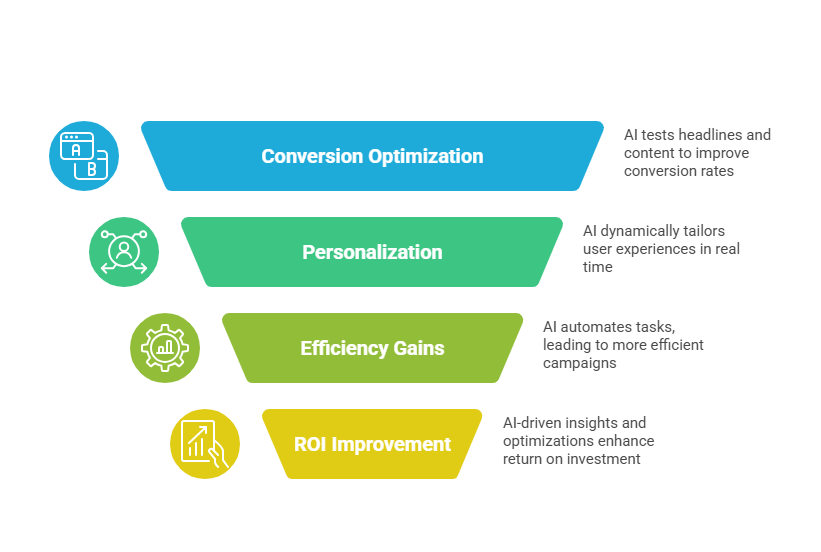
Instead of guessing what headline might work better, AI can test dozens in parallel. Instead of manually segmenting users, it can dynamically personalize experiences in real time.
A few years ago, this level of sophistication was mostly available to large enterprises. Now, even startups can access it.
The result?
More efficient campaigns
Better ROI
Faster experimentation cycles
And maybe the biggest benefit, more time to focus on strategy instead of repetitive execution.
How AI Is Reshaping Growth Marketing
There’s been a noticeable shift in how teams approach marketing. It’s no longer about having the biggest budget, but about being the smartest with data.
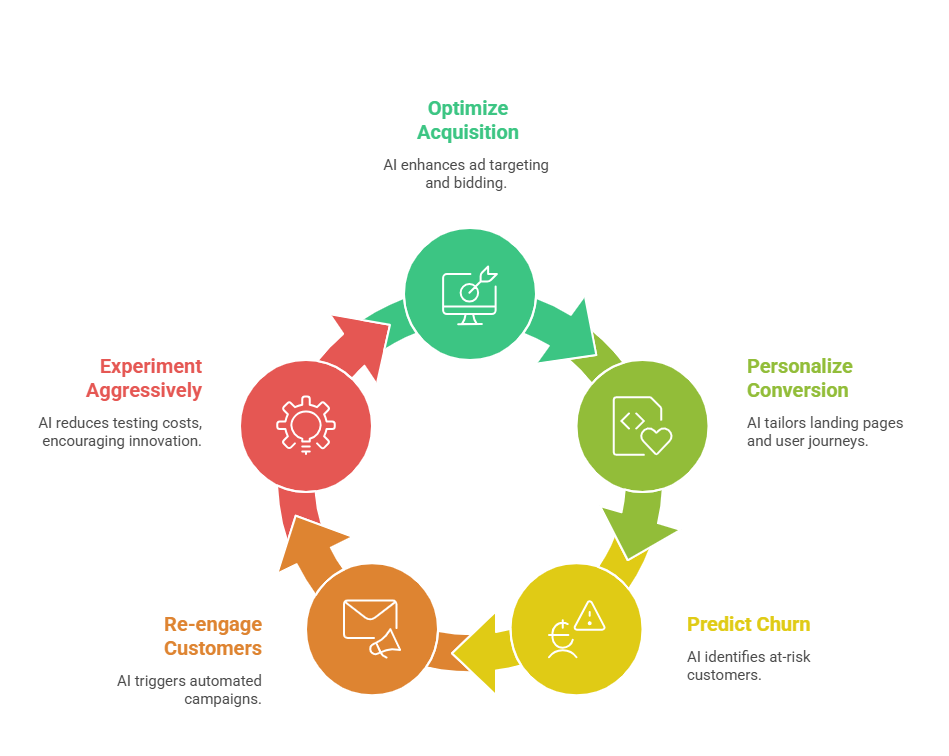
AI is influencing nearly every layer of growth marketing.
At the acquisition stage, tools are optimizing ad targeting and bidding strategies. In the conversion phase, they’re personalizing landing pages and user journeys. And in retention, they’re predicting churn and triggering automated re-engagement campaigns.
It’s kind of like having a data scientist, copywriter, and analyst all working together in one system.
One interesting pattern I’ve noticed is that teams using AI tend to experiment more aggressively. Because the cost of testing goes down. You’re not afraid to try 20 variations of something because the tool is handling the complexity.
That shift in mindset alone can be a huge competitive advantage.
Categories of AI Tools Every Growth Marketer Should Know
Before we jump into specific tools, it helps to understand the categories they fall into. Because picking the right tool is often about knowing what problem you’re trying to solve.
Some tools focus on content creation. Others on analytics. Some are built for ad optimization, while others specialize in personalization or automation.
And honestly, you don’t need everything.
In fact, trying to stack too many tools can slow you down. The goal is to build a lean, effective stack that supports your growth engine.
AI-Powered Content Creation Tools
Content is still at the core of growth marketing. That hasn’t changed. But how we create it has.
Tools like ChatGPT, Jasper, and Copy.ai are helping marketers generate blog posts, ad copy, emails, and social media content at scale.
What’s interesting is not just speed, but iteration.
You can test multiple messaging angles quickly. For example, if you’re running Facebook ads, you can generate 10 different hooks in minutes, instead of spending hours brainstorming.
But here’s the thing. AI-generated content still needs human direction.
The best results usually come when you combine AI with clear strategy. You guide the tone, messaging, and positioning, and let the tool handle execution.
That balance is where things really start to click.
AI Tools for SEO and Content Optimization
SEO has always been a long game. But AI is making it more predictable.
Platforms like Surfer SEO, Clearscope, and MarketMuse analyze top-performing content and provide recommendations on structure, keywords, and readability.
It’s almost like reverse-engineering what Google wants.
Instead of guessing keyword density or headings, you get data-backed suggestions. This can significantly improve your chances of ranking.
What’s also evolving is AI-driven topic clustering. Tools now help you map entire content strategies, not just individual articles.
And in 2026, this is becoming increasingly important. Because search engines are focusing more on topical authority rather than isolated keywords.
AI for Paid Advertising Optimization
Paid ads can get expensive quickly. And small inefficiencies can add up.
AI tools are stepping in to optimize bidding, targeting, and creative performance in real time.
Platforms like AdCreative.ai and Pencil are using machine learning to generate and test ad creatives that are more likely to convert.
Meanwhile, Google and Meta’s own AI systems are becoming more autonomous. Smart bidding, dynamic creatives, and audience expansion are now standard features.
But here’s where external tools still add value.
They give you more control and insights. Instead of relying entirely on platform algorithms, you can layer your own data and testing frameworks.
And that can lead to better performance over time.
AI Analytics and Customer Insights Tools
Data is everywhere. The challenge is making sense of it.
AI-powered analytics tools like Mixpanel, Amplitude, and Heap are helping marketers understand user behavior in much deeper ways.
They track how users interact with your product, where they drop off, and what drives conversions.
But what’s really powerful is predictive analytics.
Some tools can forecast which users are likely to churn or convert. This allows you to take proactive action instead of reacting too late.
For example, if a user shows signs of disengagement, you can trigger a personalized email or offer.
That level of precision can significantly improve retention rates.
AI Tools for Personalization and CRO
Conversion rate optimization is no longer just about A/B testing.
AI tools like Dynamic Yield and Mutiny are enabling real-time personalization. They adjust website content, messaging, and offers based on user behavior and attributes.
So instead of showing the same landing page to everyone, you tailor experiences for different segments.
This can be as simple as changing a headline or as complex as customizing entire funnels.
And it works.
Because users feel like the experience is more relevant to them.
AI Marketing Automation Platforms
Automation has been around for a while, but AI is taking it to another level.
Tools like HubSpot, ActiveCampaign, and Customer.io are integrating AI to optimize workflows, email timing, and segmentation.
Instead of setting rigid rules, these platforms can adapt based on user behavior.
For instance, they might determine the best time to send an email for each individual user.
Or adjust messaging based on engagement patterns.
This creates a more dynamic and responsive marketing system.
Emerging AI Tools to Watch in 2026
There’s a wave of new tools that are pushing boundaries even further.
Some are focused on voice and video content generation. Others on hyper-personalized experiences powered by large language models.
We’re also seeing tools that combine multiple functions into one platform. Content creation, analytics, automation, all integrated.
It’s still early for many of these, but the direction is clear.
Marketing stacks are becoming more unified and intelligent.
How to Choose the Right AI Tools for Your Business
This is where a lot of people get stuck.
There are so many options, and it’s easy to feel like you need everything.
But you really don’t.
Start by identifying your biggest bottleneck.
Is it traffic? Conversion? Retention?
Then look for tools that directly address that problem.
Also consider integration.
Your tools should work well together. Otherwise, you end up with data silos and inefficiencies.
And maybe this is obvious, but budget matters too.
Some tools are expensive, and not always necessary in early stages.
It’s better to start small and scale your stack as your business grows.
Common Mistakes When Using AI in Growth Marketing
AI can be incredibly powerful, but it’s not magic.
One common mistake is over-reliance.
Some teams expect AI to solve everything automatically. But without proper inputs and strategy, results can be disappointing.
Another issue is lack of testing.
Even with AI, you still need to experiment and validate assumptions.
And sometimes, people forget about brand voice.
AI-generated content can feel generic if not guided properly. Maintaining a distinct voice is still important.
Real-World Example of AI-Driven Growth
Let’s take a simple scenario.
A SaaS company wants to increase conversions on its landing page.
They use an AI tool to analyze user behavior and identify drop-off points. Then they implement dynamic personalization to adjust messaging based on user segments.
At the same time, they use AI to generate multiple headline variations and test them automatically.
Within a few weeks, they see a noticeable increase in conversion rates.
Nothing revolutionary on its own. But combined, these optimizations create a significant impact.
That’s how AI-driven growth usually works.
Small improvements, stacked together.
The Future of Growth Marketing with AI
Looking ahead, it feels like we’re just getting started.
AI is becoming more context-aware, more creative, and more integrated into everyday tools.
We might see fully autonomous marketing systems in the future. Systems that plan, execute, and optimize campaigns with minimal human input.
That sounds exciting, but also a bit uncertain.
Because creativity, storytelling, and strategy still require human judgment.
So maybe the future isn’t about replacing marketers, but augmenting them.
Giving them better tools to do their best work.
Conclusion
If there’s one takeaway from all this, it’s that AI Growth Marketing Tools are no longer optional.
They’re becoming essential for staying competitive in 2026.
But success isn’t about using the most tools. It’s about using the right ones, in the right way.
Start simple. Focus on your biggest growth lever. Experiment consistently.
And over time, build a system that works for your business.
Because at the end of the day, tools don’t drive growth.
People do.
AI just helps them move faster.