

Content creation today feels… different, right? There’s more volume, more pressure, and honestly, more gray areas than ever before. With AI tools writing blogs, ads, scripts, and even research drafts, one thing has become absolutely critical: originality.
And not just human originality, but verifiable originality.
That’s where plagiarism detection has evolved. Traditional tools are no longer enough. Writers, marketers, and even agencies now need smarter systems that can detect both copied content and AI-generated similarities. That’s exactly why AI Plagiarism Checker Tools are gaining traction so fast.
In this article, we’ll explore the most effective and widely used tools available today. Not just a surface-level list, but a deep dive into how they work, when to use them, and what makes each one worth considering.
Why AI Plagiarism Detection Matters More Than Ever
Let’s be real for a second.
A few years ago, plagiarism checking was mostly about catching copy-paste content. You’d run text through a tool, get a similarity score, fix a few lines, and move on.
Now? It’s more complex.
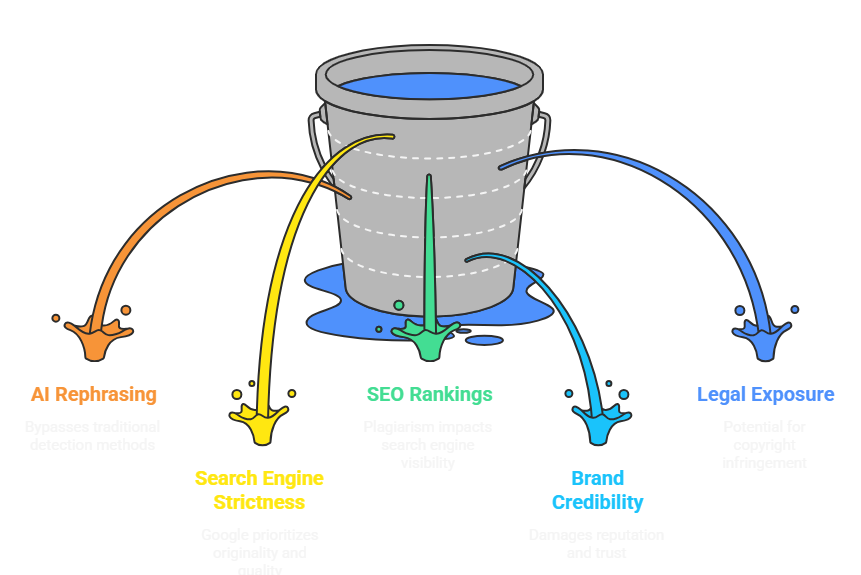
AI-generated content can rephrase existing material so well that traditional detectors often miss it. At the same time, search engines like Google are becoming stricter about content quality, originality, and usefulness.
So the risk isn’t just academic anymore. It’s SEO rankings, brand credibility, and even legal exposure.
That’s why investing in the right AI Plagiarism Checker Tools isn’t optional anymore. It’s kind of foundational if you’re serious about content.
What Makes a Good AI Plagiarism Tool?
Before jumping into the tools themselves, it helps to know what actually matters.
A good tool today should do more than scan for duplicate sentences. It should ideally:
- Understand semantic similarity, not just exact matches
- Detect AI-generated patterns alongside plagiarism
- Provide detailed source links and comparison insights
- Integrate easily into your writing workflow
- Handle long-form content without breaking or timing out
Some tools lean more toward academic use, others toward SEO and marketing. And that’s okay. It really depends on your needs.
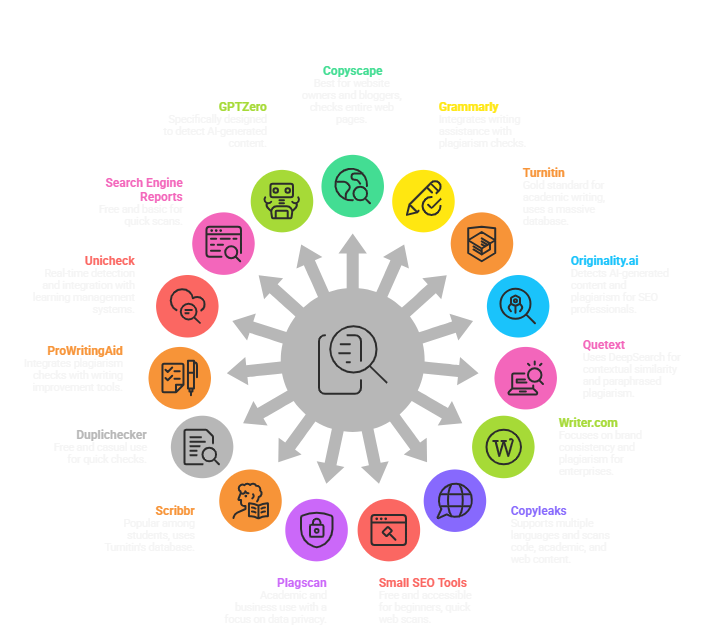
1. Copyscape
Copyscape has been around for a long time, and honestly, that longevity says a lot.
It’s one of the most trusted plagiarism detection tools for website owners and bloggers. Instead of just scanning text, it can check entire web pages against existing indexed content online.
What makes it stand out is its precision. It doesn’t overwhelm you with noise. You get clear matches, source URLs, and percentages that actually make sense.
However, Copyscape doesn’t focus heavily on AI detection yet. So if your main concern is identifying AI-written content, you might need to pair it with another tool.
Still, for web-based plagiarism checks, it’s reliable and widely respected.
2. Grammarly Plagiarism Checker
Most people know Grammarly for grammar corrections, but its plagiarism feature is surprisingly robust.
It scans billions of web pages and academic databases, offering a clean and easy-to-understand report. The integration is seamless, especially if you’re already using Grammarly for writing.
The interesting part is how it combines writing assistance with originality checking. You can fix tone, clarity, and plagiarism in one place, which feels efficient.
That said, Grammarly isn’t the most advanced when it comes to AI detection. It’s more of an all-in-one writing assistant than a specialized plagiarism tool.
3. Turnitin
If you’ve ever been in academia, you’ve probably encountered Turnitin.
It’s considered one of the gold standards in plagiarism detection, particularly for academic writing. Universities worldwide rely on it to check essays, research papers, and theses.
Turnitin’s strength lies in its massive proprietary database. It doesn’t just compare against web content but also against student submissions and academic journals.
Recently, it has also introduced AI writing detection features, although there’s still ongoing debate about accuracy.
It’s powerful, no doubt. But access is limited mostly to institutions, which makes it less practical for freelance writers or marketers.
4. Originality.ai
This tool is gaining serious attention, especially among SEO professionals.
Originality.ai was designed specifically to detect AI-generated content alongside plagiarism. That combination is what makes it particularly valuable in today’s landscape.
It uses advanced machine learning models to analyze writing patterns and estimate whether content is AI-generated. At the same time, it runs plagiarism checks across web sources.
One thing users appreciate is its team management features. Agencies can assign scans, track reports, and maintain transparency across projects.
If you’re publishing content at scale, this tool feels almost built for you.
5. Quetext
Quetext takes a slightly different approach with its “DeepSearch” technology.
Instead of just identifying direct matches, it looks at contextual similarities. That means it can catch paraphrased plagiarism more effectively than some traditional tools.
The interface is also beginner-friendly. You paste your content, click scan, and get a color-coded report highlighting issues.
It’s not the most advanced AI detector, but for writers who want a balance between simplicity and accuracy, Quetext works well.
6. Writer.com Plagiarism Checker
Writer.com focuses heavily on enterprise and brand consistency, but its plagiarism checker is worth mentioning.
It integrates well into workflows, especially for teams producing high volumes of content. The tool checks for duplication while also ensuring tone and style consistency.
This makes it particularly useful for companies that care about brand voice as much as originality.
The downside is that it may feel a bit overkill for individual freelancers.
7. Copyleaks
Copyleaks is one of the few tools that strongly emphasizes both plagiarism detection and AI content detection.
It supports multiple languages and can scan code, academic writing, and web content. That versatility is pretty impressive.
Its AI detection engine is quite advanced, analyzing linguistic patterns and probabilities. While not perfect, it’s among the better options available right now.
It’s also used by educational institutions and businesses alike, which speaks to its reliability.
8. Small SEO Tools Plagiarism Checker
This is a more accessible option, especially for beginners or those on a tight budget.
Small SEO Tools offers a free plagiarism checker that scans content against web sources. It’s quick, easy, and doesn’t require much setup.
However, the trade-off is depth. It’s not as accurate or comprehensive as premium tools.
Still, for quick checks or smaller projects, it gets the job done.
9. Plagscan
Plagscan is another academic-focused tool, though it’s also used by businesses.
It provides detailed reports with source comparisons, making it easier to understand where overlaps occur.
One thing that stands out is its data privacy approach. Documents aren’t automatically stored or added to databases, which is important for sensitive content.
It’s reliable, though perhaps not as modern in terms of AI detection capabilities.
10. Scribbr Plagiarism Checker
Scribbr is particularly popular among students and researchers.
It uses Turnitin’s database under the hood, which gives it strong credibility. The reports are detailed and easy to interpret, even for beginners.
Scribbr also offers proofreading services, which can be useful if you’re working on high-stakes documents.
It’s more academic than marketing-focused, but still highly effective.
11. Duplichecker
Duplichecker is another free tool that many writers use casually.
It allows you to paste text or upload files and quickly check for plagiarism. The results are straightforward, though sometimes a bit limited in depth.
It’s best suited for quick checks rather than in-depth analysis.
12. ProWritingAid Plagiarism Checker
ProWritingAid is similar to Grammarly but with a stronger focus on writing improvement.
Its plagiarism checker is integrated into a broader editing system that analyzes style, readability, and structure.
For writers who want to improve their craft while ensuring originality, this dual approach can be quite valuable.
13. Unicheck
Unicheck is widely used in education and business environments.
It provides real-time plagiarism detection and integrates with learning management systems. The reports are clear, with side-by-side comparisons.
Its cloud-based approach makes collaboration easier, especially for teams.
14. Search Engine Reports Plagiarism Checker
This is another free option, similar to Small SEO Tools.
It’s useful for quick scans and basic plagiarism detection. However, like most free tools, it lacks advanced AI detection features.
It’s more of a backup option than a primary tool.
15. GPTZero
GPTZero is specifically designed to detect AI-generated content.
Unlike traditional plagiarism tools, it focuses on identifying patterns typical of AI writing, such as predictability and sentence structure.
It’s particularly useful for educators and editors trying to differentiate between human and AI-generated text.
However, it doesn’t replace a full plagiarism checker. It works best when used alongside one.
How to Choose the Right Tool for Your Needs
Honestly, there’s no single “best” tool for everyone.
If you’re a blogger or SEO writer, tools like Originality.ai or Copyleaks might make more sense. They balance AI detection with plagiarism scanning.
If you’re in academia, Turnitin or Scribbr are still the gold standard.
And if you’re just starting out, free tools can be a decent entry point, even if they’re not perfect.
The key is understanding your workflow and risk level. High-volume publishing requires more robust solutions. Occasional writing? You might not need something that heavy.
The Future of Content Originality
This space is evolving fast. Maybe faster than most people expected.
AI writing tools are improving daily, which means plagiarism detection tools have to keep up. It’s almost like an arms race between content generation and content verification.
We’re already seeing hybrid tools that combine AI detection, plagiarism scanning, and even fact-checking.
And honestly, that might become the standard soon.
Because at the end of the day, it’s not just about avoiding duplication. It’s about building trust with your audience.
Final Thoughts
Content is everywhere. But original, thoughtful, and trustworthy content? That’s still rare.
Using the right AI Plagiarism Checker Tools can help you stay on the right side of that line. Not just technically, but ethically too.
And maybe that’s the real point here.
It’s not just about passing a scan. It’s about creating something that actually deserves to exist.
Frequently Asked Questions (FAQs)
1. What are AI plagiarism checker tools?
AI plagiarism checker tools are advanced software solutions that detect copied or AI-generated content by analyzing writing patterns, semantic similarity, and web sources.
2. Can AI plagiarism tools detect ChatGPT content?
Some tools like Originality.ai, Copyleaks, and GPTZero can estimate whether content is AI-generated, though accuracy is not always 100%.
3. Are free plagiarism checkers reliable?
Free tools can detect basic duplication but often lack depth and accuracy compared to premium solutions.
4. Which tool is best for SEO writers?
Originality.ai and Copyleaks are popular among SEO professionals because they combine AI detection with plagiarism scanning.
5. Is Grammarly plagiarism checker enough?
Grammarly works well for basic checks, but it may not be sufficient for detecting AI-generated content.
6. What is the difference between plagiarism detection and AI detection?
Plagiarism detection finds copied content, while AI detection analyzes patterns to determine if content was generated by AI.
7. Do plagiarism tools store my content?
Some tools do store content for future comparison, while others prioritize privacy. Always check the policy before use.
8. Can plagiarism tools detect paraphrased content?
Advanced tools like Quetext and Copyleaks can identify paraphrased similarities using contextual analysis.
9. Are plagiarism tools important for bloggers?
Yes, especially for SEO. Duplicate content can negatively impact search rankings and credibility.
10. Should I use multiple tools?
In many cases, yes. Combining an AI detector with a plagiarism checker provides more comprehensive results.