
Artificial intelligence has quietly moved from being a futuristic concept to something marketers rely on every single day. A few years ago, most marketing teams were still experimenting with automation platforms, predictive analytics, or smart segmentation. Now, things are different. AI is deeply embedded into campaign management, ad optimization, personalization, and content creation.
Modern marketing is complicated. Teams manage multiple channels, analyze huge volumes of data, and try to personalize experiences for thousands or even millions of customers. Doing all of this manually is almost impossible. That’s where AI Marketing Tools come in.
These tools help marketers automate repetitive tasks, uncover insights from data, create high-performing content, and optimize campaigns in real time. Instead of spending hours analyzing spreadsheets or writing dozens of ad variations, marketers can now focus on strategy and creativity.
In this guide, we’ll explore ten powerful platforms that can dramatically improve the way campaigns are planned, executed, and optimized. Each tool solves a different marketing challenge, from content generation and SEO optimization to advertising automation and conversational marketing.
By the end of this article, you’ll understand how modern AI Marketing Tools can streamline workflows, increase efficiency, and ultimately help businesses drive better results.
The Rise of AI in Modern Marketing
Marketing has always evolved alongside technology. Email automation changed customer communication. Social media reshaped brand engagement. Data analytics improved decision-making.
Artificial intelligence is now pushing the industry into another transformation.
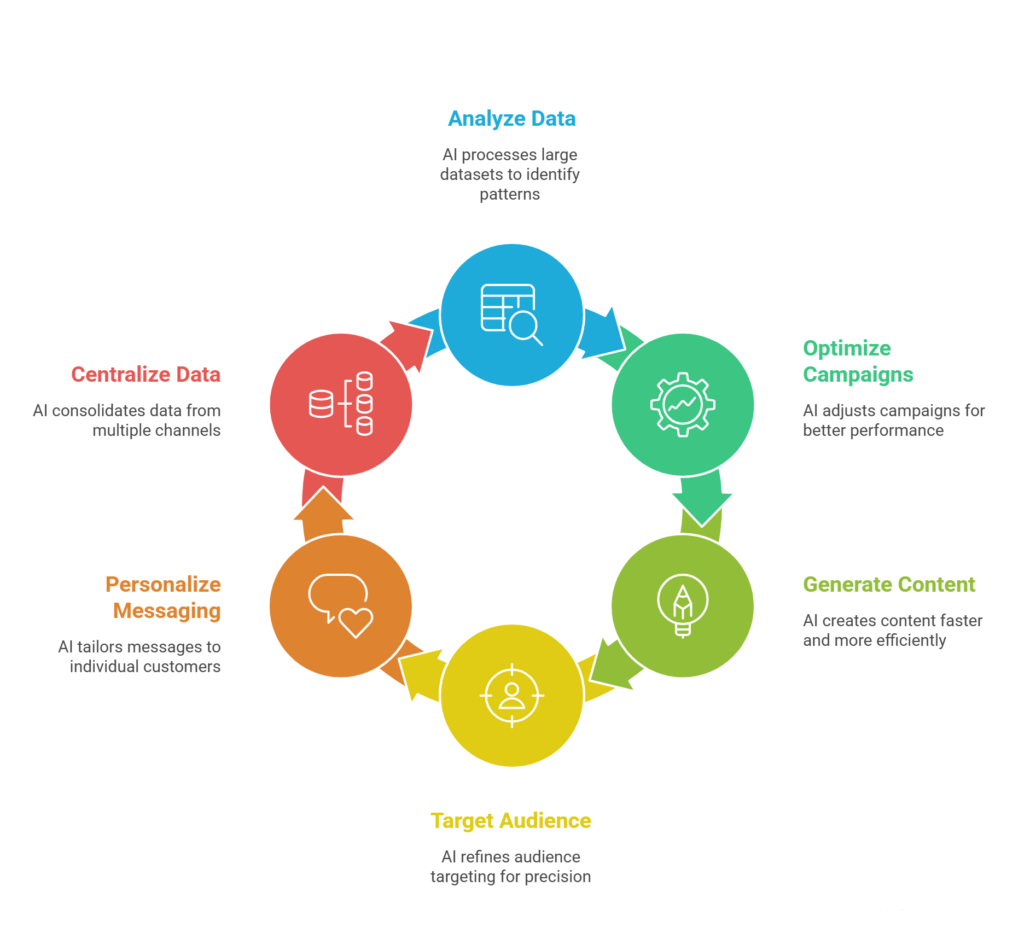
AI allows machines to analyze large datasets, recognize patterns, and make predictions faster than humans. When applied to marketing, these capabilities unlock powerful advantages. Campaigns can be optimized continuously. Content can be generated faster. Audience targeting becomes more precise.
This is exactly why many companies are adopting AI Marketing Tools as a core part of their marketing stack. These systems do more than automate simple workflows. They learn from campaign performance, improve targeting algorithms, and recommend strategic adjustments.
Another reason AI adoption is accelerating is the explosion of marketing channels. Businesses now operate across search, social media, email, websites, and paid advertising platforms simultaneously. Managing these touchpoints manually is inefficient.
With intelligent automation, marketers can centralize data, personalize messaging at scale, and optimize campaigns across channels using AI Marketing Tools that continuously analyze performance.
At the same time, AI does not replace marketers. Instead, it acts as a co-pilot. Strategy, creativity, brand voice, and customer empathy still depend on human insight. AI simply handles the heavy lifting.
Why Businesses Are Investing in AI-Driven Campaign Automation
There’s a reason venture capital, tech giants, and marketing platforms are investing heavily in artificial intelligence. The return on investment is clear.
Companies that integrate AI Marketing Tools into their workflow often see measurable improvements in productivity and campaign performance. Tasks that once required hours can now be completed in minutes.
One of the biggest advantages is speed. AI systems analyze data instantly, allowing marketers to identify trends before competitors. For example, ad performance can be evaluated continuously, enabling quick adjustments to budget allocation or creative elements.
Another benefit is personalization. Consumers expect tailored experiences, but manually creating unique messages for different audience segments is difficult. AI can analyze behavior, preferences, and purchase history to deliver relevant messaging automatically.
Efficiency is another major factor. Marketing teams often spend too much time on repetitive tasks such as data reporting, A/B testing, and content formatting. Automation tools reduce this workload, allowing marketers to focus on strategy and innovation.
Perhaps most importantly, AI Marketing Tools help reduce guesswork. Instead of relying on intuition alone, marketers can make decisions backed by predictive analytics and data insights.
The result is smarter campaigns, improved customer experiences, and better marketing ROI.
How AI Marketing Automation Works
To understand the value of automation platforms, it helps to look at how these systems actually operate behind the scenes.
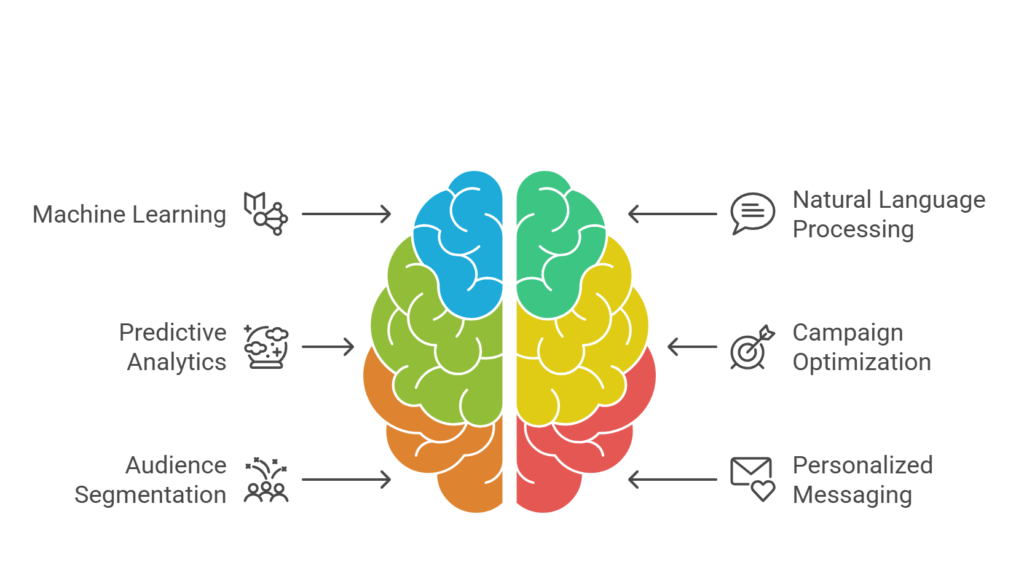
Most AI Marketing Tools rely on three key technologies: machine learning, natural language processing, and predictive analytics.
Machine learning enables systems to learn from historical campaign data. For example, if certain headlines consistently generate higher click-through rates, the system identifies that pattern and recommends similar variations.
Natural language processing allows AI to generate and analyze human language. This technology powers content generation tools, chatbots, and sentiment analysis platforms that evaluate customer conversations.
Predictive analytics focuses on forecasting future outcomes based on historical behavior. Marketing teams use these predictions to optimize ad spend, prioritize leads, and improve customer retention strategies.
When these technologies are combined, they create powerful AI Marketing Tools that automate complex tasks such as campaign optimization, audience segmentation, and personalized messaging.
10 Powerful Tools Transforming Marketing Automation
Below are ten platforms that are helping marketers automate campaigns, improve efficiency, and generate better results. Each one focuses on a different aspect of marketing operations.
Jasper AI
Content creation is one of the most time-consuming tasks in marketing. Writing blog posts, ad copy, social media captions, and email sequences can take hours.
Jasper AI was designed to simplify this process.
The platform uses advanced natural language processing to generate high-quality marketing content quickly. Marketers can input a short prompt describing the topic, tone, and audience, and Jasper produces structured content within seconds.
One of the most interesting things about Jasper is its ability to adapt to brand voice. Businesses can train the system using past content, allowing the AI to generate copy that feels consistent with their messaging style.
Many marketers rely on platforms like Jasper when scaling content production using AI Marketing Tools that accelerate writing without sacrificing quality.
It’s particularly useful for teams running multiple campaigns simultaneously, where speed and consistency matter.
HubSpot AI
HubSpot has long been known as a powerful marketing automation platform. In recent years, the company has integrated artificial intelligence across many of its tools.
HubSpot’s AI capabilities assist with email optimization, predictive lead scoring, chatbots, and campaign insights. The platform analyzes user behavior across websites, emails, and CRM data to identify patterns that indicate buying intent.
This allows marketers to prioritize leads more effectively and deliver personalized content at the right stage of the buyer journey.
For companies looking to centralize data, automate communication, and improve conversion rates, HubSpot represents one of the most comprehensive AI Marketing Tools available today.
The platform also integrates seamlessly with other marketing systems, which makes it easier to create unified workflows.
ChatGPT for Marketing Content and Campaign Ideation
AI language models are transforming the way marketers brainstorm ideas and create content.
Tools like ChatGPT help marketing teams generate campaign concepts, write marketing copy, draft landing page text, and even develop customer personas.
The real value comes from speed. Instead of spending hours brainstorming creative angles, marketers can explore multiple ideas within minutes.
Many teams now combine ChatGPT with other AI Marketing Tools to accelerate both strategy and execution. For example, marketers might generate ad copy using AI and then test those variations automatically across different advertising platforms.
Another advantage is versatility. The tool can assist with SEO content outlines, social media calendars, product descriptions, and email campaigns.
When used properly, it becomes a powerful brainstorming partner.
Surfer SEO
Search engine optimization requires constant analysis of competitors, keywords, and content structure.
Surfer SEO uses artificial intelligence to analyze top-ranking pages and recommend optimization strategies. The platform evaluates factors like keyword usage, heading structure, content length, and semantic relevance.
Marketers receive real-time suggestions while writing content, helping them create articles that are more likely to rank in search results.
For businesses investing in organic traffic strategies, Surfer SEO is one of the most practical AI Marketing Tools available.
It simplifies the process of optimizing content for search engines without requiring deep technical knowledge of SEO algorithms.
Canva Magic Studio
Visual content plays a huge role in modern marketing campaigns. Social media ads, banners, presentations, and brand visuals must be created quickly and consistently.
Canva’s AI features, often referred to as Magic Studio, make this process dramatically easier.
The platform includes AI image generation, automated design suggestions, background removal, and content resizing. These features allow marketers to produce professional graphics in minutes.
Instead of relying heavily on design teams, marketers can create campaign assets independently using AI Marketing Tools that streamline visual production.
This is particularly helpful for startups and small teams that need to launch campaigns quickly.
Copy.ai
Copy.ai focuses specifically on marketing copy generation. The platform helps businesses write product descriptions, sales emails, social media posts, and landing page content.
What makes Copy.ai interesting is its workflow automation capability. Instead of generating single pieces of content, marketers can create automated workflows that produce entire sets of marketing assets.
For example, a product launch campaign might automatically generate email sequences, ad copy, and social media announcements.
Platforms like this demonstrate how AI Marketing Tools are evolving beyond simple text generation into complete marketing workflow automation systems.
AdCreative.ai
Paid advertising requires constant experimentation. Marketers need to test different visuals, headlines, and ad formats to identify the best-performing combinations.
AdCreative.ai uses machine learning to generate advertising creatives optimized for platforms like Facebook and Google Ads.
The system analyzes performance data from previous campaigns and recommends designs likely to generate higher click-through rates.
This significantly reduces the time marketers spend designing and testing ads manually.
Advertising teams increasingly rely on AI Marketing Tools like AdCreative.ai to scale campaign production while maintaining performance.
Seventh Sense
Email marketing is still one of the most effective digital channels. However, timing plays a huge role in campaign success.
Seventh Sense uses artificial intelligence to determine the optimal time to send emails to each individual subscriber.
Instead of sending emails to an entire list simultaneously, the platform analyzes user behavior patterns and schedules messages at times when each recipient is most likely to engage.
This level of personalization is difficult to achieve without AI Marketing Tools capable of analyzing large datasets in real time.
The result is higher open rates, improved engagement, and better email marketing performance.
Drift AI Chatbots
Customer conversations have become a critical part of modern marketing. Many website visitors expect immediate responses when they have questions.
Drift provides AI-powered chatbots that engage visitors, answer questions, and guide them through the sales funnel.
The system analyzes user intent and routes high-value leads to sales representatives while handling routine queries automatically.
Conversational marketing platforms like Drift are becoming essential components of marketing stacks built around AI Marketing Tools that enhance customer engagement and lead generation.
Zapier with AI Automation
Automation often requires connecting multiple tools together. Marketing teams use different platforms for email marketing, analytics, social media, advertising, and CRM systems.
Zapier acts as the glue between these systems.
With AI-powered automation workflows, Zapier can trigger actions across hundreds of apps. For example, a new lead form submission might automatically trigger an email sequence, add the contact to a CRM, and notify a sales team member.
This type of integration is essential when businesses build complex ecosystems of AI Marketing Tools that must work together seamlessly.
Instead of manually transferring data between platforms, workflows run automatically in the background.
How to Choose the Right AI Marketing Tools for Your Business
Selecting the right technology depends heavily on business goals, marketing maturity, and team size.
Some companies prioritize content creation, while others focus on advertising optimization or customer engagement. Understanding which marketing processes consume the most time can help identify the best tools to implement first.
Scalability should also be considered. As businesses grow, marketing complexity increases. Investing in flexible AI Marketing Tools ensures that automation systems can adapt to future campaign requirements.
Integration capabilities are equally important. Tools that connect easily with CRM systems, analytics platforms, and advertising networks create more efficient workflows.
Finally, marketers should evaluate the learning curve. Some platforms require significant onboarding, while others are designed to be intuitive for beginners.
The best approach is often to start small, test a few tools, and gradually expand the automation stack as the team becomes more comfortable with AI-driven marketing processes.
The Future of AI in Marketing
Artificial intelligence is still evolving rapidly, and the next few years will likely bring even more advanced capabilities.
Predictive marketing will become more accurate as AI systems analyze increasingly larger datasets. Campaigns may eventually adjust themselves automatically in response to performance signals.
Content personalization will also become more sophisticated. Instead of segmenting audiences into broad categories, AI systems will generate individualized messaging tailored to each user’s behavior and preferences.
As technology advances, AI Marketing Tools will likely become central to nearly every marketing function, from strategy planning to campaign optimization and customer engagement.
However, human creativity will remain essential. AI can analyze patterns and automate processes, but brand storytelling, emotional connection, and strategic thinking still depend on human marketers.
The most successful companies will combine the strengths of both.
Final Thoughts
Marketing has entered an era where speed, data, and personalization determine success. Artificial intelligence provides the infrastructure needed to manage these challenges effectively.
From content creation and SEO optimization to advertising automation and conversational marketing, the tools covered in this article demonstrate how AI can dramatically improve marketing efficiency.
Adopting the right AI Marketing Tools allows businesses to reduce manual workloads, make smarter decisions, and launch campaigns faster than ever before.
For marketers willing to experiment and adapt, AI represents one of the most powerful opportunities in modern digital marketing.
The key is not replacing human creativity but enhancing it with intelligent automation. When marketers and AI systems work together, the result is smarter campaigns, stronger customer relationships, and sustainable growth.