

Most “best countries for digital nomads” lists read like they were written by someone who has never actually filed a visa application. They rank Bali next to Portugal next to Estonia with the same three bullet points: nice weather, good coffee, fast Wi-Fi. What they skip is the stuff that actually determines whether you can live somewhere: can you legally stay past 90 days, can you afford it once you factor in the real numbers, and can you still make your 9am stand-up without setting an alarm for 3am.
That last one trips up more nomads than people admit. You can find the cheapest, prettiest, most visa-friendly country in the world, and it still won’t work if your clients are in New York and you’re eight time zones away with a four-hour usable overlap.
This list covers six countries worth taking seriously in 2026, based on three filters: how realistic the best countries for digital nomads visa path actually is right now, what things genuinely cost once rent, insurance, and coworking are added up, and how each country’s time zone lines up with major client hubs. After the country breakdowns, there’s a section on the actual tools worth using to verify all of this yourself, because visa rules change fast and you should never take one blog post’s word for it, including this one.
What Actually Makes the Best Countries for Digital Nomads in 2026
A country earns a spot on this list if it clears three bars: a visa path that’s actually usable without a lawyer on retainer, a cost of living that holds up once you add insurance and coworking to the rent number, and a time zone that leaves you a real overlap window with your team or clients.
Visa ease matters more in 2026 than it did two years ago. Georgia tightened its labor permit rules in March 2026. Thailand’s Destination Thailand Visa (DTV) rejection rate has climbed as immigration cracks down on vague freelance paperwork. Indonesia raised its income bar for the Bali remote worker visa. The “just show up and figure it out” era of digital nomad life is mostly over. Every country below still has a workable path, but “workable” now means reading the fine print.
Cost of living isn’t just rent. A one-bedroom in central Lisbon and a one-bedroom in Chiang Mai can be the same price once you add health insurance, a coworking membership, and the currency conversion fees most banks quietly charge on every purchase.
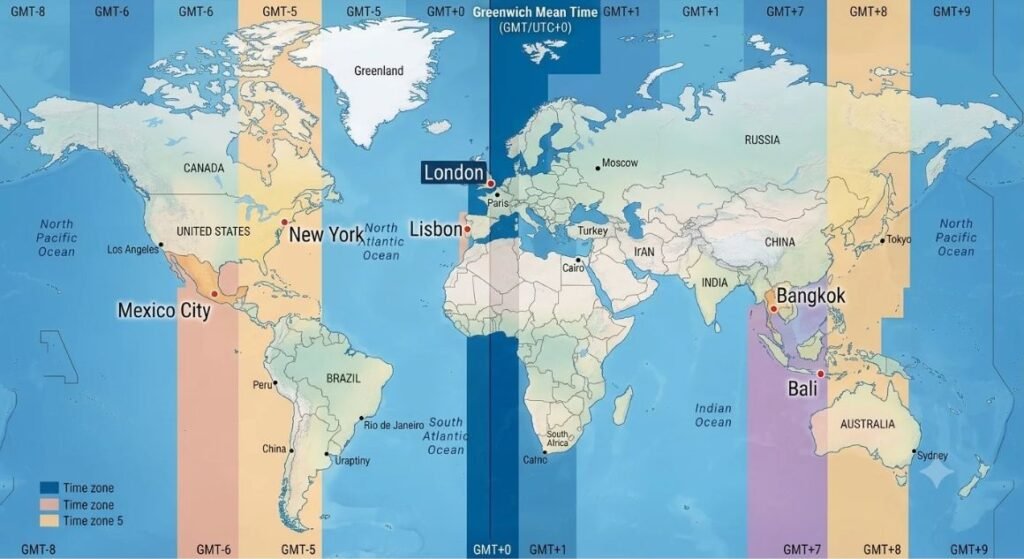
Time zone fit is the one category most lists skip entirely, and it’s often the deciding factor. If your clients are on the US East Coast, Georgia’s four-hour lead over CET puts your entire workday out of sync with theirs. If your team is in London, Mexico City gives you a five-to-eight-hour gap depending on daylight saving. None of that shows up in a “10 Best Countries” listicle, but it shows up fast in your calendar.
Portugal — Best for EU Access and a Clear Digital Nomad Visa Path
Is Portugal still worth it for digital nomads in 2026? Yes, mainly because the D8 visa is now a mature, well-understood process rather than the improvised system it was when it launched in 2022, and it comes with a genuine path to EU residency.
The D8 Digital Nomad Visa is Portugal’s route for remote workers and freelancers earning income from outside Portugal. In 2026, the minimum monthly income requirement is €3,680, which equals four times the Portuguese minimum wage of €920. On top of that, most applicants also need to show liquid savings, with the baseline savings requirement set at 12 times the minimum wage, totaling €11,040 for 2026. Add a spouse or kids and the thresholds climb further, with the income requirement rising by 50% for a spouse and 30% per dependent child.
Processing isn’t instant. Consulates typically take around three months to process the application, and after you arrive, Portugal’s immigration agency (AIMA) issues residence permits within an additional 2 to 12 weeks, putting the total timeline from application to residence card at roughly six months. Worth knowing before you plan a move date around a lease signing.
What the D8 gets you: a residence permit that lets you travel across the Schengen Area without needing separate visas, and Portugal amended its Nationality Law in May 2026 with significant changes to the citizenship pathway for foreign residents, so it’s worth checking the current rules rather than relying on older guides if citizenship is part of your plan.
Lisbon is no longer the budget European base it was during the pandemic years. A comfortable, all-in monthly budget (apartment, coworking, food, insurance) in central Lisbon now sits closer to €2,400-€2,800. Porto and the Algarve run meaningfully cheaper if the income threshold is the tight part of your plan.
Time zone: UTC/UTC+1, overlapping well with UK and Central European teams and giving a workable morning overlap with the US East Coast.
Portugal’s D8 Digital Nomad Visa requires €3,680/month in income and roughly €11,040 in savings as of 2026, with a total application-to-residence-card timeline of about six months. It remains one of the clearest digital nomad visa paths in Europe, with Schengen-wide travel rights attached to the permit.
Spain — Best for Community and Manageable Cost of Living
Should you pick Spain over Portugal? If the deciding factor is the size of the expat and remote-work community rather than the visa terms, Spain edges ahead. Barcelona, Valencia, and Madrid each have established coworking and nomad networks that are larger and more mature than most Portuguese cities outside Lisbon.
Spain’s Digital Nomad Visa, launched under the Startup Act in 2023, requires income of €2,849 per month, or €34,188 per year, which is 200% of Spain’s minimum wage. That’s a notably lower bar than Portugal’s D8. Add €1,068/month for the first family member and €356/month for each additional one if you’re bringing dependents.
One rule that surprises a lot of applicants: this isn’t a fully foreign-income-only visa. Nomads can pick up local clients, but only up to 20% of total professional activity can come from Spanish sources, and renewal reviews now check this against actual income records, with anything over 30% making refusal likely. If you plan to take on a Spanish client or two, keep that math in mind before you sign a contract that pushes you over the line.
Processing is fast by European standards. Applying from inside Spain through the UGE (the government’s dedicated unit for this visa) takes about 20 working days, while applying through a US consulate runs 15 to 45 days. The real bottleneck, as with most of these visas, is gathering apostilled documents and background checks, not the government review itself.
The visa also comes with a real tax upside. Holders can apply for the Beckham Law regime, a special tax status that lets qualifying foreign residents pay a flat 24% rate (up to €600,000) on Spanish-sourced income only, instead of Spain’s standard progressive rates that climb to 47%, while foreign income is generally exempt. For anyone earning well above the visa’s income floor, that’s a meaningful difference.
Time zone: UTC+1, the same practical overlap as Portugal, with slightly better connectivity to North African and Middle Eastern clients if that’s part of your book of business.
Mexico — Best for US/Canada Time Zone Overlap
If your clients or team are in the US or Canada, does Mexico solve the time zone problem better than anywhere in Europe or Asia? Pretty much, yes. Mexico City sits in Central Time, meaning a normal workday lines up almost exactly with New York, Chicago, and most of Canada, with zero red-eye calls required.
Here’s the part most people don’t expect: Mexico has no dedicated digital nomad visa. What it has instead is the Temporary Resident Visa, and most remote workers use this as the practical equivalent. Since Mexico rebased its financial thresholds to the UMA (a daily economic reference unit) in 2025, the income bar has risen. As of 2026, the standard path requires roughly $4,300 to $4,500 per month in net income over the past six months, or around $73,000 to $75,000 in average savings over the prior 12 months, though the exact figure varies by consulate.
That’s a real jump from the older, looser thresholds nomads got used to, and it’s worth verifying with the specific consulate handling your application before assuming the number. Some consulates still publish lower figures. Fees also went up alongside the income requirements, and the current framework runs on the 2026 UMA rebase that took effect in mid-2025.
For shorter stays, most passport holders can still enter visa-free and stay up to 180 days per visit, at the border officer’s discretion, though this isn’t a legal residency status and doesn’t carry any income proof requirement. Plenty of nomads use this for a season or two before committing to the Temporary Resident process, though repeated back-to-back entries can draw scrutiny from immigration.
Cost of living is where Mexico wins outright. A comfortable, private-apartment budget in Mexico City or Oaxaca runs $1,100-$1,600/month all-in, and that’s before factoring in one of the strongest food scenes of any country on this list.
Time zone: UTC-6 (Mexico City), a near-perfect match for US Central time and a workable overlap for both coasts.
Mexico has no standalone digital nomad visa, but its Temporary Resident Visa works as the de facto equivalent, requiring around $4,300-$4,500/month in income or roughly $73,000-$75,000 in savings as of 2026. Its real advantage is time zone alignment with the US and Canada, not visa simplicity.
Thailand — Best for Low Cost of Living in Southeast Asia
Is Thailand still the budget nomad haven it used to be, now that the rules have tightened? Mostly yes, but the path there has changed. The days of cycling through tourist visa exemptions are functionally over.
The Destination Thailand Visa (DTV), introduced in 2024, is Thailand’s official digital nomad visa, valid for five years, with each entry allowing a stay of up to 180 days, extendable once by another 180 days at an immigration office. You can leave and re-enter for a fresh stay as often as needed within the five-year window.
Financially, it’s one of the more accessible options on this list. Applicants need proof of 500,000 THB, approximately $14,500 USD, in savings, with the fund seasoned in the account for a few months in most cases. That’s a savings-based test rather than a monthly income threshold, which suits freelancers with irregular income better than Spain or Portugal’s model.
2026 brought real friction, though. Rejection rates have climbed, particularly for freelancers submitting vague documentation and applicants using unrecognized soft-power programs, and the e-Visa system now flags IP addresses and GPS locations to catch people applying while already inside Thailand. Separately, the Thai Cabinet approved rolling back the visa-free stay from 60 days to 30 days for most nationalities in May 2026, which pushes more remote workers toward the DTV as the only realistic long-stay route.
Cost of living is still the headline draw. Chiang Mai remains one of the cheapest fully functional nomad bases anywhere, with a comfortable monthly budget of roughly $700-$1,200 including rent, coworking, and food. Bangkok runs higher but still well below European capitals.
Time zone: UTC+7, workable for Australian and East Asian clients, but a genuinely difficult overlap for US teams, with usable call windows typically landing in the very early morning Thai time.
Georgia — Best for Visa-Free Long Stays and Zero Bureaucracy
Can you really just show up in Georgia and stay for a year with no visa application? For most nationalities, still yes, and that remains the single biggest reason Georgia keeps showing up on nomad shortlists. Citizens from 95 countries, including the US, Canada, and most of Europe, can enter Georgia visa-free and stay for a full 365 days, no application, no income proof required at the border.
But 2026 brought a genuine structural shift that older guides haven’t caught up with. Since March 1, 2026, holding a residence permit alone no longer grants the legal right to work in Georgia. Foreign nationals now need both a Right to Labour Activity permit and the corresponding visa or work residence permit at the same time. This mainly affects people applying for formal residency or Georgia’s old Individual Entrepreneur tax status, not people using the simple visa-free stay to work remotely for foreign clients. Still, the old “Work Remotely from Georgia” program is effectively obsolete now, despite still showing up frequently in search results, so it’s worth confirming current rules before assuming a guide from 2023 still applies.
For nomads who just want the visa-free year and nothing formal, the practical requirements haven’t changed much: stable foreign income of around $2,000 USD per month, or total savings of at least $24,000 USD, plus health insurance. Nobody checks this at the border, but it’s worth having documentation ready in case immigration asks, and it’s the baseline most nomads use to self-assess whether the move makes financial sense.
Cost of living is genuinely low. Tbilisi runs $800-$1,300/month all-in, with a 1 Gbps home internet connection costing around $15/month, among the best value-for-speed ratios of any city on this list. A full meal at a neighborhood restaurant runs $5-8, and the food scene punches well above what the price tag suggests.
Time zone: UTC+4, a difficult fit for US clients but a solid overlap window for teams across Europe, the Middle East, and India.
Georgia’s visa-free stay still allows most nationalities to live and work remotely for up to 365 days with no formal application. A March 2026 labor permit reform tightened rules for people seeking formal work residency or Georgia’s old tax-incentive programs, but it doesn’t affect nomads simply working remotely for foreign clients during their visa-free year.
Indonesia (Bali) — Best for the Long-Stay Digital Nomad Visa
Is Bali still the nomad magnet it was five years ago, now that the visa rules and prices have both shifted? It’s a different version of the same appeal. Bali has moved from budget hack to a lifestyle destination with a real legal visa attached to it, and that’s a trade worth understanding before booking a one-way ticket.
The E33G Remote Worker Visa is Indonesia’s official digital nomad route, covering all of Indonesia including Bali. It requires foreign-source income of at least $60,000 per year, a valid contract with a company registered outside Indonesia, and a minimum bank balance of $2,000 for the preceding three months. That $60,000 threshold is notably higher than Spain, Portugal, or Georgia, and it rules out a lot of freelancers with variable or lower income.
The visa grants one year of stay with an online extension available, comes bundled with a KITAS (Indonesia’s temporary residence permit), and costs approximately IDR 7,000,000, around $430, under the current fee schedule, before agent fees if you use one.
Two things to watch closely. First, tax residency triggers fast: spending 183 days of physical presence in Indonesia within any 12-month period makes you a tax resident under Indonesian law, and Indonesia implemented tighter foreign income tax rules starting April 1, 2026, so this is a country where getting tax advice before you move matters more than it used to. Second, working on a tourist or social visa instead of the E33G is explicitly illegal, not just a gray area, and enforcement has increased alongside the new rules.
Cost of living has climbed. Bali is 30-40% more expensive than it was in 2022, according to Numbeo’s 2025 data, and popular areas like Canggu now run €1,200-€1,800/month for anything decent. Quieter parts of the island and Ubud still offer better value than the beach towns.
Time zone: UTC+8, comparable to Thailand’s positioning, strong for Australia and Asia-Pacific clients, difficult for US-based work.
The Tools That Actually Matter for Researching Visas, Cost of Living, and Time Zones
None of the country research above replaces checking current numbers yourself before you commit to a move, because visa thresholds shift with minimum wage updates and enforcement policy changes with almost no warning. These are the tools worth actually using.
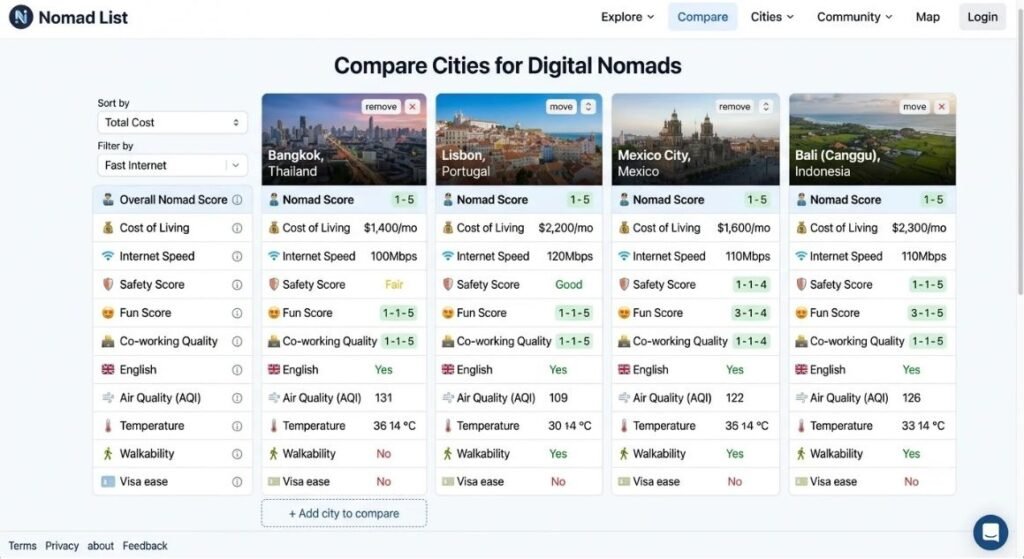
Nomad List — Best for City-by-City Livability Data
What it does: Nomad List aggregates cost of living, internet speed, safety, air quality, and community size for hundreds of cities, then lets you filter and compare them side by side.
What it does well: The city-level granularity beats country-level research every time. “Portugal” tells you almost nothing useful. “Porto vs. Lisbon vs. Faro” tells you where your budget actually lands.
Where it falls short: Some of the community-sourced cost data skews toward users who are already living comfortably, so the numbers can run a bit high compared to what a budget-conscious nomad would actually spend.
Best for: Comparing multiple cities inside the same country before picking where to base yourself.
Pricing: Free tier with limited city data. Paid membership runs roughly $8-15/month depending on the plan, as of 2026.
Numbeo — Best for Real Cost of Living Comparisons
What it does: Numbeo crowdsources rent, grocery, transport, and utility prices from residents in thousands of cities worldwide, then builds cost of living indices you can compare directly.
What it does well: It’s the closest thing to a neutral source for line-item costs, since it’s not trying to sell you a coworking membership or a relocation package. Rent breakdowns by neighborhood are genuinely useful.
Where it falls short: Data quality varies a lot by city. Well-covered hubs like Lisbon or Bangkok are reliable. Smaller or less-traveled cities can have thin, outdated, or skewed sample sizes.
Best for: Sanity-checking a blog post’s cost claims (including this one) against real, city-specific numbers before you commit.
Pricing: Free to browse. A small paid tier exists for ad-free access and extra filters.
VisaGuide.World / iVisa — Best for Checking Visa Requirements Fast
What it does: Both platforms track visa requirements, application steps, and processing times by nationality and destination, and flag policy changes as they happen.
What it does well: Given how often digital nomad visa thresholds change (Portugal, Spain, and Mexico all adjusted their income requirements within the 2026 tax and wage cycle alone), having a source that updates faster than a static blog post matters. Use these to verify current numbers, not just this article’s.
Where it falls short: Neither replaces an immigration lawyer for anything complicated, like dependents, prior visa denials, or dual citizenship situations. Treat them as a first-pass check, not a final answer.
Best for: A fast gut-check on whether you currently qualify before spending money on document translation and apostilles.
Pricing: Free to browse requirements. iVisa charges service fees if you use it to actually process an application.
World Time Buddy — Best for Overlap Planning With Clients or Teammates
What it does: World Time Buddy is a simple visual scheduler that shows multiple time zones stacked against each other, so you can see your working hours against your client’s or team’s in one view.
What it does well: It makes the time zone problem concrete instead of abstract. Seeing “your 9am is their 2am” in a visual bar is far more useful than doing the math in your head every time you plan a call.
Where it falls short: It’s a planning tool, not a scheduling tool. It won’t send invites or manage recurring meetings; you’ll still need a calendar app for that.
Best for: Deciding between two shortlisted countries when the deciding factor is overlap with a specific client or team, not general appeal.
Pricing: Free.
Wise — Best for Managing Money Across Currencies While Abroad
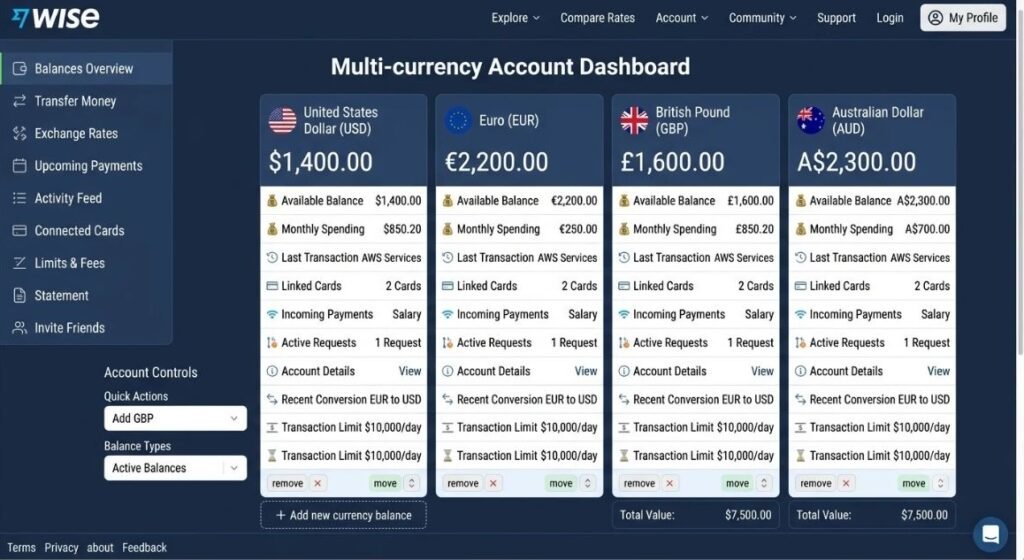
What it does: Wise is a multi-currency account and debit card that lets you hold, convert, and spend in dozens of currencies without the markup traditional banks charge on foreign transactions.
What it does well: For anyone getting paid in USD or EUR and spending in Thai baht, Mexican pesos, or Georgian lari, the exchange rate transparency and low fees add up fast. On a $2,000 monthly spend, a traditional bank’s 2-3% foreign transaction fee quietly costs $40-60 a month, or several hundred dollars a year.
Where it falls short: It’s not a full banking replacement in every country. Some services, like local mortgages or certain long-term rental deposits, still expect a local bank account.
Best for: Anyone getting paid in one currency and living in another, which is essentially every person on this list.
Pricing: Free account. Currency conversion runs a small percentage fee, typically well under 1%, far below standard bank card fees.
Conclusion
The right country for a digital nomad in 2026 isn’t the one at the top of a generic ranking. It’s whichever one lines up with your specific income, your specific clients’ time zone, and a visa path you can actually complete without surprises six months in. Mexico wins if your work runs on US business hours. Georgia wins if bureaucracy-free entry matters more than anything else. Portugal and Spain win if EU access and community are the priority.
The one move that pays off no matter which country you pick: verify the current numbers yourself before you book anything. Visa thresholds moved in Portugal, Spain, Mexico, Thailand, Georgia, and Indonesia within 2026 alone, and a guide written even six months ago can already be out of date.
Hotskill has structured lessons on using AI tools for exactly this kind of fast-moving research, from setting up alerts on visa policy changes to building your own cost of living tracker instead of trusting a single blog post. Download the app on iOS or Android and start your first lesson today: hotskill.co/download.
FAQ
What is a digital nomad visa?
A digital nomad visa is a legal residence permit that allows a foreign national to live in a country while working remotely for an employer or clients based outside that country. It’s distinct from a tourist visa because it explicitly permits remote work and usually requires proof of income, and distinct from a standard work visa because it doesn’t require local employment.
Portugal vs. Spain — which is actually better for digital nomads?
Spain has a lower income threshold (€2,849/month vs. Portugal’s €3,680/month) and a bigger expat community in cities like Barcelona and Valencia. Portugal offers a clearer, more established path to permanent residency and citizenship through the D8. If income is the tight constraint, Spain wins. If long-term EU residency is the goal, Portugal has the edge.
How do I actually apply for a digital nomad visa?
Start by confirming current income and savings thresholds through the country’s consulate website or a tool like VisaGuide.World, since these change yearly. Gather income documentation (payslips, contracts, or bank statements), get any required documents apostilled and translated, then apply either at a consulate in your home country or, where allowed, from inside the destination country. Processing times range from about three weeks (Spain) to six months (Portugal, end to end).
Is a digital nomad visa worth it if I could just travel on a tourist visa instead?
For stays under 90 days in most countries, a tourist entry is simpler and requires no paperwork. Past that, a proper digital nomad visa becomes worth it fast, both for legal certainty and because tourist-visa remote work sits in a legal gray area that countries like Indonesia and Thailand are actively cracking down on in 2026.
Do I really need a formal visa if I’m just staying a few months?
If your total stay fits inside the visa-free or tourist allowance for your nationality, and you’re not establishing tax residency, a formal visa often isn’t necessary. Georgia’s 365-day visa-free entry is the clearest example of this working well. The risk increases the longer you stay and the more your center of life (housing, banking, income routing) shifts to that country.
Why did my visa application get rejected even though I met the income requirement?
The most common rejection reasons across Portugal, Spain, and Thailand’s DTV in 2026 are incomplete or vague income documentation, recently deposited “seasoned” funds that look artificially placed right before application, and freelance income that isn’t clearly tied to clients or contracts outside the destination country. Meeting the raw income number isn’t enough; the paper trail behind it has to hold up.
Do I need to speak the local language to get a digital nomad visa?
No. None of the six countries in this list require language proficiency for the visa itself. Portugal’s path to citizenship does eventually require a Portuguese language test, but that’s a separate, later step from the D8 visa application.
Which country is best for someone brand new to the digital nomad lifestyle?
Portugal and Thailand are generally the easiest starting points. Portugal has an established expat infrastructure and clear rules. Thailand’s Chiang Mai has one of the most mature digital nomad communities in the world, with coworking spaces, meetups, and support networks built specifically for newcomers.
How much does health insurance cost as a digital nomad?
Expect roughly $45-$280/month depending on age, coverage level, and whether the destination country requires a specific minimum coverage amount (Indonesia’s E33G, for example, requires international health insurance and doesn’t accept standard travel insurance policies). Budget on the higher end for countries with mandatory minimum coverage requirements tied to the visa itself.