
Introduction
Here’s something we’ve all felt even if we haven’t said it out loud:
Words can move you.
Sometimes it’s a lyric in a song. A sentence in a book. Or a simple line on a website that makes you pause… feel something… and then do something. Maybe you smiled. Maybe you clicked “Add to cart.”
That’s copywriting.
Copywriting isn’t just writing. It’s telling the right story to the right person at the right time. It nudges without yelling. It connects human needs to business goals without feeling pushy or salesy.
At its core, copywriting is empathy in action.
It’s about understanding how people think, what they want, what they fear and using words to spark action. Whether that action is signing up for a free trial, donating to a cause, or buying a product, if the words lead to movement, you’re doing it right.
So how did copywriting begin?
Let’s rewind.
History and Evolution of Copywriting
A. The Origins of Copywriting
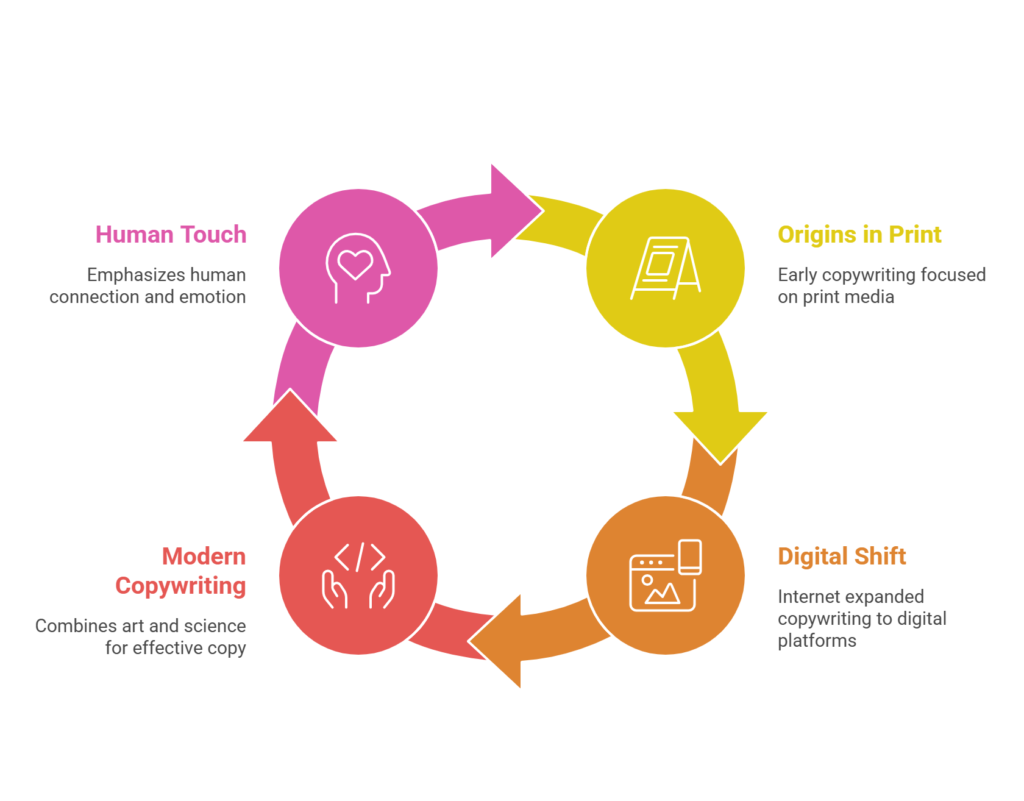
Modern copywriting began in the late 1800s think bold newspaper ads, early billboards, and mass-market print campaigns.
Pioneers like John E. Powers and Claude Hopkins weren’t just writing catchy phrases. They studied human behavior, tested messaging, and focused on results. They introduced the idea that advertising should sell, not just look good.
Iconic lines like:
- “A Diamond Is Forever” – De Beers
- “Just Do It” – Nike
weren’t accidental. They came from deep audience insight—the kind you can’t fake.
B. The Digital Shift
Then the internet changed everything.
Copy expanded beyond print into:
- Websites
- Emails
- Search ads
- Apps
- Social media
- Landing pages
Attention spans shrank. Competition exploded. Copy now had to balance emotional connection with SEO, character limits, page speed, and user journeys.
You weren’t just writing you were competing with cat videos and inbox overload.
C. Copywriting Today
Today, copywriting lives at the intersection of art and science.
- Data
- A/B testing
- Analytics
- AI-generated drafts
Yet underneath all of that?
Still one human talking to another.
Brands like Glossier sound like your cool skincare-obsessed friend. Mailchimp feels smart without being stiff. That’s not accidental that’s voice.
Modern copy must feel:
- Human
- Helpful
- Honest
- Action-oriented
AI can help write the first 60%. But the last 40%—the nuance and emotion—that’s human.
So what actually makes copy work?
Key Elements of Effective Copywriting
A. Know Exactly Who You’re Talking To
You can’t write for everyone—and you shouldn’t try.
Strong copy speaks to one person.
Ask yourself:
- What problem are they trying to solve?
- What moment are they in?
- What’s frustrating them right now?
The more specific you are, the more personal the copy feels.
B. Use Clear, Persuasive Language
Confusing copy doesn’t convert.
You’re not here to impress—you’re here to communicate fast.
Instead of:
“Optimize efficiency across distributed systems”
Say:
“Make your tools work better together.”
Write how people talk.
Skip the buzzwords.
Be direct.
C. Always Include a CTA (Call to Action)
Every piece of copy needs a next step.
- Sign up
- Download
- Learn more
- Buy now
A great CTA gives direction + motivation.
Compare:
- “Start your free trial”
- “Start sleeping better tonight”
Same action. Very different impact.
D. Benefits First, Features Second
People don’t care about features.
They care about outcomes.
Don’t say:
“Bluetooth 5.3, 40-hour battery life”
Say:
“Lose the cords. Enjoy your playlist all day—no charging stress.”
Features explain.
Benefits persuade.
Types of Copywriting (With Examples)
A. SEO Copywriting
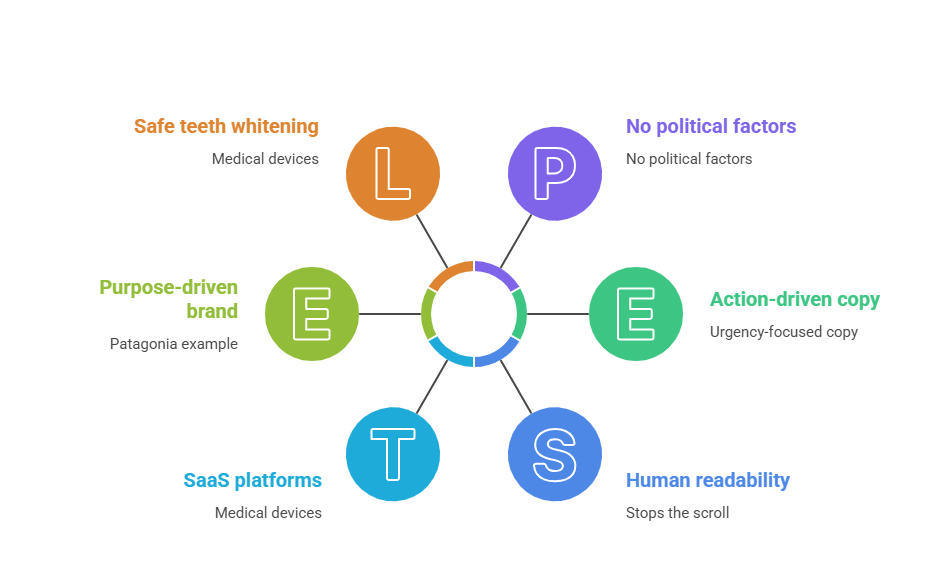
SEO copy balances human readability with search visibility.
Examples:
- “How to Whiten Teeth Safely at Home”
- “How to Create a Budget in 7 Steps”
Keywords matter—but clarity matters more. Write for people first, algorithms second.
B. Direct Response Copywriting
This is action-driven, urgency-focused copy.
Examples:
- “Your 30% discount ends tonight.”
- “Download the guide—get clients this week.”
Fast setup. Clear problem. Clear solution.
C. Brand Copywriting
Brand copy shapes personality.
- Apple → Clean, aspirational
- Old Spice → Bold, funny
- Patagonia → Purpose-driven
It’s not about selling fast—it’s about building trust and recognition.
D. Technical Copywriting
Technical copy simplifies complexity.
Used for:
- SaaS platforms
- Medical devices
- Financial products
The goal? Make complicated things feel understandable.
E. Social Media Copywriting
You have seconds.
Great social copy:
- Stops the scroll
- Feels human
- Matches platform behavior
Example:
“Guess what’s back 👀 (and better than ever)”
Short. Casual. Effective.
Copywriting vs. Content Writing
A. Different Goals
- Copywriting: Drives action
- Content writing: Builds trust and education
Example:
- Copy sells the running shoes
- Content explains how to train for a 5K
They work best together.
B. Different Styles
- Copy → punchy, persuasive
- Content → flowing, informative
Blending both is where strong marketing lives.
Skills Required for Copywriting
A. Creativity With Purpose
Great copy isn’t about fancy words—it’s about clarity.
Sometimes the most persuasive copy is the simplest:
“Need it tomorrow? Done.”
B. Strong Research Skills
Great copy comes from real conversations:
- Reviews
- Reddit threads
- Customer feedback
When your copy sounds like the reader’s inner voice—it works.
C. Psychology Basics
People buy emotionally first, logically later.
Drivers include:
- FOMO
- Belonging
- Ease
- Safety
- Status
Understand these, and persuasion follows.
D. SEO Fundamentals
You don’t need to be an SEO expert—but you should know:
- Keyword intent
- Placement
- Natural optimization
Small tweaks = big reach.
Popular Copywriting Tools
Writing & Editing
- Grammarly
- Hemingway Editor
- AI tools (for drafts, not final copy)
SEO Tools
- Ahrefs / SEMrush
- Google Keyword Planner
- Moz
Analytics & Testing
- Google Analytics
- Hotjar
- VWO / Optimizely
Learning & Inspiration
- Copyhackers
- Marketing Examples
- Swipe files
VIII. How to Become a Successful Copywriter
A. Learn—Then Practice
Books help. Practice matters more.
Rewrite ads. Analyze emails. Build mock projects. Skill grows through repetition.
B. Build a Portfolio
Don’t wait for permission.
Redo a landing page. Rewrite a donate page. Show that you can move people.
C. Find Clients & Community
- Freelance platforms
- Cold outreach (done right)
- LinkedIn & online communities
Referrals come from doing solid work consistently.
Conclusion: The Power of Copywriting
Copywriting will keep evolving.
Tools will change. Platforms will change. Formats will change.
But one thing won’t:
People still need to feel something before they act.
That’s why copywriting matters.
Words are small—but when used right, they’re powerful.
So if you’re curious about copywriting, here’s your next step:
Start.
Write one headline. Rewrite one CTA. Improve one subject line.
You don’t need permission.
You just need to begin.
And once you do—
That’s when things start clicking.