
Running your first Facebook ads feels a bit like being handed a toolbox with no instructions.
You’ve got a solid product or service. You believe there’s demand. But the moment Facebook asks you to set a budget, everything suddenly feels… unclear.
Some days, it honestly feels like throwing money into a slot machine and hoping it spins out sales.
The good news? It doesn’t have to feel like that.
Once you understand what actually affects Facebook ad costs—and how the system decides where to spend—you gain control. You’ll know what to spend, when to spend it, and how to stretch your budget further.
Whether you’re a solo founder, part of a lean startup, or a marketer tired of watching ad spend disappear with no returns, this guide is built for you.
No fluff. Just practical strategy.
Think of this as a back-pocket survival map for Facebook Ads budgeting.
Let’s break down where your money goes—and how to make every dollar or euro work harder.
Understanding Facebook Ads Budget Types
Before launching a campaign, Facebook asks an important question:
How do you want to control your spending?
It’s a bit like dining out you can either set a daily tab or pre-pay for the whole meal.
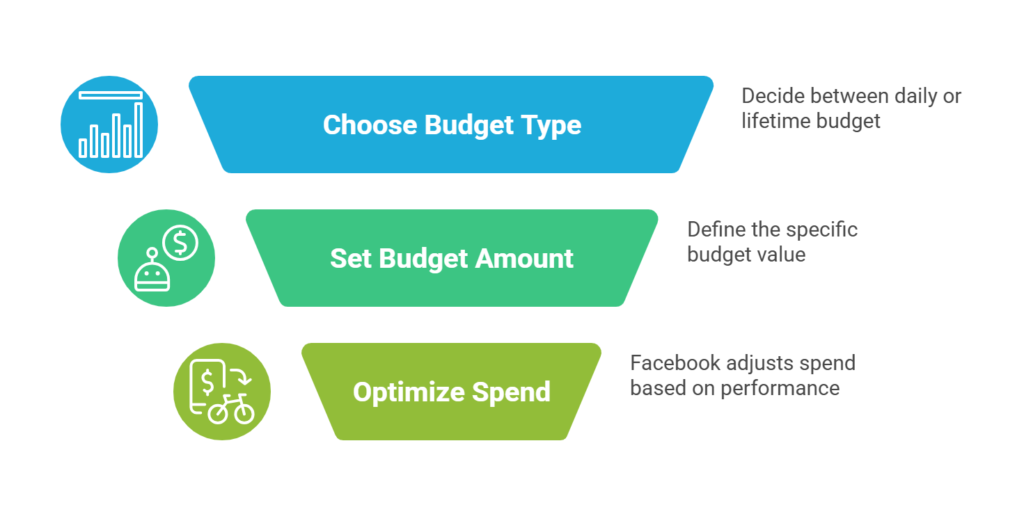
Daily Budget vs. Lifetime Budget
Daily Budget
- You choose how much you’re comfortable spending per day
- Example: €20/day
- Facebook may spend up to ~25% more on high-opportunity days
- Best for:
- Always-on campaigns
- Brand awareness
- Ongoing lead generation
- Easy to pause, scale, or tweak
Lifetime Budget
- You set a fixed total amount for a specific date range
- Example: €500 over 10 days
- Facebook distributes spend based on performance across days
- Best for:
- Product launches
- Seasonal promotions
- Events and flash sales
Quick takeaway:
- Daily budget = predictability
- Lifetime budget = flexibility + optimization
Choosing the right one early can prevent wasted spend or missed opportunities.
What Shapes Your Facebook Ads Budget?
Your results aren’t dictated by budget alone. Several behind-the-scenes factors determine how efficiently your money is spent.
Key Factors That Influence Cost
- Campaign goal
Awareness, leads, sales, or app installs—each has a different cost structure. - Audience size & targeting
- Smaller, warmer audiences → cheaper conversions
- Large, cold audiences → higher costs but essential for scaling
- Creative & placements
- Video vs image
- Feed vs stories vs reels
Performance varies widely by format.
- Industry competition
Sectors like finance, real estate, healthcare, and ecommerce typically have higher CPMs and CPAs. - Bidding & account structure
Whether you use CBO (Campaign Budget Optimization) or ad-set budgets plays a major role in where your money flows.
Budgeting works best when all these elements are aligned—not when you fixate on a single number.
Setting an Effective Facebook Ads Budget
This is where most beginners hesitate—but it doesn’t need to be complicated.
Step 1: Define Your Objective
Be crystal clear.
❌ “Increase engagement”
✅ “Generate 100 email signups this month”
Clear goals make budgeting measurable and realistic.
Step 2: Estimate Your Budget
Use this simple formula:
Budget = Target Conversions × Average CPA
Example:
- Target: 40 leads
- Average CPA: €20
- Budget needed: €800
If you don’t know your CPA yet, start with a test budget of €100–€200 and let data guide your next move.
Step 3: Allocate Budget Across the Funnel
Not everyone is ready to buy immediately.
A strong starting framework:
- 60% → Retargeting & conversions
- 30% → Cold traffic & awareness
- 10% → Testing (new creatives, messaging, audiences)
This keeps your funnel moving instead of leaking money at the top.
Smart Budget Allocation Strategies
How you distribute your budget can make or break results.
1. Scale Gradually
If an ad set is performing well, don’t double the budget overnight.
Instead:
- Increase by 20–30% every 2–3 days
- Maintain algorithm stability
- Prevent sudden performance drops
Think steady growth, not sudden spikes.
2. Avoid Budget Concentration
Running multiple ad sets?
Give each enough budget to generate useful data. Once winners appear:
- Shift spend toward them
- Pause underperformers
Cold audiences and warm audiences behave differently—budget them separately.
3. A/B Test (Without Overspending)
Testing doesn’t require big money.
Try:
- Two headlines
- Two creatives
- Two CTAs
Start with €5–€10/day per variant.
Scale only what proves itself.
Facebook Ads Budget Optimization
Planning spend is only half the job. Optimizing live campaigns is where profits come from.
Metrics You Must Track Daily
- Cost Per Acquisition (CPA)
- Cost Per Click (CPC)
- Click-Through Rate (CTR)
- Return on Ad Spend (ROAS)
- Frequency (watch for fatigue)
Rising CPA + falling CTR usually = creative fatigue or targeting mismatch.
Make Adjustments Early
If something’s underperforming:
- Change the headline
- Refresh visuals
- Adjust targeting
Waiting rarely fixes bad ads. Acting early saves budget.
Use Campaign Budget Optimization (CBO)
CBO allows Facebook to:
- Shift budget toward top-performing ad sets automatically
It’s powerful—but still needs human supervision.
Automate smartly, not blindly.
Common Budget Mistakes to Avoid
- Overspending from day one
Test cheaply before scaling. - Underfunded tests
€10 total won’t provide meaningful insights. - Mixed audience targeting
New prospects ≠ past buyers. Separate them.
Spotting these early keeps campaigns healthy.
Real-World Budget Strategies
☕ Local Coffee Shop (Vienna)
- Budget: €400 over 2 months
- Winning creative: Short staff videos
- Result: Increased weekday foot traffic
🛒 Fitness E-Commerce Brand
- Budget: €50/day
- Strategy: Retarget cart abandoners
- Outcome: CPA dropped from $25 → $14
🏥 Physical Therapy Clinic
- Budget: €700
- Best message: “Move easier”
- Result: Higher bookings without increasing spend
Small tweaks + smart budget shifts = big gains.
Conclusion: Spend With Purpose & Stay Flexible
Facebook Ads don’t reward guesswork.
They reward:
- Clear goals
- Smart testing
- Continuous optimization
The goal isn’t to spend more—it’s to spend with intent.
What works today may not work tomorrow. That’s normal.
The strongest Facebook Ads budget strategy is built to adapt, not sit still.
You don’t need massive spend to win.
You need clarity, patience, and a plan that evolves.