

Decision-making is an intrinsic part of human life, influencing personal, professional, and organizational outcomes. From simple choices like what to eat for breakfast to complex strategic business decisions, every choice carries consequences. Amidst the countless decisions we make daily, some are made intuitively or emotionally, while others are made logically and systematically. This is where rational decision making comes into play. Understanding the principles, steps, and applications of rational decision making is essential for anyone seeking better outcomes, whether in personal life or in professional contexts.
Rational decision making is a structured and deliberate process where individuals or organizations make choices by systematically evaluating all available options and selecting the one that maximizes benefits while minimizing potential risks. Unlike decisions driven by impulse, habits, or emotions, rational decision making relies on logic, evidence, and critical thinking. It provides a framework for minimizing errors, reducing biases, and enhancing the overall quality of decisions.
In this article, we will explore the concept of rational decision making, its key principles, the steps involved, factors affecting it, its advantages and limitations, and practical strategies to implement it effectively in daily life and business contexts.
Understanding Rational Decision Making
Rational decision making is rooted in classical economic and management theories, which assume that decision-makers are fully informed, capable of assessing alternatives objectively, and motivated to maximize their utility. At its core, it is about making decisions that are consistent, logical, and goal-oriented.
The primary objective of rational decision making is to select the optimal course of action from a set of alternatives. This requires a clear understanding of the problem, identification of alternatives, assessment of possible outcomes, and careful weighing of consequences. Rational decision-making models emphasize the importance of systematic analysis, evidence-based reasoning, and methodical evaluation rather than relying on intuition or past habits.
It is important to note that rational decision making is not about being emotionless. Emotions and intuition play a significant role in human cognition. However, rational decision-making frameworks provide a structure to ensure that emotional impulses do not override logic and reason when critical outcomes are at stake.
Key Principles of Rational Decision Making
Rational decision making is governed by several fundamental principles that distinguish it from other forms of decision-making approaches. These principles provide the foundation for consistent, logical, and effective decisions.
Goal Orientation
The primary principle of rational decision making is goal orientation. Every decision should aim to achieve a clear and measurable objective. Whether the decision involves personal growth, financial investments, or organizational strategy, defining the end goal helps prioritize options and guide the evaluation process.
Comprehensive Information Analysis
Rational decision making requires the collection and analysis of all relevant information. Decision-makers must understand the context, potential risks, available resources, and expected outcomes. This principle assumes that better information leads to better decisions.
Logical Consistency
Decisions must follow a logical progression. The evaluation of alternatives, assessment of outcomes, and selection of the best option should align with rational principles. Logical consistency ensures that decisions are not contradictory and that each step in the process supports the overall objective.
Consideration of Consequences
Rational decision making involves evaluating the short-term and long-term consequences of each option. Decision-makers must anticipate potential risks and benefits to select the most advantageous course of action.
Objectivity and Impartiality
A rational decision-maker must minimize personal biases and subjective influences. Objective analysis ensures that decisions are based on evidence and reason rather than preferences, emotions, or external pressures.
Preference for Optimal Solutions
The ultimate goal of rational decision making is to identify the solution that maximizes benefits or utility. This requires comparing alternatives based on defined criteria and selecting the option that delivers the highest value.
The Rational Decision-Making Process
Rational decision making is most effective when followed as a structured process. The process typically involves multiple stages that guide decision-makers from problem identification to the implementation and evaluation of the chosen solution.
Step 1: Define the Problem
The first step in rational decision making is accurately identifying and defining the problem. A poorly defined problem can lead to irrelevant solutions and wasted resources. Decision-makers must clearly understand the nature of the problem, the stakeholders involved, and the desired outcomes.
Step 2: Identify Alternatives
Once the problem is defined, the next step is to identify all possible alternatives. In this stage, creativity and comprehensive thinking are essential. The goal is to generate a wide range of options without prematurely eliminating possibilities. This ensures that the best possible solution is considered.
Step 3: Evaluate Alternatives
After identifying alternatives, each option must be evaluated based on specific criteria. Criteria may include cost, time, feasibility, potential risks, and alignment with the desired goals. Rational decision making emphasizes a systematic assessment where each alternative is weighed carefully before making a choice.
Step 4: Predict Outcomes
In this step, decision-makers estimate the potential outcomes of each alternative. This requires analyzing both short-term and long-term consequences, considering both direct and indirect impacts. Predicting outcomes helps in selecting an option that is most likely to achieve the desired results.
Step 5: Make the Decision
After evaluating alternatives and predicting outcomes, the rational decision-making process culminates in selecting the option that offers the greatest benefit or utility. The choice should be consistent with the established goals, evidence, and logical analysis conducted in previous steps.
Step 6: Implement the Decision
Decision implementation involves executing the chosen solution effectively. Even the most rational decision can fail if not implemented correctly. This stage may require planning, resource allocation, and coordination among stakeholders to ensure smooth execution.
Step 7: Evaluate and Review
The final step is to monitor the results of the decision and assess its effectiveness. Rational decision making is iterative; reviewing outcomes allows decision-makers to learn from successes and failures and refine future decisions. Continuous evaluation enhances decision quality over time.
Factors Affecting Rational Decision Making
While rational decision making is based on logic and systematic evaluation, several factors can influence the process. Understanding these factors can help mitigate potential pitfalls and improve decision outcomes.
Information Availability
Access to accurate and relevant information is critical for rational decision making. Incomplete or misleading information can compromise the decision-making process, leading to suboptimal outcomes.
Cognitive Biases
Human decision-making is often influenced by cognitive biases, such as overconfidence, anchoring, or confirmation bias. Rational decision-making frameworks encourage awareness of these biases and strategies to minimize their impact.
Time Constraints
Limited time can affect the thoroughness of the decision-making process. While rational decision making ideally requires careful evaluation, practical constraints often necessitate balancing speed with thorough analysis.
Complexity of the Problem
Highly complex problems with multiple variables and uncertainties challenge rational decision making. In such cases, decision-makers may need advanced analytical tools, modeling, or expert consultation to arrive at optimal solutions.
Emotional Influences
Emotions can influence decision-making, even when logic is prioritized. Rational decision making acknowledges the role of emotions but emphasizes structured frameworks to ensure that decisions remain goal-oriented and evidence-based.
Advantages of Rational Decision Making
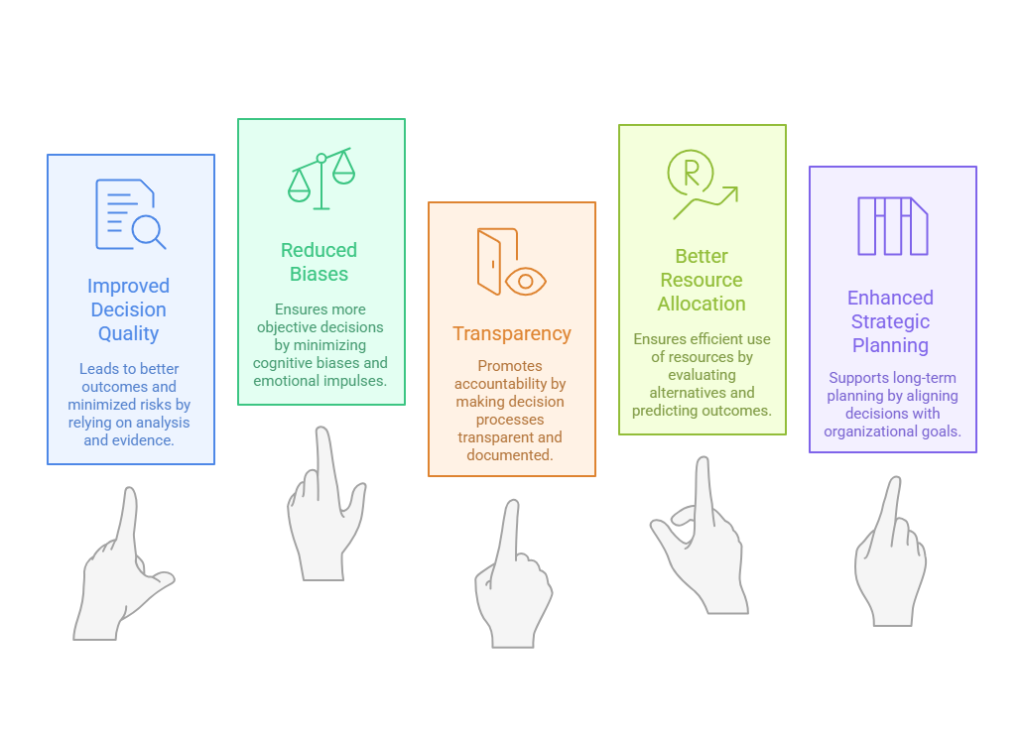
Rational decision making offers several benefits that make it a preferred approach in personal, professional, and organizational contexts.
Improved Decision Quality
By relying on systematic analysis and evidence, rational decision making enhances the overall quality of decisions. Decisions are more likely to achieve desired outcomes and minimize risks.
Reduced Biases and Errors
The structured nature of rational decision making reduces the impact of cognitive biases and emotional impulses, leading to more objective and impartial decisions.
Transparency and Accountability
Rational decision-making processes are transparent and well-documented. This promotes accountability, especially in organizational settings, as stakeholders can trace the reasoning behind decisions.
Better Resource Allocation
By evaluating alternatives and predicting outcomes, rational decision making ensures efficient use of resources, minimizing waste and maximizing value.
Enhanced Strategic Planning
Rational decision making supports long-term planning and strategy development. Decisions are aligned with organizational goals and objectives, creating a roadmap for sustainable success.
Limitations of Rational Decision Making
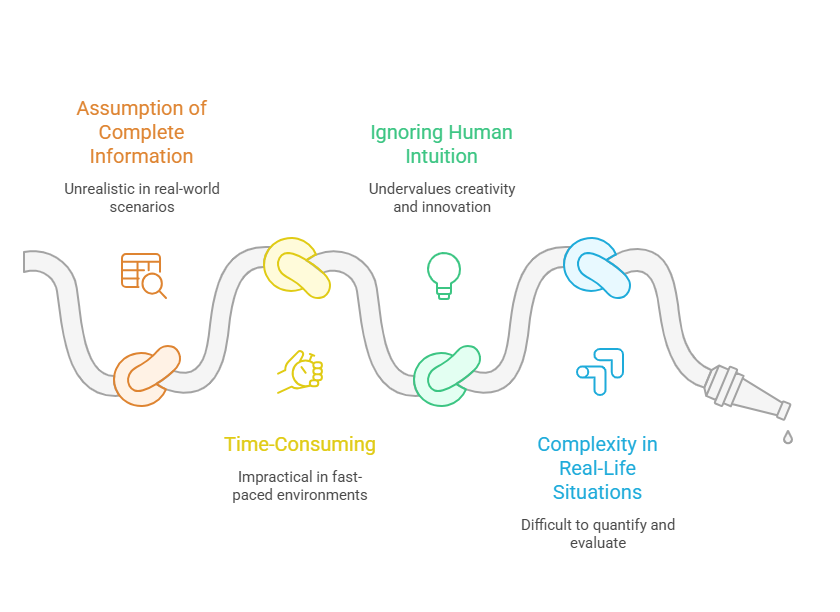
Despite its advantages, rational decision making is not without limitations. Understanding these limitations helps in applying the approach effectively.
Assumption of Complete Information
Rational decision making assumes that all relevant information is available, which is often unrealistic in real-world scenarios. Uncertainty and incomplete information can limit decision accuracy.
Time-Consuming
The thorough analysis required in rational decision making can be time-consuming, which may not be practical in fast-paced environments requiring quick decisions.
Ignoring Human Intuition
Strict adherence to rational decision-making frameworks may undervalue human intuition and creativity, which can sometimes lead to innovative solutions.
Complexity in Real-Life Situations
Some decisions involve complex, dynamic variables that are difficult to quantify and evaluate. In such cases, rational decision making may be challenging to implement fully.
Practical Applications of Rational Decision Making
Rational decision making is widely applicable across personal life, business management, and organizational strategy.
In Personal Life
Individuals can apply rational decision-making principles to financial planning, career choices, health-related decisions, and relationship management. For instance, evaluating educational or career opportunities systematically can lead to better long-term outcomes.
In Business Management
Organizations use rational decision making in strategic planning, project management, investment decisions, and operational improvements. Structured frameworks help managers minimize risks, optimize resource allocation, and achieve business objectives effectively.
In Public Policy
Rational decision making is critical in government and public policy. Policymakers evaluate potential policy options, predict societal impacts, and select solutions that maximize public welfare while minimizing unintended consequences.
In Healthcare
Healthcare professionals use rational decision making in diagnosis, treatment planning, and resource management. Evidence-based approaches ensure better patient outcomes and efficient use of medical resources.
Strategies to Enhance Rational Decision Making
Improving rational decision-making skills requires a combination of analytical thinking, self-awareness, and practical tools.
Develop Critical Thinking Skills
Critical thinking enables individuals to analyze information objectively, identify assumptions, and evaluate alternatives logically. Regular practice of critical thinking enhances rational decision-making abilities.
Minimize Cognitive Biases
Awareness of cognitive biases and implementing strategies to counteract them, such as seeking diverse perspectives and using structured decision frameworks, improves decision accuracy.
Gather Relevant Information
Prioritize collecting comprehensive and reliable information before making decisions. This reduces uncertainty and supports evidence-based choices.
Use Decision-Making Tools
Analytical tools such as decision matrices, cost-benefit analysis, and scenario planning help structure the decision-making process and identify optimal solutions.
Evaluate and Learn from Decisions
Consistently reviewing past decisions, analyzing outcomes, and learning from mistakes strengthens future decision-making capabilities. Rational decision making is iterative, and continuous improvement is key.
Conclusion
Rational decision making is a systematic, goal-oriented, and logical approach that enables individuals and organizations to make informed and effective choices. By following structured processes, analyzing alternatives, predicting outcomes, and minimizing biases, decision-makers can achieve better results in personal, professional, and organizational contexts.
While rational decision making has limitations, such as time constraints and assumptions of complete information, its benefits in enhancing decision quality, transparency, and strategic planning make it indispensable. By integrating critical thinking, analytical tools, and iterative evaluation, anyone can improve their ability to make rational decisions.
Understanding and practicing rational decision making empowers individuals and organizations to navigate complex choices with confidence, achieve desired outcomes, and create long-term value in an increasingly dynamic and uncertain world.