

Marketing is more than promotion or advertising; it is a structured process centered on understanding human needs, delivering value, and building meaningful interactions between organizations and customers. At the foundation of this discipline lie several interrelated ideas that shape how markets function and how businesses operate. Among them, exchange, transactions, and relationships form a conceptual chain that explains how value is created, delivered, and sustained in modern marketplaces. These principles provide both theoretical grounding and practical direction for marketers seeking to design strategies that generate trust, satisfaction, and loyalty.
Marketing scholars emphasize that the foundation of marketing revolves around identifying customer needs and satisfying them in ways that also help organizations achieve their goals. This framework incorporates the development of offerings, the creation of value, and the pursuit of customer satisfaction through structured interactions between buyers and sellers.
In contemporary environments characterized by digital platforms, global competition, and data-driven insights, these foundational principles remain highly relevant. Organizations that understand them thoroughly are better equipped to build sustainable business models and adapt to changing consumer expectations. This article explores these ideas in depth, presenting both conceptual understanding and actionable insights for readers seeking to apply them in real-world contexts.
Understanding the Core Concepts of Marketing
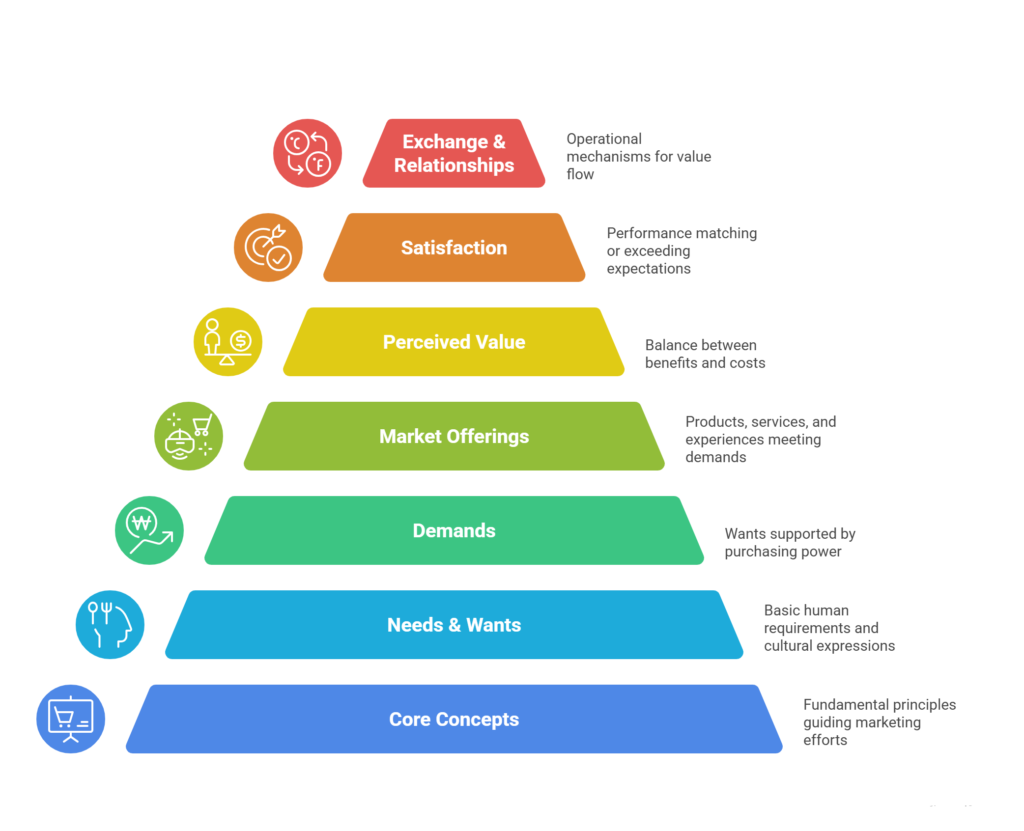
To appreciate exchange, transactions, and relationships, it is essential to recognize their place within the broader structure of marketing theory. The Core Concepts of Marketing describe the fundamental principles that guide organizations in creating and delivering value to customers while achieving strategic objectives. They encompass elements such as needs, wants, market offerings, perceived value, satisfaction, and market structures. These ideas are interconnected and collectively explain how businesses identify opportunities and maintain relevance in competitive environments.
Needs refer to basic human requirements such as food, safety, or belonging, while wants represent culturally shaped expressions of those needs. When wants are supported by purchasing power, they become demands. Businesses respond by developing offerings that combine products, services, and experiences designed to meet these demands. The success of these offerings depends on perceived value, defined as the balance between benefits received and costs incurred by customers. Satisfaction arises when performance matches or exceeds expectations, which in turn influences loyalty and future interactions.
Within this framework, exchange, transactions, and relationships emerge as operational mechanisms through which value flows. Marketing activity occurs when individuals decide to meet their needs through exchange rather than alternative methods such as self-production or coercion. These mechanisms transform abstract needs and wants into observable market behaviors, making them central to understanding modern marketing practice.
The Nature of Exchange in Marketing
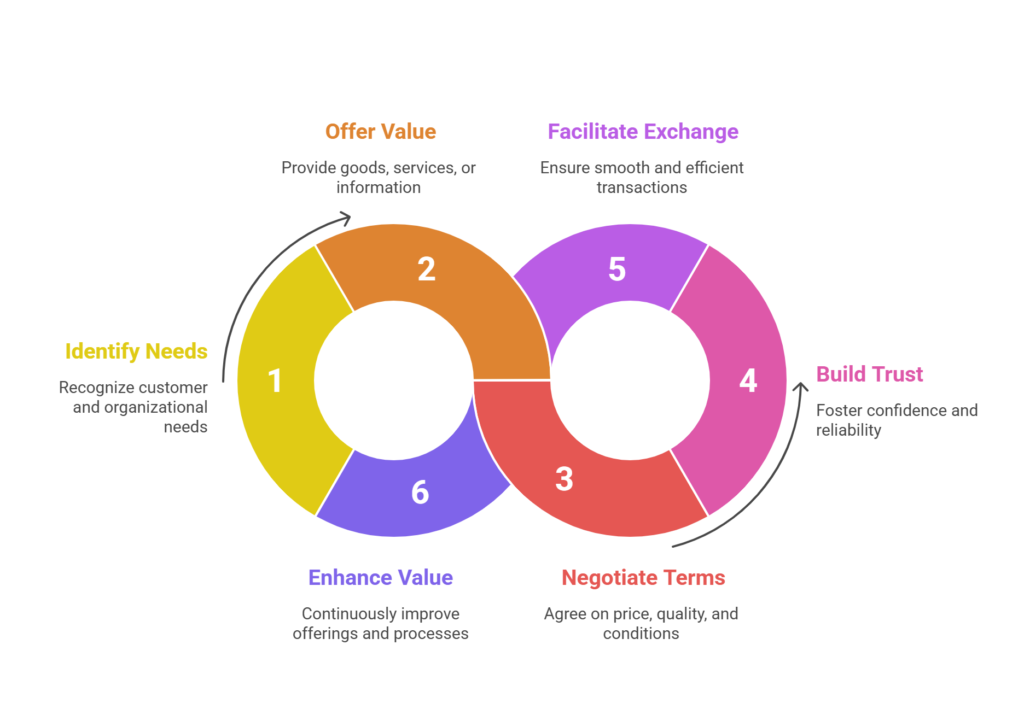
Exchange lies at the heart of marketing activity. It describes the act of obtaining something desired by offering something of value in return. This mutual transfer of value enables participants to satisfy their needs in ways that would otherwise be impossible or inefficient. Exchange can involve money, goods, services, time, or information, and it requires voluntary participation from both parties, each perceiving benefit in the arrangement.
For exchange to occur successfully, certain conditions must exist. There must be at least two parties, each possessing something of value to the other, along with the freedom to accept or reject the offer. Communication and agreement on terms are also essential. These conditions highlight that exchange is not merely economic but also social and communicative, requiring trust and understanding between participants.
Exchange plays a transformative role in society. By enabling specialization and cooperation, it allows individuals and organizations to produce and consume beyond their own capabilities. Through exchange, markets expand and productivity increases, creating wealth and diversity of choice. This societal dimension underscores why exchange is considered the foundational mechanism of marketing systems.
From a managerial perspective, marketers must design exchanges that maximize perceived value for customers while sustaining organizational profitability. Achieving this balance involves understanding customer preferences, clearly communicating benefits, and ensuring fairness in pricing and quality. Trust and communication significantly influence whether people are willing to engage in exchange, emphasizing the importance of relationship-building even at this initial stage.
In practical application, businesses should analyze customer expectations, reduce friction in purchasing processes, and ensure transparency in communication. By doing so, they create environments in which exchanges occur naturally and repeatedly, strengthening market presence and customer confidence.
Transactions as Measurable Units of Exchange
While exchange represents a conceptual process, transactions serve as its measurable manifestation. A transaction is a specific trade between parties involving at least two things of value, agreed-upon conditions, and defined timing and location. In simpler terms, it is the moment when exchange becomes concrete and observable, such as when payment is made and ownership is transferred.
Transactions function as units of measurement in marketing performance because they reflect actual market activity. Each transaction provides data that organizations can analyze to assess demand, pricing effectiveness, and operational efficiency. This measurement aspect explains why transactions are closely tied to accounting, performance evaluation, and planning processes within businesses.
Historically, many marketing approaches focused heavily on maximizing individual transactions. Transactional marketing emphasized identifying target customers, negotiating terms, completing sales, and ending interactions once value exchange occurred. While efficient in certain contexts, this approach sometimes resulted in poor follow-up service and weak customer retention because it prioritized short-term outcomes over long-term engagement.
Despite these limitations, transactions remain vital. They represent revenue generation and tangible business results. Without transactions, exchange remains theoretical, and relationships lack economic substance. For marketers, optimizing transactions involves ensuring clear agreements, seamless payment systems, reliable delivery, and transparent communication. Such improvements enhance customer satisfaction and reduce barriers to future interactions.
In modern digital commerce, transactions are increasingly automated, data-driven, and personalized. Online platforms record behavioral patterns, enabling predictive insights that shape pricing strategies, promotions, and product recommendations. This evolution demonstrates how transactions have moved beyond simple economic exchanges to become informational assets that guide strategic decision-making.
Building Relationships in Marketing Contexts
Beyond individual exchanges and transactions lies the broader concept of relationships. Marketing relationships develop through repeated interactions that foster trust, loyalty, and mutual benefit between organizations and stakeholders. They represent an evolution from isolated exchanges toward sustained engagement over time.
Relationship marketing specifically focuses on creating, maintaining, and enhancing connections with customers and partners. It prioritizes long-term satisfaction over short-term profit, recognizing that loyal customers often provide greater value through repeat purchases and advocacy. Scholars have described this approach as seeking to maintain effective relationships rather than simply acquiring new customers, highlighting its strategic importance in service industries and competitive markets.
Relationships extend beyond customers to include suppliers, distributors, and other stakeholders. Strong professional networks create access to resources, information, and opportunities, improving resilience and innovation capacity. Such connections illustrate that relationship-building is not confined to sales interactions but encompasses the entire ecosystem surrounding business operations.
From an operational standpoint, relationship development requires consistent quality, fair pricing, effective communication, and responsiveness to feedback. These elements reinforce trust and commitment, encouraging customers to remain engaged. Modern technologies, including customer relationship management systems and data analytics, facilitate personalization and continuous engagement, strengthening relational bonds.
In application, marketers should invest in after-sales service, loyalty programs, personalized communication, and community-building initiatives. These strategies transform customers into long-term partners rather than one-time buyers, contributing to sustainable growth and brand resilience.
Interconnections Between Exchange, Transactions, and Relationships
Exchange, transactions, and relationships should not be viewed as isolated constructs but as interconnected stages within a continuum of marketing interaction. Exchange initiates value flow by enabling participants to obtain desired outcomes. Transactions formalize and record these exchanges, providing measurable outcomes. Relationships develop when exchanges and transactions are repeated and enriched by trust and satisfaction.
This progression reflects a shift in marketing philosophy from product-centric to customer-centric thinking. Instead of focusing solely on immediate gains, contemporary marketing emphasizes holistic engagement that nurtures loyalty and shared value creation. Organizations that recognize these connections can align operational processes with strategic objectives more effectively.
The interplay between these elements also highlights the dynamic nature of markets. Exchanges adapt to changing consumer expectations, transactions reflect economic conditions and technological capabilities, and relationships evolve through cultural and social influences. Understanding these dynamics enables marketers to anticipate trends and design adaptive strategies.
Strategic Implications for Modern Marketers
In practical terms, mastering these concepts requires translating theory into action. Organizations must identify value propositions that encourage exchange, optimize processes that facilitate transactions, and nurture experiences that strengthen relationships. Achieving this integration demands cross-functional collaboration, data analysis, and customer-centric design.
Digital transformation has amplified the importance of relationship-oriented marketing. Social media engagement, personalized content, and community-building initiatives illustrate how organizations now interact continuously with customers rather than only during purchase events. These practices reinforce relational depth while supporting transactional efficiency.
Furthermore, globalization and technological innovation have diversified exchange mechanisms. Virtual services, subscription models, and platform-based ecosystems demonstrate that value exchange no longer relies solely on physical goods. Marketers must therefore adapt conceptual understanding to emerging contexts, ensuring relevance and competitiveness.
Conclusion
Exchange, transactions, and relationships form an interconnected triad that defines marketing practice and theory. Exchange establishes the possibility of value transfer, transactions operationalize that transfer, and relationships sustain it over time. Together they illustrate how marketing transforms human needs into structured interactions that benefit both organizations and customers.
By understanding these mechanisms deeply, marketers gain actionable insight into designing strategies that foster trust, efficiency, and long-term growth. Whether operating in traditional industries or digital ecosystems, professionals who apply these principles thoughtfully are better positioned to create meaningful value and maintain competitive advantage.
Ultimately, mastery of the Core Concepts of Marketing empowers organizations to navigate evolving market landscapes with clarity and purpose, ensuring that interactions with customers remain mutually beneficial and enduring.