

You’ve got the offer, the traffic, and a landing page converting at 2%. The copy is the problem, and nobody on the team has time to rewrite it for the fifth time this quarter. So you open a search tab and find forty tools that all promise “high-converting copy in seconds.”
Picking one is the real work. This guide gives you the best AI landing page copy generators worth your time, with a straight verdict on what each one does well, where it breaks, and who should actually pay for it.
A landing page copy generator is software that uses a large language model (LLM, an AI system trained on huge amounts of text) to draft headlines, subheadings, benefit bullets, and calls to action (CTAs) from a short brief. Some are standalone writing apps. Others live inside page builders. A few are general chatbots that happen to be very good at the job.
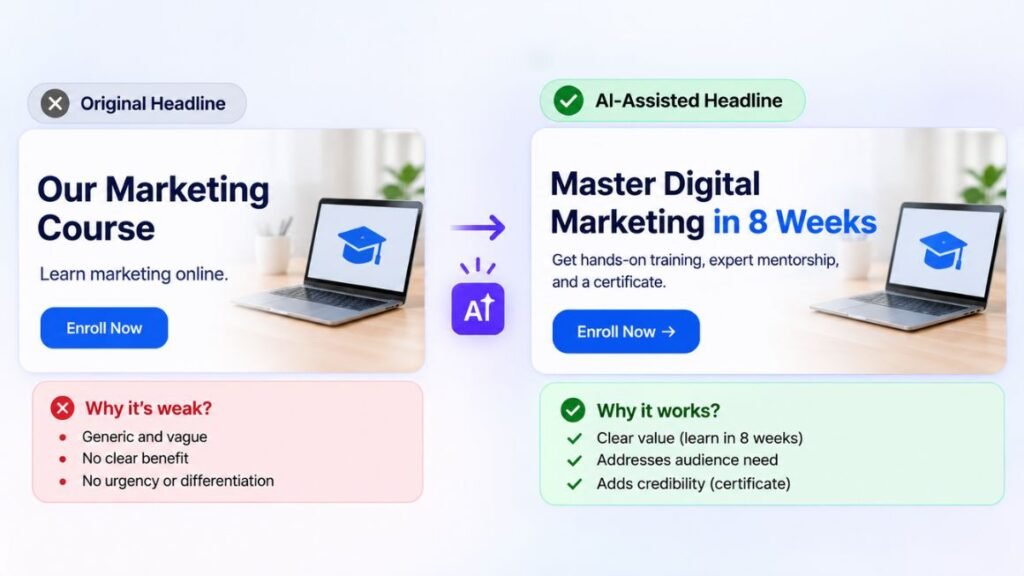
How Do You Choose a Landing Page Copy Tool?
Choose based on where you work, not on feature lists. If you build pages in a specific builder, a tool inside it saves the most time. If you write in documents first, a standalone writer or chatbot fits better.
Here’s the checklist we’d use before paying for anything.
- Brand voice control. Can you feed it past copy, a style guide, or product docs so the output doesn’t sound generic?
- Structure awareness. Does it understand a page has a hero, proof, objections, and a CTA, or does it spit out random paragraphs?
- Variant testing. Can you generate five headline options quickly and tell them apart?
- Edit friction. How many clicks from draft to live page?
- Cost per page. Usage limits and credits matter more than the sticker price.
Most marketers shopping for AI copywriting tools for landing pages overbuy. A free chatbot plus a good brief beats a $100 tool with a lazy prompt. The paid products earn their keep when you need brand governance, team workflows, or tight builder integration.
One more thing. Every tool below can produce confident nonsense about your product. You supply the facts, the offer, and the proof. The tool supplies the phrasing.
The best tool for landing page copy is the one closest to where you already work, because edit friction costs more than subscription fees. Judge any tool on brand voice control, page-structure awareness, variant generation, and real cost per page. Always supply your own facts and proof, since every large language model can state false claims with confidence.
Jasper: Best for Brand-Consistent Campaign Copy
Jasper is a marketing-focused AI platform built around brand voice, reusable knowledge, and campaign workflows. For teams that care about sounding like one company across ten pages, it’s the most mature option here.
You upload brand guidelines and example content, then Jasper applies that voice to new drafts. You can also store product facts so it stops inventing features. That combination is why agencies keep it around.
What it does well: Brand Voice and company knowledge settings keep tone steady across pages and channels. Campaign-style workflows let you generate the landing page, matching ads, and follow-up emails from one brief.
Where it falls short: It costs more than general chatbots and offers no permanent free plan. Its templates can push you toward formulaic copy if you don’t edit hard. For one-off pages, it’s overkill.
Best for: Marketing teams and agencies producing many pages under one brand.
Pricing: Paid plans with a trial, as of late 2026. Check Jasper’s pricing page before you commit, since tiers shift often.
Copy.ai: Best for Repeatable Copy Workflows
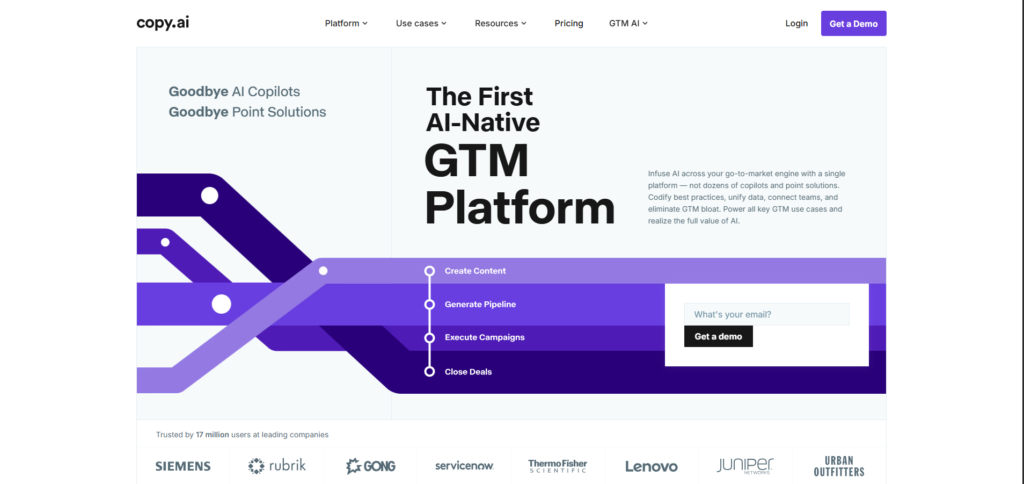
Copy.ai started as a simple copy generator and has since moved toward automated go-to-market workflows. For landing pages, that means you build a repeatable process: input a product brief and audience, get structured page sections back every time.
That’s genuinely useful if you launch pages often. You design the workflow once, and anyone on the team can run it.
What it does well: Workflows turn a brief into consistent output without rewriting prompts each time. It handles variations across segments, like one page per industry, quickly.
Where it falls short: The product’s focus has drifted toward sales and GTM teams, so pure landing page tooling feels secondary. Its plan structure and pricing changed more than once during 2026, which makes budgeting awkward.
Best for: Teams that run the same page-building process over and over.
Pricing: Tiered paid plans, with changes during 2026. Verify current limits and what’s included before buying.
Writesonic: Best for SEO-Minded Landing Pages
Writesonic combines a long-form writing assistant with SEO tooling, and it has a landing page generator template alongside its article tools. If your landing pages need to rank organically as well as convert, this is a sensible pick.
It pulls search context into drafts, which helps when your page targets a specific query rather than only paid traffic.
What it does well: SEO guidance sits next to the writing, so you can check keyword use while you draft. It’s flexible, with templates for headlines, descriptions, and ad copy that you can reuse on the same page.
Where it falls short: The interface has grown crowded as features were added. Copy from the landing page template needs a real edit pass, because it leans on stock marketing phrasing.
Best for: Content marketers whose landing pages double as organic search entries.
Pricing: Several paid tiers, as of 2026 per third-party trackers. Confirm credit limits for your volume.
Unbounce Smart Copy: Best for Writing Inside Your Builder
Unbounce Smart Copy is the AI writing assistant built into the Unbounce landing page builder. You describe your business and goal, and it drafts copy for the section you’re editing. No tab switching, no pasting.
This is the cleanest workflow for anyone already on Unbounce. The copy appears in the page you’re building, and Unbounce’s other optimization features sit right beside it.
What it does well: It generates text where you need it, from the builder, which cuts edit friction to almost nothing. It pairs naturally with Unbounce’s testing tools.
Where it falls short: It only works inside Unbounce, so it’s irrelevant if you build elsewhere. Its brand voice controls are lighter than Jasper’s.
Best for: Unbounce users who want drafts without leaving the editor.
Pricing: Included with Unbounce plans, with usage limits that vary. Verify against your plan tier.
Instapage: Best for Ad-Matched Pages
Instapage is a landing page platform known for ad-to-page matching, and it includes an AI content generator in its editor. Its pitch is simple: your page should echo the ad that sent the click.
If you run paid campaigns with many ad groups, that matters. Message match between ad and page is one of the most reliable levers in paid acquisition.
What it does well: AI drafting sits inside a platform built for paid traffic, with personalization and heatmaps around it. It’s strong for teams scaling many similar pages by audience.
Where it falls short: It’s expensive relative to rivals, and the AI writer is a feature, not the headline product. You’re paying mostly for the platform.
Best for: Paid media teams running many ad-specific pages.
Pricing: Premium pricing, as of 2026. Expect to talk to sales for larger plans.
Anyword: Best for Predicting Which Variant Wins
Anyword’s selling point is a predictive performance score. It rates each copy variant against a model trained on marketing performance data, so you can rank headlines before you test them.
Treat the score as a sorting aid, not a verdict. It won’t replace a real A/B test, but it shrinks twenty options to the three worth testing.
What it does well: Scoring helps you pick variants faster, and you can set a target audience and channel to shape output. Teams that debate headlines for hours get a neutral tiebreaker.
Where it falls short: The scores come from a model, not from your own traffic, so they can mislead on niche audiences. The interface feels data-heavy if you only want a quick draft.
Best for: Performance marketers who test constantly and want to prioritize.
Pricing: Third-party trackers list entry paid plans around the $49 a month mark in 2026. Verify before purchase.
Leadpages: Best for Small Business Speed
Leadpages is a landing page builder aimed at small businesses, and it includes AI features for generating copy and images inside the editor. It’s built for owners who need a page live this afternoon.
You won’t get enterprise governance. You will get a template, a draft, and a published page in one sitting.
What it does well: It lowers the barrier for non-marketers, with templates and AI drafting in one place. Lead capture tools are built in, so the page does something useful immediately.
Where it falls short: Its AI writing is basic compared with dedicated tools, and customization has limits. Bigger teams will outgrow it.
Best for: Solopreneurs, coaches, and local businesses.
Pricing: Subscription plans with AI features included on some tiers, as of 2026. Check tier details.
Landingi: Best for Multilingual Pages
Landingi is a landing page platform with an AI assistant for generating and rewriting copy, and it supports many languages. If you run campaigns in several markets, that combination is rare at this price tier.
You can draft in one language, adapt it, and keep the layout consistent across versions.
What it does well: Language coverage and a large template library speed up regional rollouts. The AI assistant handles rewrites and tone changes inside the editor.
Where it falls short: Machine-adapted copy still needs a native speaker’s review, because idioms and tone can land badly. The assistant is less sophisticated than frontier chatbots.
Best for: Agencies and brands running the same offer across markets.
Pricing: Tiered plans, as of 2026. Confirm whether AI usage has separate limits.
Claude: Best for Long Briefs and Careful Instructions
Claude is Anthropic’s AI assistant, and Claude Sonnet 5.5 is the model most people use day to day. It handles long, detailed briefs well, which is exactly what good landing page copy needs.
Honestly, it’s our default when the brief is complicated. Paste in customer interviews, a product doc, three competitor pages, and your style rules, then ask for a hero section, proof section, and objection handling. It follows layered instructions closely and tends to write in a more natural register.
What it does well: Projects let you store brand docs and past copy so every chat starts informed. It’s strong at tightening drafts, rewriting for a specific reader, and explaining its choices so you can argue back.
Where it falls short: It’s a chatbot, not a page builder, so you paste results elsewhere. It has no built-in conversion data, and it can still invent claims if you don’t supply facts.
Best for: Marketers who write detailed briefs and want careful, controllable drafts. It’s one of the most flexible AI copywriting tools for landing pages if you’re willing to prompt well.
Pricing: Free tier plus paid plans, as of 2026. Check Anthropic’s pricing page for current limits.
Try this prompt:
You're a conversion copywriter. Write a landing page hero for [product].
Audience: [role, pain point]. Offer: [specific offer]. Proof: [real stat or testimonial].
Give me 5 headlines under 10 words, 3 subheads, and 3 CTA buttons.
Don't invent features or numbers. Flag anything you're unsure about.
ChatGPT: Best for Fast Iteration and Custom Assistants
ChatGPT is OpenAI’s chatbot, and it’s the tool most marketers already have open. Custom GPTs let you save a landing page copywriting assistant with your brand rules built in, so teammates can reuse it.
It’s quick, flexible, and good at brainstorming angles. Canvas, its side-by-side editing view, makes revising a page section feel closer to editing a document than chatting.
What it does well: Rapid iteration and variety, with custom assistants you can share. Strong at generating angles, objection lists, and alternative headlines.
Where it falls short: Default output drifts toward the same stock phrases everyone else gets. You need a detailed brief and tight constraints to avoid generic copy.
Best for: Anyone who wants flexible, low-cost AI tools to write landing page copy without learning a new interface.
Pricing: Free tier plus paid plans, as of 2026. Verify features by plan.
Copysmith: Best for Bulk Ecommerce Copy
Copysmith focuses on ecommerce and product content, with bulk generation and store integrations. It’s less about one perfect landing page and more about producing hundreds of product-level pages.
If you run a catalog, it solves a different problem than most tools here. It handles volume.
What it does well: Bulk workflows generate descriptions and page sections across many products. Integrations reduce the copy-and-paste grind.
Where it falls short: Output is more templated, so it’s weak for a single high-stakes campaign page. Brand voice depth is modest.
Best for: Online stores with large catalogs.
Pricing: Paid plans, as of 2026. Confirm bulk limits.
Rytr: Best Budget Option
Rytr is a lightweight, low-cost writing assistant with tone settings and use-case templates. It’s the tool you try when you want to test the idea before committing real budget.
It won’t match premium platforms on depth, but for a first draft on a tight budget, it’s perfectly fine.
What it does well: Simple interface and low cost. Tone and use-case options get you a usable starting point fast.
Where it falls short: It lacks deep brand voice control, brief analysis, and team features. Quality varies, so expect heavier editing.
Best for: Freelancers and beginners testing AI drafting.
Pricing: A limited free plan and low-cost paid tiers, as of 2026. Verify the current character limits.
Framer: Best for Copy and Layout Together
Framer is a website builder with AI features that generate page layouts from a text prompt. Its AI draws a structure and fills it with placeholder or generated copy, which is a fast way to see a page rather than only read it.
That changes how you think about copy. You see headline length, button text, and section flow in context immediately.
What it does well: You get layout and draft copy together, ideal for early concepts. Designers and marketers can iterate in one tool.
Where it falls short: The AI-generated copy is a starting point, not a final draft. It’s a builder first, so its writing depth trails dedicated tools.
Best for: Design-led teams who want to prototype a page quickly.
Pricing: Free and paid plans, as of 2026. Check what AI features each tier includes.
Hypotenuse AI: Best for Product-Led Pages
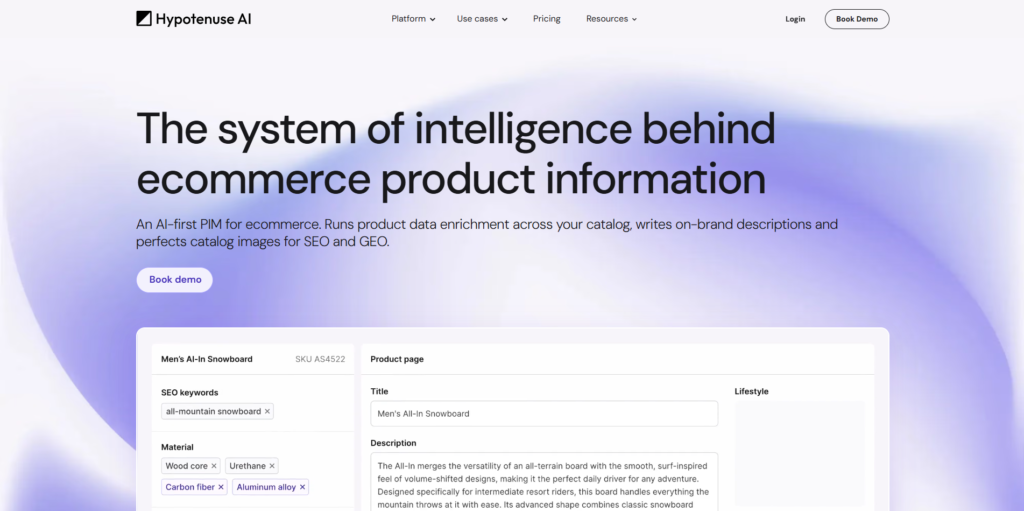
Hypotenuse AI is built for ecommerce and product marketing, generating descriptions, category copy, and bulk content with brand voice settings. It sits between a pure writing tool and a content operations platform.
For product pages that act as landing pages, it fits naturally.
What it does well: Bulk generation with brand voice settings, plus product attribute inputs that keep copy accurate. It handles multi-language output.
Where it falls short: It’s tuned for product content, so campaign landing pages with a story to tell need more manual shaping.
Best for: Ecommerce teams writing product-centered pages at scale.
Pricing: Paid plans, as of 2026. Verify credit allowances.
Writer: Best for Regulated and Enterprise Teams
Writer is an enterprise generative AI platform with style guide enforcement, its own Palmyra models, and governance controls. Its value isn’t flashy drafts. It’s keeping every page compliant and on-brand.
In finance, healthcare, or any industry with legal review, that matters more than clever phrasing.
What it does well: Style and terminology rules apply automatically, and admins control what the AI can and can’t say. It supports team-wide consistency at scale.
Where it falls short: It’s built for organizations, so individuals will find it heavy. Pricing is typically custom, which slows evaluation.
Best for: Large or regulated companies needing guardrails.
Pricing: Custom or enterprise pricing, as of 2026. Contact Writer for quotes.
Builder-integrated tools like Unbounce Smart Copy, Instapage, Leadpages, and Landingi cut the steps between draft and live page. Standalone tools like Jasper, Claude, and ChatGPT give you more control over voice and structure. Pick integration for speed, and pick standalone for quality.
Quick Comparison Table
| Tool | Best for | Lives inside a builder? | Brand voice control |
|---|---|---|---|
| Jasper | Brand-consistent campaigns | No | Strong |
| Copy.ai | Repeatable workflows | No | Moderate |
| Writesonic | SEO-driven pages | No | Moderate |
| Unbounce Smart Copy | In-builder drafting | Yes | Light |
| Instapage | Ad-matched pages | Yes | Light |
| Anyword | Variant prediction | No | Moderate |
| Leadpages | Small business speed | Yes | Light |
| Landingi | Multilingual pages | Yes | Light |
| Claude | Long briefs | No | Strong (via Projects) |
| ChatGPT | Fast iteration | No | Strong (via custom GPTs) |
| Copysmith | Bulk ecommerce | No | Modest |
| Rytr | Budget drafting | No | Light |
| Framer | Layout plus copy | Yes | Light |
| Hypotenuse AI | Product-led pages | No | Moderate |
| Writer | Enterprise governance | No | Very strong |
How to Write a Landing Page Brief That Gets Better Output
Give the tool five things: your audience, their problem, your offer, your proof, and your constraints. That one habit improves output more than switching tools.
Simple idea. Most people skip it anyway.
Here’s the process to use with any of these AI tools to write landing page copy:
- Define the single conversion goal. One page, one action. Say it plainly.
- Describe the reader. Role, situation, and what they’ve already tried.
- State the offer and the proof. Only real numbers, quotes, and logos.
- List objections. Price, time, trust, switching cost.
- Set constraints. Word limits, banned phrases, reading level, and tone.
- Ask for options, not one answer. Request five headlines and pick.
Then edit like a human. Cut filler. Replace vague claims with specifics. Read the hero aloud, and if you wouldn’t say it to a customer, rewrite it.
In our experience with Hotskill learners, the biggest jump in output quality comes from adding the objections list. Tools write far better proof sections once they know what the reader doubts.
A quick example. A weak brief says, “Write a landing page for our project management app.” A strong one says, “Write a hero for freelance designers who lose hours chasing client approvals. Offer: 14-day free trial. Proof: ‘Cut approval emails by half,’ from a named customer. Avoid the words ‘streamline’ and ‘solution.'” The second brief produces a page you can actually test.
A good landing page brief names the audience, the problem, the offer, real proof, and the reader’s objections. Adding objections is the single most useful upgrade, since it tells the tool what the reader doubts. Always ask for several options and edit the final choice yourself.
Conclusion
Here are the takeaways. Pick a tool that matches where you already work. Write a proper brief with proof and objections. And always edit the draft yourself.
If you only try three, start with Claude or ChatGPT for drafting, your builder’s native writer for speed, and Anyword when you need help choosing between variants. Those cover most needs, and you’ll know within a week whether a paid platform is worth it. Treat this list of the best AI landing page copy generators as a shortlist, then test two against the same brief on your own offer.
Today’s step: take your weakest landing page, write the five-part brief from above, and run it through two tools. Compare the headlines side by side.
Hotskill breaks down AI workflows like this in structured, bite-sized lessons built for busy marketers. Download the app on iOS or Android at hotskill.co/download.
FAQ
What is an AI landing page copy tool?
It’s software that writes landing page text from a short brief using a large language model. It drafts headlines, subheadings, benefit lists, and CTAs. Some tools sit inside page builders, while others are standalone writing apps or general chatbots.
Which tool is best for beginners?
ChatGPT or Rytr is the easiest starting point, since both are simple and low-cost. If you already use a page builder like Unbounce or Leadpages, start with its built-in writer. That way you skip copy-paste steps.
Claude vs ChatGPT for landing pages: what’s the difference?
Claude tends to follow long, layered briefs closely and write in a more natural register. ChatGPT is fast, flexible, and strong with custom assistants. Many marketers use both, drafting in one and tightening in the other.
Do I need coding skills to use these tools?
No. Every tool here works with plain-language instructions. Builder-based tools like Landingi or Framer also let you place copy visually, without touching code.
Can AI-written copy hurt my SEO?
Not by itself. Search engines care about helpfulness and accuracy, not who typed the words. Thin, generic, or inaccurate copy can hurt you, so edit for specifics and add real proof.
How do I stop AI copy from sounding generic?
Give the tool real details. Include customer language, specific numbers, and a list of phrases to avoid. Generic prompts produce generic pages. Then read the draft aloud and cut anything you wouldn’t say to a customer.
Why isn’t my tool giving me good results?
Usually the brief is too thin. Add your audience, their problem, your offer, proof, and objections. Also set constraints like word count and tone, and ask for several options instead of one.
Are paid tools worth it if I already have ChatGPT?
Sometimes. Paid platforms earn their cost through brand governance, team workflows, bulk generation, or builder integration. If you’re a solo marketer writing a few pages a month, a chatbot with a good brief is usually enough.
Can I use AI tools to write landing page copy for A/B tests?
Yes, and it’s one of the best uses. Ask for several headline angles, such as benefit-led, fear-led, and curiosity-led. Then test the two or three strongest against each other with real traffic.
How often should I update landing page copy?
Review it whenever your offer, audience, or traffic source changes, and at least quarterly. Check conversion data, then use AI to draft new variants against your current best performer.