

Most media buyers don’t have a tooling problem. They have a choice problem. Every platform now promises automated bidding, predictive budgets and one-click creative, and every demo looks the same. Meanwhile your CPA (cost per acquisition, the average amount you pay for each conversion) creeps up while you sit in a spreadsheet at 9pm.
This guide cuts through the noise. We ranked the Best AI Media Buying Tools by what they actually do for a working buyer in 2026: which ones manage budgets across channels, which ones generate and test creative, which ones fix your measurement, and which ones are mostly a good demo.
Media buying is the process of purchasing ad placements on channels like Meta, Google and programmatic networks to reach a target audience at the lowest workable cost. Whether you buy for an agency, a DTC brand or your own startup, each entry below covers what the tool does, where it shines, where it falls short, who it fits and what it costs.

What Does Media Buying Automation Actually Do?
It takes over the repetitive decisions: who sees your ad, how much you bid, where the budget goes and which creative runs. A human still sets the goal. The software handles thousands of small adjustments a day that nobody could do by hand.
AI-Powered Media Buying generally covers four jobs. Bid optimization means adjusting what you pay per auction in real time. Budget allocation means shifting spend toward campaigns that perform. Audience prediction means finding people likely to convert before they’ve shown intent. Creative testing means generating variations and scoring which ones work.
Here’s the catch. Automation magnifies whatever you feed it. Feed it clean conversion data and a clear target, and it’s excellent. Feed it messy tracking and a vague goal, and it burns budget faster than you could manually. That’s why the best AI Tools for Media Buying cover measurement and creative as well as bidding.
Automation in media buying handles bids, budgets, audiences and creative testing, but it only performs as well as the conversion data behind it. Buyers who fix tracking first and automate second consistently get better results than those who automate first.
How Do You Choose the Right Tool?
Start with your biggest bottleneck, not the longest feature list. If creative production is slowing you down, a creative generator beats a bidding engine. If you can’t trust your numbers, attribution comes before anything else.
Five questions narrow it down fast:
- Which channels do you buy on? A Meta-only team needs different tools than a team running CTV and retail media.
- What’s your monthly spend? Enterprise platforms often make no sense under a certain budget, because fees eat the gains.
- Do you need rules or machine learning? Rule-based tools do exactly what you tell them. Machine learning tools decide for you.
- How much control do you want? Platform-native automation is powerful but opaque.
- Who will run it? A tool nobody on your team understands gets switched off in a month.
When you shortlist AI Media Buying Software, ask for a trial or a pilot on one account before committing. Pricing in this article is indicative as of 2026, and vendors change plans often, so confirm on each site.
Meta Advantage+: Best for Social Prospecting at Scale
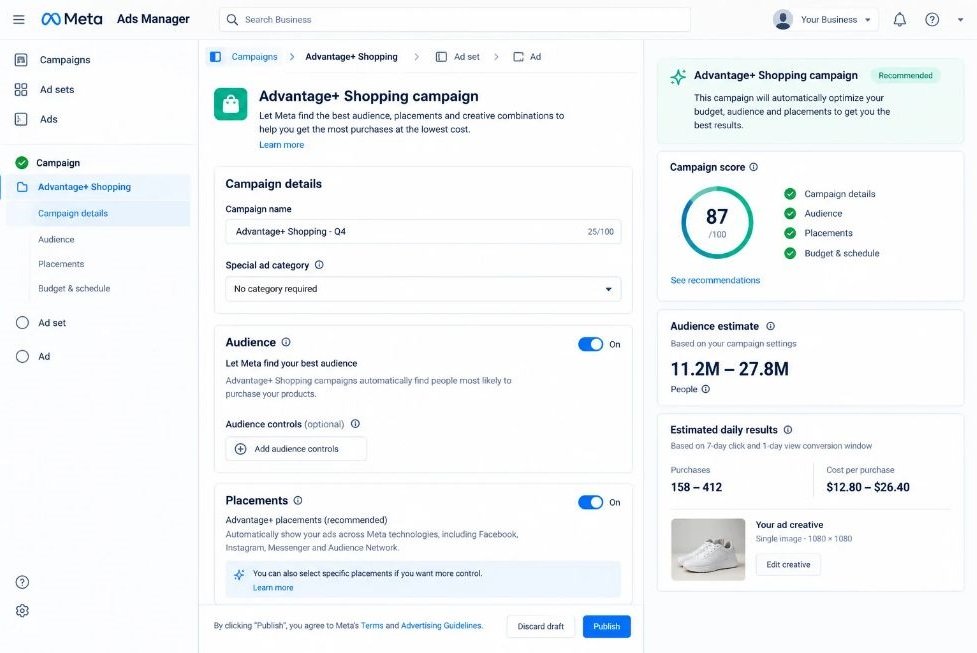
For most Meta advertisers, Advantage+ is the first automation worth switching on. Advantage+ is the suite of automated campaign types inside Meta Ads Manager, including Advantage+ Shopping and Advantage+ App campaigns, that handles targeting, placements and creative combinations for you.
What it does well: It finds buyers faster than manual interest targeting in most accounts we see, and it tests creative variations without you building every ad set. Meta’s own Business Help Center guidance says an ad set needs roughly 50 optimization events per week to exit the learning phase, so accounts with steady conversion volume benefit most.
Where it falls short: It’s a black box. Audience controls are limited, reporting by segment is thin, and a weak product feed or tracking setup quietly hurts results.
Best for: Ecommerce and app brands with consistent weekly conversions.
Pricing: Free to use. You pay for ad spend only (as of 2026).
Google Performance Max: Best for Cross-Channel Reach on Google
If you already buy on Google, Performance Max is the most capable native option. Performance Max (PMax) is a campaign type that runs ads across Search, YouTube, Display, Discover, Gmail and Maps from a single campaign, using Google’s machine learning to pick the channel and audience.
What it does well: One campaign covers the whole Google inventory, and Smart Bidding adjusts bids per auction using signals you can’t access manually. Add strong asset groups and first-party audience signals, and it often beats fragmented campaign structures.
Where it falls short: Channel-level transparency has improved but still lags standard Search. PMax can also cannibalize your branded search unless you add brand exclusions, which many accounts forget.
Best for: Retail, lead generation and local businesses with clean conversion tracking.
Pricing: Free. You pay for ad spend (as of 2026).
The Trade Desk Kokai: Best for Programmatic and Connected TV
Kokai is the right pick when your plan goes beyond walled gardens. A DSP (demand-side platform) is software that lets advertisers buy ad inventory across many websites, apps and streaming services in real time. Kokai is The Trade Desk’s current platform, built around its Koa AI to score impressions, recommend bids and plan audiences.
What it does well: It gives you scored, transparent inventory across the open internet and CTV (connected TV, meaning ads on streaming services), and its forecasting helps you plan reach before you spend.
Where it falls short: The learning curve is steep. Self-serve access is limited, and smaller budgets rarely justify the effort or the fees.
Best for: Agencies and brands with mid-to-large budgets across display, video and CTV.
Pricing: Fee based on spend, typically with managed-service minimums. Contact sales.
Platform-native tools such as Meta Advantage+, Google Performance Max and The Trade Desk Kokai automate bidding and targeting inside a single environment at little or no extra cost. They work best when you already have clean tracking and steady conversion volume, and they work worst when you need transparency into where your money went.
Madgicx: Best for Meta Advertisers Who Want a Control Layer
Madgicx adds analytics and automation on top of Meta Ads Manager. It’s a Meta-focused platform that pairs reporting dashboards with AI recommendations for budgets, audiences and creative.
What it does well: The creative insights view shows which images, hooks and formats drive results across your account, which Ads Manager makes tedious. Autonomous budget moves can save hours each week for lean teams.
Where it falls short: It’s mostly a Meta tool, so multi-channel teams will still need something else. And some AI recommendations are obvious to an experienced buyer.
Best for: Solo buyers and small DTC teams spending mainly on Meta.
Pricing: Subscription tiers scaled to monthly ad spend. Check current plans.
Smartly.io: Best for Enterprise Creative and Social Automation
Smartly.io is built for brands running big, multi-market social campaigns. It’s an advertising platform that automates creative production, campaign setup and budget allocation across Meta, TikTok, Pinterest, Snapchat and others.
What it does well: Dynamic creative templates turn product feeds into thousands of ads without a design bottleneck. Its budget tools shift spend between campaigns and channels based on performance, which is hard to manage manually at scale.
Where it falls short: It’s priced and designed for large advertisers. Setup takes time, and smaller teams won’t use enough of it to justify the cost.
Best for: Enterprise advertisers and agencies managing many accounts.
Pricing: Custom quotes, commonly tied to ad spend.
Bïrch (formerly Revealbot): Best for Rule-Based Automation
Bïrch is the tool for buyers who want control, not a black box. Rule-based automation means the software follows if-then instructions you write, such as pausing an ad set when its CPA passes a limit.
What it does well: Bulk ad launching, scheduled budget changes and custom rules across Meta, Google, TikTok and Snapchat. Honestly, for many accounts, a smart set of rules beats a vague AI recommendation because you know exactly why something changed.
Where it falls short: It’s more automation than machine learning, so it won’t discover audiences or strategies for you. Your rules are only as good as your thinking.
Best for: Performance buyers who know their numbers and want guardrails.
Pricing: Tiered plans based on ad spend (as of 2026, verify on the site).
Optmyzr: Best for Google and Microsoft Ads Optimization
Optmyzr is a PPC (pay-per-click) management platform focused on Google Ads and Microsoft Advertising. It surfaces optimization opportunities, runs rule-based automations and helps you manage budget pacing and bid strategies at account level.
What it does well: Its Rule Engine and optimization suggestions cut hours of audit work, and the reporting is strong enough for client-facing agencies. It also plays nicely with Google’s Smart Bidding rather than fighting it.
Where it falls short: It doesn’t cover social platforms, and the feature depth can overwhelm new users.
Best for: Search-heavy agencies and in-house PPC teams.
Pricing: Monthly plans that scale with managed ad spend, typically starting in the low hundreds of dollars.
Skai: Best for Omnichannel and Retail Media
Skai (formerly Kenshoo) targets large brands buying across search, social and retail media. Retail media means advertising on the sites of retailers such as Amazon, Walmart and Instacart, where shoppers are already close to buying.
What it does well: It unifies search, social and retail media planning and reporting in one place, which saves enterprise teams from stitching exports together. Its AI-driven bidding and budget tools are built for that cross-channel view.
Where it falls short: It’s an enterprise product with enterprise onboarding and pricing. Small teams will find it heavy.
Best for: Large brands and agencies with retail media in the mix.
Pricing: Custom enterprise quotes.
StackAdapt: Best Self-Serve Programmatic Platform
StackAdapt is the friendlier route into programmatic. It’s a self-serve DSP covering native, display, video, CTV, audio and digital out-of-home placements.
What it does well: Its machine learning bidding and audience prediction make programmatic approachable for teams without a trading desk. Native ads in particular perform well for content-led and B2B campaigns.
Where it falls short: Reporting depth takes some digging, and quality control on inventory needs your attention. It’s not a replacement for deep channel expertise.
Best for: Mid-size brands and agencies entering programmatic.
Pricing: Platform fee on spend, with minimums that vary. Ask sales for current terms.
Programmatic platforms like The Trade Desk Kokai and StackAdapt use machine learning to bid on impressions across the open internet and streaming. Kokai suits larger budgets and CTV-heavy plans, while StackAdapt offers a more approachable self-serve route for mid-size teams.
AdCreative.ai: Best for Fast Ad Creative Generation
AdCreative.ai solves the creative bottleneck. It generates ad images, banners and copy variations and assigns each a predicted performance score based on patterns from past ads.
What it does well: You can produce dozens of on-brand variations in minutes, then test the top scorers. For small teams without designers, that’s a real time saver.
Where it falls short: Outputs can look generic. And the predicted score is based on general data, not your own account history, so treat it as a hint, not a verdict.
Best for: Small businesses and freelancers who need volume fast.
Pricing: Monthly plans starting in the tens of dollars (as of 2026).
Pencil: Best for Predictive Creative Scoring on Your Own Data
Pencil, a generative ad platform from The Brandtech Group, goes further on creative intelligence. It generates ads and then predicts performance using models informed by your own historical ad data.
What it does well: Scoring against your brand’s account history is more useful than generic benchmarks. Teams can cut weak concepts before spending a cent on them, which protects budget.
Where it falls short: It needs a decent history of past ads to predict well, and it’s priced for brands rather than solo buyers.
Best for: Brands running high creative volume on social and video.
Pricing: Custom quotes.
Triple Whale: Best for Ecommerce Attribution
Triple Whale fixes the “which ad really worked?” argument. Attribution is the method of assigning credit for a sale to the ad, channel or touchpoint that influenced it.
What it does well: It connects to Shopify and your ad accounts, showing blended ROAS (return on ad spend, the revenue earned per dollar of ad spend) and cohort data in one view. Its Moby AI assistant answers questions about your numbers in plain language.
Where it falls short: It’s built for ecommerce, so lead-gen and B2B teams get less value. Attribution models still estimate, and no tool is perfect after iOS privacy changes.
Best for: Shopify and DTC brands that want one source of truth.
Pricing: Tiered by revenue or order volume, with a limited entry option at times. Verify current plans.
Cometly: Best for Server-Side Tracking and Conversion Sync
Cometly improves the data your ad platforms learn from. It tracks conversions on the server and sends cleaner events back to Meta, Google and others, so their algorithms optimize on better information.
What it does well: Better signal in means better optimization out. For accounts where browser tracking loses events, this can quietly lift performance without touching a single ad.
Where it falls short: It’s a data layer, not a media planner, so it won’t build campaigns for you. Implementation needs care to avoid duplicate events.
Best for: Lead-gen and ecommerce teams with tracking gaps.
Pricing: Tiered plans based on ad spend. Check the site for current rates.
TikTok Smart+: Best for Short-Video Performance Campaigns
TikTok Smart+ is TikTok’s automated campaign suite. It handles targeting, creative combination and budget distribution, while TikTok’s Symphony tools help generate video assets and scripts.
What it does well: It lowers the barrier to running TikTok ads. Strong creative plus automated delivery often finds pockets of cheap reach that manual setups miss.
Where it falls short: Creative fatigue (when audiences see the same ad too often and response drops) hits fast on TikTok. Automation can’t fix a weak hook.
Best for: Brands with an active short-video content process.
Pricing: Free to use. You pay for ad spend (as of 2026).
Amazon DSP: Best for Retail and Shopper Audiences
Amazon DSP is for brands that sell on or near Amazon. It lets you buy display, video, audio and streaming placements, both on Amazon properties and across the web, using Amazon’s shopper signals.
What it does well: Shopper audiences built from real purchase behavior are hard to match elsewhere. Amazon’s AI-assisted audience and bidding tools help you reach people at different stages of the buying path.
Where it falls short: It’s complex, fees add up, and the benefits tilt toward advertisers whose products actually sell through Amazon.
Best for: Marketplace sellers and consumer brands with retail media goals.
Pricing: Fee on spend, with minimums that have shifted over time. Check current terms.
Quick Comparison Table
| Tool | Main Strength | Channels | Cost Model |
|---|---|---|---|
| Meta Advantage+ | Social prospecting | Meta | Free (ad spend) |
| Google Performance Max | Cross-channel Google reach | Free (ad spend) | |
| The Trade Desk Kokai | Programmatic and CTV | Open internet | Fee on spend |
| Madgicx | Meta control layer | Meta | Subscription |
| Smartly.io | Enterprise social automation | Multiple social | Custom |
| Bïrch | Rule-based control | Multiple | Subscription |
| Optmyzr | Search optimization | Google, Microsoft | Subscription |
| Skai | Omnichannel and retail media | Multiple | Custom |
| StackAdapt | Self-serve programmatic | Open internet | Fee on spend |
| AdCreative.ai | Creative generation | Multiple | Subscription |
| Pencil | Predictive creative | Social and video | Custom |
| Triple Whale | Ecommerce attribution | Multiple | Subscription |
| Cometly | Server-side tracking | Multiple | Subscription |
| TikTok Smart+ | Short-video automation | TikTok | Free (ad spend) |
| Amazon DSP | Shopper audiences | Amazon and web | Fee on spend |
Which Tool Should You Start With?
Start with the free native automation on the platform where you spend the most, then add one tool that fixes your biggest bottleneck. Don’t buy five tools at once.
Here’s how that plays out. A solo Shopify founder spending mostly on Meta should switch on Advantage+, then add Triple Whale for measurement and AdCreative.ai for volume. A search-heavy agency should use Performance Max and Smart Bidding, then add Optmyzr for account-level control. An enterprise team running CTV and retail media should look at Kokai, Skai and Amazon DSP.
For most buyers, the Best AI Tools for Media Buyers aren’t the fanciest. They’re the ones that remove a specific weekly headache. And the move toward AI-Powered Media Buying rewards teams that stay in the loop: set the goal, check the output, and step in when the numbers drift.
Conclusion
The Best AI Media Buying Tools share one trait: they fix a specific problem you actually have. Native platforms like Advantage+, Performance Max and TikTok Smart+ give you free automation. Programmatic tools extend your reach. Creative and attribution tools make sure the machines learn from good data and good ads.
Your next step is simple. Open the ad account where you spend most, check that your conversion tracking is clean, and turn on one native automation as a test this week. Then pick one paid tool from this list that targets your biggest bottleneck, and run it against your current setup for a month.
Want to build these skills properly instead of piecing them together from tool demos? Hotskill teaches AI workflows for advertising in structured, bite-sized lessons built for busy professionals. Download the app on iOS or Android at hotskill.co/download.
Frequently Asked Questions
What is media buying, and how does AI change it?
Media buying is the purchase of ad space across channels to reach a target audience. AI changes the daily work by automating bids, budget moves, audience selection and creative testing. You still define the goal and judge the results, but the repetitive optimization happens automatically.
Can AI replace a human media buyer?
No, not for anything beyond small, simple accounts. AI handles execution well, but humans set strategy, judge brand fit, spot tracking errors and decide what to test next. The strongest results come from buyers who direct the tools rather than hand over control.
How is a DSP different from Meta Ads Manager?
Meta Ads Manager buys inventory only on Meta’s own apps. A DSP such as The Trade Desk Kokai or StackAdapt buys across thousands of sites, apps and streaming services. DSPs offer broader reach and more control, but they need bigger budgets and more expertise.
Which tool is best for a small ecommerce brand?
Most small stores should start with Meta Advantage+ and Triple Whale, then add a creative generator like AdCreative.ai if production is slow. This stack covers delivery, measurement and creative without enterprise pricing. It also fits the Best AI Tools for Media Buyers shortlist for lean teams.
How much should I budget for these platforms?
Native tools from Meta, Google and TikTok are free beyond ad spend. Mid-tier platforms usually run from tens to a few hundred dollars monthly. Enterprise AI Media Buying Software is quoted individually and often tied to a percentage of spend, so expect a sales conversation.
Do I need to know how to code to use these tools?
No. Nearly every tool here works through a visual interface. Coding helps with custom reporting or Google Ads scripts, but it isn’t required. Most AI Tools for Media Buying are designed for marketers, not developers.
Why isn’t automation improving my ad results?
Usually the cause is data, not the algorithm. Check that conversion events fire correctly, that you have enough weekly conversions for the platform to learn, and that your creative is fresh. Switching tools rarely fixes a broken tracking setup.
Do I need a third-party tool if I already use Meta and Google automation?
Not always. If you buy on one or two platforms and your tracking is solid, native automation may be enough. Third-party tools earn their place when you need cross-channel reporting, better attribution, faster creative production or more control than the platforms allow.
How do I know if a tool is actually working?
Run a controlled test. Keep one comparable campaign managed your usual way and another using the tool, then compare CPA, ROAS and time spent over at least four weeks. If results are equal, the tool needs to save you meaningful hours to be worth it.
How many tools should one team use at the same time?
Two or three is usually the limit. One platform for delivery, one for measurement and perhaps one for creative covers most needs. More than that, and overlapping dashboards create conflicting numbers and wasted subscriptions.