
Introduction
You’ve seen them — those little chat bubbles asking, “Need help with anything?” Usually ignorable. But behind that tiny prompt, something much bigger is happening.
AI chatbots have quietly become one of the strongest tools in modern digital marketing. What started as basic helpdesk automation has evolved into intelligent digital assistants that:
- Remember users
- Track behavior
- Suggest relevant actions
- Know when to step back
Today’s customers want fast, personal responses — 24/7.
Not form emails. Not hold music.
When implemented correctly, AI chatbots sit perfectly in the middle:
personal but not pushy, fast but not careless, helpful without crossing trust boundaries.
And here’s the real win:
Chatbots aren’t just about saving support time — they’re about building trust at scale.
This guide explores:
- What AI chatbots are
- Why they work in marketing
- Where they fail
- How to use them without damaging your brand
What Are AI Chatbots?
Let’s simplify it.
AI chatbots are software programs designed to communicate like humans across:
- Websites
- Mobile apps
- Social media DMs
- Messaging platforms
- Voice interfaces
They run non-stop. No breaks. No distractions.
Their intelligence comes from Natural Language Processing (NLP) — allowing bots to understand slang, typos, emojis, and casual phrasing.
Types of AI Chatbots
1. Rule-Based Chatbots
- Follow fixed logic trees
- Respond with predefined answers
- Best for FAQs, store hours, refund policies
2. AI-Driven Chatbots
- Learn from user behavior
- Identify intent
- Improve over time
- Handle complex conversations
Think of them as a fast-learning intern who never sleeps.
Used across retail, finance, healthcare, SaaS, education, these bots can integrate with CRMs, email tools, analytics platforms — even AR experiences.
And businesses invest in them for one reason: results.
Benefits of Using AI Chatbots in Marketing
AI chatbots aren’t about trends. They’re about meeting modern expectations.
Key Benefits
1. Higher Customer Engagement
Bots analyze clicks, pauses, and browsing behavior, then respond accordingly.
Less billboard. More personal shop assistant.
2. 24/7 Availability
Late-night shoppers? Global audiences?
Bots never clock out.
3. Real Personalization
Not “Hi there,” but:
“Hey Sarah, still comparing hiking boots? These are on sale.”
This level of relevance directly improves conversions.
4. Scalable Without Extra Hiring
One chatbot can manage thousands of conversations daily — cost-efficient and consistent.
5. Actionable Customer Insights
Every conversation reveals:
- User intent
- Pain points
- Drop-off triggers
- Content gaps
That data feeds marketing, product, and ad strategy.
Reality check: ~80% of routine queries can be handled by chatbots, freeing humans for high-value conversations.
Applications of AI Chatbots in Marketing
AI chatbots plug into nearly every buyer touchpoint.
Common Use Cases
- Lead Generation & Qualification
Bots ask qualifying questions and route high-intent leads to sales teams. - Customer Support Automation
Order tracking, refunds, payments, FAQs — solved instantly. - Product Recommendations & Upselling
Smart, real-time suggestions based on past behavior. - Events & Webinar Management
Registrations, reminders, follow-ups, surveys — fully automated. - Social Media DM Handling
Instagram, Facebook, WhatsApp — bots reply, qualify, and convert.
From college admissions to insurance claims, if there’s a conversation, there’s a chatbot use case.
How to Implement AI Chatbots in Your Marketing Strategy
Step-by-Step Framework
1. Define a Clear Objective
Ask:
What should this chatbot achieve?
- Lead capture
- Support reduction
- Conversion uplift
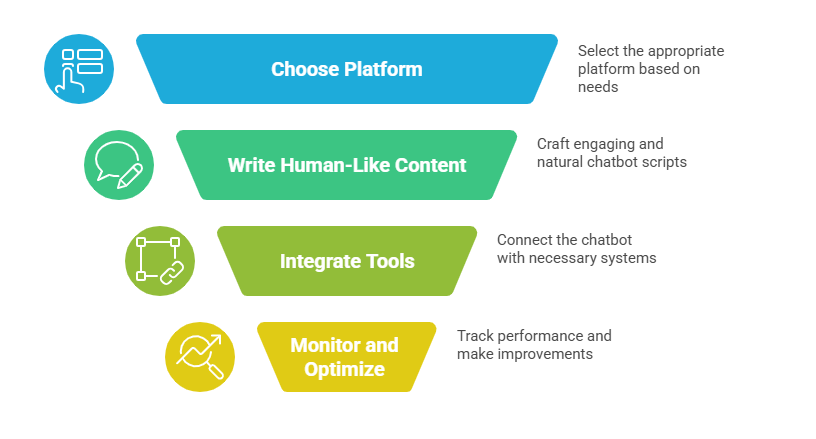
2. Choose the Right Platform
- Small teams: ManyChat
- Advanced use: Drift, Intercom
Scalability matters.
3. Write Like a Human
- Anticipate real questions
- Use friendly language
- Avoid robotic scripts
4. Integrate Your Tools
Connect the chatbot with:
- CRM (Salesforce)
- Email (Mailchimp)
- Analytics
The goal is a connected experience.
5. Monitor & Optimize
Track:
- Chat completion rates
- Drop-off points
- Click-throughs
Test greetings, tone, and flows continuously.
And yes — give your bot a name and personality. People know it’s AI, but tone still matters.
Challenges & Limitations of AI Chatbots
Chatbots aren’t magic. Here’s where things break.
Common Challenges
- Context Misunderstanding
Sarcasm or frustration can confuse bots — escalations must be easy. - Over-Automation
Too many bot interactions = cold brand experience. - Data Privacy Risks
Compliance (GDPR, HIPAA) is non-negotiable. - Ongoing Maintenance Required
Bots need updates, retraining, and bug fixes.
Rule of thumb:
Automation should assist people, not replace empathy.
Future Trends of AI Chatbots in Marketing
What’s coming next?
Emerging Trends
- More Natural Conversations
Advanced NLP will handle informal language better. - Voice-Based Chatbots
Voice assistants integrated into customer support and commerce. - AR / VR Integration
Virtual assistants in online stores and virtual campuses. - Predictive Assistance
Bots proactively suggesting offers, reminders, and refills.
Chatbots are shifting from reactive to predictive experiences.
Case Studies: AI Chatbots That Worked
Successful Examples
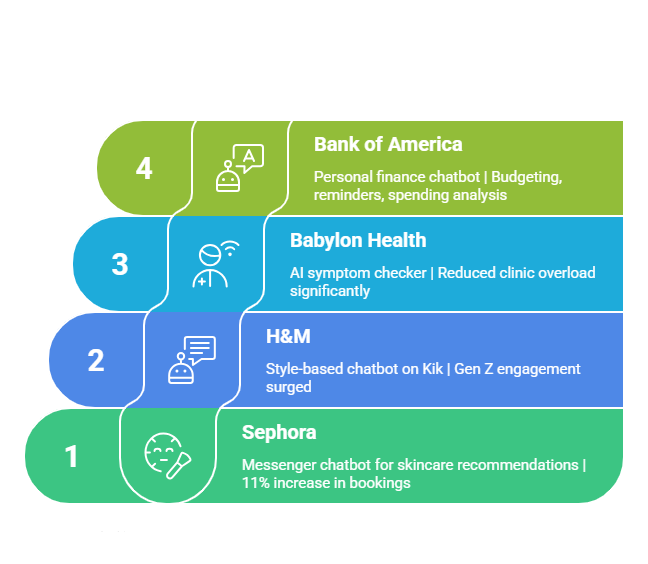
1. Sephora
- Messenger chatbot for skincare recommendations
- Result: 11% increase in bookings
2. H&M
- Style-based chatbot on Kik
- Gen Z engagement surged
3. Babylon Health
- AI symptom checker
- Reduced clinic overload significantly
4. Bank of America (Erica)
- Personal finance chatbot
- Budgeting, reminders, spending analysis
When chatbots solve real problems, users rely on them — not avoid them.
Conclusion
AI chatbots in marketing are no longer optional — they’re a competitive advantage.
The best ones:
- Feel natural
- Reduce friction
- Support trust
- Drive measurable growth
But success depends on empathy, clarity, and continuous improvement.