

Email marketing hasn’t died. If anything, it’s gotten smarter. And honestly, a little more intimidating.
With inboxes getting more crowded and attention spans shrinking, guessing what works is no longer enough. You need data. You need iteration. And increasingly, you need AI.
That’s where AI email A/B testing tools come in. They don’t just test subject lines anymore. They analyze behavior, predict outcomes, personalize content, and sometimes even make decisions for you in real time. It’s kind of wild when you think about it.
In this guide, I’ll walk you through 10 of the best tools available right now, what makes them different, and how you can actually use them in your campaigns. Not just features, but practical insights too.
What Are AI Email A/B Testing Tools?
Before we dive into tools, let’s quickly align on what we mean here.
Traditional A/B testing tools let you test two versions of an email. You split your audience, send version A to one group and version B to another, and then pick a winner based on open rates or clicks.
AI email A/B testing tools go several steps further.
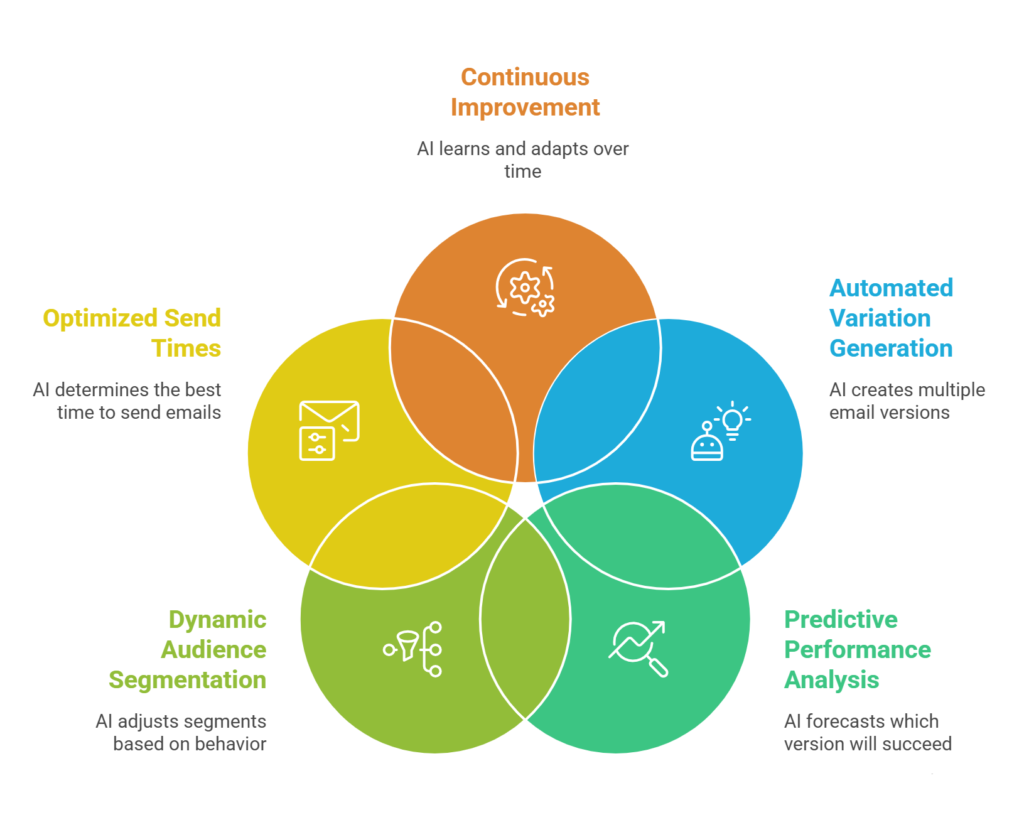
They can automatically generate variations, predict which version will perform best, segment audiences dynamically, and even optimize send times based on user behavior. Some tools continuously test and adapt, instead of stopping after one experiment.
It’s less about running tests… and more about building a self-improving system.
Why Marketers Are Shifting to AI-Driven Testing
There’s a reason why AI-powered tools are becoming the default, not the exception.
Manual A/B testing is slow. It requires planning, waiting, analyzing, and then repeating. By the time you find a winning variation, your audience behavior may have already changed.
AI compresses that cycle dramatically.
It can test multiple variables simultaneously, identify patterns humans might miss, and optimize campaigns in real time. Also, let’s be honest, it removes a lot of the guesswork that marketers pretend they enjoy.
And if you’re managing large lists or multiple campaigns, it’s almost impossible to scale testing manually.
10 Best AI Email A/B Testing Tools for Marketers
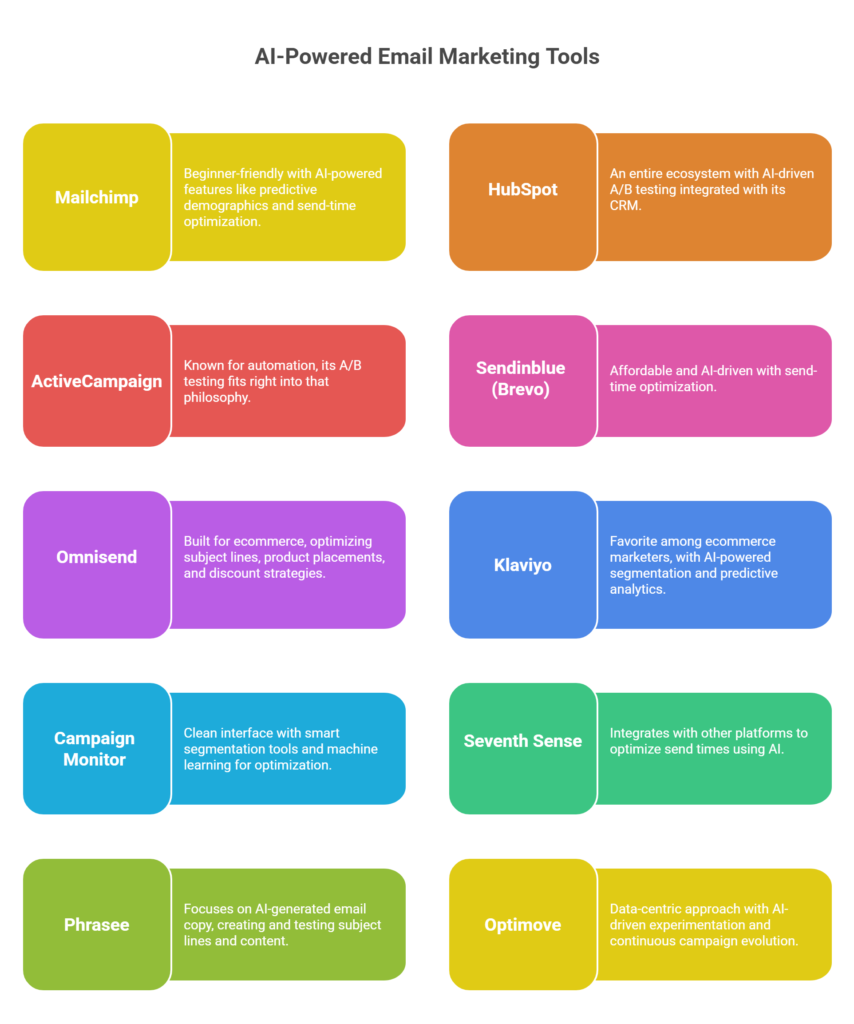
Now let’s get into the tools themselves. I’ve tried to cover a mix of enterprise platforms, SMB-friendly tools, and a few that are more experimental or AI-heavy.
1. Mailchimp
Mailchimp has evolved quite a bit from being a beginner-friendly email tool to something much more sophisticated.
Its AI-powered features, especially predictive demographics and send-time optimization, make it a strong contender for marketers who want automation without complexity.
Mailchimp’s A/B testing capabilities allow you to test subject lines, content, sender names, and send times. But where it gets interesting is its AI recommendations. The platform suggests winning combinations based on past campaign performance, which saves a lot of time.
What I personally find useful is its ability to automatically select a winner and send it to the remaining audience. It’s simple, but effective.
For small to mid-sized businesses, this tool strikes a nice balance between usability and intelligence.
2. HubSpot
HubSpot is more than just an email marketing tool. It’s an entire ecosystem.
Its AI-driven A/B testing is deeply integrated with its CRM, which means your tests are informed by rich customer data. That’s a big advantage.
You can test different email elements, but more importantly, HubSpot uses machine learning to optimize content personalization. It understands user behavior across touchpoints, not just emails.
Another thing worth mentioning is adaptive testing. Instead of running fixed tests, HubSpot can continuously refine content based on performance signals.
It’s ideal for teams that want data-driven insights tied directly to revenue outcomes.
3. ActiveCampaign
ActiveCampaign is known for its automation capabilities, and its A/B testing fits right into that philosophy.
What makes it stand out is the ability to test entire automation workflows, not just individual emails. You can experiment with different sequences, delays, and messaging paths.
Its predictive sending feature uses AI to determine the best time to send emails to each contact. This alone can significantly improve open rates.
There’s also conditional content, which allows you to personalize email elements dynamically based on user data. It’s not exactly A/B testing in the traditional sense, but it achieves similar outcomes.
If you’re into automation-heavy strategies, this tool is incredibly powerful.
4. Sendinblue (now Brevo)
Sendinblue, now rebranded as Brevo, has quietly become a strong player in the AI-driven email space.
Its A/B testing features are fairly standard on the surface, allowing you to test subject lines and content. But the AI-powered send-time optimization adds a layer of sophistication.
It analyzes past engagement data to determine when each user is most likely to open emails.
The platform is also quite affordable compared to competitors, which makes it appealing for startups and smaller teams.
While it may not have the most advanced AI capabilities, it delivers solid performance for the price.
5. Omnisend
Omnisend is built specifically for ecommerce, and that focus shows in its features.
Its A/B testing capabilities are tailored for promotional emails, product recommendations, and cart recovery campaigns.
The AI engine helps optimize subject lines, product placements, and even discount strategies. It learns from customer purchase behavior, which makes the tests more relevant.
What’s interesting is its ability to combine email with SMS and push notifications in testing workflows.
For ecommerce brands, this multi-channel approach can lead to significantly better results.
6. Klaviyo
Klaviyo is another favorite among ecommerce marketers, and for good reason.
Its AI-powered segmentation and predictive analytics make A/B testing much more precise. Instead of testing broadly, you can run experiments on highly specific audience segments.
Klaviyo also provides detailed insights into revenue impact, not just engagement metrics. That’s crucial if you’re focused on ROI.
The platform’s predictive models can estimate customer lifetime value and churn risk, which can inform your testing strategy.
It’s a bit more advanced, so there’s a learning curve, but the payoff can be significant.
7. Campaign Monitor
Campaign Monitor offers a clean and intuitive interface, but don’t let that simplicity fool you.
Its A/B testing features allow you to experiment with subject lines, sender names, and email designs. The platform also includes smart segmentation tools that enhance test accuracy.
While it doesn’t lean as heavily into AI as some others, it does incorporate machine learning for performance insights and optimization suggestions.
It’s a good option if you want something straightforward but still effective.
8. Seventh Sense
Seventh Sense is a bit different from the others on this list.
Instead of being a full email marketing platform, it integrates with tools like HubSpot and Marketo to optimize send times using AI.
It analyzes individual recipient behavior to determine the best time to send each email. This can dramatically improve engagement rates.
While it doesn’t handle traditional A/B testing in isolation, it enhances testing outcomes by ensuring emails are delivered at the optimal moment.
In a way, it’s like adding a layer of intelligence on top of your existing system.
9. Phrasee
Phrasee focuses specifically on AI-generated email copy.
It uses natural language generation to create and test subject lines, headlines, and email body content. The platform continuously learns which language patterns drive engagement.
What’s fascinating is how it combines copy generation with A/B testing. Instead of you coming up with variations, the AI does it for you.
And honestly, sometimes it comes up with ideas you wouldn’t think of.
It’s particularly useful for brands that send large volumes of emails and need constant variation.
10. Optimove
Optimove takes a more advanced, data-centric approach to email marketing.
Its AI-driven experimentation framework allows for continuous testing across multiple variables. It doesn’t just pick winners. It evolves campaigns over time.
The platform also focuses heavily on customer segmentation and lifecycle marketing. This means your tests are always context-aware.
Optimove’s predictive models help identify the best messaging strategies for different customer groups.
It’s more suited for enterprise teams, but the level of sophistication is impressive.
How to Choose the Right Tool for Your Needs
Choosing the right tool isn’t just about features. It’s about fit.
If you’re a small business, something like Mailchimp or Brevo might be enough. They’re easy to use and provide decent AI capabilities.
If you’re running complex campaigns or managing large datasets, tools like HubSpot or Optimove make more sense.
And if your focus is on ecommerce, Klaviyo or Omnisend are probably better aligned with your needs.
It’s also worth considering integration. Your email tool should work seamlessly with your CRM, analytics platforms, and other marketing tools.
Practical Tips for Using AI in Email A/B Testing
Even with the best tools, results don’t magically happen.
You still need a strategy.
Start by defining clear goals. Are you trying to improve open rates, click-through rates, or conversions?
Then focus on one variable at a time, at least initially. AI can handle complexity, but clarity helps you understand what’s actually working.
Also, don’t completely rely on automation. AI is powerful, but it’s not perfect. Sometimes human intuition still matters.
And finally, keep testing. The biggest mistake marketers make is stopping after one successful experiment.
The Future of Email Testing Looks… Autonomous
We’re moving toward a world where email campaigns optimize themselves.
AI will handle testing, segmentation, personalization, and even content creation. Marketers will focus more on strategy and creativity.
That said, there’s still a need for human oversight. AI can optimize for metrics, but it doesn’t always understand brand voice or long-term strategy.
So maybe the future isn’t fully automated. Maybe it’s a collaboration between human insight and machine intelligence.
Final Thoughts
AI email A/B testing tools are no longer optional. They’re becoming essential.
Whether you’re running a small newsletter or managing enterprise-level campaigns, these tools can help you make smarter decisions faster.
The key is to start experimenting. Pick a tool, run tests, analyze results, and iterate.
Because at the end of the day, email marketing is still about connection. AI just helps you get there more efficiently.
And maybe, just maybe, with fewer guesswork-filled nights staring at open rate reports.