
Let’s be honest—getting attention online is tough. People scroll fast, skim faster, and bounce even quicker. So when someone actually opens Google and types a search like “affordable SEO agency” or “best coffee grinder,” you want your ad right there—top of the page, front and center.
That’s exactly what Google Ads is designed for.
Google Ads isn’t just about showing ads. It’s about catching users at the moment of intent—when they’re researching, comparing, or ready to buy.
But here’s where many advertisers go wrong:
💸 Spending more doesn’t guarantee better results.
If your ads aren’t relevant, you’ll pay more and get less.
That’s where Quality Score comes in.
Your Quality Score affects:
- Where your ad appears
- How much you pay per click
- Whether your ad shows at all
Higher Quality Score = lower CPC + better visibility
If you’re spending even ₹1 on Google Ads, improving Quality Score should be a top priority.
Let’s break down how to do it—step by step.
Types of Google Ads Campaigns
Before optimization, you need clarity on which campaign type you’re using. Google Ads offers different formats depending on your goals.
Main Google Ads Campaign Types
- 🔎 Search Network Campaigns
Text ads triggered by user searches like “local plumber” or “best CRM software.” - 🖼️ Display Network Campaigns
Banner and image ads across websites, apps, and Gmail—great for awareness. - 🎥 Video Campaigns (YouTube Ads)
Powerful for storytelling, demos, and emotional hooks. - 🛍️ Shopping Campaigns
Ideal for ecommerce—shows products, prices, and images directly in search. - 📱 App Campaigns
Designed to promote mobile apps across Google Search, YouTube, Play Store, and more.
📌 Important:
Quality Score impacts every campaign type. The higher it is, the more efficient your ad spend becomes.
Setting Up a Google Ads Account
A strong Quality Score starts with a solid foundation.
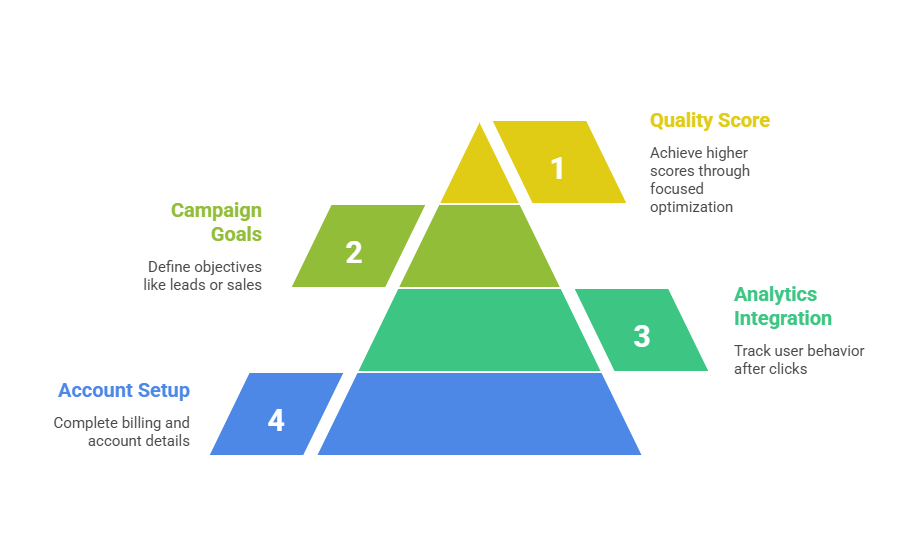
Google Ads Setup Checklist
- Create your account
Visit ads.google.com and complete billing and account details. - Link Google Analytics
Seeing clicks is good—but knowing what users do after clicking is where the real insights live. - Define clear campaign goals
Ask yourself:- Are you driving leads?
- Increasing sales?
- Building awareness?
🎯 Pro Tip:
Write down what success looks like before launching:
- “100 leads per month”
- “40 sales within 30 days”
Clear goals = focused optimization = higher Quality Score.
Keyword Research and Selection
Keywords are the backbone of Quality Score.
They tell Google—and your audience—what your ad is actually about.
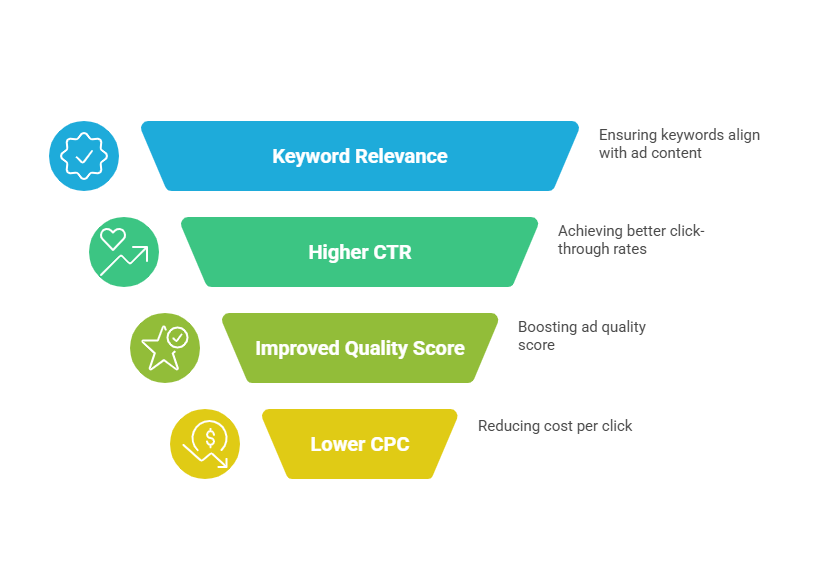
Why Keywords Matter for Quality Score
✔ Relevant keywords → higher CTR
✔ Higher CTR → better Quality Score
✔ Better Quality Score → lower CPC
✔ Lower CPC → higher ROI
That’s the chain reaction.
How to Choose the Right Keywords
- Use tools like:
- Google Keyword Planner
- SEMrush
- Ahrefs
- Focus on intent-driven keywords
- Prefer long-tail keywords (more specific, less competition)
Example:
❌ “dishwasher”
✅ “compare countertop dishwashers”
Keyword Match Types
- Broad Match – Large reach, less control
- Phrase Match – Balanced targeting
- Exact Match – High relevance, strong intent
- Negative Keywords – Prevent waste (e.g., “free,” “jobs,” “cheap”)
Clean keyword targeting sets the tone for your entire campaign.
Writing Effective Ad Copy
Perfect grammar doesn’t sell—clarity and relevance do.
People decide whether to click in seconds.
How to Write High-CTR Ad Copy
- Headlines
- Ask questions
- Address pain points
- Make bold yet believable promises
- Descriptions
- Keep it concise
- Highlight benefits, not features
- Tell users why to click
- Display URL
- Reinforce keyword relevance
- Example:
yourbrand.com/SEO-Services
- Ad Extensions
- Sitelinks
- Callouts
- Structured snippets
📌 Why this matters:
Google rewards ads that people actually click—with higher Quality Scores.
Write like you’re talking to one person, not an audience of thousands.
Bidding Strategies and Budgeting
High bids don’t win—relevance does.
Google often prefers ads with:
✔ Better Quality Scores
✔ Higher CTR
✔ Stronger landing pages
Bidding Options
- Manual CPC – Full control, requires monitoring
- Automated Bidding – Google optimizes based on goals:
- Maximize Conversions
- Target CPA
- Target ROAS
Smart Budgeting Tips
- Start with a test budget
- Review spend weekly
- Shift budget toward high-converting keywords
- Pause keywords that burn money without returns
💡 A $3 keyword generating ₹3,000 revenue beats a $10 keyword with zero conversions.
Targeting Options in Google Ads
Even great ads fail when shown to the wrong people.
Key Targeting Controls
- 📍 Location Targeting
Show ads only where you sell. - 🌍 Language Targeting
Simple but often overlooked. - 🎯 Audience Targeting
- Demographics
- Interests
- Remarketing audiences
- 📱 Device Targeting
Adjust bids by device performance.
Refine often. Small tweaks can dramatically improve Quality Score.
Monitoring and Optimizing Campaigns
Launching an ad ≠ finishing the work.
Metrics to Monitor Regularly
- CTR – Low CTR = relevance issue
- CPC – Rising CPC = Quality Score may be falling
- Conversion Rate – Landing page alignment issue
- Quality Score – Your campaign health check
Optimization Best Practices
- Run A/B tests continuously
- Test landing pages
- Update negative keywords
- Shift budget to top performers
Weekly analysis beats monthly panic.
Common Google Ads Mistakes to Avoid
Avoid these budget killers:
- ❌ Targeting keywords without intent
- ❌ Ignoring negative keywords
- ❌ Running ads without conversion tracking
- ❌ Spending big with unclear goals
Google won’t protect your budget—you have to.
Advanced Google Ads Techniques
Once you’ve nailed the basics, level up.
Advanced Tactics
🚀 Remarketing
Re-engage visitors who didn’t convert.
🚀 Dynamic Search Ads
Automatically match ads with site content.
🚀 Customer Match
Upload email lists to reach existing users.
🚀 Google Tag Manager + Looker Studio
Track deeper user behavior and trends.
These are especially powerful for competitive or regulated industries.
Conclusion
If there’s one takeaway, it’s this:
Quality Score changes everything in Google Ads.
It’s not magic—it’s fundamentals done consistently well.
✔ Intent-based keywords
✔ Human-focused ad copy
✔ Smart targeting
✔ Continuous optimization
Lower costs. Better clicks. Higher conversions.
High Quality Scores aren’t badges—they’re shortcuts to results.
So don’t just run ads.
Build pathways.
Make it easy for people to find what they’re already searching for.
That’s great marketing—and that’s how you start winning. 🚀