

Marketing in the property sector has undergone a profound transformation over the last decade. Traditional methods such as print advertising, billboards, and in-person networking remain relevant, but they no longer dominate the customer acquisition journey. Buyers now begin their property search online, compare agents through social platforms, and evaluate listings via mobile devices before ever scheduling a viewing. Studies show that as many as 96% of home buyers start their search online, highlighting how central digital engagement has become to property transactions.
This shift has forced agencies, brokers, and independent professionals to rethink how they allocate marketing budgets. Instead of investing heavily in offline tactics, modern organizations devote significant resources to online channels, analytics, and automation. In fact, more than half of real estate marketing budgets are already directed toward digital channels, and this share is expected to continue rising in the coming years.
Budgeting for marketing campaigns is therefore not just about deciding how much to spend. It involves aligning business objectives, forecasting returns, balancing short-term lead generation with long-term brand building, and adjusting investment across channels as market conditions change. This article provides a comprehensive, actionable guide to planning and managing budgets for property marketing initiatives in today’s competitive environment, helping professionals maximize visibility and return on investment while minimizing waste.
Understanding the Role of Real Estate Digital Marketing
Budget planning begins with understanding why digital outreach has become indispensable in the property sector. Buyers and sellers interact with brands through search engines, social media feeds, listing platforms, and email communication, often engaging with multiple touchpoints before making decisions. Digital engagement has been shown to drive substantially more website traffic compared with traditional methods, while also generating a meaningful share of qualified leads.
Because of these outcomes, the industry has significantly increased its reliance on online promotion. Digital channels account for more than half of total marketing spending among agents and brokers, with projections indicating further expansion in the near future. The growth reflects the ability of online tools to offer precise targeting, measurable results, and flexible cost structures. Compared with static advertising, marketers can analyze metrics such as conversion rates, acquisition costs, and engagement levels to refine strategy in real time.
Within the body of property promotion, the concept of Real Estate Digital Marketing emerges as a comprehensive framework integrating search optimization, paid advertising, content production, social engagement, and automated communication tools. Its effectiveness lies in combining visibility, personalization, and analytics to nurture prospects throughout the buying or selling journey. Agencies that structure budgets around this integrated approach tend to outperform competitors that rely on isolated or reactive spending.
Determining the Overall Marketing Budget
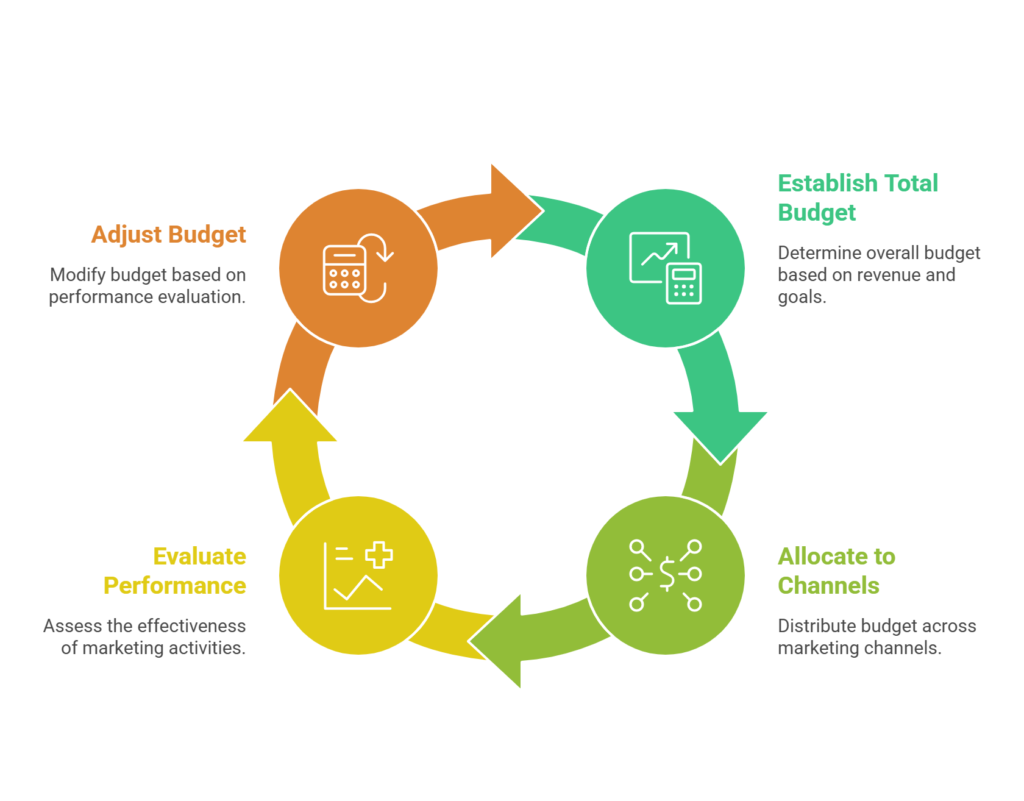
Before allocating funds to individual channels, organizations must establish the total marketing budget relative to revenue or growth ambitions. Benchmarks suggest that established real estate agencies commonly dedicate between 7% and 10% of their gross commission income to marketing activities. Businesses aiming for rapid expansion or operating in highly competitive markets may invest as much as 15% to 20%, while boutique operations might spend less.
General marketing research reinforces this proportional approach, indicating that companies in many industries allocate roughly 5% to 15% of revenue to promotional initiatives, with startups often investing at the higher end to establish brand recognition. This perspective highlights that budget size should reflect strategic objectives rather than arbitrary figures. Organizations seeking stability may maintain moderate spending levels, whereas those pursuing aggressive growth must prepare to invest more heavily.
Market conditions also influence spending levels. Rising marketing costs and increased competition have led many companies to shift toward higher investment tiers compared with previous years. A growing share of firms now allocate between $1,000 and $5,000 or more per month toward digital campaigns, illustrating how industry expectations continue to evolve.
By evaluating revenue, competition, and strategic ambitions together, decision makers can establish a realistic budget baseline before distributing funds across channels.
Allocating Funds Across Digital Channels
After determining the total budget, the next step is deciding how to divide resources among online marketing activities. Strategic allocation is essential because each channel serves different purposes and delivers distinct performance patterns. Benchmarks across industries suggest typical percentage distributions for digital spending, including strong investment in search optimization, paid advertising, social promotion, and content creation.
For instance, guidance shows that organizations frequently allocate about one quarter of their digital budgets to search optimization efforts focused on improving organic visibility, another significant portion to pay-per-click advertising for immediate reach, and remaining funds across social, content, and email initiatives. Comparable ranges indicate that SEO often receives between 20% and 30% of investment, while PPC may command 25% to 35%, reflecting its role in generating fast traffic and measurable conversions.
Contemporary marketing frameworks also recommend balancing resources between paid search, social advertising, content development, and automation technologies to maintain both acquisition and retention momentum. The emphasis is not on rigid adherence to percentages but on adjusting allocations according to performance indicators and business priorities.
Effective budget distribution recognizes that no single channel can achieve every objective. Search strategies build long-term authority, paid ads produce rapid exposure, social platforms enhance brand recognition, and email systems sustain customer relationships. Allocating resources thoughtfully across these complementary areas helps marketers capture diverse audiences and nurture them through multiple stages of the decision process.
Evaluating Costs and Returns
Budgeting decisions should never be based solely on assumptions or industry averages. Instead, marketers must analyze performance metrics to determine which investments yield meaningful results. Key indicators include customer acquisition cost, return on investment, conversion rates, and click-through performance, each offering insight into campaign efficiency.
In property promotion, cost-per-lead benchmarks provide additional guidance. Average PPC leads in the sector often fall within a moderate price range, enabling agencies to estimate expected returns when planning ad expenditures. Conversion rates and visitor-to-lead benchmarks further help evaluate whether digital initiatives are producing satisfactory outcomes.
Beyond sector-specific figures, cross-industry ROI comparisons highlight the potential value of various channels. Search optimization has demonstrated strong long-term returns, while paid search and social platforms can generate rapid revenue impact. Email communication, particularly for retention, has shown substantial value per dollar spent. These insights emphasize the importance of balancing immediate gains with sustainable growth.
Ultimately, performance evaluation ensures that budgets remain dynamic rather than fixed. By measuring results consistently, organizations can shift resources toward high-performing activities and scale back underperforming initiatives, maintaining efficiency and competitiveness.
Strategic Budgeting Across Campaign Stages
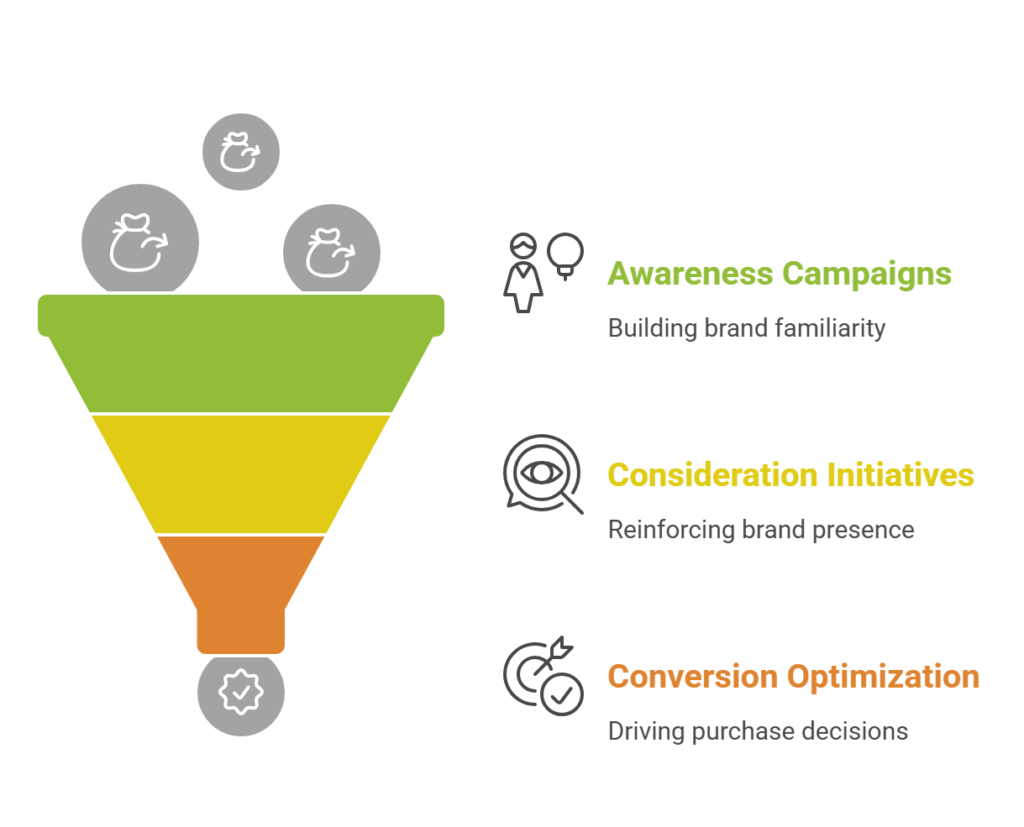
Budgeting is not merely a financial exercise; it reflects strategic thinking about the customer journey. Property buyers typically progress from awareness to consideration to transaction, interacting with multiple touchpoints along the way. Funding should therefore correspond to each stage’s requirements.
Early-stage awareness campaigns may prioritize visibility through content creation or social engagement, building familiarity and trust. Mid-stage initiatives often focus on search and remarketing tactics that reinforce brand presence during evaluation. Final-stage campaigns emphasize conversion optimization through targeted advertising and personalized communication.
Data-driven allocation models suggest using historical performance data to forecast outcomes and optimize distribution, allowing marketers to address constraints such as minimum profit targets or spending limits while maximizing effectiveness. Research into multi-channel advertising further indicates that adjusting per-channel budgets can significantly improve total conversions when managed strategically.
These insights highlight that budgeting should evolve alongside campaign progression. Rather than allocating funds uniformly, organizations must adjust investment to support prospects as they move toward purchasing decisions.
Integrating Technology and Analytics into Budget Planning
Modern campaign budgeting increasingly relies on technological tools capable of processing large datasets and generating actionable insights. Marketing automation platforms, predictive analytics, and attribution modeling allow professionals to determine which touchpoints contribute most effectively to conversions.
Advanced allocation methods, including machine-learning-driven optimization, can identify patterns in consumer behavior and recommend adjustments to maximize outcomes. Research has shown that such approaches can improve policy efficiency and outperform traditional allocation methods in large-scale campaigns.
While smaller agencies may not implement highly sophisticated models, even basic analytics integration can significantly improve decision making. Tracking website interactions, advertising performance, and email engagement offers sufficient information to guide incremental adjustments. As technology becomes more accessible, incorporating data-driven planning into budgeting processes will become increasingly standard across the industry.
Challenges in Budgeting and How to Address Them
Despite its importance, budgeting for marketing campaigns presents several challenges. Market volatility, shifting consumer preferences, and competitive pressures can all affect performance outcomes. In addition, digital channels evolve rapidly, requiring constant adaptation to algorithm updates, platform innovations, and privacy regulations.
Another challenge lies in balancing experimentation with stability. Allocating funds to proven channels ensures predictable results, yet innovation demands testing emerging platforms or techniques. Organizations must reserve a portion of their budgets for exploration while safeguarding core revenue-generating activities.
Finally, attribution complexity complicates budget assessment. Determining which channels truly influenced conversions requires careful analysis of customer interactions across multiple touchpoints. Adopting structured attribution frameworks can help resolve this uncertainty, enabling more precise evaluation and improved future planning.
Building a Sustainable Budgeting Framework
Creating a sustainable budgeting framework involves integrating several principles into ongoing decision making. First, organizations must define clear objectives aligned with broader business goals, ensuring that spending supports measurable outcomes. Second, they should establish realistic financial parameters based on revenue and competitive context. Third, channel allocation should remain flexible, evolving in response to performance data.
Continuous monitoring and reporting ensure accountability, while collaboration between marketing and finance teams enhances strategic alignment. Over time, these practices form a disciplined budgeting culture that supports growth and resilience.
Within this holistic framework, the practical application of Real Estate Digital Marketing becomes not simply a tactic but a structured process guiding investment decisions. By aligning resources with strategic insights and measurable outcomes, organizations can maximize campaign effectiveness while maintaining fiscal responsibility.
Conclusion
Budgeting for modern marketing initiatives in the property sector requires far more than estimating promotional costs. It demands strategic planning, analytical evaluation, and ongoing adaptation to evolving market conditions. Digital channels have become the primary drivers of visibility, engagement, and lead generation, prompting organizations to allocate increasing portions of their resources toward online outreach.
By establishing budgets aligned with revenue objectives, distributing funds across complementary channels, and evaluating results through data-driven metrics, agencies can achieve both immediate impact and long-term sustainability. Incorporating technological tools and acknowledging potential challenges further strengthens financial planning processes.
Ultimately, effective budgeting transforms marketing from an uncertain expense into a predictable investment. Organizations that adopt structured, informed approaches will not only improve campaign outcomes but also strengthen their competitive positioning in an increasingly digital property marketplace.