

If you’ve ever logged into Google Ads at 11 p.m. to fix a bid that’s been bleeding budget since lunch, you already know the problem. PPC accounts don’t wait for business hours, and neither do the mistakes. Search terms drift, competitors change bids, a landing page breaks, and by the time you notice, you’ve already spent the money. An AI agent for PPC management is built to close that gap. It’s software that watches your account continuously and acts on what it sees, instead of waiting for you to open a dashboard and decide.
This isn’t the same thing as the “automated rules” you set up in Google Ads five years ago. Those just execute if-this-then-that logic you wrote yourself. What’s changed in 2026 is that these systems now reason about your account goals, not just fixed thresholds, and either recommend or directly make changes across bidding, budgets, targeting, and creative.
This guide walks through what these tools actually do, reviews the ones worth your time, and gives you a straight answer on whether they’re worth the cost. No fluff, no vendor pitch dressed up as advice.
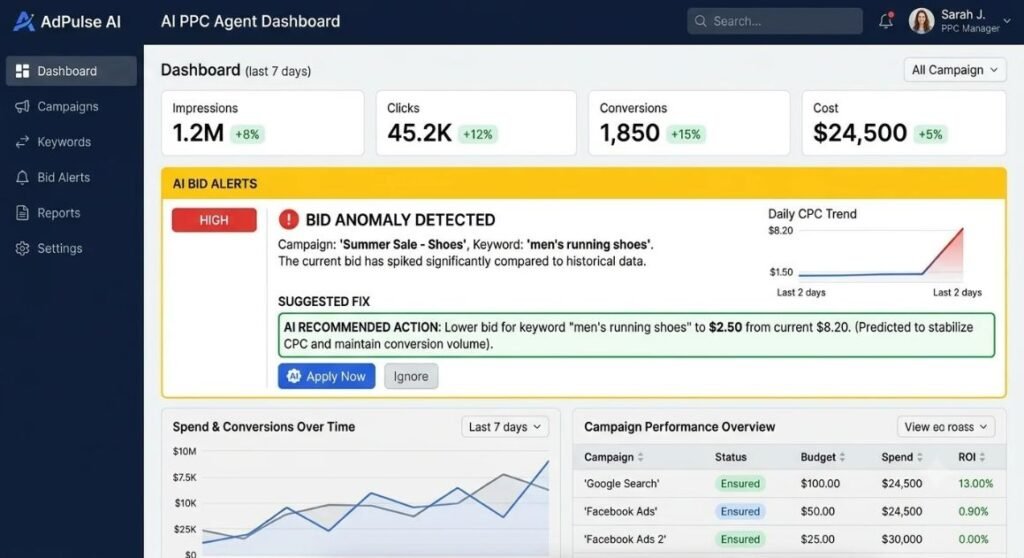
What Is an AI PPC Agent, and How Is It Different From Automated Rules?
An AI PPC agent is software that reads live performance data from your ad accounts, decides what needs to change to hit a stated goal, and either executes that change or proposes it for your approval, without you writing the underlying logic yourself.
That last part is the actual difference. A rules engine, the kind built into Google Ads or tools like Optmyzr’s Rule Engine, only does what you told it to do: “if CPA exceeds $40 for three days, pause the ad group.” It’s predictable, but it’s also blind to anything you didn’t think to write a rule for. An agent reads the account the way a strategist would, weighs multiple signals at once, and can flag a problem you never anticipated. Rules are cheap and dependable. Agents adapt, but they need guardrails.
An AI PPC agent differs from a rules engine because it reasons about account goals rather than executing fixed if-then logic. Rules engines like Google Ads’ native automated rules or Optmyzr’s Rule Engine only act on conditions a human wrote in advance. Agents evaluate multiple signals together and can surface issues nobody scripted for, though this adaptability is exactly why approval gates matter before changes go live.
Here’s where it gets more concrete. Google’s own AI Max, the feature layer rolled out across Search campaigns in 2026, uses machine learning to match search intent without a fixed keyword list, write ad copy variations on the fly, and expand landing pages dynamically. According to Google’s own data, <cite index=”10-1″>AI Max for Search campaigns see an average of 7% more conversions or conversion value at a similar CPA or ROAS</cite> compared to using search term matching alone. That’s not a third-party agent bolted on top of your account. It’s the platform itself becoming more agentic, and it’s the baseline every other tool in this space now has to beat.
What an AI Agent Can Actually Automate in Your PPC Account
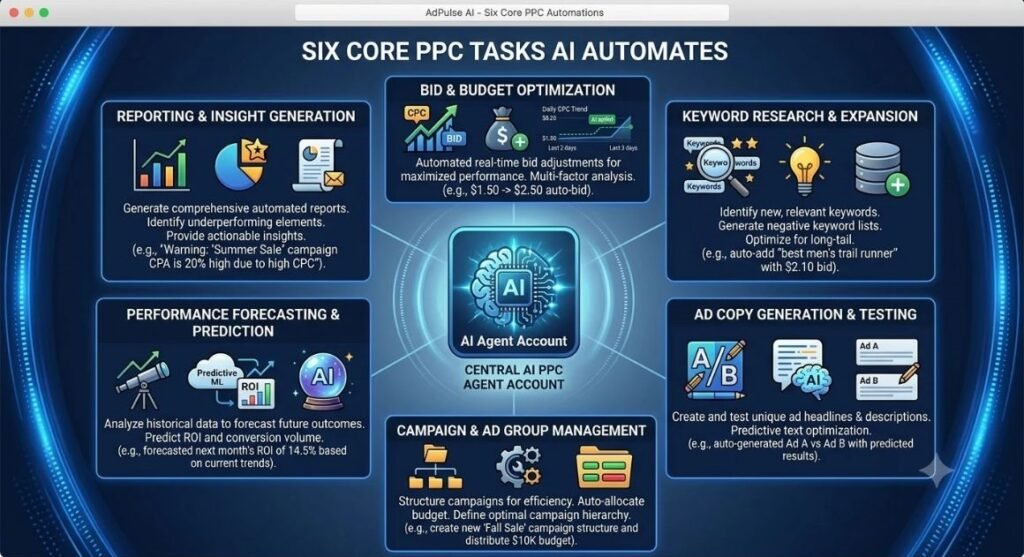
Most PPC managers assume “automation” means bid adjustments and stop there. That’s a fraction of what these systems handle in 2026. Here’s the fuller picture, task by task.
Bid and budget management. The agent shifts spend between campaigns and ad groups in real time, chasing the conversion value that’s actually happening rather than a forecast from last week. This is the single biggest time save for anyone running more than three or four active campaigns.
Search term and negative keyword mining. Instead of you scrolling through a search terms report every Monday, the agent flags wasted spend on irrelevant queries and either adds negatives automatically or queues them for one-click approval.
Creative testing and rotation. Agents can generate ad copy variations, test them against each other, and retire the losers without you manually building A/B tests in the interface.
Audience and placement adjustments. For platforms like Meta, the agent watches for creative fatigue and audience overlap, then reallocates budget toward the segments still converting.
Anomaly detection and account health checks. This is the quiet workhorse function. The agent catches a broken conversion tag, a sudden CPA spike, or a landing page returning a 404, often before you would have noticed it yourself.
Reporting and pacing. Agents pull performance data across accounts into a single view, so you’re not stitching together three platform dashboards and a spreadsheet every Friday.
None of this replaces strategy. It replaces the repetitive checking and adjusting that eats the hours you’d rather spend on strategy in the first place.
AI-Powered Tools for PPC Management, Reviewed in Detail
There’s no single best tool here. Your account size, channel mix, and how much control you want to hand over all point toward different products. Here’s an honest look at the ones that actually matter in 2026.
Google AI Max and Performance Max
What it does: AI Max is a feature layer inside standard Search campaigns that handles keywordless intent matching, real-time ad copy generation, and URL expansion. Performance Max is the broader automated campaign type that runs across Search, Display, YouTube, and Shopping from one budget.
What it does well: It’s free, it’s native, and Google has the most training data on its own auction of anyone in this list. <cite index=”17-1″>AI Max applies machine learning to match search intent without requiring an exhaustive keyword list, generate headlines in real time, and expand final URLs to match user intent</cite>. For most advertisers spending under $20K a month, this alone covers a large share of what a paid tool would otherwise do.
Where it falls short: Transparency. You don’t get channel-level or audience-level detail the way you would from a third-party dashboard, and a bad automated headline or an off-intent search theme can quietly drain budget overnight if nobody’s watching. Google itself now offers multi-campaign A/B testing to manage this risk, but it still requires someone checking in regularly.
Best for: Any advertiser running Google Ads, as a baseline layer underneath whatever else you use.
Pricing: Free, included with any Google Ads account (as of 2026).
Optmyzr
What it does: A PPC optimization suite built around a Rule Engine, one-click recommendations, and cross-account audits for Google and Microsoft Ads, with lighter Meta support.
What it does well: Depth. Optmyzr is the tool agencies reach for when they need granular control over Search and Shopping campaigns and want to see exactly why a recommendation was made before applying it.
Where it falls short: The learning curve. Most users need four to six weeks to get comfortable with the Rule Engine, and Meta Ads functionality is thin compared to dedicated social tools.
Best for: Agencies and in-house search specialists managing multiple Google Ads accounts who want power-user control, not a black box.
Pricing: From roughly $208 to $250/month depending on managed spend, tiered pricing, 14-day free trial (as of 2026).
Madgicx
What it does: An AI optimization platform focused almost entirely on Meta (Facebook and Instagram), covering audience segmentation, creative insights, and automated budget reallocation.
What it does well: Creative fatigue detection and audience-level insight. It surfaces which ad creative is dying before your CPA tells you, which is genuinely useful for e-commerce brands running high ad volume.
Where it falls short: It’s Meta-only in practice. If you’re running a multi-channel account, you’ll need a second tool for Google or Microsoft Ads. Pricing also scales quickly with spend.
Best for: Small to mid-size e-commerce brands running Meta-first campaigns.
Pricing: From about $44 to $55/month for lower spend tiers, scaling up with ad spend (as of 2026).
Revealbot (now branded Bïrch)
What it does: A rules-based automation engine spanning Meta, TikTok, Google, and Snapchat, with bulk ad creation and AI-suggested rule templates.
What it does well: Cross-platform coverage at a lower price point than most competitors, plus genuinely useful bulk campaign creation for agencies managing dozens of ad sets.
Where it falls short: It sits closer to a rules engine than a true reasoning agent. You’re still configuring the logic; it just executes faster and across more platforms than doing it manually.
Best for: Agencies needing one tool to automate rule-based tasks across several ad platforms at once.
Pricing: From roughly $99 to $208/month depending on managed spend (as of 2026).
Skai (formerly Kenshoo)
What it does: An enterprise commerce-media platform unifying retail media, paid search, and paid social across hundreds of publishers, with an AI layer called Celeste built in.
What it does well: Scale. If your team manages retail media placements on Amazon or Walmart alongside traditional search and social, Skai is one of the only platforms built to handle all of it under one governance model.
Where it falls short: Cost and complexity. This isn’t a self-serve tool. It’s sold through a procurement process, and the price gap between Skai and a self-serve tool like Optmyzr runs into the tens of thousands of dollars a year.
Best for: Large enterprise teams running retail media alongside search and social, not solo marketers or small agencies.
Pricing: Published annual tiers starting around $114,000/year for up to $4M in managed ad spend, scaling to $756,000/year at higher tiers (as of 2026).
Smartly.io
What it does: An enterprise cross-channel creative and campaign automation platform, strongest on the creative production side of paid social.
What it does well: Automating creative variations at scale for large advertisers running hundreds of ad combinations across Meta, TikTok, Snapchat, and Pinterest simultaneously.
Where it falls short: It’s built for enterprise creative teams, not solo PPC managers optimizing a handful of Search campaigns. Overkill if creative isn’t your bottleneck.
Best for: Large brands and agencies where creative volume, not bid strategy, is the constraint.
Pricing: Custom, enterprise-quoted (as of 2026).
Adalysis
What it does: An audit and A/B testing tool for Google and Microsoft Ads that flags account issues and statistically evaluates ad copy tests.
What it does well: Catching account health problems, like disapproved ads, quality score drops, or broken ad group structures, before they cost real money.
Where it falls short: It doesn’t manage bids or budgets the way Optmyzr or a true agent does. Think of it as a diagnostic layer, not a management layer.
Best for: Teams that want a second set of eyes auditing account health, used alongside a bid management tool rather than instead of one.
Pricing: From about $149/month (as of 2026).
How to Choose the Right AI PPC Agent for Your Workflow
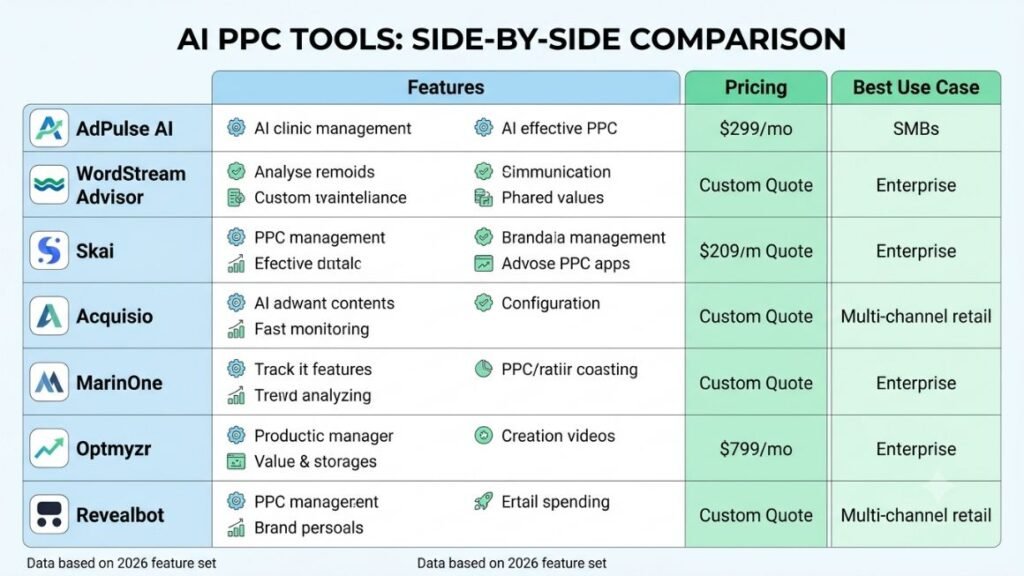
Start with your channel mix, not the tool’s marketing page. If you’re Google-only, Optmyzr or AI Max cover most of what you need. If you’re Meta-heavy, Madgicx or Revealbot make more sense. Running both, plus retail media? That’s when Skai’s price tag starts to look reasonable instead of absurd.
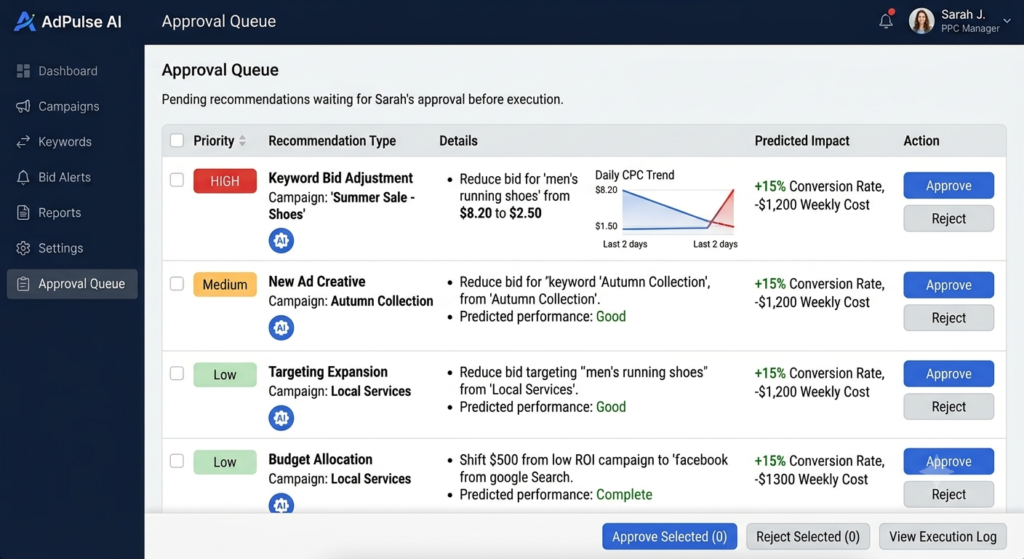
Next, decide how much control you actually want to give up. Some tools only recommend changes and wait for your click. Others execute autonomously inside guardrails you set once. If you’re new to a platform’s automation, start with recommendation mode. Hand over full execution once you trust the pattern of suggestions it’s making.
And be honest about spend level. A $149-a-month tool makes sense at $30K in monthly spend. It doesn’t make sense at $3K, where the tool costs more than the inefficiency it’s meant to fix. Below roughly $5,000 a month in spend, native platform automation (AI Max, Meta’s Advantage+) usually covers 70 to 80% of the value a paid tool would add anyway.
How to Set Up Your First AI PPC Agent, Step by Step
- Audit your conversion tracking first. No agent, however good, can optimize toward a goal it’s measuring incorrectly. Confirm your conversion tags fire correctly before connecting anything.
- Pick one platform to start. Don’t connect Google, Meta, and TikTok simultaneously on day one. Start with the channel that has the most conversion volume, so the agent has enough data to work with.
- Set a clear target metric. Choose one primary goal, target CPA or target ROAS, not both. Agents optimize better against a single, unambiguous objective.
- Start in recommendation mode. Let the tool suggest changes for a week or two before you flip on autonomous execution. Review what it’s proposing and why.
- Set spend and change guardrails. Cap the maximum daily budget shift and the maximum bid change per action. This is what prevents a bad recommendation from becoming a bad week.
- Turn on autonomous execution for low-risk tasks first. Negative keyword additions and creative rotation are lower-stakes than budget reallocation. Automate those first.
- Review weekly, not daily. Once the guardrails are set, resist the urge to check every change. Weekly reviews are usually enough to catch drift without micromanaging the agent.
Common Mistakes to Avoid When Automating PPC With AI
The biggest one is connecting an agent to an account with broken tracking. Feed it bad conversion data and it will optimize toward the wrong goal with total confidence, and fast. Fix tracking before you automate anything.
The second is skipping guardrails because the demo looked smooth. A search theme can pull in irrelevant queries overnight, or an AI-generated headline can misrepresent your offer, and nobody notices until the invoice arrives. Set spend caps from day one.
The third is running two automation tools against the same budget without coordinating them. If Optmyzr and Meta’s native Advantage+ are both trying to reallocate the same shared budget, they’ll fight each other and neither will perform as designed.
The fourth, and the one people underestimate most, is treating automation as “set it and forget it.” <cite index=”9-1″>Agentic AI uses the same underlying models to independently plan, chain decisions, and execute multi-step tasks without ongoing human direction</cite>, but that autonomy is exactly why oversight still matters. The tools remove repetitive work. They don’t remove your judgment from the account.
Is Automated PPC Management Actually Worth the ROI?
For most accounts spending more than $10,000 a month, yes. Below that, the math gets tighter, and native platform tools usually close most of the gap for free.
The ROI case isn’t really about the tool finding some magic optimization a human missed. It’s about time. A PPC manager who’s no longer manually checking search terms, adjusting bids, and pulling reports by hand can manage two or three times as many accounts, or spend that freed time on the creative and strategic work that actually moves the needle. That’s the real return on an AI agent for PPC management, and it’s why agencies adopt these tools faster than in-house teams.
There’s a broader adoption signal here too. <cite index=”3-1″>PwC found that 79% of companies are adopting AI agents, and 66% of adopters report measurable value</cite>, a pattern that holds up in paid media specifically. That said, the same research shows adoption doesn’t guarantee results by itself. The accounts that see real ROI are the ones with clean tracking, clear guardrails, and someone still reviewing the account weekly, not the ones that connected a tool and walked away.
The ROI of AI-driven PPC automation comes primarily from reclaimed time rather than a single dramatic performance jump. Google reports AI Max drives roughly 7% more conversion value at a similar CPA, which is meaningful but incremental. The larger gain is that a PPC manager freed from manual bid checks and search term audits can manage more accounts or focus on strategy, which is where most of the reported ROI actually shows up.
Conclusion
An AI PPC agent won’t rewrite your strategy or replace the judgment a good PPC manager brings to an account. What it does is take the repetitive, time-sensitive work off your plate, the bid checks, the search term audits, the 11 p.m. budget fires, so you can spend your actual hours on the decisions that need a human. Start with the native automation you already have access to, layer in one dedicated tool once your spend justifies it, and set guardrails before you set it loose.
If you want to get better at using these tools instead of just reading about them, Hotskill has hands-on lessons built for exactly this kind of AI workflow. Download the app on iOS or Android and start your first lesson today at hotskill.co/download.
Frequently Asked Questions
What is an AI agent used for in PPC management?
It’s software that monitors your ad accounts continuously and makes or recommends changes to bids, budgets, targeting, and creative based on live performance data, rather than waiting for a human to check a dashboard and decide manually.
How is an AI PPC agent different from Google’s automated bidding?
Google’s Smart Bidding optimizes one variable, usually bids, toward a target. A full AI agent typically looks across bids, budgets, search terms, and creative at once, and can act across multiple campaigns or even multiple platforms simultaneously.
Do I need coding skills to use these tools?
No. Every tool covered here, from Optmyzr to Madgicx to Google’s AI Max, is built for marketers without a technical background. The exception is Google Ads Scripts, which does require basic JavaScript, but that’s a separate, optional path for advanced users.
Is an AI agent worth it if I already use Google’s native automation?
It depends on your spend and channel mix. Below roughly $5,000 to $10,000 a month, native automation usually covers most of the value. Above that, or if you’re running multiple platforms, a dedicated tool typically pays for itself in reclaimed time alone.
How much do AI PPC management tools cost?
Self-serve tools run from about $44 to $250 a month depending on managed ad spend, as of 2026. Enterprise platforms like Skai are quoted annually and can run into the hundreds of thousands of dollars a year, so most small and mid-size teams never need that tier.
Can an AI agent completely replace a PPC manager?
No, and treating it that way is where accounts go wrong. Agents remove repetitive manual work like bid checks and search term audits. Strategy, creative direction, and catching when the agent is optimizing toward the wrong goal still need a human.
Which AI PPC tool is best for a Meta-only e-commerce account?
Madgicx is the strongest fit for Meta-first e-commerce brands, given its focus on creative fatigue detection and audience-level automation. Revealbot is a solid alternative if you also need lighter automation on TikTok or Snapchat.
Why isn’t my AI PPC agent improving performance?
The most common cause is broken or inaccurate conversion tracking. An agent optimizes toward whatever signal it’s given, so if that signal is wrong, the “optimization” will actively work against you. Audit your tracking setup before troubleshooting anything else.
How long does it take to see results after setting up an AI agent?
Most tools need two to four weeks of live data before recommendations stabilize, since the underlying models need enough conversion volume to detect real patterns rather than noise. Low-volume accounts take longer to show clear results.
Should I let the agent execute changes automatically, or just recommend them?
Start with recommendation mode for at least one to two weeks so you can review what it’s proposing and why. Move to autonomous execution only for lower-risk tasks first, like negative keywords, before handing over budget or bid control.