

You’ve found a creative that converts. Now what? Scaling it usually means testing dozens of copy variations, splitting budgets across new audiences, and watching dashboards until your eyes hurt. Most media buyers hit this wall the moment a winning ad set starts pulling real spend.
That’s the gap tools in this space are built to close. This roundup breaks down 15 platforms marketers are actually using to move past manual scaling, with honest notes on where each one shines and where it doesn’t. Whether you’re a solo buyer stretching a small budget or an agency juggling client accounts, one of these fits your workflow.
Before diving in, one definition worth pinning down: automated bid and budget adjustment is when software raises or lowers ad spend on specific ad sets based on live performance data, instead of a human checking dashboards and making the call manually.
Madgicx — Best for Meta-Focused Optimization at Scale
What it does: Madgicx is an AI ad platform built specifically around Meta campaigns, combining automated audience targeting, budget rules, and creative performance tracking in one dashboard.
Madgicx earns its reputation once your Meta campaigns are generating enough volume to feed the algorithm, typically upward of $5,000 in monthly ad spend. Below that threshold, the AI doesn’t have enough signal to make sharp calls.
What it does well: Once the data starts flowing, Madgicx surfaces micro-optimization opportunities that would take a human analyst hours to find manually, things like which specific audience overlap is quietly cannibalizing your own ad sets. Its Cost Guard feature automatically pauses underperforming ad sets before they burn through budget.
Where it falls short: The interface has a real learning curve, and support for platforms outside Meta and Google is thinner than the marketing suggests. Smaller accounts often see underwhelming results simply because there isn’t enough data yet.
Best for: Media buyers running Meta and Instagram as their primary revenue channel with consistent, meaningful spend.
Pricing: Starts around $49 per month as of 2026, scaling with connected ad spend. A free trial is available.
Madgicx is the strongest Meta-native option for teams already spending several thousand dollars a month, since its AI needs real data volume to outperform manual management. Below that spend threshold, simpler tools deliver similar results for less cost.
Smartly.io — Best for Enterprise Creative at Scale
What it does: Smartly.io connects creative production, targeting, bidding, and reporting into one workflow, built for teams running thousands of ad variations across multiple markets and languages at once.
What it does well: Dynamic creative optimization here is genuinely strong. Dynamic creative optimization is the automatic generation and testing of many ad variations by combining different headlines, images, and calls-to-action, then scaling whichever combination wins. Upload a product catalog and brand assets, define a template, and Smartly generates platform-ready creatives without a designer touching each one individually.
Where it falls short: This is not a tool for a solo marketer or a small business. The onboarding process assumes an in-house team, and pricing reflects that. It’s overkill if you’re managing one or two ad accounts.
Best for: Enterprise teams and large agencies running high-volume, multi-market creative programs.
Pricing: Custom, quote-based pricing as of 2026, typically starting in the low thousands per month depending on spend volume.
Albert.ai — Best for Fully Autonomous Campaign Management
What it does: Albert.ai is a digital marketing platform built to run campaigns with minimal human input, making real-time decisions on targeting, budget, and creative testing across channels.
What it does well: If you want AI to actually run the show rather than just recommend actions, Albert is in its own category. It cross-references performance signals across Search, Social, and Display simultaneously, something rule-based tools can’t replicate.
Where it falls short: Handing that much control to an algorithm makes some teams nervous, and rightly so. You lose granular visibility into why certain decisions get made, which is a real problem for teams that need to explain results to a client or a CFO.
Best for: Teams comfortable trading manual control for speed and willing to trust the black box.
Pricing: Enterprise, quote-based as of 2026.
Revealbot — Best for Rule-Based Cross-Platform Automation
What it does: Revealbot lets you build custom automation rules for bid adjustments, budget changes, and campaign status updates across Meta, Google, TikTok, and Snapchat.
What it does well: Instead of relying on a black-box algorithm, you define the exact conditions that trigger each action. If cost per result crosses a threshold and frequency climbs too high, pause the ad set automatically. That specificity is what performance marketers actually want, automation without giving up control.
Where it falls short: You need to know what rules to build in the first place. Revealbot won’t tell you a strategy is broken; it just executes whatever logic you give it, faithfully, even bad logic.
Best for: Marketers who want automation across multiple platforms without surrendering decision-making to an opaque model.
Pricing: Starts around $31 per month as of 2026, scaling with ad spend, with a free trial available.
Optmyzr — Best for Google and Microsoft Ads Power Users
What it does: Optmyzr is a PPC management platform focused on Google Ads and Microsoft Ads, offering bulk optimization tools, rule scripts, and detailed account audits.
What it does well: Power users get an enormous amount of control here. The Rule Engine lets you script highly specific bid and budget logic, and the Quality Score tracker catches issues most native dashboards bury three menus deep.
Where it falls short: The feature density is a double-edged sword. New users often feel overwhelmed navigating the sheer number of reports and settings available.
Best for: Experienced PPC specialists managing search campaigns who want granular scripting control.
Pricing: Starts around $208 per month as of 2026, based on ad spend tiers.
Opteo — Best for Simple Google Ads Optimization
What it does: Opteo is a lighter-weight alternative to Optmyzr, surfacing prioritized, plain-language recommendations for Google Ads accounts without the scripting complexity.
What it does well: The recommendations feed is genuinely digestible. It ranks suggested changes by potential impact and explains the reasoning in a sentence or two, which makes it approachable for marketers without a deep PPC background.
Where it falls short: That simplicity comes at the cost of depth. Teams that want granular script control will outgrow Opteo fast.
Best for: Small teams and freelancers managing Google Ads who want clear guidance over raw customization.
Pricing: Starts around $99 per month as of 2026.
Adzooma — Best for SMB Multi-Platform Recommendations
What it does: Adzooma is a PPC management platform with an AI opportunity engine that identifies and implements optimizations across Google, Microsoft, and Meta Ads.
What it does well: Accessibility is the whole point. One-click implementation for suggested optimizations means someone without technical PPC training can act on recommendations immediately.
Where it falls short: The recommendation engine sometimes flags generic best practices rather than account-specific insight, so experienced buyers may find the suggestions too surface-level.
Best for: Small to mid-sized businesses managing Google, Meta, and Microsoft Ads who want one-click implementation.
Pricing: Starts around $99 per month as of 2026, scaling with monthly ad spend across connected accounts.
AdRoll — Best for Retargeting and Cross-Channel Reach
What it does: AdRoll is a programmatic advertising and retargeting platform that uses AI to identify and re-engage visitors who didn’t convert on their first visit, across web, social, and email.
What it does well: The cross-channel retargeting logic is mature and well-tested. AdRoll’s predictive audience targeting can identify which abandoned visitors are statistically most likely to convert if retargeted, which helps allocate budget toward the highest-value segments.
Where it falls short: AdRoll is not a creative production tool, and its interface feels dated next to newer platforms. Teams expecting a modern, all-in-one dashboard may be disappointed.
Best for: eCommerce brands that need reliable retargeting infrastructure more than cutting-edge creative tools.
Pricing: Starts around $30 per month as of 2026 for the self-serve plan, plus media spend.
Wask — Best Starting Point for Small Businesses
What it does: Wask is an AI-driven ad management platform built for small businesses and growing eCommerce brands running Meta and Google Ads without a dedicated performance team.
What it does well: The price-to-value ratio here is hard to beat in 2026. Wask handles campaign setup, budget suggestions, and basic creative variation testing in a way that feels built for real marketers rather than PPC engineers.
Where it falls short: It doesn’t scale well once you’re running enterprise-level volume or need deep multi-market creative workflows.
Best for: Small businesses and growing eCommerce brands that want smart automation without drowning in complexity.
Pricing: Starts around $49 per month as of 2026, with a free trial available.
Pencil — Best for AI-Generated Creative Production
What it does: Pencil uses generative AI to produce ad creative, images, video, and copy variants, trained on what has historically performed well for your brand or category.
What it does well: This is a genuinely useful shortcut for teams that are creative-bottlenecked rather than budget-bottlenecked. Pencil can generate dozens of ad variants from a single brief in minutes, which used to take a design team days.
Where it falls short: Output quality varies by category. Highly regulated or visually complex product categories, like financial services or luxury goods, tend to need more manual polish than Pencil’s default output provides.
Best for: Teams that need creative volume fast and are willing to refine AI-generated drafts rather than start from scratch.
Pricing: Custom, quote-based as of 2026.
Creative-generation tools like Pencil solve a different bottleneck than budget-automation tools like Revealbot. Most scaling teams eventually need both: one to produce enough creative variants to test, and one to redistribute budget once winners emerge.
Skai — Best for Enterprise Omnichannel Advertising
What it does: Skai (formerly Kenshoo) is an enterprise-grade platform managing search, social, retail media, and app advertising across multiple channels from a single interface.
What it does well: The cross-channel data unification is its strongest asset. Skai pulls performance data from disparate platforms into consistent reporting, which matters enormously for large brands trying to compare Amazon Ads spend against Meta spend on equal footing.
Where it falls short: Implementation takes weeks, not days, and the platform is priced well out of reach for small teams.
Best for: Large enterprises and agencies managing complex, multi-channel advertising portfolios.
Pricing: Custom, quote-based as of 2026.
AdStellar — Best for Full-Stack Meta Creative to Launch
What it does: AdStellar covers the entire Meta ad workflow, from creative production to campaign launch to performance analysis, inside one platform.
What it does well: Most scaling tools solve one piece of the puzzle. AdStellar is built to handle the whole thing: generate image ads, video ads, and UGC-style avatar content directly from a product URL, or clone competitor ads pulled from the Meta Ad Library. One-click scaling rules let you push budget toward winning ad sets the moment they cross a performance threshold.
Where it falls short: Because it’s Meta-specific, teams running significant budget on TikTok or Google will need a second tool alongside it.
Best for: Performance marketers who want one platform to handle Meta creative, launch, and optimization end to end.
Pricing: Tiered by ad spend as of 2026; check current plans directly.
Hell Yeah AI — Best for Fully Autonomous Ad Scaling
What it does: Hell Yeah AI is an AI-native platform that autonomously adjusts bids, generates and tests creatives, and reallocates budget across channels in real time, without a human approving each action.
What it does well: This is genuinely one of the more aggressive autonomous options on the market. It fires downstream signals that trigger campaign actions automatically, closing the gap between insight and action that used to take a media buyer hours to act on manually.
Where it falls short: That level of autonomy means less day-to-day control. Teams that need to justify every budget shift to a client may find the lack of manual checkpoints uncomfortable.
Best for: Growth-stage teams that want AI to run scaling decisions with minimal human intervention.
Pricing: Custom, quote-based as of 2026.
Cometly — Best for Attribution-Driven Scaling Decisions
What it does: Cometly is an attribution and analytics platform built to give performance marketers accurate, cross-channel conversion data before they commit larger budgets to a winning campaign.
What it does well: Most ad optimization tools tell you what happened after the fact. Cometly’s real strength is closing the gap between ad spend and actual revenue outcomes, correcting for the attribution blind spots native platform dashboards routinely miss, especially once Meta’s own reporting misattributes credit across multiple touchpoints.
Where it falls short: Cometly doesn’t run campaigns or generate creative. It’s a data layer, not a management layer, so it needs to sit alongside an execution tool.
Best for: Performance marketers and growth teams who need accurate attribution before making large-scale budget calls.
Pricing: Custom pricing as of 2026.
Motion — Best for Creative Performance Analytics
What it does: Motion connects ad performance metrics directly to specific creative elements, colors, hooks, pacing, CTAs, to identify which creative decisions are actually driving results.
What it does well: This closes a real gap. Most platforms tell you an ad is performing; Motion tells you why, breaking a video ad down frame by frame to flag which seconds cause drop-off. That’s the difference between guessing your next creative test and designing it on evidence.
Where it falls short: Motion is an analytics layer, not a launch or budget-automation tool, so it works best paired with a platform like Revealbot or Madgicx rather than as a standalone solution.
Best for: Teams running heavy video creative testing who need to know which specific elements are winning.
Pricing: Custom, quote-based as of 2026.
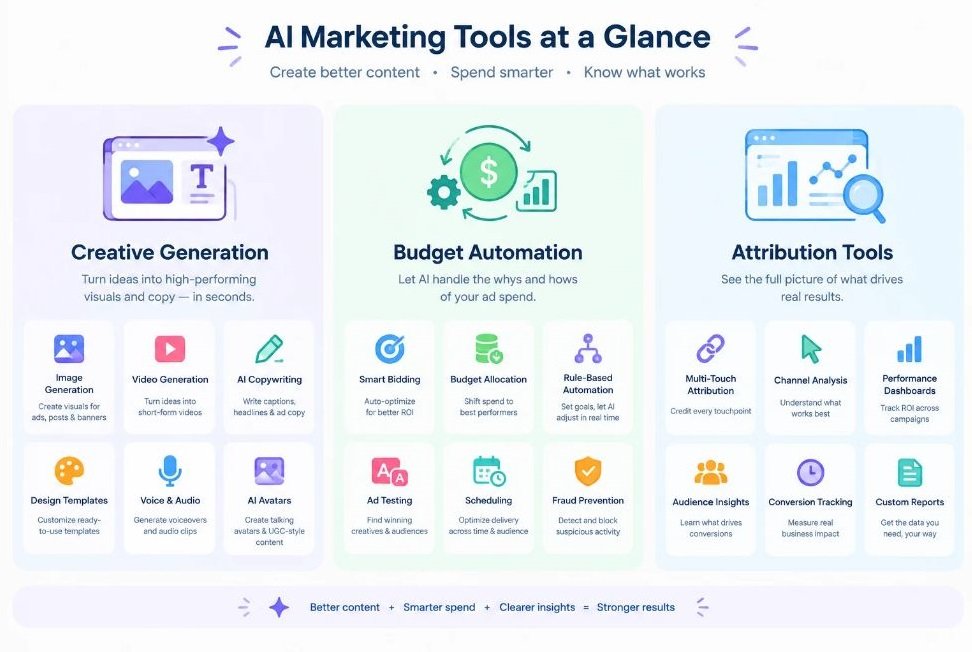
There’s no single winner across this whole list. AI ad scaling tools now split cleanly into three jobs, budget automation, creative generation, and attribution, and most scaling teams end up running at least two of these tools together rather than expecting one platform to do everything. If you’re just starting out, pick the tool that fixes your biggest bottleneck right now, not the one with the longest feature list.
Getting Started
Pick the tool that matches your actual bottleneck, not the longest feature list. If your creative pipeline is thin, start with a generation tool. If budget reallocation is the slow part, start with a rules-based platform like Revealbot. Either way, the fastest path forward is picking one tool this week and actually running it against a live campaign, not researching all 15 before you act.
If you want to build real skill with these platforms instead of just picking one and hoping, Hotskill has structured lessons on AI ad workflows built for exactly this kind of hands-on learning. Download the app on iOS or Android at hotskill.co/download.
FAQs
What are AI ad scaling tools?
AI ad scaling tools are software platforms that use machine learning to automate the repetitive work of growing a paid ad campaign, things like adjusting budgets, generating creative variants, and reallocating spend toward winning ad sets. They replace manual monitoring and rule-checking with automated, data-driven decisions.
How is AI ad scaling different from regular ad optimization?
Regular optimization usually means a human checking dashboards and manually adjusting bids or budgets. AI-driven scaling automates that decision-making, either through predefined rules (like Revealbot) or through autonomous algorithms (like Albert.ai) that act without waiting for human approval.
Do I need one of these tools if I’m only spending a few hundred dollars a month?
Probably not yet. Most of these platforms, especially Meta-focused ones like Madgicx, need meaningful data volume to outperform manual management. Below roughly $2,000 to $5,000 in monthly spend, a lighter tool like Wask or Opteo usually delivers better value.
Which tool is best for a solo media buyer just starting out?
Wask and Revealbot are both strong starting points. Wask handles setup and basic optimization without much technical overhead, and Revealbot lets you build simple rules as you learn what triggers you actually want.
Can these tools replace a media buyer entirely?
Not reliably. Even the most autonomous options, like Albert.ai and Hell Yeah AI, still need a human setting strategy, defining goals, and catching mistakes the algorithm doesn’t understand as mistakes. They reduce workload, not accountability.
Why isn’t my AI ad tool improving my results?
Usually one of two reasons: not enough data volume for the algorithm to learn from, or misconfigured rules and goals that are technically working as designed but optimizing for the wrong metric. Check what the tool is actually optimizing toward before assuming it’s broken.
Do I need coding skills to use tools like Optmyzr or Revealbot?
No. Both use rule-builders with dropdown logic rather than actual code. Optmyzr’s Rule Engine has more depth and a steeper learning curve than Revealbot, but neither requires programming knowledge.
Should I use a creative-generation tool or a budget-automation tool first?
It depends on your bottleneck. If you don’t have enough winning creative to test, start with a generation tool like Pencil or AdStellar. If you already have winners but can’t move budget fast enough, start with Revealbot or Madgicx instead.
Is attribution software like Cometly necessary if I already use Meta Ads Manager?
If you’re scaling based on Meta’s native reporting alone, you may be making budget decisions on inaccurate data. Meta’s own attribution frequently misassigns credit across touchpoints, and a dedicated attribution layer corrects for that before you commit larger spend.
Which of these tools work across multiple ad platforms, not just Meta?
Revealbot, Optmyzr, Adzooma, and Skai all support multi-platform management across combinations of Meta, Google, Microsoft, TikTok, and Snapchat. Tools like Madgicx and AdStellar are Meta-specific by design.