

You set a price, watch sales for a few weeks, then leave it alone for months. Meanwhile your competitors changed theirs three times, demand shifted with the season, and your stock levels moved. That gap between how fast the market changes and how slowly most teams reprice is where revenue quietly leaks.
AI Pricing Optimization Strategies close that gap. They use machine learning (software that finds patterns in past data and gets better as it sees more) to recommend or set prices based on demand, competitor moves, inventory and customer behavior. This guide is for e-commerce owners, retail marketers, and B2B or SaaS pricing leads who suspect they’re underpricing or over-discounting but can’t prove it.
Picking a tool is the confusing part. Almost every vendor says “AI,” yet some products only track competitor prices while others run full demand models. So here’s what you’ll get: realistic numbers on what AI can add, nine tools explained one by one with honest strengths and limits, the strategies that actually work, a six-step rollout plan, and ten FAQs.
What Is Pricing Optimization With AI and How Does It Work?
Pricing optimization with AI means using machine learning models to estimate how buyers react to different prices, then recommending the price most likely to hit a goal you set, such as revenue, profit margin or sell-through. It replaces fixed markups and quarterly gut checks with decisions that update as your data changes.
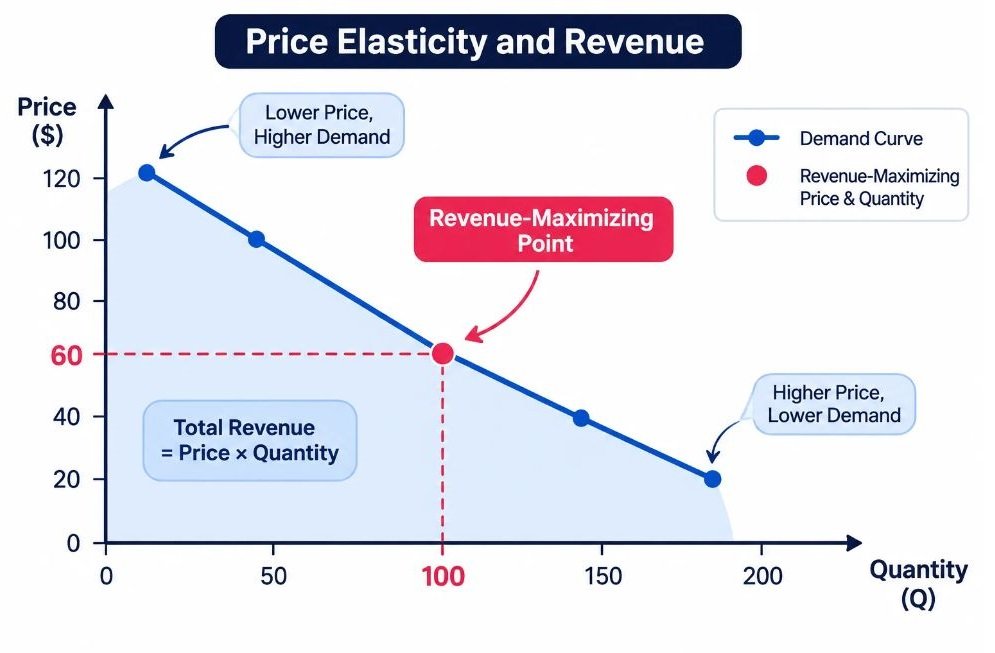
The core idea is price elasticity, a measure of how much demand changes when your price changes. Some products barely react to a price rise. Others lose half their buyers after a small one. Finding out which is which, product by product, is the whole game.
Here’s a simple illustration. Say you sell a stand mixer at $249. A model trained on two years of sales might learn that dropping to $239 lifts weekly units by only 3%, which doesn’t cover the lost margin. It might also learn that raising the price to $259 loses almost no buyers, because every competitor sits near $269. An analyst could work that out for one product. A model can do it for 40,000.
The Loop Behind Every Pricing Engine
Whatever the brand name on the dashboard, nearly every system runs the same loop:
- Step 1: Collect data. Sales history, costs, stock levels, promotions and competitor prices flow in.
- Step 2: Forecast demand. The model predicts how many units you’ll sell at different price points.
- Step 3: Recommend a price. It picks the price that best serves your goal, inside the limits you set.
- Step 4: Apply guardrails. Price floors, ceilings and brand rules filter the recommendation.
- Step 5: Execute and learn. The price goes live, results feed back in, and the next forecast improves.
AI for Pricing Optimization works best when you feed it a year or more of clean sales history. With less, it’s guessing. That’s why a brand-new store with 60 days of data usually gets more value from competitor tracking than from a full demand model.
Optimization, Dynamic Pricing and Rules: What’s the Difference?
These three get mixed up constantly, so here are clean definitions.
Dynamic pricing is the practice of changing prices automatically over time as conditions change. Rule-based pricing is a fixed instruction you write yourself, like “always stay 2% below Competitor X.” Price optimization is the decision layer that works out what price you should aim for in the first place.
Dynamic pricing is the tactic. Optimization is the brain behind it. A tool can do one without the other, and plenty of products labeled “AI” are really just fast rule engines.
You’ll also hear the term agentic AI, meaning software that can plan and carry out several steps on its own, such as pulling data, testing a price change and drafting the update, with little prompting. It’s the newest layer in pricing tools, and a few vendors covered below already ship it.
Pricing optimization with AI uses machine learning to estimate price elasticity, the way demand responds to price, and then recommends prices that meet a revenue, margin or sell-through goal. Dynamic pricing is the automatic execution of price changes, while optimization decides the target. Many tools sold as AI are actually rule engines, so check whether a product forecasts demand or only reacts to competitors.
How Much Revenue Can Pricing AI Really Add?
Credible research points to gains in the low single digits for margin, with a wide spread depending on your data quality and category. McKinsey’s work on digital pricing transformations puts sustained margin improvement at 2 to 7 percentage points, with first benefits showing in as little as three to six months. That’s meaningful money for any business that sells at scale.
AI-Powered Pricing Optimization isn’t a magic lever, though, and the newest evidence is worth knowing. McKinsey’s AI in Pricing Survey, run in November 2025 with 419 respondents, tracked how companies use AI across pricing tasks. In one B2B program McKinsey described, adding agentic AI delivered more than 50 basis points of extra margin on top of the roughly 200 basis points earlier AI had already produced. (A basis point is one hundredth of a percentage point, so 200 basis points is 2%.)
The software market tells the same story from the spending side. Mordor Intelligence’s 2026 report sizes price optimization software at USD 1.95 billion in 2026, growing to USD 4.17 billion by 2031, a 16.06% compound annual growth rate. The Business Research Company counts AI-driven price optimization specifically and lands at USD 3.05 billion in 2026, up from USD 2.61 billion in 2025. The totals differ because each firm draws the market boundary differently. The direction doesn’t differ at all.
A word of caution. You’ll see flashy vendor claims online, like 25% or 30% revenue lifts. Treat those as marketing unless a named customer and a test design sit behind them. Gains come from boring places:
- Fewer unnecessary discounts on products that would have sold at full price
- Faster reaction when a competitor drops or raises a price
- Better markdown timing on seasonal stock, so you clear inventory without giving away margin
- Smarter prices across the long tail of products nobody has time to review by hand
That last one matters most. Your top 50 products get attention. Your other 5,000 get a markup rule from 2019. A model gives every SKU (stock keeping unit, meaning one specific product variant) the same quality of review.
McKinsey research links digital pricing programs to 2 to 7 percentage points of sustained margin improvement, and its November 2025 survey of 419 respondents shows AI spreading across pricing tasks. Market analysts such as Mordor Intelligence and The Business Research Company both project steady double-digit growth for pricing software through 2031. Real gains come from fewer needless discounts, faster competitor response and better prices on the long tail, not from headline-grabbing vendor claims.
Which AI Pricing Tools Are Worth Your Time?
For most businesses the right tool depends on three things: how many products you sell, whether you sell to consumers or to other businesses, and how much pricing expertise your team already has. Competitor trackers suit small stores. Demand-based platforms suit large retailers. Quote and deal tools suit B2B sellers.
Pricing in this category changes often and many vendors only publish quotes, so every figure below is “as of 2026” and worth confirming before you buy. Here’s the quick map:
| Tool | Best for | Core strength | Pricing model (as of 2026) |
|---|---|---|---|
| Prisync | Small online stores | Competitor price tracking and simple repricing | Self-serve, from $99/month |
| Omnia Retail | Mid-market retail and D2C | Automated pricing strategies with market data | From about €399/month, custom above that |
| Wiser Solutions | Brands and retailers | Market intelligence and shelf monitoring | Quote-based |
| Competera | Enterprise retail | Demand-driven optimization with scenario testing | Quote-based |
| Intelligence Node | Enterprise retail | Real-time price intelligence and product matching | Quote-based |
| PROS | Large B2B and airlines | Deep AI optimization at enterprise scale | Enterprise contract |
| Zilliant | B2B distribution | Price optimization and deal scoring | Enterprise contract |
| Vendavo | Industrial B2B | Margin management and deal governance | Enterprise contract |
| Pricefx | Mid-to-large B2B | Cloud pricing with analytics and rebates | Enterprise contract |
Honestly, the table hides the most important split. The first three tools mainly tell you what the market is doing. The rest mainly decide what you should do about it. Plenty of businesses need the first kind before they’re ready for the second. The same split shows up inside AI-Powered Pricing Optimization products too, so read feature lists carefully.
Tools for Small and Mid-Sized E-commerce Stores
If you sell online and manage somewhere between a few dozen and a few thousand products, you don’t need a six-figure platform. You need clean competitor data, sensible guardrails and a tool your team will actually open.
Prisync: Best Starting Point for Small Stores
What it does: Prisync tracks competitor prices and stock availability across the sites you point it at, then shows where you sit against the market. It also includes a repricing engine, MAP monitoring (minimum advertised price checks, which catch resellers who advertise below the floor you set) and price history.
What it does well: Setup is fast and the interface is plain. Plans allow unlimited competitors, update prices several times a day and include Excel reports and price position comparisons. A 14-day free trial needs no card, according to a competitor’s comparison page that checked in October 2026.
Where it falls short: Be clear about what you’re buying. Prisync is monitoring first. Its repricing works from rules you write, and as far as its public documentation shows, it doesn’t build demand forecasts. Reviewers also call the plans a bit pricey and rigid for very small shops, and API access costs an extra 20% on the higher tiers.
Best for: Stores with 100 to 5,000 products that want to stop checking competitor sites by hand.
Pricing (as of 2026): URL-based plans run $99 a month for 100 products, $199 for 1,000 and $399 for 5,000. Larger catalogs need a custom quote.

Omnia Retail: Best for Retailers Ready to Automate Strategy
What it does: Omnia Retail is a pricing platform built around market data and automated price strategies. You define how each product group should be priced, and the system carries it out. Its Pricing Strategy Tree lets you build those rules visually, so the logic stays transparent. Omnia Agent, its agentic layer, lets you ask pricing questions in plain language and get analysis back.
What it does well: It balances automation with control, which is the hardest thing to get right. Reviewers on G2 place it mostly in the mid-market, and the company reports strong standing in G2’s Winter 2026 grid for retail pricing software.
Where it falls short: It rewards teams that already know what role each product plays, such as traffic driver, profit maker or clearance item. If you don’t have that clarity yet, you’ll spend the first month building it. Buyers wanting one platform for every retail function may also need extra products.
Best for: Mid-market retailers and D2C (direct-to-consumer) brands with a defined pricing owner.
Pricing (as of 2026): G2 lists SMB plans from €399 a month. Enterprise plans are custom.
Wiser Solutions: Best for Seeing the Whole Shelf
What it does: Wiser is a retail intelligence platform combining price monitoring, MAP monitoring, repricing and in-store shelf intelligence. It’s based in San Mateo, California, and connects to marketplaces including Google Shopping, Amazon, eBay, Bol.com and Kaufland.
What it does well: Product matching is its standout. Wiser says it matches both exact items and equivalent ones, including bundles and private label products, at scale. That matters when a competitor sells a near-identical item under a different name, which breaks simpler trackers.
Where it falls short: It’s closer to a market-intelligence tool than a pricing brain. If you want a model telling you which price to set, you’ll still need a layer on top. Entry pricing isn’t clearly published either, so expect a sales call.
Best for: Brands that need to police MAP compliance and see how products appear on shelves, online and in stores.
Pricing (as of 2026): Quote-based. One comparison site lists a $399 monthly starting tier, but G2 shows no public pricing, so confirm directly.
Tools for Enterprise Retail
Once you manage tens of thousands of products across regions or stores, competitor tracking alone stops being enough. You need models that forecast demand and let you test a decision before it hits shoppers.
Competera: Best for Demand-Driven Retail Pricing
What it does: Competera is a pricing platform for online and omnichannel retailers. Its models use what the company calls Contextual AI, weighing more than 20 demand drivers, such as customer behavior and real-time demand, instead of looking at competitor prices alone. You can run it in AI-driven mode or rule-based mode, and a “what if” feature lets you test scenarios before publishing prices.
What it does well: The scenario testing is the practical win. Instead of trusting a recommendation blindly, your team can see the predicted effect on revenue and margin first. In January 2025 the company announced store-level optimization and an AI Pricing Assistant, which matter if prices should differ between physical locations. Competera also claims prediction accuracy around 95% and a customer base of more than 50 retailers. Both are vendor claims, so ask for proof in your own category.
Where it falls short: It needs integrated internal data, including ERP (enterprise resource planning) records, to train its models. If your data is scattered across spreadsheets, expect a heavy onboarding project.
Best for: Enterprise online and omnichannel retailers with solid data pipelines.
Pricing (as of 2026): Quote only, with a free trial available.
Intelligence Node: Best for Real-Time Competitive Data
What it does: Intelligence Node is a retail price intelligence platform. It claims to run the largest proprietary pricing dataset in the world, and it uses AI-driven product matching to line up your items with competitors’ items. It also offers a price optimization suite delivered as APIs, which combine your internal data on inventory and sell-through with market prices.
What it does well: Breadth and speed of market data. If your pricing depends on knowing what hundreds of rivals charge right now, this is built for that job. Its API-first design also suits teams that want to feed prices into their own systems.
Where it falls short: API-first means engineering effort. If you want a polished dashboard your merchandisers can drive on day one, a more packaged product may feel easier. Its strengths also lean toward price positioning more than full demand modeling.
Best for: Large retailers and marketplaces with developers on hand.
Pricing (as of 2026): Custom and quote-based.
Tools for B2B and Industrial Pricing
B2B pricing is a different animal. You’re not setting one shelf price. You’re quoting customer by customer, negotiating discounts, and managing contracts and rebates. The AI job here is deal-level guidance: what’s the highest price this buyer will accept on this quote?
PROS: Best for Deep AI Optimization at Enterprise Scale
What it does: PROS builds AI price optimization with native demand-signal and elasticity modeling. It’s used heavily in B2B quoting and in industries like airlines, where prices shift constantly.
What it does well: It’s the most AI-first platform in this group. Comparison sites consistently rank it ahead of Pricefx and Vendavo on optimization depth, and it integrates tightly with CPQ (configure, price, quote, the software that builds sales quotes). At very large scale, the lift from its models tends to outweigh the extra cost.
Where it falls short: It demands change management. Someone has to decide who sets prices, and sales teams used to discretion won’t always like model-driven guidance. It also isn’t designed for subscription-metering SaaS businesses.
Best for: Companies with more than about $500 million in revenue that treat AI optimization as a hard requirement.
Pricing (as of 2026): Enterprise contract. Third-party comparison sites cite roughly $100,000 to $300,000 a year plus implementation. Treat that as a ballpark, since vendors don’t publish it.
Zilliant: Best for Distributors and Manufacturers
What it does: Zilliant offers price optimization and deal scoring for B2B sellers. Deal scoring rates each quote on how likely it is to win and how much margin it leaves.
What it does well: It fits environments with 10,000 to over 100,000 SKUs, which is typical for distribution. Its quote analytics help reps decide how much discount a deal can actually carry.
Where it falls short: Its recommendation engine is narrower than PROS, with a heavier focus on quote analytics than on broad demand modeling. It also isn’t a fit for companies with simple fixed-price catalogs.
Best for: Industrial distributors and manufacturers with huge catalogs and discretionary discounting.
Pricing (as of 2026): Enterprise contract. Third-party estimates put it at roughly $60,000 to $150,000 a year.
Vendavo: Best for Margin Discipline and Deal Governance
What it does: Vendavo combines pricing analytics with deal governance, meaning approval rules that control who can discount how much. It has a strong following in chemicals and industrial sectors.
What it does well: Rollout tends to be faster and less disruptive than PROS, because the workflow feels familiar to sales teams. If your biggest problem is discount leakage, it attacks that directly.
Where it falls short: Its AI modules are newer add-ons, and comparisons as of early 2026 rate them less mature than PROS. Choose it for governance first and AI second.
Best for: Industrial sellers whose main pain is inconsistent discounting.
Pricing (as of 2026): Enterprise contract. One comparison site cites about $75,000 to $200,000 a year; verify with the vendor.
Pricefx: Best for Faster, Lighter Enterprise Rollouts
What it does: Pricefx is a cloud-native pricing platform with a spreadsheet-like interface, variance analytics and AI-driven rebate management.
What it does well: Analysts pick it up quickly because it feels like Excel, and implementations commonly run three to five months. It carries a 4.4 out of 5 rating from 112 reviews on G2, with enterprise buyers making up most of the reviews.
Where it falls short: It leans more descriptive than predictive. It explains what happened to your margins very well, but its AI is lighter than PROS for forward-looking optimization. Don’t buy it expecting a full demand model.
Best for: Mid-to-large B2B companies that want visibility and faster time to value.
Pricing (as of 2026): Enterprise contract. A third-party comparison suggests a floor around $50,000 a year, though that’s custom.
Prisync, Omnia Retail and Wiser Solutions suit small and mid-sized e-commerce teams, while Competera and Intelligence Node target enterprise retail with demand modeling and real-time market data. For B2B sellers, PROS leads on AI optimization depth, Zilliant fits distribution, Vendavo fits deal governance, and Pricefx offers the lightest rollout. Most vendors publish quotes rather than prices, so confirm costs directly before shortlisting.
Which Pricing Strategies Work Best With AI?
AI works best on a handful of proven pricing strategies, not on endless tinkering. The four with the clearest payoff are competitor-based, demand-based, segment-based and markdown pricing, and most businesses should start with just one.
AI Pricing Optimization Strategies all share a pattern: pick one business goal, give the model one clean decision to make, and measure it against a control group. Here’s how the four main ones play out.
Competitor-Based Pricing
You set prices relative to what rivals charge, using tools like Prisync or Wiser for the data. It’s the easiest strategy to start with. But don’t chase the lowest price blindly. Matching a competitor who’s clearing old stock just wrecks your margin. Add rules so you only follow competitors who actually matter, meaning those with real stock and a similar service level.
Demand-Based Pricing
The model forecasts demand and sets prices to match, raising them when interest is high and easing off when it’s soft. This is where platforms like Competera and PROS earn their cost. It needs far more data than competitor tracking, but it finds money competitors’ prices never reveal, such as products customers will pay more for.
Segment-Based Pricing
You price differently for different customer groups or channels, for example a B2B account with a long contract history versus a one-off buyer. Zilliant and Vendavo are built around this. In consumer retail, tread carefully: openly personalized prices can damage trust fast (more on that below).
Markdown and Clearance Pricing
The model decides when and how deeply to discount aging stock. Fashion, grocery and seasonal retailers get the most from this because every week of delay costs margin. It’s also the safest place to experiment, since the alternative is usually a blunt calendar-based sale.
Whichever strategy you pick, the first job isn’t buying software. It’s deciding what “better” means. Revenue? Margin? Units cleared by month end? A model optimizing for revenue will happily cut margin to near zero, so define the goal before you define the guardrails.
How Do You Roll It Out Without Breaking Trust?
Start small, set hard limits and prove the result with a controlled test before scaling. Most failed pricing projects don’t fail on the algorithm. They fail because the data was messy, the team didn’t trust the output, or nobody defined success.
The Six-Step Rollout
- Step 1: Pick one goal. Choose revenue, margin or sell-through. One goal per pilot.
- Step 2: Audit your data. Check that costs are accurate, SKUs match across systems and you have at least a year of sales history. Fix gaps first.
- Step 3: Choose a pilot category. Pick a group of 50 to 200 products with decent sales volume. Not your flagship line and not your dead stock.
- Step 4: Set guardrails. Define price floors, ceilings, MAP limits and a maximum daily change. For example, no price moves more than 5% in a day.
- Step 5: Run a controlled test. Apply AI prices to the pilot group and keep a similar group on old prices. Compare revenue, margin and conversion after four to eight weeks.
- Step 6: Review weekly, then scale. Look at overrides, exceptions and surprises. Expand only when the pilot beats the control group.
That sounds like a lot of steps. It isn’t once you’ve done it twice.
AI for Pricing Optimization also gets better when someone owns it. Name one person who reviews recommendations weekly and can approve or reject changes. Tools without an owner drift into either blind automation or total neglect.
Five Mistakes That Sink Pricing Projects
- Dirty data. A model trained on wrong costs will confidently recommend wrong prices. Garbage in, garbage out still applies.
- Chasing the cheapest competitor. Lowest-price races destroy margin and rarely win loyal customers.
- Skipping approvals. Full automation on day one means a data glitch can mark your catalog at $1. Keep a human in the loop at first.
- Hiding changes from your sales team. B2B reps who don’t understand why a quote price changed will override the system. Show them the reasoning.
- Ignoring fairness and rules. Prices that jump wildly or vary between customers without explanation hurt trust, and some rules apply. In the EU, for example, sellers must tell shoppers when a price was personalized through automated decision-making. Check the laws in your market before you personalize.
Here’s the honest bottom line on all five: none of them are technology problems. They’re process problems, and a good tool won’t fix a bad process.
What Should You Do Next?
Three takeaways are worth acting on. First, pick one goal and one pilot category instead of repricing everything at once. Second, match the tool to your stage: a competitor tracker for small catalogs, a demand platform for large retail, a deal-level tool for B2B. Third, prove every change against a control group before you scale it.
Your next step today is small. Pull your top 100 products into a sheet, add cost, current price and the lowest competitor price, and mark where you’re guessing. That sheet is your pilot brief, and it will tell you in an afternoon whether you need a tracker or a full platform.
If you want to build these skills with structure, Hotskill teaches AI workflows like this in bite-sized lessons made for busy professionals. Download the app on iOS or Android at hotskill.co/download.
FAQ
What is pricing optimization with AI?
It’s the use of machine learning to predict how customers respond to different prices and then recommend the price that best meets a goal like revenue or margin. The model learns from your sales history, costs, inventory and competitor prices, and it keeps updating as new data arrives. The result is more precise pricing than fixed markups or manual spreadsheet reviews.
What’s the difference between dynamic pricing and price optimization?
Dynamic pricing is the automatic changing of prices over time as conditions shift. Price optimization is the analysis that decides which price you should aim for in the first place. You can run dynamic pricing with simple rules and no AI, but optimization is what makes those changes profitable rather than just fast.
How is AI pricing different from rule-based repricing?
Rule-based repricing follows instructions you wrote, such as staying 3% under a rival. AI pricing forecasts demand and weighs many factors at once, so it can decide that a product should rise in price even when competitors haven’t moved. Rules are easier to explain and cheaper to start. AI finds opportunities rules can’t see.
How do I start using AI to set prices?
Begin with one goal and one product category. Clean your cost and sales data, choose a tool that fits your catalog size, set price floors and ceilings, and run a four-to-eight-week test against a control group. Only scale once the pilot clearly beats your old pricing.
Is AI pricing worth it for a small online store?
It can be, but probably not the enterprise kind. A store with a few hundred products usually gets the best return from a competitor tracker like Prisync, which starts at $99 a month as of 2026. Full demand-modeling platforms need more data and budget than a small shop typically has. Start light and upgrade when your catalog and data grow.
Do I really need AI if I already track competitor prices?
Tracking tells you what others charge, not what you should charge. If your products are near-identical to rivals’, tracking plus sensible rules may be enough. AI starts earning its keep when you have differentiated products, a big catalog or seasonal demand, where the right price depends on more than a competitor’s number.
Why aren’t my AI pricing recommendations improving results?
The usual causes are bad cost data, too little sales history, unclear goals and guardrails so tight the model can’t move prices. Check whether you’re measuring against a proper control group, because seasonality can make gains or losses look bigger than they are. If the tool only reacts to competitors and never forecasts demand, you may simply have a rule engine with an AI label.
Do I need coding skills to use these tools?
No, for most of them. Prisync, Omnia Retail and Pricefx are built for business users, with dashboards and visual rule builders. Intelligence Node’s optimization is delivered as APIs, so it generally needs a developer. Enterprise platforms like PROS usually come with implementation support from the vendor.
How much do AI pricing tools cost?
It varies enormously. Self-serve trackers start around $99 a month as of 2026. Mid-market platforms such as Omnia Retail start near €399 a month. Enterprise B2B platforms are sold on contract and typically run from tens of thousands to several hundred thousand dollars a year, plus implementation. Always get a written quote, since most vendors don’t publish enterprise prices.
Is AI pricing legal and fair to customers?
Using algorithms to set prices is legal in most markets, but rules apply around price discrimination, personalized pricing and anti-competitive behavior. In the EU, sellers must disclose when prices are personalized through automated decision-making. Fairness is also a trust issue: explain price changes where you can, avoid sudden spikes, and keep a human reviewing unusual moves.