

Storytelling has always been at the heart of human communication. From ancient myths to modern marketing campaigns, stories shape how we think, feel, and act. But here’s the thing… creating compelling stories consistently is hard. Even experienced writers hit creative blocks, struggle with structure, or simply run out of ideas.
That’s exactly where AI storytelling tools come in.
Over the past few years, these tools have evolved from basic text generators into intelligent creative partners. Today, they can help you build plots, develop characters, maintain narrative consistency, and even generate entire story arcs with surprising depth. In fact, modern AI systems are now capable of maintaining long-form coherence and following detailed creative instructions, which was a major limitation just a couple of years ago.
In this guide, we’ll explore 10 of the most powerful tools available right now, how they work, and how you can actually use them to boost your creativity, whether you’re a marketer, content creator, novelist, or just someone experimenting with storytelling.
Why AI Storytelling Tools Are Changing Creativity
Before diving into the tools, it’s worth understanding why they matter so much.
Traditionally, storytelling required a mix of imagination, structure, and discipline. You had to brainstorm ideas, outline plots, write drafts, edit endlessly and maybe, just maybe, end up with something good.
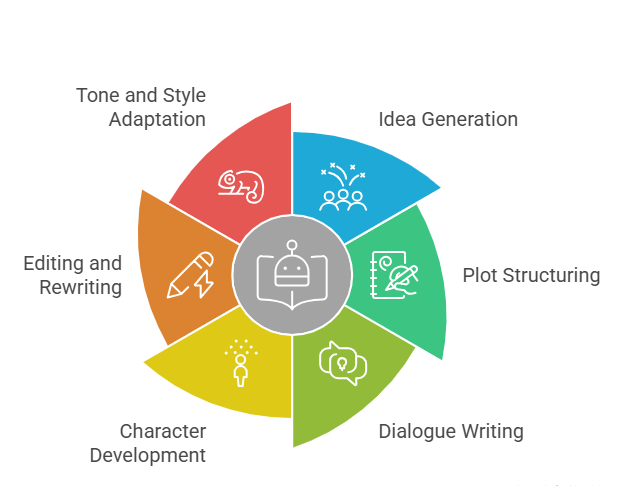
Now, AI can assist at every stage:
- Idea generation
- Plot structuring
- Dialogue writing
- Character development
- Editing and rewriting
More importantly, AI tools today can adapt to tone, genre, and style with impressive accuracy.
This doesn’t mean AI replaces creativity. If anything, it amplifies it.
1. ChatGPT – The Most Versatile Storytelling Companion
Let’s start with the obvious one.
ChatGPT is probably the most widely used AI storytelling tool today, and for good reason. It’s incredibly flexible. You can ask it to write a short horror story, a brand narrative, or even a full screenplay.
What makes it powerful is its ability to handle multiple storytelling formats in one place. You can brainstorm ideas, generate outlines, write scenes, and refine dialogue all within the same conversation.
For marketers, this is gold. You can quickly generate campaign narratives, ad scripts, or even customer journey stories.
Where it shines:
It adapts to almost any genre or tone. You can experiment freely without needing a specialized tool.
Where it struggles:
Long-form consistency can sometimes drift if you’re writing very large stories.
Still, for most users, it’s the perfect starting point.
2. Claude – Best for Long-Form Storytelling
If ChatGPT is your creative assistant, Claude feels more like a patient co-writer.
Claude stands out because of its ability to handle long-form content. It can maintain context across large documents, which means your characters stay consistent, and your plot doesn’t fall apart halfway through.
This is especially useful if you’re working on:
- Novels
- Detailed scripts
- Multi-chapter stories
One thing I personally find interesting is how well it follows nuanced instructions. You can specify tone, perspective, pacing and it actually listens.
The downside?
It’s not as strong in visual storytelling or multimedia outputs.
But for pure writing, it’s one of the best.
3. Sudowrite – Built Specifically for Fiction Writers
Sudowrite is not trying to be everything for everyone. It’s built specifically for storytelling.
And honestly, that focus shows.
It offers features like:
- “Describe” tool for vivid imagery
- “Expand” for turning ideas into full scenes
- “Rewrite” for tone adjustments
What makes Sudowrite different is that it understands storytelling structure. It doesn’t just generate text, it helps you think like a writer.
This is especially helpful if you’re stuck in the middle of a story and don’t know how to move forward.
4. NovelAI – Best for World-Building
If you’re into fantasy or sci-fi, NovelAI is worth exploring.
It excels at:
- Creating detailed fictional worlds
- Maintaining lore consistency
- Developing immersive narratives
Unlike general AI tools, NovelAI is trained heavily on genre-specific content. That means it understands tropes, archetypes, and narrative patterns better in certain genres.
It also includes image generation features, which adds another layer to storytelling.
That said, it’s less effective for non-fiction or marketing-focused narratives.
5. Jasper AI – Ideal for Marketing Storytelling
Jasper AI is widely used in digital marketing, and storytelling is a big part of that.
It’s designed to create engaging, conversion-focused content. Think:
- Brand stories
- Ad copy
- Video scripts
- Landing page narratives
What sets Jasper apart is its focus on tone and brand voice. You can train it to match your brand style, which makes it extremely useful for businesses.
For marketers, this tool is less about fiction and more about persuasive storytelling.
6. Writesonic – Fast and Efficient Story Generation
Writesonic is known for speed.
If you need quick story drafts or content ideas, it delivers fast results without compromising too much on quality.
It’s particularly useful for:
- Short stories
- Blog narratives
- Content ideation
The interface is simple, and you don’t need a steep learning curve.
But yes, it’s not as deep or nuanced as some other tools on this list.
7. Copy.ai – Great for Creative Concepts and Story Hooks
Copy.ai is more of an idea generator than a full storytelling engine.
It excels at:
- Story hooks
- Titles
- Taglines
- Short-form narratives
If you’re starting from scratch and need inspiration, this tool is surprisingly helpful.
However, it’s not ideal for long-form storytelling. Think of it as the brainstorming partner rather than the writer.
8. Squibler – Structured Story Writing
Squibler is designed for writers who need structure.
It helps you:
- Organize chapters
- Outline plots
- Track progress
This makes it especially useful for novelists or scriptwriters working on long projects.
It combines writing tools with project management, which is something many AI tools lack.
9. Canva Magic Write – Visual + Text Storytelling
Storytelling isn’t just about text anymore.
Canva Magic Write combines writing with design, allowing you to create visually engaging stories.
You can:
- Generate text
- Design storyboards
- Create presentations
This is perfect for marketers, educators, and content creators who rely on visual storytelling.
10. AI Dungeon – Interactive Storytelling Experience
AI Dungeon takes a completely different approach.
Instead of generating static stories, it creates interactive narratives where you can:
- Make choices
- Shape the story in real-time
- Explore branching plots
It’s like playing a game and writing a story at the same time.
This makes it incredibly engaging, especially for beginners or those exploring storytelling creatively.
How to Choose the Right Tool
Here’s the tricky part.
There’s no single “best” tool.
It really depends on what you’re trying to do:
- For versatility → ChatGPT
- For long-form writing → Claude
- For fiction → Sudowrite or NovelAI
- For marketing → Jasper or Copy.ai
- For visuals → Canva
Also, many creators don’t rely on just one tool. They combine multiple tools to create a workflow that fits their needs.
Practical Ways to Use AI in Storytelling
Let’s make this actionable.
Here are a few ways you can actually use these tools:
Start with idea generation. Use AI to brainstorm multiple story concepts quickly.
Then move to outlining. Ask the tool to structure your story into acts or chapters.
Next, generate drafts. Let AI create rough versions of scenes.
Finally, refine. Edit, rewrite, and add your personal touch.
This hybrid approach works best.
The Future of AI Storytelling
We’re still early.
AI storytelling is evolving fast, especially with improvements in context memory and instruction-following capabilities.
In the future, we’ll likely see:
- More interactive storytelling
- Better emotional depth
- Multi-modal narratives (text, video, audio combined)
AI won’t replace storytellers. But it will change how stories are created.
Conclusion
Storytelling is no longer limited by time, skill, or creative blocks.
With the right AI storytelling tools, you can generate ideas faster, write better stories, and experiment with creativity in ways that weren’t possible before.
But here’s the important part.
AI is just a tool.
Your creativity, your perspective, your voice that’s what makes a story truly powerful.
Use AI to enhance your storytelling, not replace it.
FAQs
1. What are AI storytelling tools?
AI storytelling tools are software platforms that use artificial intelligence to help create, structure, and refine stories.
2. Can AI write a complete story?
Yes, many tools can generate full stories, but human editing is usually needed for quality.
3. Are AI-generated stories original?
They are generated based on patterns in data, but the output is typically unique.
4. Which tool is best for beginners?
ChatGPT is often the easiest to start with due to its flexibility.
5. Can AI replace human writers?
No, AI enhances creativity but cannot fully replace human storytelling.
6. Are these tools free?
Some offer free versions, while others require subscriptions.
7. Can marketers use AI storytelling tools?
Absolutely. They are widely used for ads, branding, and content marketing.
8. Do AI tools maintain story consistency?
Advanced tools can maintain consistency, especially in shorter texts.
9. Is AI storytelling good for novels?
Yes, tools like Claude and Sudowrite are particularly useful for long-form writing.
10. What is the future of AI storytelling?
It will likely become more interactive, immersive, and integrated with multimedia content.