

Most B2B marketing teams know exactly which accounts they want to land. The problem is never the target list. It’s what happens after: researching each account, tracking buying signals across dozens of stakeholders, and writing personalized outreach at a pace no human team can sustain. That gap between strategy and execution is why so many ABM programs stall at 20 accounts instead of scaling to 200.
An AI agent for account-based marketing is built to close exactly that gap. Instead of another dashboard you have to check manually, it’s a system that researches accounts, flags buying signals, and drafts personalized content on its own, then hands you the finished work to approve. This article walks through what these agents actually do, how to set one up, which platforms are worth your time in 2026, and where the limitations still are.
By the end, you’ll know whether this fits your team’s stage, what to expect in the first 90 days, and how to avoid the mistakes that make most agentic ABM rollouts underdeliver.
What Is an AI Agent, and How Is It Different From a Chatbot?
An AI agent is a software system that can plan a multi-step task, take actions across connected tools, and adjust its next move based on what it finds, without a human prompting every single step. That’s the core distinction that matters here.
A chatbot answers the question you type into it. An automation tool runs the exact same steps every time, regardless of what it encounters. An agent does neither. Give it a goal like “build a briefing on this account before Thursday’s call,” and it will pull firm-o-graphic data, scan recent news, check CRM activity, and pull the whole thing into a document, deciding along the way which sources are worth checking and which aren’t.
That “deciding along the way” part is what makes agentic systems useful for ABM specifically. Account research isn’t a fixed script. Every account has a different tech stack, different stakeholders, and different signals worth chasing. A rigid workflow tool breaks the moment an account doesn’t match the template. An agent adapts.
It’s worth being honest here: not every tool marketed as an “agent” in 2026 actually behaves this way. A lot of vendors slap the label on what’s really a scripted automation with an AI-generated summary bolted on. The real test is whether the system can handle a task it wasn’t explicitly programmed for. If it can only follow the exact steps you configured, it’s automation with better branding, not an agent.
This type of system differs from a chatbot or automation tool because it can plan multi-step tasks, take actions across connected systems, and adjust its approach based on what it finds, rather than executing a fixed script or waiting for a single prompt. For ABM, this matters because account research and outreach personalization rarely follow the same pattern twice.
Read More: AI Agents for Performance Marketing: Automate, Optimize, and Scale
What Is Account-Based Marketing, and Why Is It Straining Under Manual Processes?
Account-Based Marketing is a B2B strategy that flips the traditional funnel: instead of generating broad leads and qualifying them down, teams first identify a specific list of high-value target accounts, then build coordinated, personalized campaigns aimed at the actual decision-makers inside those accounts. From here, we’ll refer to it as ABM, since that’s how most practitioners talk about it day to day.
ABM isn’t a niche tactic anymore. According to Outcomes Rocket’s 2025 State of ABM report, based on 771 marketers across industries, 71.2% of organizations currently run ABM programs, and the average reported ROI across those programs was 137%. That’s not a marginal improvement over broad-funnel marketing. It’s a fundamentally different return profile.
But adoption and satisfaction aren’t the same thing. Demand Gen Report’s 2025 ABM Benchmark Survey found that the top challenges practitioners face are proving ROI (47%), aligning sales and marketing (43%), and scaling programs (40%). That last one, scaling, is the real bottleneck. Most teams can run a tight, personalized ABM motion for 15 or 20 accounts using spreadsheets and manual research. Almost none can do it for 150 accounts without either hiring a much bigger team or automating a meaningful chunk of the research and content work.
AI is already part of the answer, at least on paper. A 2025 analysis found that 84% of marketers now use AI and intent data to enhance personalization in their ABM campaigns. The gap is between using AI tools for isolated tasks and having a system that runs the research-to-outreach pipeline end to end. That same Demand Gen survey found a telling split: 45% of practitioners see real promise in AI for personalization, but nearly 70% say its current effectiveness is limited in practice.
That gap between promise and reality is exactly where an agentic approach is meant to help. Point solutions that generate a single email or summarize a single account don’t move the scaling needle much. A system that chains research, signal detection, and drafting together, and does it without a marketer manually stitching six tools together for every account, is a different proposition.
ABM delivers strong measurable returns, with an average reported ROI of 137% across programs, but scaling remains the top operational challenge, cited by 40% of practitioners in 2025. Most teams can personalize manually for a small account list; almost none can do it manually at 150+ accounts without automating the research and content layer.
Read More: AI Agents for Digital Marketing: The Complete 2026 Guide
How Does an Agent for ABM Actually Work?
At a basic level, an agent built for ABM runs a loop: gather context on an account, decide what’s worth acting on, produce an output, and route that output to a human for approval or to a connected system for execution. The loop repeats per account, continuously, instead of every time a marketer remembers to check.
This is where an AI agent for account-based marketing stops being a concept and becomes a practical layer sitting between your data sources and your go-to-market team. It typically connects to a CRM like Salesforce or HubSpot, an intent data provider, your website analytics, and sometimes a sales engagement platform. From there, it pulls signals: a target account visiting your pricing page three times in a week, a new VP of Marketing starting at a target company, a competitor mention in an earnings call transcript.
The agent doesn’t just surface these signals in a feed. It decides what they mean and what to do next. A new executive hire at a target account might trigger a personalized welcome sequence and a briefing doc for the account owner. A spike in pricing-page visits might trigger a sales alert plus a tailored case study recommendation. None of this requires a marketer to manually configure “if X, then Y” rules for every possible scenario, which is the part that breaks traditional marketing automation the moment an account behaves unpredictably.
Here’s the honest caveat: the quality of everything downstream depends entirely on the data going in. An agent connected to a messy CRM with duplicate accounts and stale firmographic data will confidently produce polished, well-formatted, wrong output. Feeding it clean account data isn’t optional prep work. It’s the actual foundation the whole system runs on.
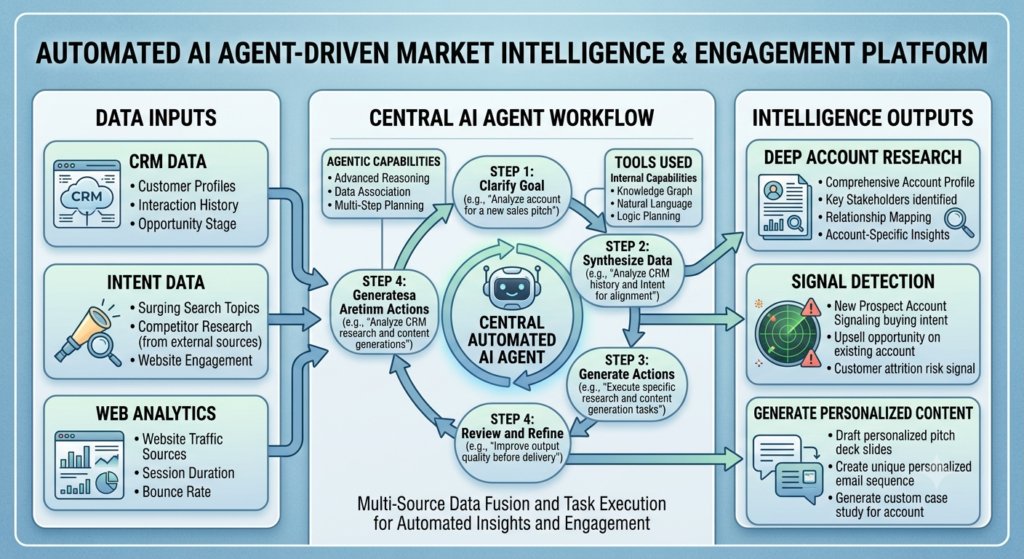
Core Capabilities: What These Agents Actually Do for B2B Teams
It helps to break this down by what the agent is actually producing, rather than talking about it abstractly. Four capabilities show up consistently across the tools B2B teams are using in 2026.
Account Research at Scale
Instead of a marketer spending 30 to 45 minutes reading a target company’s website, recent press, LinkedIn activity, and job postings before a first outreach attempt, the agent compiles that into a structured brief in a few minutes. It pulls company size, funding stage, recent leadership changes, tech stack signals, and relevant news, and organizes it so a rep can skim it before a call instead of digging for it.
Buying Signal Detection
This is pattern-matching across data sources that a human would never check consistently for every account: intent data spikes, job postings for roles related to your product category, executive changes, and competitor mentions. The value isn’t finding one signal. It’s catching signals across an entire account list continuously, which is exactly the part that breaks down when it’s a manual process.
Personalized Outreach Generation
Using the account research as context, the agent drafts emails, LinkedIn messages, or ad copy tailored to that specific account’s situation, not a generic template with a merge field for the company name. This is the part most teams see first, because it’s the most visible output, but it’s only as good as the research feeding it.
Meeting Prep and Account Briefs
Before a sales call, the agent can compile a one-page brief covering what’s changed at the account since the last touch, what content they’ve engaged with, and what talking points are likely to land. In Hotskill’s own testing with marketing teams adopting agentic workflows, reps who used pre-call briefs generated this way cut prep time from roughly 25 minutes per meeting to under 5.
Where this consistently falls short: none of these four capabilities replace judgment on messaging strategy or deal-specific nuance. The agent gives you a strong first draft and a solid research base. A human still needs to decide what actually gets sent, especially for your highest-value accounts where one wrong assumption in an email can cost you the relationship.
Read More: AI Agent for Search Engine Optimization: Benefits, Use Cases & Tools
How to Build Your First ABM Workflow With an Agent, Step by Step
Setting this up isn’t complicated, but skipping steps here is exactly why most rollouts underdeliver. Follow this sequence rather than jumping straight to “turn on the agent and see what happens.”
- Define your target account list first, in a spreadsheet or your CRM. Don’t let the agent build this for you initially. You need to know your ideal customer profile better than any tool does at the start.
- Connect your CRM and one intent data source. Start narrow. HubSpot or Salesforce plus a single intent provider is enough for a first pass. Adding five data sources on day one just adds noise.
- Set the agent’s first job to research, not outreach. Have it build account briefs for your top 20 accounts and review the output by hand before trusting it with anything customer-facing.
- Review a sample of outputs against what you already know about those accounts. If the briefs are missing obvious, easily findable information, the data connections need fixing before you move forward.
- Turn on signal-based alerts for a small subset of accounts. Watch what triggers an alert for a week or two before expanding to the full list.
- Add outreach drafting last, and route every draft through human approval. Nobody should be auto-sending agent-written emails to target accounts without a person reading them first, at least in this early phase.
- Expand the account list gradually, doubling roughly every two to three weeks. This gives you time to catch data quality issues before they touch 300 accounts at once instead of 20.
Read More: AI Agent for Influencer Marketing: Everything Marketers Need to Know
Which Platforms Are Bringing Agents Into ABM Right Now?
The market here moved fast through 2025 and into 2026. A handful of platforms are worth knowing by name, and it’s worth being direct about what each one is actually good at rather than repeating their marketing copy.
Demandbase built its reputation on intent data and account identification, and its agentic features are strongest at signal detection and account scoring. Where it falls short is content generation. Teams often pair it with a separate tool for drafting outreach. Best for: mid-market and enterprise teams that already have a mature intent data strategy and want to layer agentic alerts on top.
6sense plays in a similar space, with a stronger focus on predictive account scoring and pipeline forecasting. Its agent-style features lean toward telling you which accounts are in-market, rather than drafting the content itself. Best for: revenue teams that want signal detection tightly wired into forecasting.
Salesforce Agentforce is the most ambitious play here, aiming to run agents natively inside the CRM for both sales and marketing tasks. It’s genuinely strong if your team already lives in Salesforce, since it avoids the integration overhead of a third-party tool. The tradeoff: it’s a heavier lift to configure well, and teams outside the Salesforce ecosystem get less value from it. Salesforce’s own Agentic Enterprise Index reported that customer service conversations handled by its autonomous agents grew at a compound monthly rate of over 2,000% between January and June 2025, which signals real production usage rather than a pilot that never scaled.
HubSpot Breeze is the more accessible option for smaller B2B teams, with agentic features built into a platform many marketing teams already know. It’s less powerful for deep account research than Demandbase or 6sense, but it’s a reasonable starting point if you’re not ready for a dedicated ABM stack.
Clay deserves a mention even though it’s not marketed purely as an ABM tool. It’s genuinely excellent for building custom research and enrichment workflows that behave agent-like, chaining data sources together per account. The learning curve is steeper than the others on this list, and it’s built for teams with someone comfortable configuring workflows rather than a fully out-of-the-box experience.
Pricing across all five varies by seat count and data volume, and every vendor here changes tiers often enough that a specific number quoted today won’t hold for long. Get a current quote directly before budgeting, as of 2026.
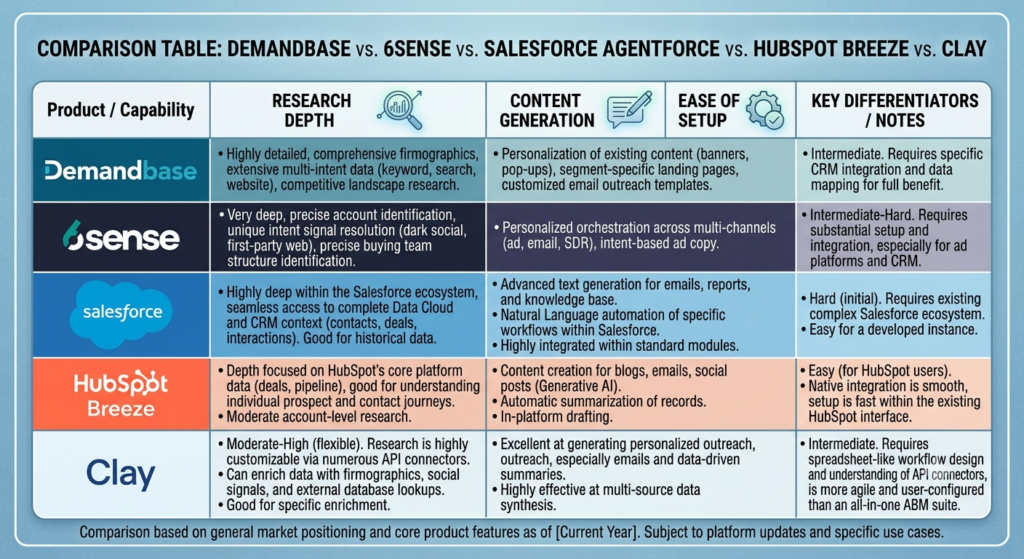
Where Agents Fall Short: Limitations B2B Teams Should Plan For
It’s worth being direct about this, because most vendor pages won’t be. Agentic ABM tools have real limitations, and pretending otherwise sets teams up for disappointment in month two.
Data quality is the biggest one. An agent pulling from a CRM with duplicate records, outdated titles, or missing firmographic fields will produce output that looks polished and is quietly wrong. Fixing this after the fact costs more time than fixing it before rollout.
Judgment on tone and strategy is the second. Agents are strong at research and first-draft generation. They’re weaker at knowing when an account needs a completely different approach because of something political or sensitive happening internally, information that often isn’t in any data source the agent has access to.
Buyer trust in AI-generated interactions is a real, current concern. Gartner’s research on B2B buying found that 69% of B2B buyers still prefer to validate AI-generated insights with a human sales rep, which reinforces that agents work best as a drafting and research layer feeding human-approved outreach, not a fully autonomous customer-facing channel, at least for now.
And integration overhead is real, especially for teams without a dedicated RevOps or marketing ops function. Connecting a CRM, an intent data source, and an outreach tool cleanly takes actual technical setup time, not a five-minute onboarding flow, regardless of what a sales demo suggests.
The main limitations of agentic ABM tools are data quality dependency, weaker judgment on sensitive account-specific nuance, and continued buyer preference for human validation, with 69% of B2B buyers wanting to verify AI-generated insights with a sales rep. Teams that treat agents as a research and drafting layer, rather than a fully autonomous channel, get the most reliable results.
Read More: AI Agent for Affiliate Marketing: How to Automate Your Affiliate Business
Getting Started: A Practical Rollout Plan
If you’re evaluating this for your team, don’t start by shopping for tools. Start by auditing your current ABM bottleneck. If your team’s real problem is finding accounts to target, the fix is different from a team whose problem is personalizing content once accounts are already identified.
For teams under 10 people, start with one platform that combines research and drafting rather than stitching together three separate tools. The integration overhead alone will eat any time savings for a small team. For teams with a dedicated RevOps function, a best-of-breed stack, like Demandbase for signals paired with a separate drafting tool, usually outperforms an all-in-one platform over time.
Budget 60 to 90 days before expecting reliable output, not because the tools are slow, but because getting your underlying data clean enough to trust takes that long for most teams. Anyone promising results in week one is either working with an unusually clean CRM already, or setting expectations that won’t hold.
Where This Leaves Your ABM Program
The teams getting real value from this aren’t the ones chasing the flashiest agent on the market. They’re the ones who fixed their CRM data first, started with a narrow account list, and kept a human reviewing outputs before anything reached a target account. That discipline matters more than which platform you pick.
If you’re ready to move past manual account research, start with one data connection and twenty accounts, not your full target list. Validate the output, then expand. That’s the difference between a rollout that sticks and one that gets quietly abandoned by month three.
Hotskill has structured lessons on building agentic workflows like this one, step by step, without the trial and error. Download the app on iOS or Android, and start your first lesson today.
Frequently Asked Questions
What tasks can an agent handle in an ABM program?
It’s a software system that researches target accounts, detects buying signals, and drafts personalized outreach with minimal manual input, adjusting its approach per account rather than following one fixed script. It sits on top of your CRM and data sources, turning raw account data into research briefs and content drafts a marketing or sales team can review and use.
How is this different from the marketing automation I already have?
Traditional automation follows the exact rules you configure, like “if a contact opens three emails, send email four.” An agent can handle situations you didn’t explicitly program for, deciding what’s relevant for a given account based on the data it finds. Automation is reliable and rigid. Agents are adaptive but need more oversight, especially early on.
Do I need a large ABM program already running before adopting an agent?
No, but you do need a defined target account list and at least one connected data source, like your CRM. Teams sometimes assume they need mature ABM infrastructure first. In practice, a clean list of 20 to 30 accounts is a reasonable starting point.
Which platform should a small B2B team start with?
For teams without a dedicated ops function, an all-in-one platform like HubSpot Breeze reduces integration overhead, even though it’s less powerful for deep research than a specialized tool like Demandbase or 6sense. Start narrow and expand once you trust the output.
Is this worth it if my team already has a full-time ABM manager?
Usually yes, because the value isn’t replacing that person, it’s removing the manual research and first-draft work that eats most of their week. A skilled ABM manager using an agent to handle research and drafting can typically cover a larger account list without burning out.
Why isn’t my agent producing useful account briefs?
The most common cause is poor underlying data, duplicate CRM records, missing firmographic fields, or a disconnected intent data source. Check the data quality before assuming the tool itself is the problem. A second common cause is asking it to cover too many accounts before validating output on a small sample first.
Can an agent send outreach emails without a human reviewing them first?
Technically yes, but it’s not recommended for target accounts, especially early in a rollout. Most teams route every AI-drafted message through human approval, particularly for high-value accounts where a wrong assumption in the copy can damage the relationship rather than just underperform.
Do I need to know how to code to set one of these up?
No. Most current platforms, including HubSpot Breeze and Salesforce Agentforce, are built for marketers to configure through a standard interface. Tools like Clay have a steeper learning curve and benefit from someone comfortable with workflow logic, but coding knowledge isn’t required for any of the mainstream options.
How long before an agentic ABM rollout shows real results?
Budget 60 to 90 days before expecting consistently reliable output. Most of that time goes into cleaning CRM data and validating research quality on a small account sample, not configuring the tool itself. Teams that skip this validation step tend to see disappointing results in month one and abandon the effort too early.
Will an AI agent replace the need for a human ABM strategist?
No. Agents are strong at research, signal detection, and first-draft content, but weak at strategic judgment calls specific to a deal or relationship. The teams getting the most value treat the agent as a research and drafting layer that frees up a strategist’s time, not a replacement for that strategic role.