

Your Facebook Ads are finally working. Clicks are landing, conversions are steady, and ROAS actually looks… beautiful.
You’ve got momentum and now you’re at that moment.
The crossroads.
You want more results. More customers. More revenue. Maybe even double what you’re getting now.
Naturally, that means scaling.
But here’s the truth most marketers learn the hard way:
Scaling Facebook Ads is easy. Scaling without destroying ROAS is not.
Increase your budget too fast?
Break your best audiences?
Reuse the same creatives for too long?
Your ROAS collapses, your CPC spikes, and your once-perfect campaign suddenly becomes a headache.
Been there.
That’s why this guide is all about how to scale Facebook Ads the smart way without your ROAS falling off a cliff.
Let’s get into it.
Scaling Isn’t Just “Spend More”
Most people think scaling = increase your budget.
If only.
Real scaling is about increasing volume without breaking performance. Increasing your budget without a proper strategy will do the exact opposite.
When scaling fails, it’s usually because of:
- Audience fatigue → same ads shown too often
- Raising budgets too fast → campaigns slip back into learning
- No creative variation → ads go stale
- Wrong signals → CTR looks okay, but ROAS is tanking
Scaling is like climbing a steep trail. The start is smooth. Then the incline hits. If you push hard without pacing yourself, you burn out fast.
So before scaling, get your foundation right
Know When You’re Actually Ready to Scale
This is where most advertisers mess up.
They scale too early.
You’re only ready to scale when you see at least 7–14 days of consistent, stable performance at your current budget.
Look for:
- Stable or dropping CPA
- Steady conversion rate
- Engagement still strong (CTR not dropping)
- Ad sets moving out of the learning phase
- Frequency rising slightly, but performance holding
Think of scaling like a long road trip.
You don’t hit the freeway at 90 mph immediately.
You prep. You check the car. You fuel up.
Same with ads. Prep if you want to go far.
Two Ways to Scale Ads (and How to Use Them Right)
You control two levers when scaling:
1. Vertical Scaling — Increase budgets on winning campaigns
2. Horizontal Scaling — Expand to new audiences
A winning scaling strategy uses both.
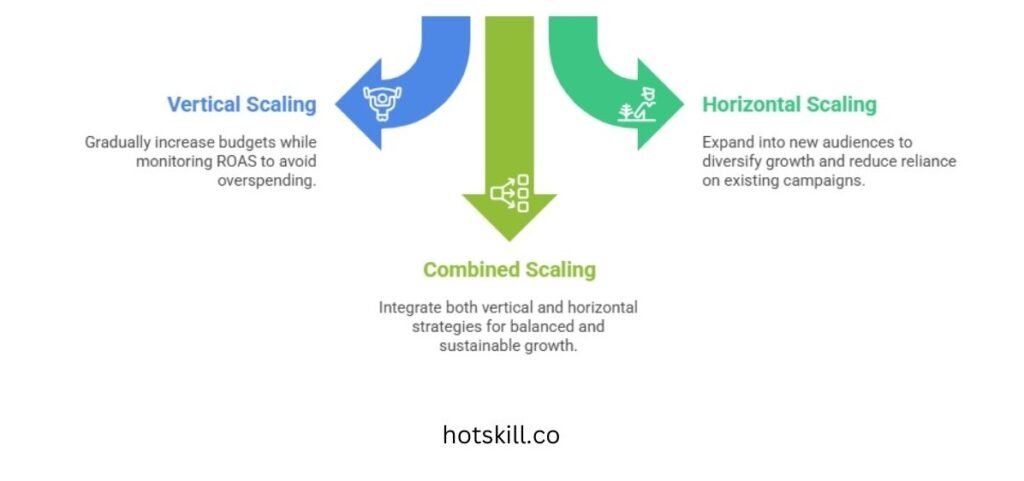
A. Vertical Scaling: Spend More Without Breaking Everything
This is the default approach: raise the budget.
But don’t do it aggressively.
Increase budgets by 20–30% every 3–4 days, not overnight.
If ROAS holds, keep going.
If it drops, stop and assess.
Best practices:
- Increase budgets gradually, not from ₹500 to ₹1,000 overnight
- Use cost caps or minimum ROAS targets for protection
- Track spikes in CPM or frequency (the earliest signs of trouble)
Scaling vertically is like adding weight at the gym.
You don’t double the plates—you go up slowly, with clean form.
B. Horizontal Scaling: New Audiences = New Growth
This is where real, sustainable scale happens.
Instead of pushing the same campaigns harder, you expand sideways into new audiences.
Ways to do it:
- Create new lookalike audiences (1%, 2%, 5%, 10%—test all)
- Combine interests (intent + lifestyle)
- Try new countries or regions
- Create audiences based on high-value customers
Scaling horizontally is like planting more seeds, not overwatering the same one.
C. The Real Power: Do Both Together
The magic happens when you:
- Slightly increase budgets (vertical)
- Introduce fresh audiences (horizontal)
This keeps volume growing without stressing any single audience or creative.
That’s how you build a scalable system, not random wins.
Creatives Matter More Than Anything
Here’s the brutal truth:
Creatives determine whether scaling works or dies.
Not budgets.
Not audiences.
Not placements.
When scaling, fatigue arrives fast. And when creatives tire, everything falls apart.
What to do:
🧠 Test constantly:
- Carousel ads
- 15-second UGC videos
- Story-style formats
- Poll ads
- Multiple headline variations
💡 Watch for fatigue indicators:
- CTR dropping
- Frequency rising
- CPC climbing
- CPM suddenly increasing
Even small creative tweaks—colors, headlines, angles—can reset performance.
One example:
A sportswear brand swapped polished studio photos for raw customer videos.
ROAS held for 30+ days even at 6x higher spend.
Creatives = oxygen.
Without them, scaling suffocates.
Budget Settings That Give You Actual Control
Facebook offers multiple ways to manage budgets. Use the right setup at the right time.
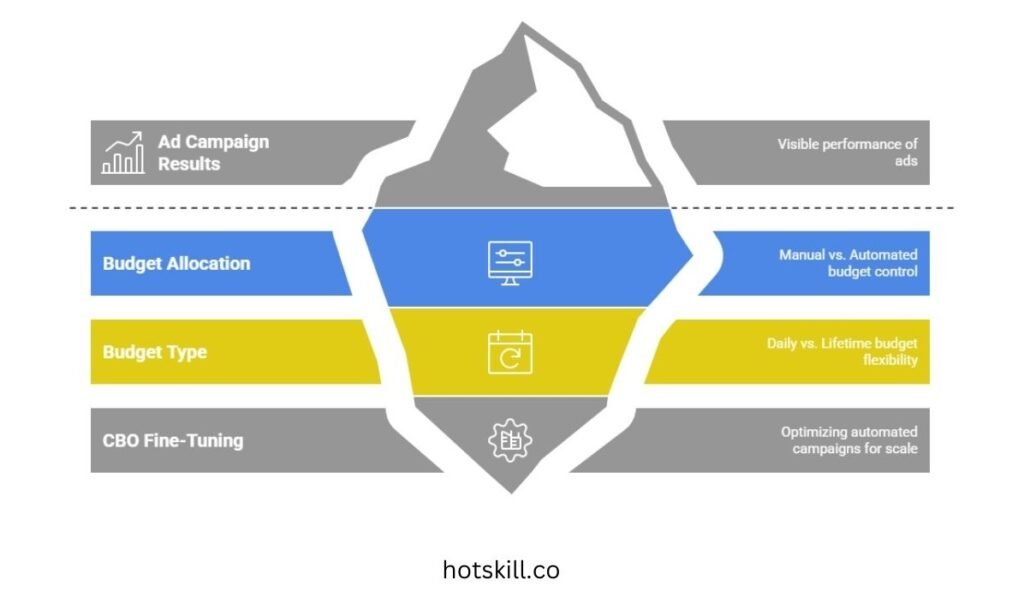
A. Manual vs. Automated
Manual (ABO)
- Best for testing
- Full control of ad set spend
Automated (CBO)
- Best for scaling
- Facebook optimizes distribution
Ideal flow:
- Test using ABO
- Move winners into CBO
- Add minimum ROAS or cost controls
B. Daily vs. Lifetime Budgets
Daily = consistent spend
Lifetime = flexible distribution
Use lifetime budgets for:
- Seasonal events
- Flash sales
- Festivals
- Launches
C. Fine-Tune CBO for Scale
Once stable:
- Move best audiences & creatives into one CBO
- Add ROAS floors
- Let Meta optimize while you supervise
Scaling becomes smoother when you stop micromanaging.
What You Should Actually Watch When Scaling
Don’t “set and forget” once you raise budgets.
Scaling requires close monitoring.
Track:
- ROAS → the king metric
- CTR → creative performance
- Frequency → audience fatigue
- CPM → market competitiveness
- CPA → cost efficiency
Use dashboards (Looker Studio, Supermetrics, Triple Whale) to simplify reporting.
If you’re spending ₹50K+/day and manually checking Ads Manager, you’re doing too much.
What to Do When Performance Drops
Scaling always comes with bumps.
Here’s how to fix them fast.
A. Ad Fatigue
Symptoms:
- CTR down
- Frequency high
- CPM rising
Fixes:
- New creatives
- UGC videos
- Different angles
- Rotate ads weekly (high spend)
Never throw more budget at tired ads.
B. Audience Burnout
Fixes:
- Expand interest layers
- Test new regions
- Refresh your creative angle
- Try broader lookalikes
C. ROAS Drops When Scaling Budgets
The biggest red flag.
Fix:
- Use cost caps
- Set minimum ROAS
- Kill bottom performers
- Pull back 20–30% to stabilize
Scaling is not a straight line. It’s a rhythm.
Advanced Scaling Strategies
Once you’ve mastered the basics, move to pro-level tactics.
A. Aggressive Retargeting
Your cheapest conversions live here.
Examples:
- Healthcare → incomplete appointments
- Education → incomplete enrollments
- SaaS → pricing page visitors
- E-commerce → abandoned carts
B. First-Party Data Power Moves
Upload customer lists. Build smarter lookalikes.
Facebook rewards strong signals.
C. Automation Rules
Life-changing.
Examples:
- If ROAS < 2 for 3 days → pause
- If CTR > 3% → increase budget by 20%
- If CPA spikes → email alert
Scale even while you sleep.
Real Brands. Real Lessons.
🧴 Skincare Brand
Scaled from ₹25K/day to ₹2L/day with:
- New creatives every 5 days
- Age-based testimonial rotation
- Gradual budget increases
ROAS stayed at 3.4x.
🚨 SaaS Brand
Doubled budget without new creatives.
CPA increased 60%.
ROAS cut in half.
Lesson: No creative refresh = no successful scaling.
💰 Fintech Brand
Built lookalikes from activation behaviors.
Paired with simple video explainers.
ROAS jumped from 2.8 → 4.1.
The pattern?
Smart creatives. Smart scaling. Smart decisions.
Final Thoughts: Scaling Facebook Ads Is a Process, Not a Power Move
Scaling Facebook Ads isn’t guesswork.
It’s not about dumping money and hoping for the best.
It’s about:
- Pacing your increases
- Watching the right metrics
- Refreshing creatives
- Expanding audiences carefully
- Using automation & controls
- Making data-backed decisions
Every scaling move is a decision.
Stack enough good decisions together, and you create unstoppable momentum.