

Most e-commerce teams are running the same playbook: a Klaviyo flow here, a Meta Ads campaign there, a support inbox nobody fully keeps up with, and a spreadsheet tracking what’s supposed to happen next. It works, until the catalog grows, traffic splits across five channels, and the team doesn’t. That’s the gap AI Agents for E-commerce Marketing are built to close. They don’t just draft copy or answer a support ticket. They plan a task, take action inside your store’s systems, and check whether it worked, without someone babysitting every step.
This guide skips the hype. You’ll get a clear definition of what these agents actually do, the strategies worth building around them, seven tools reviewed honestly (including where they fall short), and real use cases you can copy. If you run marketing for a store doing six or seven figures and you’re deciding whether this is worth your time this quarter, you’re in the right place.
What Is an AI Agent, Really?
An AI Agent for E-commerce is a system that can plan a multi-step task, take real actions inside your store’s tools, and adjust based on the outcome, without a human writing out every instruction. That’s the core difference from a chatbot or a basic automation rule, and it’s worth sitting with for a second.
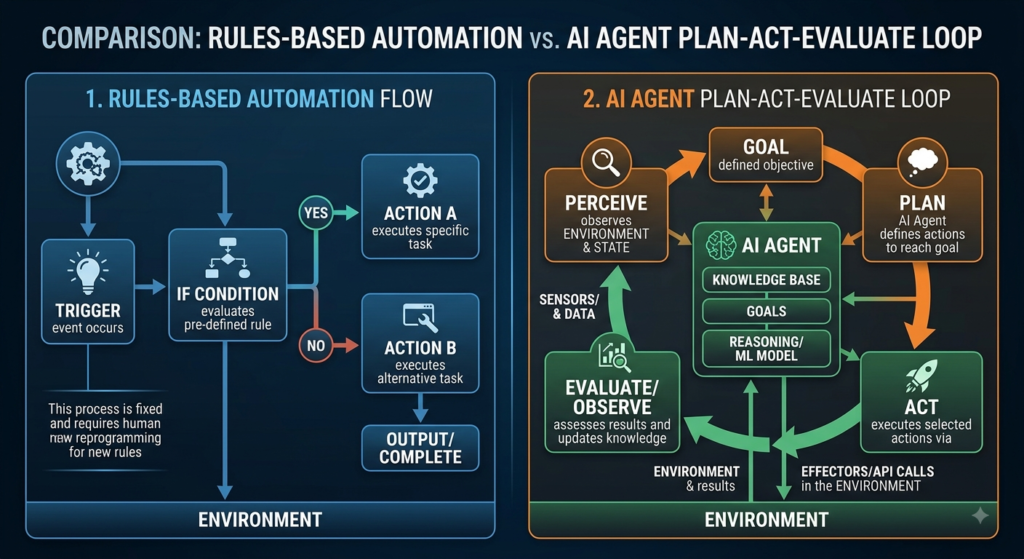
A chatbot answers what it’s asked. A rules-based automation (“if cart abandoned, send email after 1 hour”) only does what you pre-programmed. An agent gets a goal (“recover as much abandoned cart revenue as possible this week”) and works out the steps: check inventory, personalize the offer, pick the channel, send it, watch whether it converted, and adjust the next attempt. It’s closer to a junior team member than a tool.
This shift is part of a broader move toward AI in E-commerce Marketing that goes past content generation and into actual execution. Most stores are still using AI to write product descriptions or subject lines. Agents go further: they run the campaign, not just the copy for it.
The core difference between a marketing agent and a standard automation rule is the loop it runs: plan a step toward a goal, take the action, check the result, then adjust. A fixed workflow just executes the same script regardless of outcome, which is why agentic tools are outperforming rule-based automation on tasks like cart recovery and ad budget allocation.
Why E-commerce Brands Are Adopting AI Agents Now
Three things changed at once: catalogs got bigger, channels multiplied, and the tools got good enough to trust with real actions instead of just drafts.
According to a Morgan Stanley forecast cited in recent e-commerce industry coverage, nearly half of online shoppers are expected to use AI shopping agents by 2030, with those agents influencing roughly a quarter of total spending. That’s not a distant trend. It’s already changing how product pages, reviews, and structured data need to be built, because AI agents on the buyer’s side are now part of the discovery process, not just the seller’s side.
On the operational side, customer experience platforms like Gorgias and Ada report that autonomous AI agents can cut manual support ticket volume by up to 80% for teams that implement them properly. That’s hours per week that move from answering “where’s my order” to actually working on retention and campaigns.
E-commerce marketing automation used to mean if-this-then-that email flows. It’s now closer to a small team of specialized agents, each handling one job (retention, support, ad optimization) and reporting outcomes back. That’s a real shift in what “automation” gets you.
Buyer-side AI is moving just as fast. As AI-powered e-commerce platforms and shopping assistants become the default entry point for product discovery, structured, accurate product data matters more than it did when a human was the only one reading your listings.
Morgan Stanley projects nearly half of online shoppers will use AI shopping agents by 2030, influencing about 25% of e-commerce spending. Customer service platforms report up to 80% reductions in manual support tickets after deploying autonomous AI agents. Together, these numbers explain why agentic tools moved from experimental to standard in e-commerce teams during 2026.
Core Strategies for Using AI Agents in Marketing
Buying a tool isn’t a strategy. Here’s where AI agents actually move revenue, not just save time.
Personalization at Scale
Static segments (“customers who bought skincare”) are being replaced by agents that build a live profile per shopper and adjust offers, product recommendations, and email content in real time. The agent watches browsing behavior, purchase history, and even response to past offers, then decides what to show next without a marketer manually building a new segment every time behavior shifts.
Honestly, this is the use case that pays off the most for most stores. A 500-SKU catalog can’t be personalized manually at any real depth. An agent can do it per visitor.
Dynamic Pricing and Promotions
Agents can monitor competitor pricing, inventory levels, and demand signals, then adjust discounts or bundle offers within guardrails you set. This isn’t the same as a race-to-the-bottom pricing bot. Done well, it protects margin on slow movers and pushes urgency on high-demand items without a person checking spreadsheets daily.
Set hard floors before you turn this on. An agent without margin guardrails will optimize for conversion, not profit, and those aren’t the same goal.
Automated Customer Service and Retention
This is where AI-powered e-commerce marketing and support genuinely overlap. Support agents that can check order status, process a return, and answer sizing questions autonomously free up your team to handle the cases that actually need judgment. And because these interactions carry purchase intent, a well-built support agent doubles as a sales channel, not just a cost center.
AI-Driven Ad Campaign Optimization
Agents connected to ad platforms can shift budget between campaigns, pause underperforming creative, and test new angles based on real-time return on ad spend, not a weekly manual review. The difference from Meta’s or Google’s own automated bidding is scope: a marketing agent can pull in your inventory levels and margin data too, not just click and conversion signals.
Abandoned Cart Recovery and Lifecycle Marketing
Instead of a fixed three-email cart sequence, an agent can decide the channel (email, SMS, WhatsApp), the offer, and the timing per shopper based on what’s worked for similar profiles before. That’s a meaningfully different result than the same generic sequence going to everyone.
7 AI Agent Tools for E-commerce, Reviewed in Detail
This isn’t a list of every tool with a landing page. These are the ones worth your evaluation time in 2026, with honest notes on where each one is strong and where it isn’t.
Shopify Magic & Sidekick, Best Free Starting Point
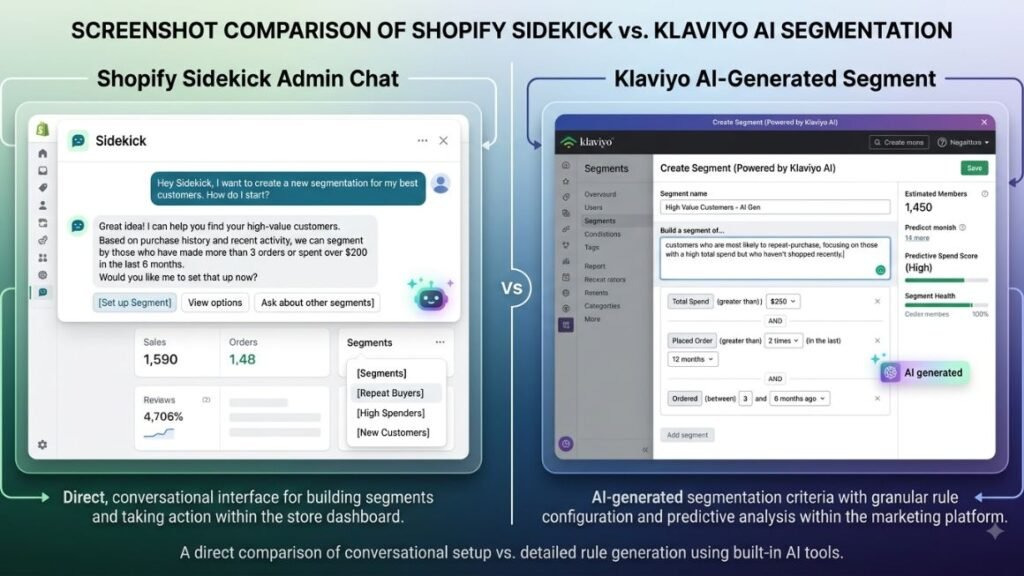
What it does: Shopify Magic is the platform’s built-in generative AI layer (product descriptions, image editing, SEO metadata, email subject lines). Sidekick is the conversational agent inside Shopify Admin that can answer questions about your store’s data and take admin actions when you confirm them, like editing products or building customer segments.
What it does well: It’s free on every Shopify plan and already inside your workflow, so there’s no new login or integration. Merchants report Magic handles the bulk of routine content generation, saving several hours a week on descriptions and metadata alone.
Where it falls short: Output quality on product descriptions leans generic until you tighten brand voice settings, and the advanced agentic features (Sidekick Pulse, multi-agent workflows) are largely reserved for Shopify Plus merchants. It’s a strong starting point, not a full marketing agent stack on its own.
Best for: Any Shopify store that hasn’t turned on native AI features yet. Start here before paying for anything else.
Pricing: Free, included in all Shopify plans as of 2026.
Klaviyo AI, Best for Retention Marketing
What it does: Klaviyo layers predictive analytics, send-time optimization, and AI-generated segments on top of its existing email and SMS platform.
What it does well: If you’re already running Klaviyo, the AI features extend flows you’ve already built instead of replacing your setup. Predictive send-time and product recommendation logic genuinely lift open and click rates without added manual work.
Where it falls short: It’s an enhancement layer, not a standalone agent. Klaviyo AI won’t plan a campaign strategy or act outside the email/SMS channel. If your growth problem is ads or support, this tool won’t touch it.
Best for: Stores with an existing Klaviyo setup that want to sharpen retention without switching platforms.
Pricing: AI features are bundled into paid Klaviyo plans, which scale with contact list size, as of 2026.
Salesforce Agentforce for Commerce, Best for Enterprise Catalogs
What it does: Agentforce deploys specialized agents across the shopping journey: product discovery, merchandising, and post-purchase support, built on Salesforce’s Commerce Cloud data.
What it does well: For large catalogs with complex merchandising rules, Agentforce can coordinate multiple agents (a discovery agent, a support agent, a merchandising agent) working from one shared customer and product data model, which avoids the mismatched-data problem you get when stitching together separate point tools.
Where it falls short: The setup and learning curve are real. This is not a weekend implementation, and it’s overkill for a small catalog or a lean team.
Best for: Enterprise or mid-market brands already running on Salesforce with a large SKU count.
Pricing: Enterprise pricing, quoted per implementation as of 2026.
Gorgias AI Agent, Best for Support-Led Retention
What it does: Gorgias runs an autonomous support agent that resolves order status, returns, and product questions directly inside your helpdesk, escalating only what it can’t confidently handle.
What it does well: Teams using Gorgias and comparable platforms report ticket volume reductions of up to 80% for common queries, which is the kind of time savings that actually shows up in headcount planning. It also tags recurring issues, which feeds directly back into your marketing and product decisions.
Where it falls short: It’s a support-first tool. It doesn’t run ad campaigns or build audience segments, so pair it with a retention or ads-focused tool rather than expecting it to cover marketing end to end.
Best for: Stores with high ticket volume where support quality is affecting repeat purchase rate.
Pricing: Tiered plans based on ticket volume, as of 2026.
Bloomreach, Best for Unified Search, Personalization, and Marketing
What it does: Bloomreach runs an AI layer across product discovery, on-site personalization, and lifecycle marketing in one platform, rather than three separate tools.
What it does well: For teams tired of stitching together a search tool, a personalization tool, and an email platform, having one data model across all three genuinely reduces the “why don’t these numbers match” problem. It’s the closest thing on this list to a full-stack suite.
Where it falls short: It’s a heavier lift to implement than a point solution, and it’s a meaningful investment for smaller catalogs where the ROI curve takes longer to prove out.
Best for: Mid-size to large teams ready to consolidate multiple point tools into one platform.
Pricing: Custom enterprise pricing as of 2026.
Rebuy Engine, Best for On-Site Upsell and Cross-Sell
What it does: Rebuy runs AI-driven product recommendations, post-purchase upsells, and personalized bundles directly on your storefront and in checkout.
What it does well: The recommendation logic adapts per shopper in real time rather than showing the same “customers also bought” block to everyone, which meaningfully lifts average order value on stores with a broad catalog.
Where it falls short: It’s narrowly focused on on-site merchandising. It won’t touch your ad spend, email flows, or support tickets, so it’s a complement to a broader stack, not a replacement for one.
Best for: Stores looking to lift average order value without a full platform migration.
Pricing: Tiered monthly plans based on store revenue, as of 2026.
Persado, Best for AI-Generated Marketing Copy at Scale
What it does: Persado uses language-analysis models to generate and test marketing copy variations (subject lines, ad copy, push notifications) optimized for emotional response and conversion.
What it does well: For teams running high-volume campaigns across many segments, Persado’s testing engine finds copy angles a human team wouldn’t have time to test manually, and it explains why a variation won.
Where it falls short: It’s a copy and testing tool, not an execution agent. It won’t send the campaign or manage the channel strategy on its own; you still need a platform to deploy what it generates.
Best for: Larger marketing teams running high-volume, multi-segment campaigns that need constant copy testing.
Pricing: Enterprise pricing, quoted per implementation as of 2026.
Real-World Use Cases
These examples are composites drawn from common patterns across mid-market stores, not single case studies, since AI Agents for E-commerce are still new enough that few brands publish hard numbers publicly.
Abandoned cart recovery, reworked. A mid-size apparel brand replaced its fixed three-email abandoned cart sequence with an agent that chose the channel and offer per shopper. First-time visitors got a soft reminder email. Repeat customers who’d abandoned twice before got an SMS with a smaller, targeted discount instead of a blanket 15% off. The result wasn’t a flashy headline number, but the pattern was consistent: recovery rate improved because the offer matched the shopper instead of a single sequence trying to fit everyone.
Support tickets that convert. A skincare brand connected its support agent to product and inventory data so it could answer “which one is right for oily skin” questions directly in chat, not just process returns. That single change turned a chunk of support conversations into a discovery channel, something a rules-based chatbot with scripted answers never managed to do.
Ad spend that reallocates itself. A home goods store used an agent to shift daily ad budget between Meta and Google based on real-time margin data, not just click-through rate. Campaigns selling lower-margin items got capped automatically, and budget flowed to higher-margin bestsellers instead, without someone checking dashboards every morning.
In Hotskill’s own AI skill tracks, we’ve found that marketers who understand how to set clear guardrails before deploying an agent, discount limits, brand voice, escalation rules, see meaningfully fewer “the AI did something weird” incidents in their first month than those who turn a tool on and walk away.
How to Start Using AI Agents in Your Store
- Step 1: Pick one workflow, not five. Choose the single highest-friction task, usually cart recovery, support, or ad budget allocation, and start there. Trying to deploy agents across your whole stack at once is how teams end up with conflicting automations.
- Step 2: Set guardrails before you set goals. Define discount limits, brand voice rules, and what requires human approval before the agent takes its first action. This is the step most teams skip and regret.
- Step 3: Connect clean data. An agent making pricing or personalization decisions on messy inventory or customer data will make confidently wrong decisions. Fix your data hygiene first.
- Step 4: Run it in shadow mode. Most platforms let you review the agent’s proposed actions before it executes them automatically. Use this for at least two weeks before granting full autonomy.
- Step 5: Measure against a baseline, not a vibe. Track the specific metric the agent is meant to move (recovery rate, ticket resolution time, AOV) against your last 30 days without it, not against general “it feels better.”
- Step 6: Expand one workflow at a time. Once the first agent is proven, add the next. Stacking untested agents on top of each other makes it impossible to tell which one is driving results.
Challenges and Limitations to Know Before You Deploy
No agent is fully hands-off, and any tool that markets itself that way is overselling. Agents can still make confidently wrong calls, especially on pricing or returns, if guardrails are loose. Data quality problems that were invisible in a manual workflow become visible fast once an agent is acting on that data automatically. And integration overhead is real: connecting an agent to your inventory system, CRM, and ad accounts takes real setup time, not the “five-minute install” some vendor pages imply.
The honest take: agents are a genuine step up from static automation rules, but they need the same oversight you’d give a new hire in their first month, not less.
Getting Started
If there’s one takeaway here, it’s this: don’t try to deploy five agents at once. Pick the workflow costing you the most time or revenue right now, whether that’s cart recovery, support tickets, or ad budget, set clear guardrails, and prove it out before expanding. The brands getting real results from AI Agents for E-commerce Marketing aren’t the ones with the biggest tool stack. They’re the ones who started with one workflow and actually measured it.
Hotskill breaks down exactly how to set up and manage AI agents like these, with hands-on lessons built for marketers, not developers. Download the app on iOS or Android and start your first lesson today: hotskill.co/download
FAQ
What do these tools actually do for an online store?
They plan and carry out marketing tasks, like personalizing offers, recovering abandoned carts, or adjusting ad budgets, based on a goal you set, rather than following a fixed rule. The system acts, checks the result, and adjusts, which is what separates it from a standard automation workflow.
AI agents vs marketing automation, what’s the difference?
Traditional marketing automation follows fixed if-this-then-that rules you build once. An AI agent works toward a goal, choosing the specific action, channel, and timing itself, and it adjusts based on what worked last time. Automation executes a script; an agent makes decisions within boundaries you set.
How do I use an AI agent for abandoned cart recovery?
Connect the agent to your store’s cart and customer data, set guardrails on discount depth and channels, then let it choose the offer, timing, and channel per shopper instead of sending the same fixed email sequence to everyone. Most platforms let you review proposed actions before granting full automation.
Is it worth it for a small store under $1 million in revenue?
Start with the free tools first, Shopify Magic and Sidekick cover a meaningful chunk of content and admin work at no extra cost. Paid, specialized agents make more sense once your catalog or support volume is big enough that manual work is genuinely costing you sales, not just time.
Do I really need a dedicated AI agent if I already use Klaviyo or Shopify’s built-in tools?
It depends on the gap. If your existing tools already cover personalization and content well, you may only need a support or ad-optimization agent to fill in what’s missing, rather than a full platform switch. Audit where manual work is actually costing you revenue before adding another tool.
Why isn’t my AI agent giving good recommendations?
The most common cause is messy or incomplete data, an agent personalizing on inaccurate inventory or customer history will make confidently wrong calls. Check your data hygiene and guardrail settings before assuming the tool itself is the problem.
Do I need to know how to code to use these tools?
No. Every tool covered here, Shopify Sidekick, Klaviyo AI, Gorgias, Rebuy, is built for marketers to configure through a standard interface, not a developer. Enterprise platforms like Salesforce Agentforce and Bloomreach involve more setup, but that’s implementation support, not coding on your end.
How much does it cost to add AI agents to my marketing stack?
It ranges widely. Shopify’s native AI tools are free, Klaviyo and Rebuy scale with your list size or revenue, and enterprise platforms like Salesforce Agentforce or Bloomreach are quoted per implementation. Most stores can start with free or low-cost tools and add paid, specialized agents as specific gaps show up.
Can AI agents replace my marketing team?
No, and treating them that way is where most deployments go wrong. Agents handle repetitive execution well, sending the right offer to the right shopper, adjusting ad budget, resolving routine tickets, but strategy, brand judgment, and handling edge cases still need a person.
What’s the biggest mistake brands make when adopting AI marketing automation?
Turning an agent loose without guardrails. Discount limits, brand voice rules, and clear escalation paths need to be set before the agent takes its first autonomous action, not adjusted after something goes wrong.