

Your product pages look fine. Your ads are running. Your email flows are set up. And your conversion rate still sits somewhere between “acceptable” and “we should probably fix this.” That gap between effort and revenue is exactly where most e-commerce teams get stuck in 2026, and it’s the reason so many are turning to AI agents instead of adding more headcount or more tools that need babysitting.
An AI Agents for E-commerce Marketing isn’t another dashboard you have to check every morning. It’s software that can plan a task, take action, and adjust based on what happens, without someone approving every step. That distinction matters more than it sounds like it should, because most of what marketers call “AI tools” are really just smarter autocomplete. This article breaks down what these agents actually do, which ones are worth your budget, and how to put them to work without turning your store into a science project.
What Is an AI Agents for E-commerce Marketing?
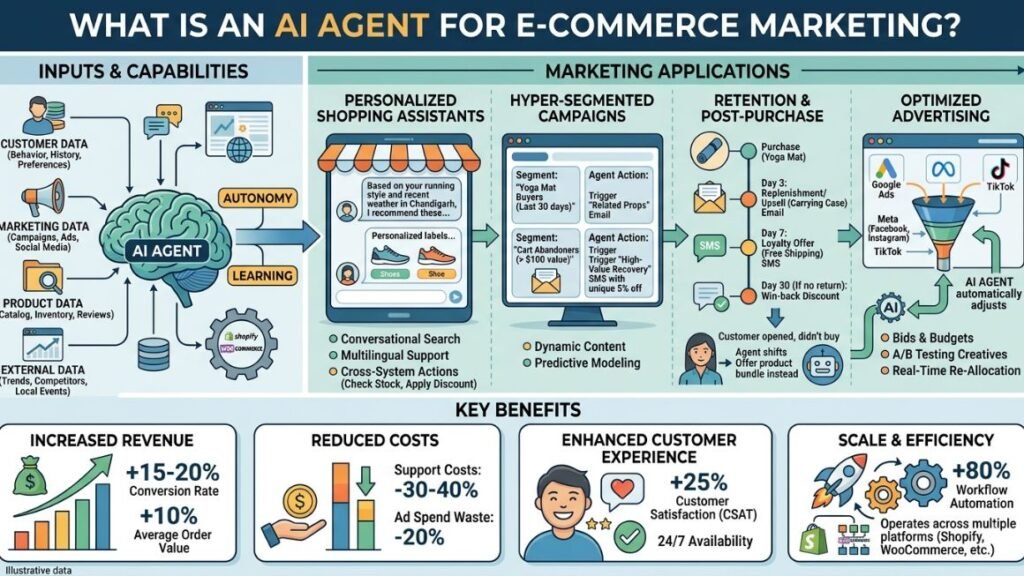
An AI Agent for E-commerce Marketing is a system that can understand a goal, such as recovering an abandoned cart or recommending a product, and carry out the steps needed to reach it without a human writing each instruction. That’s different from a basic chatbot script or a rules-based automation, which only does what it’s explicitly told, in the exact order it’s told.
The agent piece matters because it can adapt mid-conversation. If a shopper asks a follow-up question a script wasn’t built for, a real agent handles it. A static flow just breaks. This is also where the term gets misused. Plenty of tools slap “AI agent” on a feature that’s really just a smarter if-then rule, so it’s worth checking whether a tool can actually make a decision or if it’s following a fixed script with a chat interface on top.
An AI Agent for E-commerce Marketing plans and executes marketing or shopping-related tasks with limited human input, adjusting to new information mid-task rather than following a fixed script. This separates true agents from rules-based automation or basic chatbots, even when both are marketed under the same “AI” label.
Why More Brands Are Adopting AI Agents for E-commerce
The honest answer is margin pressure. Ad costs keep climbing, and most stores can’t just outspend their way to a better conversion rate anymore. More teams are experimenting with AI agents for e-commerce because manual campaign management doesn’t scale past a certain point, and hiring another specialist for every channel isn’t realistic for most budgets.
There’s also a data problem agents are well suited to solve. A single shopper touches your site, your email list, your ads, and your support inbox, and stitching that together manually is slow. AI in e-commerce marketing now covers everything from on-site personalization to post-purchase retention, not just chatbots answering shipping questions.
Rep AI’s 2025 Ecommerce Shopper Behavior Report found that shoppers who engage with an on-site AI assistant convert at roughly 12.3% compared to 3.1% for those who don’t, a difference of roughly four times, and they reach checkout about 47% faster. That’s the kind of gap that justifies testing an agent even if you’re skeptical going in.
Shopify Sidekick — Best for Native Store Management
What it does: Sidekick is an AI assistant built directly into the Shopify admin, accessible from nearly every page by clicking the icon in the top navigation bar with no setup required. It writes product descriptions, email copy, and discount announcements, answers plain-English analytics questions like which traffic source converts best, and lets you adjust theme elements through conversation.
What it does well: As of the Winter ’26 Edition, Sidekick moved from a reactive chatbot to a proactive AI coworker that anticipates business needs and executes complex workflows. That update also added full-screen mode, chat memory that preserves your preferences across sessions, mobile voice chat, and contextual help that changes based on where you are in the admin. If you already run on Shopify, this is the fastest way to get an agent working without adding another subscription.
Where it falls short: Sidekick is tied to the Shopify ecosystem, so it won’t help if you’re on a different platform, and its marketing tasks are still narrower than dedicated email or on-site tools. It’s a strong operations layer, not a full replacement for e-commerce marketing automation software.
Best for: Shopify merchants who want day-to-day admin and content help without a separate login.
Pricing: Free on every Shopify plan, from Basic through Plus, with over 1 million Shopify merchants worldwide already using it as of 2026.
Klaviyo AI — Best for Predictive Email and SMS
What it does: Klaviyo built its reputation as the go-to email platform for Shopify stores, with deep ecommerce integrations, predictive analytics, and revenue attribution. Its AI layer predicts customer lifetime value, churn risk, and optimal send times, then triggers flows automatically based on those predictions.
What it does well: This is where AI marketing automation for e-commerce gets genuinely useful, because the flows aren’t static. An abandoned-cart sequence can shift its send time or offer based on that specific shopper’s predicted behavior instead of using the same three-email template for everyone. Abandoned-cart automation alone typically recovers 10 to 15% of lost revenue when it’s set up properly.
Where it falls short: Pricing scales with your contact count, not just how much you actually email, and it climbs fast. The Email plan runs about $20 a month at 500 contacts, $100 at 5,000, and $400 at 25,000, with SMS billed separately on top. A fast-growing list can turn Klaviyo into one of your bigger software line items.
Best for: DTC brands that already treat email and SMS as core revenue channels, not an afterthought.
Pricing: Free up to 250 active profiles, then scaling from roughly $20/month, as of 2026.
Rep AI — Best for On-Site Conversion Recovery
What it does: Rep AI positions itself as an Agentic Commerce Operating System built specifically for e-commerce brands, using a behavioral engine that proactively engages shoppers at the moment they’re about to leave, instead of waiting for them to open a chat window.
What it does well: This is a genuine AI agent for e-commerce, not a scripted popup. It reads on-site behavior, like hesitation on a size chart or repeated scrolling past the same product, and steps in with a relevant nudge. That 12.3% versus 3.1% conversion lift mentioned earlier came directly from Rep AI’s own data, so treat it as a best-case number, but the underlying mechanism (catching intent before someone bounces) is sound regardless of vendor.
Where it falls short: Merchant reviews on the Shopify App Store are mixed once usage scales. One reported being upgraded to $500 a month with limited visibility into billing history, and a few noted that conversations can feel generic if the bot isn’t tuned to the catalog. Budget for setup time, not just the subscription.
Best for: Stores with meaningful traffic and a catalog complex enough that shoppers genuinely need guidance.
Pricing: Starts at $39/month for the base plan, scaling up to $299/month for the AI Sales Agent tier, with a 30-day free trial, as of 2026.
Octane AI — Best for Guided Product Discovery
What it does: Octane AI is a quiz builder that turns product selection into a short, guided conversation. Customers answer a handful of questions about their needs, and the CORE-1 engine maps those answers to specific SKUs using machine learning trained on conversion data.
What it does well: For catalogs where the right product genuinely depends on the customer, think skincare, supplements, or fitness gear, this replaces a consultation a human would otherwise have to do. Brands like Jones Road Beauty and Vegamour have published case studies showing 2 to 5 times higher conversion on quiz traffic compared to traffic that skips it. It also syncs quiz answers into your email platform, so a customer’s stated skin type or goals can drive future segmentation.
Where it falls short: It’s built for catalogs with real variation. A store selling one type of product with a few color options won’t see much benefit from this kind of guided flow, and credit-based pricing can get unpredictable if quiz traffic spikes.
Best for: Beauty, wellness, and complex-catalog brands where product-market fit varies by customer.
Pricing: Starts from $50/month with a free trial available, billed on quiz engagement credits, as of 2026.
Fin AI Agent (Intercom) — Best for Shopping Support in One Thread
What it does: Fin for Ecommerce combines two jobs most tools keep separate: shopping assistance for product discovery and recommendations, and customer support for order management, returns, refunds, and exchanges, all inside one conversation.
What it does well: The handoff problem is real. A customer who starts asking about sizing and ends up asking about a return shouldn’t have to repeat themselves to a second bot. Fin identifies whether a conversation needs shopping help, support, or both, and moves between them without the customer noticing. That continuity is genuinely rare among AI tools for e-commerce marketing right now.
Where it falls short: Pricing structure takes some getting used to. It layers a helpdesk subscription of $10 to $750 a month based on ticket volume with AI resolution fees of $0.90 to $1.00 per interaction, and AI-resolved tickets still count toward the helpdesk ticket total, which some third-party analysts describe as double billing. Costs can spike during high-volume periods like Black Friday if you’re not watching usage.
Best for: Shopify merchants who want one agent handling both pre-purchase questions and post-purchase support.
Pricing: Helpdesk subscription from $10/month plus $0.90 to $1.00 per AI resolution, as of 2026.
Northbeam — Best for Attribution-Driven Budget Decisions
What it does: Northbeam isn’t a customer-facing agent. It’s an AI-powered e-commerce marketing measurement layer that uses machine learning to figure out which channels actually drove a sale, replacing last-click tracking that breaks down once shoppers switch devices or block cookies.
What it does well: It combines first-party data collection, multi-touch attribution, and media mix modeling to give growth teams one source of truth across Meta, Google, TikTok, Snap, Pinterest, and CTV. If you’re running spend across five channels and can’t tell which one is actually working, this is the tool that answers that question with something more rigorous than “the dashboard says ROAS is fine.”
Where it falls short: This is a serious spend commitment, not a starter tool. It tends to deliver the most value for mid-market and enterprise ecommerce brands or agencies managing large accounts, and smaller stores will likely find the cost hard to justify against the ad budget it’s measuring.
Best for: Brands spending enough across paid channels that a wrong budget call actually hurts.
Pricing: Starter plans begin around $1,500 per month, with Professional tiers from roughly $2,500 per month, as of 2026.
The most useful agents in e-commerce right now cluster around three jobs: on-site conversion (Rep AI, Octane AI), lifecycle retention (Klaviyo AI), and support-to-sales continuity (Fin AI Agent). Store operations (Sidekick) and spend measurement (Northbeam) sit around that core, and most brands don’t need all six at once.
How to Build an AI Agent Strategy for E-commerce Conversions
Buying tools isn’t a strategy. Here’s how to actually put e-commerce marketing automation to work without wasting a quarter on setup that never ships.
- Find your biggest leak first. Pull your funnel data and find the single stage losing you the most revenue, whether that’s cart abandonment, product-page bounce, or post-purchase churn. Don’t buy a tool before you know this.
- Pick one agent for that leak. Match the tool to the problem instead of the trend. A high bounce rate on complex products points to Octane AI or Rep AI, not Klaviyo.
- Connect it to data the agent can act on. An agent making decisions on incomplete product data or a stale customer list will make bad decisions faster than a human would.
- Set a two-week test window with one clear metric. Conversion rate, recovered revenue, or average order value. Not all three at once.
- Review actual conversation or campaign logs, not just the summary dashboard. Vendor dashboards grade their own homework. Read ten real interactions before you trust the reported lift.
- Expand only after the first agent proves itself. Stacking three new tools at once makes it impossible to know which one is actually responsible for a change in conversion rate.
In Hotskill’s own AI skill tracks, we’ve found that learners who test one AI agent at a time, with a defined metric before they start, are far more likely to keep using it past the first month than those who install several tools at once and hope one of them sticks.
Common Mistakes When Deploying AI Agents in E-commerce
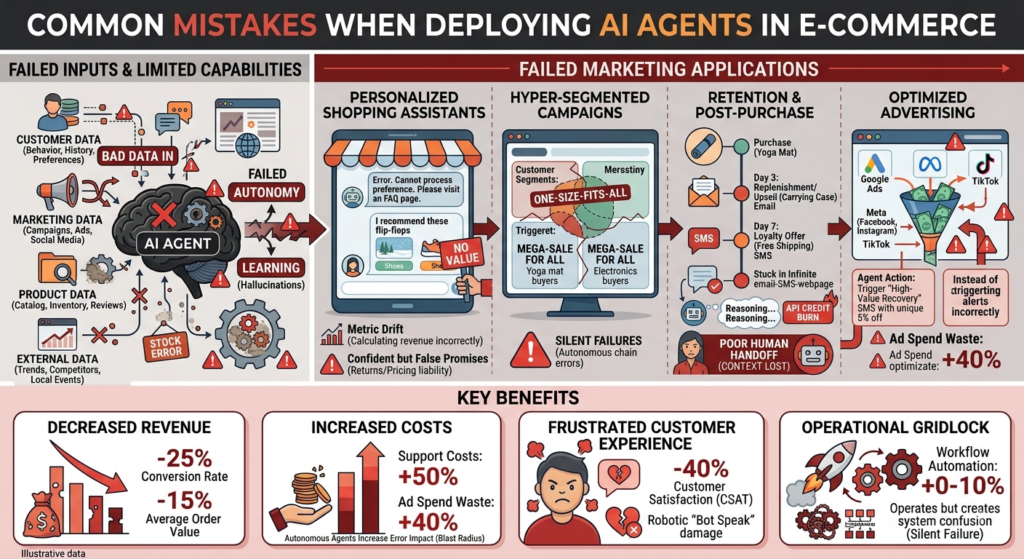
Most failed rollouts share the same handful of problems. Skipping the data cleanup is the biggest one. AI automation for online stores only works as well as the product titles, inventory accuracy, and customer data feeding it, and a beautifully configured agent working from bad data still gives bad recommendations.
The second mistake is treating every tool’s reported conversion lift as gospel. Vendor case studies are real, but they’re also cherry-picked. Run your own two-week test before committing budget long term. And the third is buying an agent for a channel you haven’t validated matters yet, like adding attribution software before you’ve even confirmed your ad spend is the problem and not your landing page.
Getting Started Without Overcomplicating It
The brands seeing real results from AI agents aren’t the ones running six tools at once. They picked the one leak costing them the most revenue, tested a single agent against it, and expanded from there. That’s a more useful starting point than trying to automate your entire funnel in one sprint.
If you want to get better at actually using these tools instead of just reading about them, Hotskill has structured AI skill tracks built around exactly this kind of hands-on work. Download the app on iOS or Android and start your first lesson today at hotskill.co/download.
FAQ
What is an AI Agent for E-commerce Marketing?
It’s a software system that can plan and carry out marketing or shopping-related tasks, such as recovering an abandoned cart or answering a product question, with limited human input at each step. Unlike a scripted chatbot, it can adjust its response based on new information mid-conversation.
How is an AI agent different from a regular chatbot?
A chatbot follows a fixed script and breaks when a conversation goes off-path. An agent can reason through unexpected questions, pull in relevant data, and change its approach without a human rewriting the flow.
Which AI agent should I start with if I only have budget for one?
Start with whichever stage of your funnel is losing you the most revenue. If shoppers are abandoning product pages, try Rep AI or Octane AI. If your email flows are underperforming, start with Klaviyo AI.
Do I need coding knowledge to set up these tools?
No. Shopify Sidekick, Klaviyo AI, Rep AI, and Octane AI are all built for merchants without a developer, using conversational setup or guided onboarding. Northbeam typically involves more technical implementation for tracking.
Is Shopify Sidekick worth it if I already use Klaviyo?
Yes, because they solve different problems. Sidekick handles store operations and admin tasks inside Shopify, while Klaviyo runs your email and SMS lifecycle marketing. They work well together rather than competing.
Why isn’t my AI chatbot converting shoppers?
Usually it’s a data problem, not a tool problem. If the agent isn’t trained on accurate product details or isn’t triggered at the right moment in the shopper’s journey, it’ll feel generic regardless of how advanced the underlying model is.
Do I really need an AI agent if I already have marketing automation set up?
If your automation is rules-based, meaning it always sends the same email at the same time regardless of behavior, an agent adds real value by adjusting to individual shopper signals. If you’re already running predictive, behavior-triggered flows, the upgrade matters less.
How much does an AI agent for e-commerce typically cost?
It ranges widely. Shopify Sidekick is free. Tools like Octane AI and Rep AI start around $39 to $50 a month. Enterprise-focused platforms like Northbeam start in the thousands per month. Match the spend to your store’s size and traffic.
Can small stores benefit from AI agents, or is this only for big brands?
Small stores benefit most from lower-cost, high-impact tools like Sidekick or Rep AI’s starter tier. Enterprise attribution tools like Northbeam usually aren’t worth the spend until your ad budget is large enough that a wrong channel decision costs real money.
How do I measure whether an AI agent is actually working?
Pick one metric before you start, like recovered cart revenue or conversion rate on assisted sessions, and track it over a defined test window instead of relying only on the vendor’s built-in reporting.