

Running an online store in 2026 means competing with brands that have personalisation engines, dynamic pricing models, automated ad optimisation, and AI-generated content working around the clock. If you’re still doing any of that manually, you’re not just slower. You’re spending money you don’t have to.
The good news: you don’t need a data science team. You need the right tools and a clear sense of what they’re actually good at. That’s what this guide covers. You’ll find a breakdown of every major AI tool category relevant to eCommerce marketing, what each tool does well, where it falls short, and which use case it genuinely fits. No overviews. No filler.
What Does AI Actually Do in eCommerce Marketing?
AI in eCommerce marketing refers to using machine learning, natural language processing, and predictive analytics to automate, personalise, and optimise every stage of the customer journey, from the first ad impression to the post-purchase email.
That definition covers a lot of ground. In practice, AI is doing four things in eCommerce marketing right now:
- Generating content at scale (product descriptions, ad copy, emails, SEO pages)
- Personalising the shopping experience (recommendations, dynamic landing pages, personalised offers)
- Optimising spend and performance (ad bidding, pricing, campaign targeting)
- Automating customer interaction (chatbots, support workflows, retention sequences)
The retailers who are pulling ahead aren’t using AI for everything at once. They’re picking one or two areas where they’re losing the most time or money, fixing those first, and then expanding. That’s the approach this guide supports.
AI in eCommerce marketing covers four core functions: content generation at scale, shopping experience personalisation, spend and performance optimisation, and customer interaction automation. Retailers who focus on one area at a time before expanding see faster, more measurable results than those who try to deploy AI across all channels simultaneously.
AI for Product Description and Content Generation
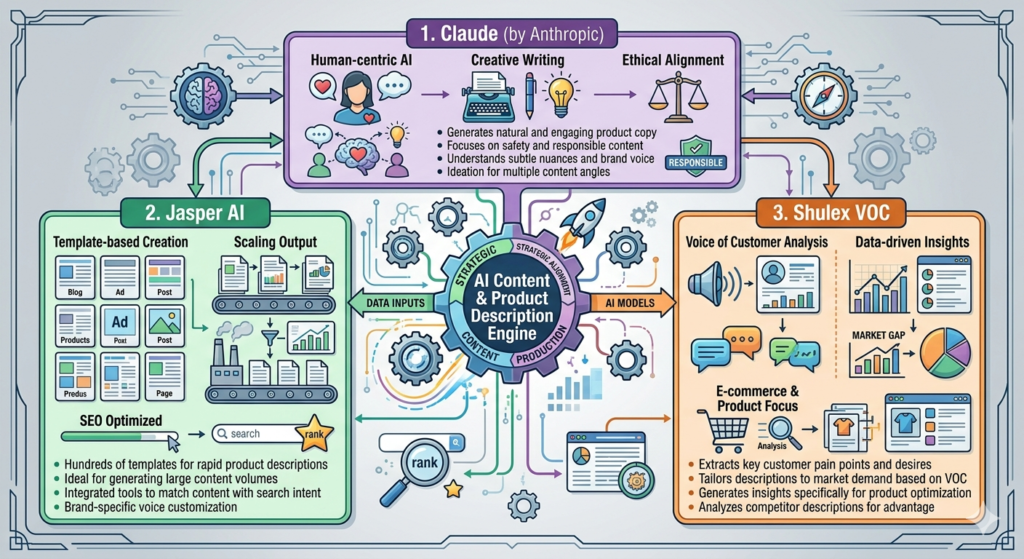
If you have hundreds or thousands of SKUs, writing unique, SEO-optimised product descriptions manually is either a full-time job or a constant backlog. AI solves this. But not all AI writing tools solve it equally.
Claude (by Anthropic)
Claude is a large language model (LLM) built by Anthropic, available at claude.ai and via API. An LLM is a type of AI that generates text by predicting the most likely next word based on patterns learned from vast amounts of training data.
For product content specifically, Claude handles long context extremely well. You can paste in a full product spec sheet, a brand voice guide, and a target audience description, and Claude will generate a product description that actually sounds like your brand, not generic copy. In our testing at Hotskill, Claude’s instruction-following on structured prompts is tighter than most alternatives, which matters when you’re generating at scale and can’t afford to manually fix every output.
Where it falls short: Claude doesn’t have native eCommerce integrations. You’ll need to pull it into your workflow via API or use a tool that wraps it.
Best for: Brands with a distinct voice that needs to come through in product copy. Stores with complex products where the description needs to balance technical accuracy with readability.
Pricing: Claude Sonnet 4.6 is available on the free tier; paid plans (Claude Pro) start at $20/month as of 2026.
Jasper AI
Jasper is an AI writing platform built specifically for marketing teams, with templates designed for eCommerce including product descriptions, ad copy, and email sequences.
Jasper works well if you want a purpose-built tool with eCommerce workflows baked in. It’s faster to set up than raw Claude because the templates handle the prompt structure for you. That said, the outputs can feel templated if you don’t customise the brand voice settings carefully. The quality ceiling is lower than Claude for complex or nuanced copy.
Best for: Stores that want a plug-and-play content tool without building custom prompts. Teams that need multiple content types (descriptions, social, ads) in one platform.
Pricing: Starts at $49/month per seat as of 2026.
Shulex VOC
Shulex VOC is an AI tool focused specifically on eCommerce content research and listing optimisation, popular with Amazon and Shopify sellers. It analyses customer reviews and competitor listings to surface what buyers actually care about, then helps you write product content built around those insights.
The insight layer is genuinely useful. Knowing that customers of a competing product consistently mention “strap digging in” gives you a real angle for your own description. The writing tool that sits on top of that research is solid but not exceptional.
Best for: Sellers on Amazon or marketplaces where listing copy directly affects conversion and search ranking.
Pricing: Free tier available; paid plans from $29/month as of 2026.
For product content generation, Claude (by Anthropic) handles complex, voice-specific copy best via API or direct prompting. Jasper AI is the faster plug-and-play option for teams who don’t want to manage prompts manually. Shulex VOC adds a research layer that neither Claude nor Jasper provides out of the box, making it particularly strong for marketplace sellers.
AI for Personalisation and Product Recommendations
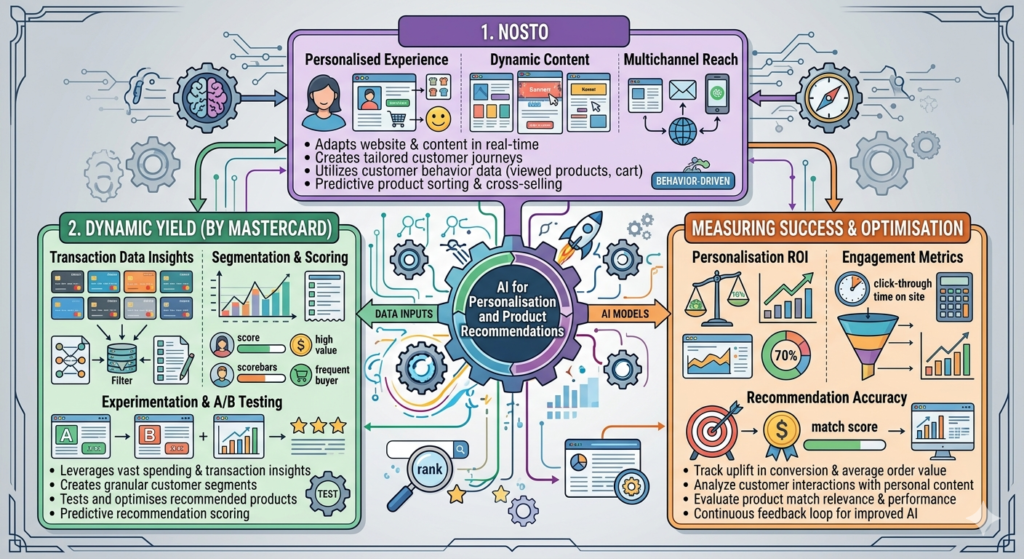
Personalisation in eCommerce marketing is the practice of showing each visitor content, products, or offers tailored to their individual behaviour, preferences, and purchase history rather than a single experience for all users.
According to McKinsey’s 2024 eCommerce Personalisation Report, personalisation can reduce customer acquisition costs by up to 50% and increase revenues by 5-15%. The stores achieving those numbers are doing it with machine learning models that process behavioural data in real time, not rule-based “customers who bought X also bought Y.”
Nosto
Nosto is a personalisation platform built for Shopify, Magento, and other major eCommerce platforms. It uses machine learning to analyse browsing behaviour, purchase history, and real-time session data to personalise product recommendations, category pages, search results, and email content.
What Nosto does well: it works out of the box without needing a data science team. You connect it to your store, let it run for two weeks to gather data, and the recommendations become meaningfully better than manual curation. In Hotskill’s review of personalisation tools, Nosto consistently came up as the fastest time-to-value option for stores doing $500K+ per year.
Where it falls short: the analytics dashboard is functional but not deep. If you want to run sophisticated A/B tests or segment by custom attributes, you’ll hit the ceiling.
Best for: Mid-market eCommerce stores that want enterprise-quality personalisation without an enterprise team.
Pricing: Pricing is based on store revenue; typically starts around $399/month for growing stores as of 2026.
Dynamic Yield (by Mastercard)
Dynamic Yield is an enterprise-grade personalisation and optimisation platform. It handles personalised product recommendations, A/B and multivariate testing, triggered messaging, and audience segmentation at scale.
Dynamic Yield is genuinely powerful. It’s also genuinely complex. You’ll need a dedicated resource to configure and manage it properly. For stores doing $10M+ per year, the investment can pay off significantly. For smaller stores, Nosto or even Shopify’s native AI recommendation features will get you most of the way there with a fraction of the setup.
Best for: Large eCommerce operations with dedicated CRO teams and complex segmentation requirements.
Pricing: Enterprise pricing, typically starting in the $2,000+/month range as of 2026.
AI for Email Marketing Automation
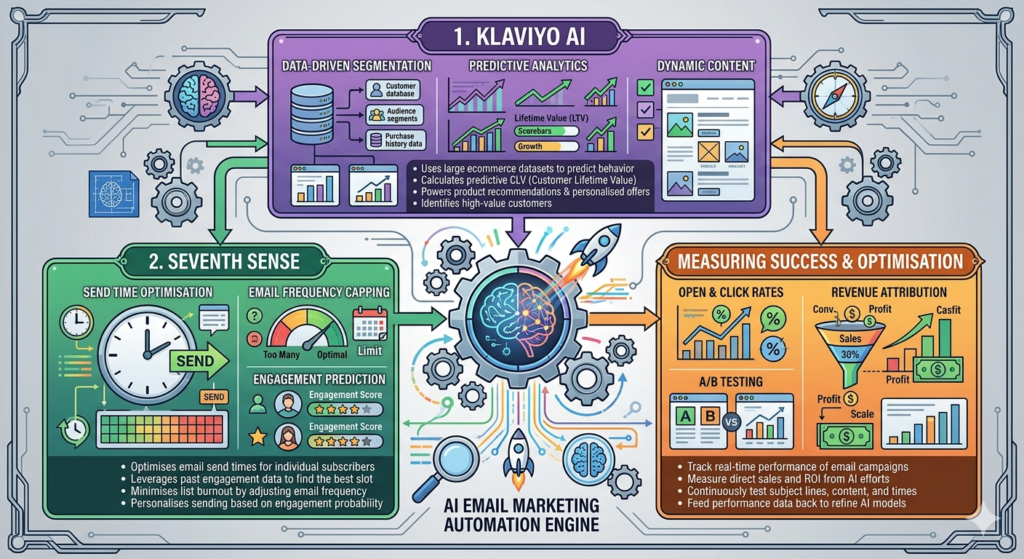
Email is still the highest-ROI channel in eCommerce, and AI is what separates stores sending generic broadcast emails from those sending sequences that feel personal at scale.
Klaviyo AI
Klaviyo is an email and SMS marketing platform with deep eCommerce integrations, and its AI features (called Klaviyo AI) are now embedded throughout the platform. Klaviyo AI includes predictive analytics for customer lifetime value and churn risk, AI-generated subject lines, send time optimisation, and smart segmentation.
The predictive CLV (customer lifetime value) model alone is worth the platform fee for stores with enough historical data. Knowing which customers are likely to buy again in the next 30 days lets you focus retention spend where it will actually convert. The AI subject line tool is useful but not magic. It generates solid options; you still need to apply judgment about which fits your voice.
Best for: Shopify and WooCommerce stores that want their email platform and eCommerce data in one place with AI built into the workflow.
Pricing: Free up to 250 contacts; paid plans scale with contact count, typically $45/month for 1,000 contacts as of 2026.
Seventh Sense
Seventh Sense is an AI tool that focuses specifically on email send time optimisation for HubSpot and Marketo users. Send time optimisation means the tool analyses each individual subscriber’s past open behaviour and sends each email at the time that specific person is most likely to open it, rather than blasting the entire list at once.
It sounds like a minor improvement. It isn’t. Stores that switch from batch-and-blast to individually timed sends typically see 15-30% improvement in open rates. The trade-off is that it only works well on lists above 10,000 contacts where there’s enough data per user. Smaller lists don’t have the signal.
Best for: Established stores with large email lists already using HubSpot or Marketo.
Pricing: Starts at $80/month for HubSpot integration as of 2026.
Klaviyo AI provides the most comprehensive AI feature set for eCommerce email marketing, including predictive CLV modelling, smart segmentation, and send time optimisation. For stores already on HubSpot or Marketo, Seventh Sense adds a layer of individual-level send time intelligence that meaningfully improves open rates on lists above 10,000 contacts.
AI for Paid Advertising and Campaign Optimisation
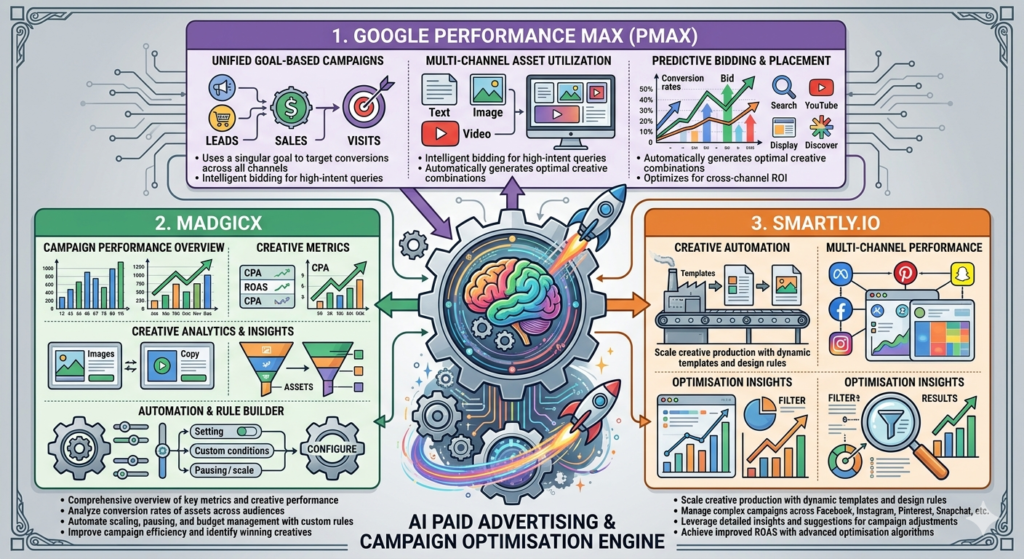
Ad spend without AI optimisation is like running water with the tap open. The major ad platforms have built AI deeply into their campaign structures, but third-party tools add a layer of control and insight that the native platforms don’t offer.
Google Performance Max (PMax)
Google Performance Max is Google’s AI-driven campaign type that automatically optimises bids, placements, and creative across Search, Display, YouTube, Gmail, and Google Shopping using machine learning.
PMax works well when you feed it high-quality inputs: strong creative assets, a clear conversion goal, and enough first-party data to train on. It fails when you give it weak creative and expect the algorithm to compensate. The “black box” nature is a real limitation. You get limited visibility into what’s working, which is frustrating for stores that want to understand performance by placement or audience.
Best for: Stores that have clear conversion tracking set up and want to let Google optimise across placements without managing separate campaigns.
Madgicx
Madgicx is a third-party AI ad management platform for Meta (Facebook and Instagram) and Google Ads. It combines autonomous ad optimisation (AI adjusts bids and budgets automatically) with creative analytics (it tells you which ad creative elements are driving performance).
The creative analytics piece is where Madgicx earns its place. Knowing that static images with red backgrounds outperform lifestyle shots in your account is genuinely actionable. The autonomous budget management is solid but requires a trust period where you let it run without intervening.
Best for: eCommerce stores spending $5K+/month on Meta or Google Ads that want AI-assisted optimisation without losing visibility into what’s working.
Pricing: Starts at $44/month as of 2026; pricing scales with ad spend.
Smartly.io
Smartly.io is an enterprise creative and campaign automation platform for Meta, TikTok, Pinterest, and Snapchat. It specialises in dynamic creative optimisation (DCO), where AI automatically assembles and tests thousands of creative variations using your product feed.
DCO is the capability where Smartly shines. For large catalogues with many product variants, letting AI assemble creative combinations at scale and test them in real time is genuinely difficult to replicate manually. The trade-off is price and complexity. This is an enterprise tool with an enterprise setup process.
Best for: Large retailers with big catalogues and dedicated paid social teams.
Pricing: Enterprise pricing; contact for quote as of 2026.
AI for Customer Support and Conversational Commerce
A customer asking a question at 11pm on a Sunday either gets an instant AI answer or leaves. That’s the business case for AI customer support in one sentence.
Gorgias AI
Gorgias is a customer support helpdesk built specifically for eCommerce (Shopify, WooCommerce, BigCommerce), and its AI features handle ticket categorisation, automated responses to common questions (order status, returns, shipping), and agent assist for more complex issues.
The Shopify integration is the key differentiator. Gorgias pulls order data directly into the ticket view, so the AI can answer “where is my order?” with a real, accurate answer rather than a generic response. In stores handling 500+ support tickets per month, Gorgias AI typically deflects 30-40% of tickets without human involvement.
Best for: Shopify-first stores with high support volume where order status, returns, and shipping questions make up the bulk of tickets.
Pricing: Starts at $10/month for up to 50 tickets; scales with ticket volume as of 2026.
Tidio AI (Lyro)
Tidio is a live chat and chatbot platform, and its AI feature, Lyro, is a conversational AI that learns from your FAQ and support content to answer customer questions in natural language. It’s designed for smaller stores that want 24/7 chat coverage without the complexity of a full helpdesk.
Lyro handles simple queries well. “Do you ship to Canada?” “What’s your return window?” “Does this come in size L?” These it answers accurately and quickly. For anything that touches order data or requires backend system access, it can’t help, so it hands off to a human. That handoff is smooth when configured well.
Best for: Small to mid-size stores that need a conversational entry point for first-time visitors and basic support queries.
Pricing: Free tier available; Lyro AI starts at $39/month as of 2026.
Gorgias AI is the strongest option for eCommerce stores on Shopify that need deep order-data integration in their support workflow. Tidio’s Lyro is better for smaller stores that want conversational AI for basic queries without the infrastructure of a full helpdesk. Neither replaces human agents for complex or emotionally charged issues.
AI for SEO and Organic Traffic
Surfer SEO
Surfer SEO is a content optimisation tool that uses AI to analyse the top-ranking pages for a keyword and tells you exactly what your content needs to match or beat them, including word count, topic coverage, internal link structure, and semantic terms.
For eCommerce SEO, Surfer is most useful for category pages and long-form buying guides. It’s less useful for product descriptions where you’re fighting for rankings against aggregators and marketplaces. The content editor gives you a real-time score as you write, which removes a lot of the guesswork from optimisation.
Best for: Stores investing in content marketing and looking to rank category or blog content.
Pricing: Starts at $89/month as of 2026.
Frase.io
Frase is an AI content research and writing tool that builds content briefs automatically from a target keyword. It pulls the top-ranking pages, extracts the common topics they cover, and builds an outline you can use as a starting point.
Frase works well as a research-first tool. It cuts content brief creation time from 2-3 hours to about 30 minutes on a complex keyword. The AI writing assistant it includes is adequate but not exceptional. Most users treat it as a research and brief tool and use Claude or another LLM for the actual writing.
Best for: Content teams that want to speed up the research and outline phase of SEO content creation.
Pricing: Starts at $45/month as of 2026.
AI for Pricing Intelligence and Dynamic Pricing
Dynamic pricing means automatically adjusting your prices based on competitor prices, demand signals, inventory levels, and customer behaviour. Airlines and hotels have done this for decades. eCommerce is catching up fast.
Prisync
Prisync is a competitor price tracking and dynamic pricing tool for eCommerce. It monitors competitor prices across thousands of products daily and gives you both alerts and automated repricing rules.
The competitor monitoring is reliable and accurate. The dynamic repricing works well for businesses where price competitiveness is a key purchase driver. The limitation: Prisync focuses on rule-based repricing (“if competitor X drops below our price by 5%, match it”), not true machine learning-driven optimisation. For more sophisticated demand-based pricing, you’d need an enterprise tool.
Best for: Stores on marketplaces or in categories where price competitiveness drives conversion.
Pricing: Starts at $99/month for up to 100 products as of 2026.
Omnia Retail
Omnia Retail is a dynamic pricing and assortment intelligence platform built for mid-to-large retailers. It uses AI to optimise pricing based on demand elasticity, competitive position, and business rules simultaneously.
Omnia’s strength is the combination of competitive data and demand modelling. You’re not just matching the cheapest competitor; you’re pricing to maximise margin within acceptable competitive bounds. This requires meaningful historical sales data to work properly.
Best for: Retailers with large catalogues and strong historical sales data who want to move beyond rule-based repricing.
Pricing: Enterprise pricing; contact for quote as of 2026.
AI for Visual Commerce and Image Optimisation
Photoroom
Photoroom is an AI image editing tool that removes backgrounds, generates product lifestyle images, and creates on-brand visuals from raw product photos. It’s designed for eCommerce sellers who need professional product imagery without a photography studio.
The background removal is fast and accurate, including on complex edges like jewellery or hair. The AI image generation feature lets you place products in lifestyle scenes, which is genuinely useful for stores that can’t afford location shoots. Quality varies and you’ll need to check outputs, but it cuts product image production time significantly.
Best for: Small to mid-size stores that produce their own product photography and need a cost-effective editing workflow.
Pricing: Free tier available; paid plans from $9.99/month as of 2026.
ViSenze
ViSenze is a visual AI platform for eCommerce that enables visual search (customers upload a photo to find similar products), AI-driven product tagging, and visual similarity recommendations.
Visual search is still niche in western eCommerce but growing fast in fashion, home decor, and beauty, where customers struggle to describe what they want in text. ViSenze’s tagging engine is the more immediate value for most stores: it automatically tags products with accurate attributes, which improves both internal search quality and SEO.
Best for: Fashion, home decor, or beauty retailers looking to improve product discovery.
Pricing: Enterprise pricing; contact for quote as of 2026.
How to Build an AI Marketing Stack for Your Store
You don’t need every tool in this guide. You need the right combination for your store’s size, channel mix, and current biggest problem.
Here’s how to think about building your stack:
Step 1: Identify your highest-cost problem first. Is it content production speed? Email conversion rates? Support ticket volume? Ad ROAS? Start there, not with the tool that sounds most impressive.
Step 2: Pick one tool per problem area. Overlapping tools in the same category create confusion and data fragmentation. One personalisation tool. One email platform with AI. One ad optimisation layer.
Step 3: Connect your data before you add AI. Most AI tools perform poorly on fragmented data. Get your Google Analytics, Shopify (or equivalent), and ad platforms speaking to each other before you layer in AI.
Step 4: Give the AI a training period. Most machine learning tools need 4-8 weeks of data before their outputs are meaningfully better than manual. Don’t judge them in week one.
Step 5: Audit and adjust monthly. AI optimises for the metric you give it. Check regularly that the metric it’s hitting is actually delivering business value, not just hitting a number.
A realistic starter stack for a store doing $1M-$5M/year: Claude (content), Klaviyo AI (email), Gorgias AI (support), and Surfer SEO (organic). That combination covers the four highest-leverage areas without requiring dedicated technical resources.
Building an effective AI marketing stack for eCommerce starts with identifying the single highest-cost problem first, choosing one tool per area, and connecting underlying data before adding AI layers. A practical stack for stores in the $1M-$5M revenue range combines Claude for content, Klaviyo AI for email, Gorgias AI for support, and Surfer SEO for organic, covering four high-leverage areas with no dedicated technical team required.
Where to Go From Here
The tools in this guide range from free (Claude’s basic tier, Tidio) to enterprise pricing (Smartly.io, Dynamic Yield). You don’t need to start expensive. Start with the channel where you’re losing the most time or leaving the most money on the table.
For most eCommerce stores, that’s content. Every hour spent writing product descriptions manually is an hour not spent on strategy, partnerships, or channel expansion. Claude can handle that backlog. Once you’ve freed up that time, the next move becomes clearer.
If you want to build real skill with these tools, not just awareness, Hotskill has structured AI skill tracks built specifically for eCommerce and marketing professionals. Hands-on lessons, specific workflows, real tool practice. Download the app on iOS or Android, and start the AI for eCommerce track today.
Frequently Asked Questions {#faq}
What is AI in eCommerce marketing?
AI in eCommerce marketing refers to the use of machine learning, natural language processing, and predictive analytics to automate, personalise, and optimise marketing activities across the customer journey. This covers content generation, product recommendations, email automation, ad optimisation, customer support, SEO, pricing, and visual commerce. It’s not one tool. It’s a category of capabilities applied across multiple channels.
How is AI different from traditional eCommerce marketing automation?
Traditional automation follows fixed rules: “if a customer abandons a cart, send them this email 2 hours later.” AI-driven automation adapts based on data. It figures out that a specific customer responds to discount offers rather than urgency messaging, and adjusts the trigger, timing, and content accordingly. The difference in performance can be significant once there’s enough data to train on.
Do I need to know how to code to use AI marketing tools for my store?
Most of the tools covered in this guide are no-code or low-code. Klaviyo, Gorgias, Nosto, and Surfer SEO all have visual interfaces designed for marketers, not developers. You’ll need developer help for API integrations (like pulling Claude into a custom workflow) or enterprise platforms like Dynamic Yield. But for the majority of eCommerce stores, no coding skills are needed.
Which AI tool is best for writing product descriptions at scale?
Claude is the strongest option for complex, voice-specific product descriptions because of its large context window and precise instruction-following. If you want a purpose-built tool with eCommerce templates already set up, Jasper AI is faster to start. If you sell on Amazon specifically, Shulex VOC adds a competitor research layer that the others don’t have.
Is AI personalisation worth it for a small eCommerce store?
It depends on your traffic volume. Personalisation tools like Nosto need a few thousand monthly visitors to generate meaningful data for their models. Below that threshold, hand-curated recommendations and simple segmentation in Klaviyo will outperform an underfed AI model. Most personalisation tools become genuinely valuable above 5,000 monthly sessions.
Why isn’t my AI ad tool giving me better results?
Usually one of three things: the conversion tracking isn’t set up correctly (so the AI is optimising for the wrong goal), the creative inputs are too weak for the algorithm to work with, or the learning period is too short. Most AI ad tools need 30-50 conversions per campaign per month before they have enough signal to optimise meaningfully. If you’re below that, you’re starving the algorithm.
Can AI replace my email marketing team?
Not completely. AI handles volume, timing, segmentation, and testing at a scale humans can’t. But someone still needs to make brand decisions, review outputs, catch errors, and manage the strategy. The honest answer is that a one-person email team with good AI tools can do what a three-person team did without them. It amplifies output, but humans still need to direct it.
How do I know if an AI tool is actually improving my results or just making changes?
Set up a clear baseline before you turn any AI tool on. Document your current open rates, conversion rates, ROAS, or support ticket deflection rate, depending on the tool. Measure the same metrics 30 and 60 days after activation. Most tools have built-in reporting, but it’s worth tracking independently so you’re not relying on the tool’s own numbers to assess whether the tool is working.
Is dynamic pricing risky for a brand-first store?
It can be, if implemented poorly. Customers who notice your price fluctuating dramatically based on demand may feel manipulated. The smarter approach is to use pricing intelligence to understand your competitive position and make deliberate adjustments rather than letting an algorithm swing prices reactively. Tools like Prisync support this with monitoring plus manual control.
What’s the first AI tool I should add to my eCommerce marketing workflow?
Start with eCommerce marketing content. Specifically, use Claude or Jasper to handle product descriptions, category page copy, or email sequences that you’re currently writing manually. Content is where most stores spend disproportionate time relative to impact, and it’s the area where AI generates the fastest, most measurable ROI with the least setup. Once you’ve built that habit, expand to email optimisation with Klaviyo AI.