
If you’ve been anywhere near digital marketing conversations lately, you’ve probably heard a lot about AI. It’s everywhere. Content, ads, analytics, even customer support. And now, email marketing, especially in eCommerce, is going through a quiet but powerful transformation.
Email marketing was already one of the highest ROI channels. But honestly, it also had its limitations. Manual segmentation, generic campaigns, guesswork-based personalization. It worked, but it wasn’t exactly smart.
That’s where things are shifting.
With AI eCommerce email marketing, brands are moving from reactive campaigns to predictive, automated, and deeply personalized communication. Emails are no longer just newsletters or discount blasts. They’re becoming dynamic conversations that adapt in real time to user behavior.
In this guide, we’re going to unpack everything. Not just what AI is doing in email marketing, but how you can actually use it to drive sales. Because tools are one thing, but execution is what really matters.
What is AI in eCommerce Email Marketing?
Before we go deeper, let’s simplify this.
AI in email marketing essentially means using machine learning and data models to automate decisions, personalize content, and optimize campaigns without constant human intervention.
Traditional email marketing might segment users into a few buckets like “new customers” or “repeat buyers.” But AI looks at hundreds of signals. Browsing behavior, past purchases, time spent on product pages, email engagement patterns, and even predicted future actions.
This is where AI eCommerce email marketing starts becoming powerful. Instead of sending the same campaign to thousands of people, you send thousands of slightly different emails tailored to each individual.
And the interesting part? Most of this happens automatically.
Why AI is a Game-Changer for eCommerce Emails
Let’s be real. The biggest challenge in email marketing today isn’t sending emails. It’s sending emails that people actually care about.
Inbox fatigue is real. People are overwhelmed. If your emails don’t feel relevant, they get ignored or worse, unsubscribed.
AI changes that dynamic in a few important ways.
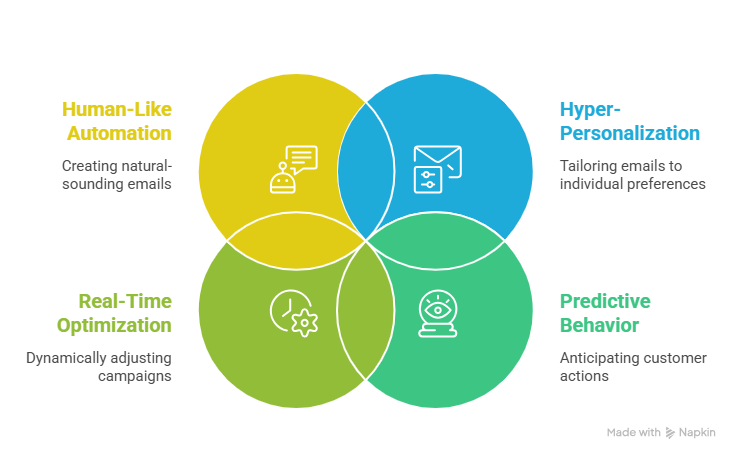
Hyper-Personalization at Scale
Earlier, personalization meant adding a first name in the subject line. Now, AI can customize product recommendations, email timing, content blocks, and even tone.
With AI eCommerce email marketing, every subscriber can receive a unique version of your email. Not just in theory, but in practice.
Predictive Customer Behavior
AI doesn’t just react. It predicts.
It can identify which users are likely to churn, who might make a purchase soon, or who needs a nudge with a discount. That predictive layer is what turns email marketing into a revenue engine.
Real-Time Optimization
Campaigns don’t need to wait for post-analysis anymore.
AI systems continuously learn and optimize. Subject lines, send times, layouts, all adjusted dynamically based on performance data.
Automation That Feels Human
This might sound contradictory, but AI actually makes automation feel less robotic.
Because emails are based on behavior and context, they feel timely and relevant. Almost like a conversation rather than a broadcast.
Core Components of AI-Powered Email Marketing
To really understand how to use AI effectively, you need to know what’s happening behind the scenes.
Smart Segmentation
Instead of static segments, AI creates dynamic groups based on behavior patterns.
For example, users who browse frequently but rarely purchase. Or users who only buy during sales. These micro-segments allow for more targeted messaging.
This is one of the foundational aspects of AI eCommerce email marketing, because everything else builds on accurate segmentation.
Predictive Product Recommendations
This is probably the most visible AI feature.
Based on browsing history and purchase behavior, AI suggests products each user is likely to buy. It’s similar to how major marketplaces recommend items, but applied within emails.
And honestly, it works. Recommended products often drive a significant portion of email revenue.
Send-Time Optimization
Not everyone checks emails at the same time.
AI analyzes individual user behavior to determine when they’re most likely to open emails. Then it sends campaigns at that exact time for each user.
It sounds simple, but the impact can be surprisingly large.
Automated Content Generation
With generative AI, brands can now create subject lines, email copy, and even design elements automatically.
It doesn’t mean removing human creativity. But it does speed things up significantly.
And yes, this is becoming a core part of AI eCommerce email marketing workflows.
Types of AI-Driven Email Campaigns That Drive Sales
Let’s move from theory to application.
Because knowing AI exists is one thing. Using it effectively is another.
Abandoned Cart Emails That Actually Convert
Cart abandonment has always been a problem in eCommerce.
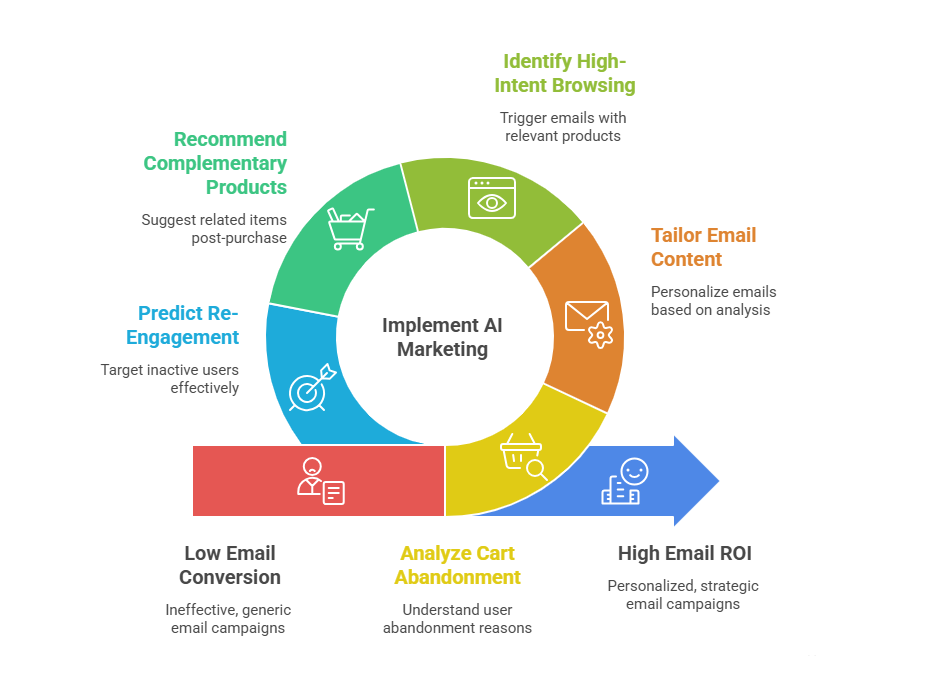
AI improves this by analyzing why the user abandoned the cart. Was it price sensitivity? Distraction? Comparison shopping?
Based on this, emails can be tailored. Some users might receive a discount. Others might get urgency messaging or product reviews.
This level of personalization is where AI eCommerce email marketing shows real ROI.
Browse Abandonment Campaigns
Not every user adds items to cart. But browsing behavior is still valuable.
AI identifies high-intent browsing sessions and triggers emails with relevant products. Sometimes even before the user forgets about them.
Post-Purchase Upsell and Cross-Sell
After a purchase, the journey isn’t over.
AI recommends complementary products based on what the user bought. For example, accessories, upgrades, or related items.
These emails often have higher engagement because they’re contextually relevant.
Re-Engagement Campaigns
Inactive users are tricky.
AI helps by predicting which users are worth re-engaging and what kind of messaging might work.
Some users respond to discounts. Others to new arrivals or personalized recommendations.
Again, this is where AI eCommerce email marketing becomes more than just automation. It becomes strategy.
Generative AI and Its Role in Email Marketing
This is the newer layer of AI, and it’s evolving fast.
Generative AI focuses on creating content rather than just analyzing data.
AI-Generated Subject Lines
Subject lines can make or break an email.
AI tools can generate multiple variations based on past performance data. Some tools even test them automatically and select the best-performing one.
Personalized Email Copy
Instead of writing one email, you can generate multiple versions tailored to different segments.
Tone, messaging, and even storytelling can vary based on user profiles.
Dynamic Email Design
AI can also suggest layouts and visual elements that align with user preferences.
While this is still evolving, it’s becoming a key component of advanced AI eCommerce email marketing setups.
Benefits of AI in eCommerce Email Marketing
Let’s zoom out for a second.
Why should a brand invest in AI for email marketing?
Increased Revenue
This is the obvious one.
Better targeting, better timing, better content. All of it leads to higher conversions.
Improved Customer Experience
Emails feel relevant instead of intrusive.
Customers receive content that aligns with their interests and behavior.
Reduced Manual Work
Campaign creation, segmentation, optimization. All of it becomes faster and more efficient.
Better Data Utilization
Most brands already have a lot of data.
AI helps turn that data into actionable insights, which is honestly where the real value lies.
Challenges and Limitations You Should Know
Now, it’s not all perfect.
There are a few things to be aware of.
Data Dependency
AI is only as good as the data it gets.
If your data is incomplete or messy, results won’t be great.
Over-Automation Risk
Too much automation can sometimes feel impersonal.
It’s important to maintain a balance between AI-driven efficiency and human creativity.
Learning Curve
Implementing AI tools requires time and understanding.
It’s not plug-and-play in most cases.
Still, despite these challenges, AI eCommerce email marketing continues to grow because the benefits outweigh the limitations for most brands.
How to Implement AI in Your Email Strategy
This is where things get practical.
If you’re starting out, don’t try to do everything at once.
Start with Data
Clean and organize your customer data.
Without this step, AI won’t be effective.
Choose the Right Tools
There are many platforms offering AI features.
Look for ones that integrate with your existing systems and offer features you actually need.
Focus on High-Impact Campaigns First
Start with abandoned cart emails or product recommendations.
These usually deliver quick wins.
Test and Iterate
AI improves over time.
Run experiments, analyze results, and refine your approach.
And gradually, you’ll build a robust AI eCommerce email marketing system that scales.
Real-World Applications and Examples
Many eCommerce brands are already using AI in interesting ways.
Some use predictive analytics to send replenishment reminders. For example, if a product is likely to run out based on past usage.
Others use AI to create dynamic email content that changes based on user interaction.
Fashion brands often use AI for personalized lookbooks. Electronics brands use it for upgrade suggestions.
The possibilities are expanding constantly.
The Future of AI in Email Marketing
This is where things get a bit speculative, but still grounded.
We’re moving towards fully autonomous marketing systems.
Emails that write themselves, design themselves, and optimize themselves in real time.
Voice and conversational interfaces might also integrate with email campaigns.
And privacy regulations will shape how data is used, pushing AI systems to become more transparent and ethical.
Even now, AI eCommerce email marketing is just scratching the surface of what’s possible.
Best Practices to Maximize Results
Even with AI, fundamentals still matter.
Relevance, timing, and value are still the core pillars.
Use AI to enhance these, not replace them.
Keep your messaging clear.
Avoid overwhelming users with too many emails.
And most importantly, always think from the customer’s perspective.
Because at the end of the day, AI is just a tool. Strategy is still human.
Conclusion
Email marketing isn’t going anywhere. If anything, it’s becoming more powerful.
AI is simply accelerating that evolution.
From personalization to automation to predictive insights, everything is becoming smarter.
And brands that adopt early tend to gain a significant advantage.
If you’re in eCommerce, this isn’t something to ignore. It’s something to explore, test, and gradually integrate into your strategy.
Because the shift is already happening.
And AI eCommerce email marketing is quickly becoming the new standard, not just a trend.