

Running paid ads used to mean logging into Meta Ads Manager, Google Ads, and a spreadsheet every morning, checking overnight numbers, and manually pausing whatever tanked. If you’ve managed even one active campaign, you know how fast that adds up. Multiply it across five campaigns, three platforms, and a dozen ad sets, and you’re spending more time babysitting dashboards than actually improving performance.
This is exactly the gap an AI Agent for Paid Advertising is built to close. Instead of a static dashboard that shows you what happened, an AI agent is software that can independently monitor a campaign, decide what to change, and make that change without you clicking a single button. Think of it less like an analytics tool and more like a junior media buyer who never sleeps and never misses a budget cap.
In this guide, you’ll get a clear definition of what these agents actually do, an honest breakdown of six tools worth trying, and a practical workflow for bringing AI into your ad management without losing control of your account.
What Is an AI Agent for Paid Advertising, Exactly?
An AI advertising agent is software that monitors live ad campaigns and takes autonomous action, such as adjusting bids, shifting budget, pausing underperformers, or generating new creative, based on rules or machine learning models rather than waiting for a human to log in.
That’s different from a reporting dashboard. A dashboard tells you your cost per acquisition went up 40% overnight. An agent notices the same thing and either pauses the ad set, reallocates budget to the better performer, or flags it with a recommended fix, all before you’ve had your coffee.
Most agents on the market today fall into one of three categories. Rule-based agents follow “if this, then that” logic you set yourself, like pausing any ad with a cost per click above a threshold. Predictive agents use machine learning to forecast which creative or audience will perform best before you spend real money. And hybrid agents, which are becoming the norm, combine both: machine learning for prediction, plus a rules layer so you keep guardrails on spend.
An AI advertising agent is software that autonomously monitors campaign performance and takes action, such as adjusting bids or pausing underperforming ads, without requiring manual review. Unlike a reporting dashboard, it acts on data rather than just displaying it, which is the core distinction marketers need to understand before adopting one.
How These Agents Actually Work
Every agent, regardless of the platform, runs on the same basic loop: pull data, evaluate against a target, act, then log the result and repeat.
- Connect the ad accounts. You link Meta Ads Manager, Google Ads, TikTok Ads, or whichever platforms you run, giving the agent read and write access.
- Set the target metric. This is usually cost per acquisition, return on ad spend, or a specific conversion volume. The agent optimizes toward this number, not toward vague goals like “more engagement.”
- Define guardrails. Daily budget caps, minimum spend before an ad is judged, and blacklisted placements all go here. Skip this step and the agent will happily overspend chasing a metric.
- Let it run and review weekly. The agent adjusts bids, budgets, and sometimes creative in near real time. You check in to confirm the direction is right, not to approve every micro-decision.
That fourth step is where most people get it wrong. Marketers either check in too often and override the agent before it has enough data to learn, or they walk away entirely and get surprised by a budget blown on a bad audience segment. Weekly reviews, with daily budget alerts as a backstop, is the sweet spot most experienced media buyers land on.
Now let’s get into the tools that actually do this work.
AdCreative.ai – Best for Ad Creative Generation
What It Does
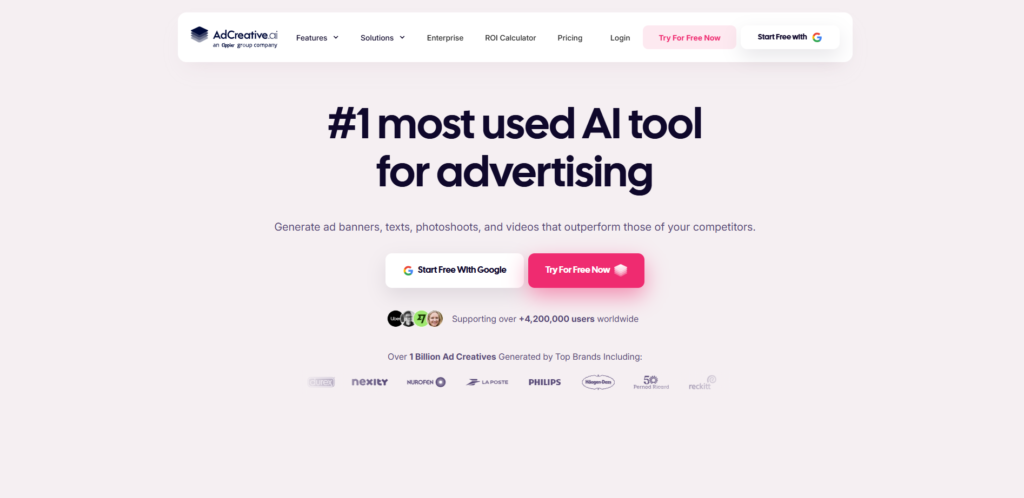
AdCreative.ai generates ad creative, banners, product shots, and ad copy using AI, then scores each variant on predicted performance before you spend a cent on media. It plugs directly into Google Ads and Meta Ads Manager so approved creative can launch without leaving the platform.
What It Does Well
The Creative Scoring AI is the standout feature. It analyzes dozens of data points per image, things like color contrast, text density, and layout, and ranks variants before launch. In our testing at Hotskill, teams running high-SKU ecommerce catalogs cut creative production time from roughly a full day to under an hour for a batch of 20 variants.
Where It Falls Short
The credit system is confusing at first. You’re not charged per generation, you’re charged per download, and the platform doesn’t publish how many credits a video asset consumes versus a static image. Budget more than you think you’ll need on the entry plan.
Best For
Ecommerce brands and agencies that need high volumes of ad variants tested quickly, especially teams without an in-house designer.
Pricing
Starter plans begin around $29 to $39 per month for 10 download credits, Professional runs roughly $249 per month with video generation unlocked, and Ultimate sits near $599 to $999 per month for agencies managing multiple brands, as of 2026. Annual billing brings the entry tier down significantly.
Madgicx – Best for Meta Ads Automation
What It Does
Madgicx is an optimization and analytics layer built specifically for Meta, meaning Facebook and Instagram. It handles bid and budget automation, audience targeting suggestions, creative analytics, and a rules engine, and it can pull in Google Ads and TikTok data for reporting even though it doesn’t run ads on those channels directly.
What It Does Well
The automation rules are genuinely sophisticated compared to Meta’s native tools. You can set conditions like “if cost per purchase exceeds $30 for 48 hours and daily spend is above $50, cut budget by 20% and notify me,” which goes well beyond the basic pause-or-scale logic most platforms offer.
Where It Falls Short
This is a Meta-only tool for actual campaign management. If most of your budget goes to Google Ads or TikTok, Madgicx becomes a reporting layer rather than an automation engine, and you’re paying for automation you can’t fully use.
Best For
Meta-heavy advertisers, particularly ecommerce brands spending $2,500 to $30,000 a month on Facebook and Instagram ads.
Pricing
Plans start around $44 per month for spend under $2,500, scale to roughly $99 to $129 per month at higher spend tiers, and add a separate Tracking Pro attribution add-on at about $49 per month per connected account, as of 2026. Pricing is spend-tiered, so confirm your tier before committing to an annual plan.
Revealbot – Best for Custom Rule-Based Automation
What It Does
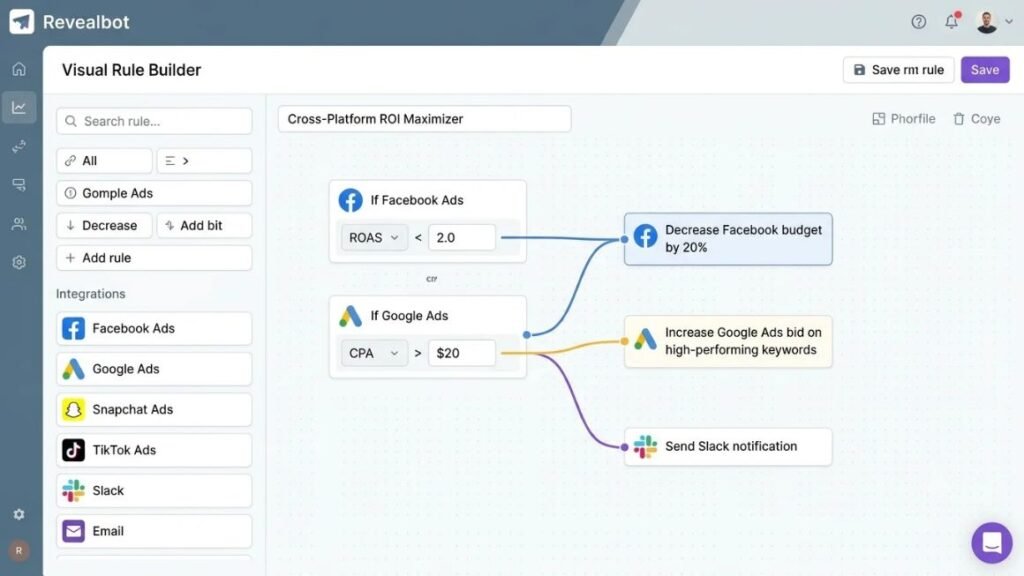
Revealbot is a rules-based automation platform that works across Meta, Google Ads, TikTok, and Snapchat. You build custom automation rules using a visual builder, and Revealbot checks your campaigns against those rules as often as every 15 minutes.
What It Does Well
Cross-platform support is the real differentiator here. Most AI ad agents lock you into one ad network, but Revealbot lets you set a single rule, like “pause any ad set with zero conversions after $75 spend,” and apply it across Meta, Google, and TikTok at once. That’s a meaningful time saver if you’re running a genuinely multi-channel account.
Where It Falls Short
Revealbot leans rules-based rather than predictive. It won’t generate creative or forecast audience performance for you the way AdCreative.ai or Smartly.io can. You still need to know what rules to write, which means it rewards experienced media buyers more than beginners.
Best For
Agencies and in-house teams running the same account across multiple ad platforms who want one automation layer instead of three separate ones.
Pricing
Revealbot’s plans scale with connected ad spend and typically fall in the low hundreds of dollars per month for small to mid-size accounts, with a free trial available. Confirm the current tier structure on their pricing page, since it’s updated frequently.
Smartly.io – Best for Enterprise Multi-Channel Campaigns
What It Does
Smartly.io combines creative automation, media buying, and predictive budget allocation across Meta, TikTok, Pinterest, Snapchat, and Google in a single platform, aimed squarely at enterprise ad teams and agencies managing large budgets.
What It Does Well
The creative-to-media pipeline is tightly integrated. You can build hundreds of ad variants from templates, launch them across five platforms, and let the predictive budget allocation shift spend toward winners automatically, all without exporting a single asset by hand.
Where It Falls Short
This is not a tool for a solo marketer or small business. The onboarding process typically involves a dedicated account team, and the pricing reflects an enterprise buyer, not a self-serve one.
Best For
Enterprise brands and large agencies running six-figure monthly ad budgets across four or more platforms simultaneously.
Pricing
Smartly.io uses custom, quote-based pricing tied to ad spend and platform coverage. There’s no public self-serve tier, so you’ll need to book a call with sales to get a number, as of 2026.
Meta Advantage+ – Best for Native Meta Campaign Automation
What It Does
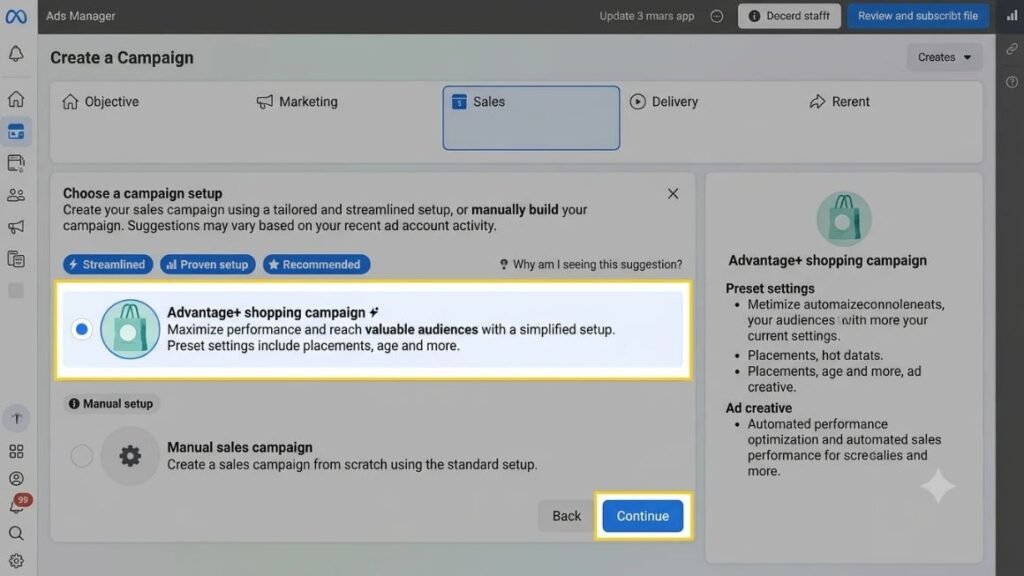
Advantage+ is Meta’s own suite of AI-driven campaign automation inside Ads Manager, covering audience targeting, placement selection, and creative optimization, all built directly into the platform you already use to run Facebook and Instagram ads.
What It Does Well
Because it’s native, there’s no integration lag and no extra login. Meta’s own 2024 data, cited in its advertiser resources, associated Advantage+ shopping campaigns with a median 12% higher return on ad spend compared to manually configured campaigns for participating advertisers. It’s also free, since it’s a feature inside Ads Manager rather than a separate subscription.
Where It Falls Short
You lose granular control. Advantage+ decides audience targeting largely on its own, which works well once it has enough conversion data but can perform poorly for new accounts or low-volume campaigns still in the learning phase.
Best For
Advertisers already running most of their budget through Meta who want automation without adding another subscription or login to the stack.
Pricing
Free, built into Meta Ads Manager. You only pay standard Meta ad spend.
Google Performance Max – Best for Native Google Ads Automation
What It Does
Performance Max is Google’s automated campaign type that uses machine learning to serve ads across Search, Display, YouTube, Gmail, and Maps from a single campaign, automatically shifting budget toward whichever channel and audience combination is converting.
What It Does Well
The cross-inventory reach is hard to replicate manually. One campaign can pull impressions from six Google surfaces at once, and the bidding automation reacts to conversion signals faster than most manual bid adjustments ever could.
Where It Falls Short
Performance Max is famously opaque about where your budget actually goes. You get channel-level reporting but not the granular placement data that Search or Display campaigns give you individually, which makes it harder to diagnose why a campaign underperforms.
Best For
Advertisers with solid conversion tracking already in place who want to expand reach across Google’s full inventory without managing five separate campaign types.
Pricing
Free, built into Google Ads. You only pay standard Google ad spend.
How to Build a Paid Ad Workflow Around AI Agents
Bringing an AI Agent for Paid Advertising into your workflow doesn’t mean firing your media buyer or handing over the keys blindly. It means changing what that person spends their time on.
- Audit your current manual tasks. List every recurring action you take in Ads Manager or Google Ads: pausing losers, reallocating budget, testing new creative. Anything you do on a fixed schedule is a candidate for automation.
- Pick one tool for one job first. Don’t roll out five agents at once. Start with creative generation or bid automation, whichever eats the most time currently, and run it for two full weeks before adding another layer.
- Set guardrails before you turn anything on. Daily spend caps, minimum learning-phase spend, and a “pause everything” kill switch should exist before the agent makes its first autonomous decision.
- Review weekly, not daily. Give the agent enough data to actually learn. Checking in every morning and manually overriding decisions defeats the purpose and can reset the platform’s learning phase.
- Reinvest the saved time in strategy. The time you get back should go toward offer testing, landing page improvements, and audience research, the things an AI agent still can’t do for you.
Building a workflow around AI advertising automation works best when teams automate one task at a time, starting with the highest-effort recurring action, rather than switching every campaign to full automation at once. Clear budget guardrails and weekly, not daily, review cycles give the underlying models enough data to actually improve performance.
Where AI Ad Agents Still Fall Short
To be fair, these tools aren’t magic, and being upfront about the limits matters more than the sales pitch.
AI agents are only as good as the conversion data feeding them. A new account with fewer than 50 conversions a month gives the model almost nothing to learn from, and automation on thin data often performs worse than a human making informed manual decisions.
They also can’t judge brand fit. An agent can tell you which ad variant gets clicked more, but it has no sense of whether that variant actually represents your brand well or might damage trust with your audience long term. That judgment call still belongs to a person.
And none of these tools replace strategy. An agent optimizes what you give it. If your offer is weak or your landing page doesn’t convert, the best AI advertising agent on the market will just help you lose money faster and with more precision.
Getting Started
The fastest path here isn’t picking the “best” tool and hoping it fixes everything. It’s picking the one task eating the most of your time this week, whether that’s creative production or bid management, and automating just that first. Once you trust the output, layer in the next tool.
If you want to get faster at evaluating which AI tools are actually worth adding to your stack instead of guessing from marketing pages, Hotskill runs structured, hands-on lessons built for exactly this kind of decision. Download the app on iOS or Android at hotskill.co/download and start your first lesson today.
FAQ
What is an AI advertising agent?
An AI advertising agent is software that autonomously manages parts of a paid ad campaign, such as bidding, budget allocation, or creative testing, by taking direct action based on performance data rather than just reporting on it. It differs from a standard analytics dashboard because it can execute changes without a human clicking approve on each one.
How is an AI ad agent different from Meta or Google’s built-in automation?
Native tools like Advantage+ and Performance Max only work within their own platform, while third-party agents like Revealbot or Madgicx can often work across multiple ad networks from one dashboard. Third-party tools also tend to offer more granular, custom rule-building than the native automated campaign types.
Do I need coding skills to use these tools?
No. Every tool covered here, from AdCreative.ai to Revealbot, uses a visual interface for building rules or generating creative. Some advanced platforms like Smartly.io offer API access for custom integrations, but that’s optional, not required.
Is an AI advertising agent worth it for a small business?
It depends on your monthly ad spend and how much time you’re currently spending on manual campaign management. If you’re spending under $1,000 a month, native tools like Advantage+ or Performance Max, which are free, usually make more sense than a paid third-party platform.
Can an AI agent replace a media buyer or ads manager?
Not fully. These agents handle repetitive, data-driven decisions well, but strategy, brand judgment, and creative direction still require a person. Most experienced media buyers use AI agents to handle the busywork so they can spend more time on strategy.
Why isn’t my AI ad agent improving performance?
The most common cause is insufficient conversion data. If your campaign hasn’t generated at least 30 to 50 conversions, the underlying model doesn’t have enough signal to optimize accurately. Check your guardrails too, overly tight budget caps can prevent the agent from testing enough variations to find a winner.
Which AI ad tool is best for ecommerce brands?
AdCreative.ai tends to work best for ecommerce brands with large product catalogs that need high volumes of tested creative quickly, while Madgicx is the stronger pick if most of that ecommerce spend runs through Meta specifically.
Do these tools work with TikTok Ads?
Some do. Revealbot and Smartly.io both support TikTok alongside Meta and Google, while Madgicx currently only manages and optimizes Meta campaigns, pulling TikTok in as a reporting source rather than an active channel.
How much should I budget for an AI advertising agent?
Entry-level tools like AdCreative.ai start around $29 to $39 a month, mid-tier platforms like Madgicx and Revealbot typically run $44 to $150 a month depending on ad spend, and enterprise platforms like Smartly.io require a custom quote. Factor this cost against the hours it saves you weekly to judge real ROI.
Is it risky to let an AI agent control my ad budget automatically?
There’s some risk if you skip guardrails, since an agent chasing a target metric without spend caps can overspend on a bad audience. Setting daily budget limits, minimum learning-phase thresholds, and a kill switch before activation reduces that risk significantly while still letting the agent do its job.