

Running Facebook ads used to mean staring at Ads Manager for hours, adjusting bids by hand, and guessing which creative was actually pulling its weight. That job doesn’t really exist anymore, at least not the way it used to. Meta’s own systems now handle most of the targeting and bidding decisions, and a growing stack of third-party platforms will write your copy, generate your creative, and pause underperforming ads while you sleep.
If you’re trying to figure out where an AI agent fits into your Facebook Ads workflow, you’re not alone. Marketers are getting pitched a dozen tools a week, half of them promising to “revolutionize” campaign management, and it’s genuinely hard to tell which ones do real work and which ones are wrappers around a spreadsheet.
This guide cuts through that. You’ll get a clear definition of what an AI agent for Facebook Ads actually does, an honest breakdown of the tools worth paying for in 2026, and a step-by-step setup process you can follow this week.
What Is an AI Agent for Facebook Ads?
An AI agent for Facebook Ads is software that makes and executes decisions about targeting, bidding, budget, or creative on your behalf, rather than just reporting data for a human to act on. That’s the key difference from a dashboard: an agent takes action.
Most tools in this category fall into one of three types. Native tools live inside Meta’s own Ads Manager, third-party automation platforms connect through the Marketing API and run rules or full autonomous optimization, and creative generation agents produce ad copy, images, or video from a brief. Some platforms, like Madgicx, do more than one of these at once.
It’s worth being precise here because “AI agent” gets thrown around loosely. A tool that suggests a bid change and waits for you to click approve is assistive automation. A tool that reallocates 20% of your budget between ad sets overnight without asking is an agent in the fuller sense. Both are useful, but they solve different problems.
An AI agent for Facebook Ads is software that autonomously executes decisions like bidding, targeting, or creative selection, rather than just surfacing recommendations. The category spans Meta’s native Advantage+ tools, third-party platforms like Madgicx and Bïrch, and creative generators like AdCreative.ai. What separates an agent from a dashboard is whether it acts on your account or just reports on it.
Why Marketers Are Handing Campaign Management to AI
The honest answer is that manual optimization stopped being competitive a while ago. Apple’s iOS 14.5 privacy changes in 2021 cut off a lot of the granular signal Meta used to rely on, and the platform’s response was to push advertisers toward broader, AI-managed targeting instead of hand-built audience stacks. Fighting that shift with manual campaigns increasingly means fighting the algorithm Meta is optimizing for.
There’s also a volume problem. Creative fatigue sets in fast on Meta, and a single media buyer manually testing headlines and images across a dozen ad sets just can’t keep pace with an algorithm cycling through thousands of variants. This is where AI agents for Facebook Ads campaign management earn their keep: they can watch every ad set at once, catch a CPA spike at 2 a.m., and shift budget before you’ve had your coffee.
None of this means human judgment is obsolete. Someone still has to define the offer, set the guardrails, and decide what “good” looks like. What’s changed is where the marketer’s time goes. Less time nudging bids, more time on strategy, creative direction, and reading the account for what the AI can’t see, like brand fit or a promotion that’s about to expire.
Meta’s Native AI: Advantage+ and the Andromeda Engine
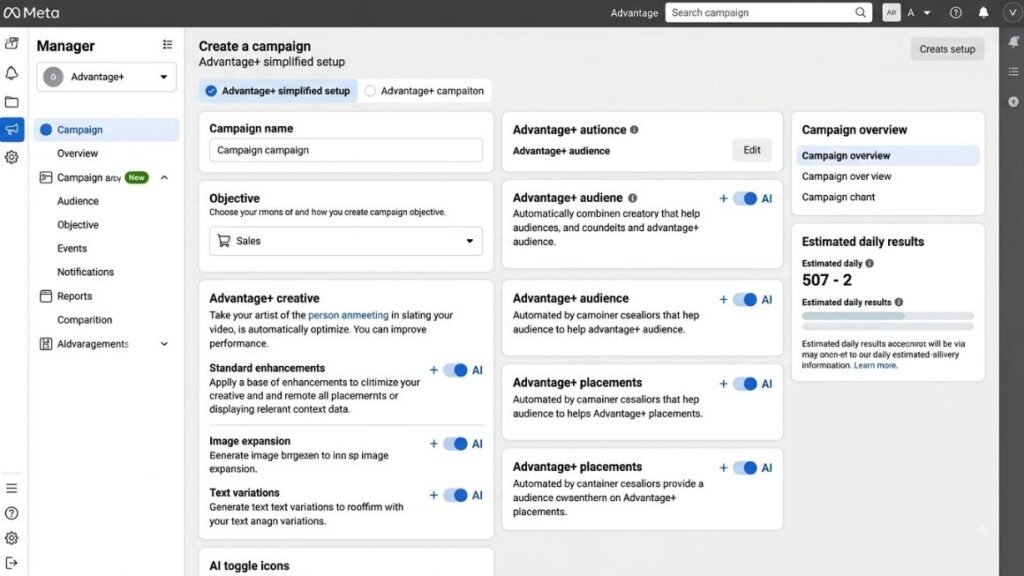
Meta Advantage+ is Meta’s own suite of AI-driven campaign features, built directly into Ads Manager, that automates audience targeting, ad placement, budget distribution, and increasingly creative selection.
Underneath Advantage+ sits Andromeda, Meta’s ad-ranking engine, which evaluates candidate ad-to-user matches at a scale roughly 10,000 times greater than the system it replaced. In February 2026, Meta merged the separate manual and Advantage+ Shopping Campaign setup flows into a single unified creation screen, and AI-driven optimization is now enabled by default across audience, placement, and budget. You can still switch individual toggles off, but the platform is clearly steering everyone toward automation.
The 2026 updates lowered the data threshold Advantage+ needs to perform well. Shopping campaigns now need roughly 25 conversions a week instead of the original 50, which brings smaller advertisers into range for the first time. Meta also added Predictive Budget Allocation, which shifts spend to high-performing segments in real time, and early tests show an 8 to 15% ROAS improvement from that feature alone.
What it does well: Advantage+ is free, native, and doesn’t require connecting a third-party app to your ad account. For straightforward e-commerce and lead gen, it’s genuinely competitive, with Meta reporting Advantage+ campaigns now represent 62% of e-commerce ad spend on the platform and deliver about 22% higher ROAS than manual campaigns on average, according to Meta’s internal data.
Where it falls short: You get limited visibility into why the algorithm made a specific decision, and brand control over AI-generated creative variations takes some setup to lock down. If you manage several ad accounts or need cross-platform reporting alongside Meta, you’ll outgrow Advantage+’s native reporting fast.
Best for: Any advertiser running Meta ads, frankly. It’s the baseline, not an optional extra anymore.
Pricing: Free, included in standard Meta ad spend, as of 2026.
The Best Third-Party AI Tools for Facebook Ads
Advantage+ handles the Meta-native layer. These tools sit on top of it, adding cross-account automation, deeper creative intelligence, or capabilities Meta simply doesn’t offer natively.
Madgicx — Best AI “Media Buyer” for Meta-Only Accounts
Madgicx is a Meta-focused AI operations layer that combines automation rules, creative analytics, and an AI assistant called AI Marketer that recommends and, on higher tiers, executes account changes.
What it does well: The standout feature is Creative Cockpit, a dashboard that breaks down ad performance by hook, format, and creative element, then lets you filter by ROAS, CPM, and CTR to spot what’s actually working. Madgicx also connects Meta, Google Analytics 4, Shopify, and Klaviyo data into one view, which is useful for e-commerce brands trying to tie ad spend to actual revenue.
Where it falls short: Madgicx is Meta-only. It doesn’t support TikTok, Google Ads, or LinkedIn, so multi-platform advertisers need a second tool for cross-channel reporting. It’s also not a creative generator; you’ll still need something like AdCreative.ai to actually produce ad assets.
Best for: E-commerce brands running meaningful Meta spend who want automation plus creative analysis in one dashboard, rather than replacing strategy work entirely.
Pricing: Entry tiers run roughly $49 to $99 a month, scaling to $149 to $299 for growth accounts and $499-plus for high-spend accounts, as of 2026. Tracking Pro is a $49/month add-on per connected account.
Bïrch (formerly Revealbot) — Best for Rule-Based Automation
Bïrch, the 2026 rebrand of Revealbot, is a rule-based automation platform that lets you write conditional triggers: pause an ad set if CPA crosses a threshold, increase budget when ROAS clears a target, or send a Slack alert on an anomaly.
What it does well: You define exactly what happens and when, which appeals to marketers who want automation without handing full decision-making to a black box. Bïrch’s $49/month Essential plan covers up to $10,000 in monthly ad spend, which is a wider spend allowance at the entry tier than most competitors offer.
Where it falls short: Because it’s rule-based rather than fully autonomous, Bïrch is only as smart as the rules you write. It won’t discover a new winning audience on its own the way a fully AI-driven platform might.
Best for: Marketers who’ve been burned by black-box automation before and want precise, auditable control over what the AI is allowed to do.
Pricing: Plans start at $49/month for up to $10,000 in monthly ad spend, with a 14-day free trial, as of 2026.
AdCreative.ai — Best for Creative Generation at Scale
AdCreative.ai is a generative AI platform that produces dozens of ad creative variations, static and video, from a single product image or brief, then scores each one on predicted performance before you spend a dollar testing it.
What it does well: Speed. Instead of waiting days for a designer, you can generate a batch of on-brand ad variations in minutes, complete with AI-written headlines and CTAs. The included iStock photo library is a genuinely useful bonus, valued at roughly $900 a year on its own.
Where it falls short: Some users report the generated visuals feel repetitive or generic without heavy manual editing, and the credit system can be confusing if you’re not tracking usage closely. It’s a creative tool, not a campaign manager, so it doesn’t touch bidding or targeting.
Best for: Solo marketers, agencies, and lean teams whose real bottleneck is creative volume, not campaign optimization.
Pricing: Starter plans begin around $20 to $39/month depending on billing cycle, scaling up to $449-plus/month for agency tiers with video production, as of 2026. A 7-day free trial with 10 credits is included.
Smartly.io — Best for Enterprise Cross-Channel Creative and Media Buying
Smartly.io is an enterprise platform that unifies creative production, media buying, and cross-channel analytics for Meta, TikTok, Pinterest, Snapchat, and connected TV.
What it does well: Smartly’s AI Studio has generated 1.9 million creative assets across more than 260 customers since its 2025 launch, delivering roughly 30 times faster creative production and an average 27% performance lift over static creatives, according to the company’s published data. It also monitors creative fatigue in real time and rotates in fresh variants automatically, which one brand, Daniel Wellington, credited with a 30% cut in campaign management time.
Where it falls short: There’s no public pricing and no self-serve signup, so you’re committing to a sales process before you see a number. The learning curve is real, and reviewers consistently flag it as expensive for smaller teams.
Best for: Large brands and agencies managing $50,000-plus in monthly cross-channel spend who need one system instead of five disconnected tools.
Pricing: Custom, quote-based enterprise pricing, generally starting in the low thousands per month, as of 2026.
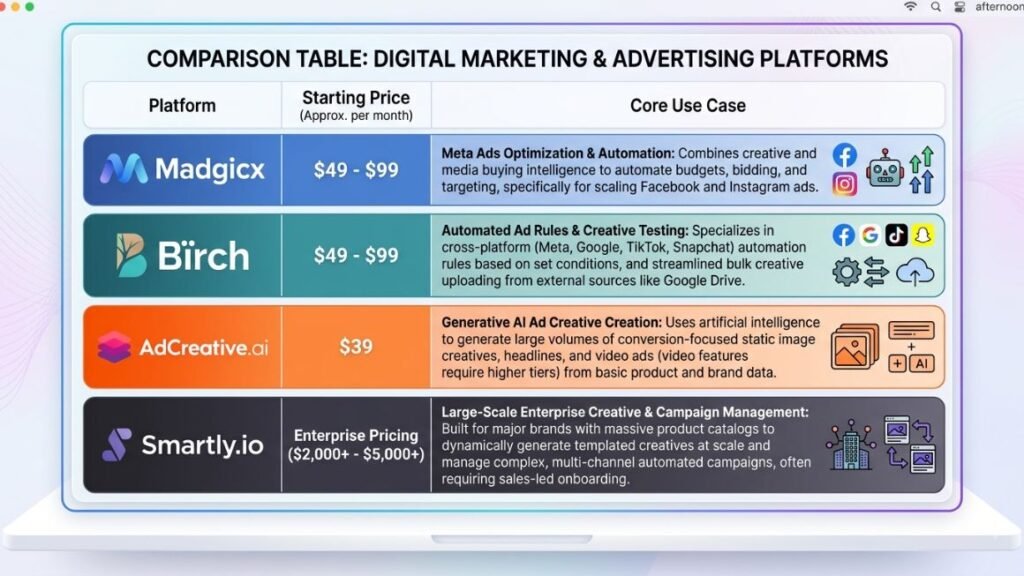
No single AI tool for Facebook Ads covers everything. Madgicx and Bïrch handle campaign automation, AdCreative.ai handles creative generation at scale, and Smartly.io handles enterprise cross-channel media buying. Most serious advertisers end up pairing at least two of these rather than relying on one platform.
How to Set Up AI-Automated Facebook Ads Step by Step
Understanding how to automate Facebook Ads with AI starts with getting your foundation right. AI optimization is only as good as the data it’s fed, so skipping setup steps to “let the AI figure it out” usually backfires.
- Set up the Meta Conversions API alongside your pixel. Server-side tracking gives Advantage+ and third-party tools cleaner signal than pixel data alone, especially post-iOS 14.5.
- Choose Sales, App, or Leads as your campaign objective and toggle Advantage+ on. This activates Meta’s AI across audience, placement, and budget by default.
- Feed the algorithm real creative variety. Upload at least 4 to 6 distinct ad concepts, not just color variations of the same image, so the AI has genuinely different options to test.
- Set a budget the algorithm can actually learn from. Aim for enough spend to hit 25-plus conversions a week per ad set; underfeeding the AI is the single most common reason Advantage+ campaigns underperform.
- Connect a third-party layer if you need it. Link Madgicx or Bïrch through the Meta Marketing API for cross-account rules, alerts, and reporting Advantage+ doesn’t offer natively.
- Write your automation rules or let the AI Marketer act. Start conservative: pause below a CTR floor, cap daily budget increases at 20%, and require a human check-in weekly for the first month.
- Review the account weekly, not daily. AI-managed campaigns need a learning phase, usually 5 to 7 days, before performance stabilizes. Constant manual tinkering resets that learning and hurts results.
That last point trips up a lot of marketers coming from fully manual management. The instinct to check in every few hours and nudge something is understandable, but it’s usually working against the system you just set up.
Building the Right AI Stack for Your Budget
There’s no single “best” AI agent for Facebook Ads. The right stack depends almost entirely on where your bottleneck actually is.
If creative production is what’s slowing you down, start with AdCreative.ai and let Advantage+ handle distribution natively. That combination alone often costs under $50 a month and covers the two biggest levers in a small account: creative volume and delivery optimization.
If you’re already generating enough creative but spending too much time babysitting budgets across ad sets, Madgicx or Bïrch is the better first purchase. Bïrch suits marketers who want auditable, rule-based control, while Madgicx suits marketers who’d rather have an AI recommend the move and act on approval.
Enterprise teams running six figures a month across multiple platforms are really in a different category, where the question isn’t which single tool to buy but which platform can consolidate creative, media buying, and reporting without five separate logins. That’s Smartly.io’s whole pitch, and at that spend level, the price tag is easier to justify against the hours saved.
Common Mistakes Marketers Make With AI Ad Agents
Even good AI tools for Facebook Ads optimization get misused in predictable ways. A few show up constantly.
The first is turning on full automation before the account has enough conversion data. An AI agent making decisions on 8 conversions a week is basically guessing, no matter how sophisticated the model behind it.
The second is treating AI-generated creative as finished work. Generated ad variants are a starting point. Reviewing them for brand voice, accuracy, and actual product fit before they go live still matters, and skipping that step is how you end up with an ad that technically follows your brief but doesn’t sound like your brand.
The third is interfering constantly. Every manual override during an AI system’s learning phase resets its optimization, so an advertiser who sets up automation and then edits the campaign three times a day is fighting the tool they just paid for.
The fourth, and this one’s specific to agencies, is running the same automation rules across every client account regardless of vertical or spend level. A rule tuned for a $5,000/month DTC brand will misfire on a $50,000/month B2B lead gen account. Rules need to be built per account, not copy-pasted.
Where This Is Heading
Facebook advertising in 2026 is converging on one model across the whole platform: you define the objective, supply the creative and budget, and let AI handle execution. The competitive edge has shifted from manual campaign optimization to input quality, meaning first-party data depth and creative asset diversity matter more than knowing how to build an audience stack by hand.
Start where your actual bottleneck is, whether that’s creative volume, budget management, or reporting across accounts, and add one tool at a time. Stacking five automation platforms on day one usually creates more noise than results.
Get Better at This, Not Just Faster
The tools in this guide will save you hours a week once they’re set up right. Getting them set up right is the part most guides skip past. If you want structured, hands-on lessons on using AI tools like these for real marketing work, not just theory, Hotskill has skill tracks built for exactly this. Download the app on iOS or Android and start your first lesson today: hotskill.co/download
FAQ
What is an AI agent for Facebook Ads?
An AI agent for Facebook Ads is software that autonomously makes and executes decisions about your campaigns, such as adjusting bids, shifting budget, or selecting creative, rather than just showing you data to act on manually. It ranges from Meta’s native Advantage+ features to third-party platforms like Madgicx and Bïrch.
Meta Advantage+ vs third-party AI tools, what’s the difference?
Advantage+ is free, built into Ads Manager, and automates targeting, placement, and budget within a single Meta account. Third-party tools like Madgicx add cross-account rules, deeper creative analytics, and reporting that Advantage+ doesn’t offer natively, usually for a monthly fee.
How do I automate Facebook Ads with AI as a beginner?
Start by turning on Advantage+ within Ads Manager, since it’s free and requires no third-party setup. Feed it several distinct creative variations and a budget that can realistically hit 25-plus weekly conversions, then let it run for a week before making changes.
Is an AI agent worth it for a small Facebook ads budget?
Below roughly $2,000 to $3,000 a month, Meta’s native Advantage+ alone usually covers most of what a paid third-party agent offers, since the fixed cost of a paid tool eats into a small budget fast. Once you’re spending consistently above that range, tools like AdCreative.ai or Bïrch start paying for themselves in time saved.
Do I need to know how to code to use these AI tools?
No. Every tool covered here, including Madgicx, Bïrch, AdCreative.ai, and Smartly.io, is built for marketers with no coding background, using visual dashboards and rule builders instead of custom scripts.
Why isn’t my AI-managed campaign performing well?
The most common cause is insufficient conversion data. If an ad set gets fewer than roughly 25 conversions a week, the algorithm doesn’t have enough signal to optimize properly. Constant manual edits during the learning phase are the second most common culprit.
Can AI agents fully replace a media buyer?
Not entirely. AI agents handle execution well, like bid adjustments and creative rotation, but strategy, offer development, and brand judgment still need a human. Most teams end up using AI to handle the repetitive work while a person sets direction.
How much do AI tools for Facebook Ads optimization cost?
Entry-tier flat-fee tools like Madgicx or Bïrch typically run $49 to $99 a month, creative generators like AdCreative.ai start around $20 to $39 a month, and enterprise platforms like Smartly.io use custom quote-based pricing that often starts in the low thousands monthly, as of 2026.
Do AI agents work for Facebook Ads and Instagram Ads at the same time?
Yes. Since Facebook and Instagram share the same Meta Ads Manager and ad account, both Advantage+ and third-party tools like Madgicx and Bïrch manage placements across both platforms by default.
What’s the biggest risk of using AI agents for Facebook Ads campaign management?
The biggest risk is over-automating an account before it has enough data or oversight, which can waste budget quickly if left unchecked. Setting conservative guardrails, like a maximum daily budget increase, and reviewing the account weekly reduces that risk significantly.