

Most email marketers aren’t losing subscribers because their product is bad. They’re losing them because their emails feel like they were written by someone who didn’t read the brief. Wrong tone, wrong timing, wrong subject line. The inbox is brutal, and generic copy doesn’t survive it.
That’s where an AI Agent for Email Marketing changes the game. An AI agent, in this context, is a system that doesn’t just generate text on demand but takes on tasks autonomously: segmenting your list, writing sequences, A/B testing subject lines, and adjusting messaging based on behaviour. It’s not autocomplete. It’s a layer of intelligence that sits between your strategy and your send button.
The problem is there are now dozens of tools claiming to do this. Some are genuinely good. Some are basic content generators with an “email” label slapped on top. This list cuts through the noise and tells you exactly which tools are worth your attention in 2026, what each one actually does well, and where they fall short.
What Makes an AI Email Agent Actually Useful?
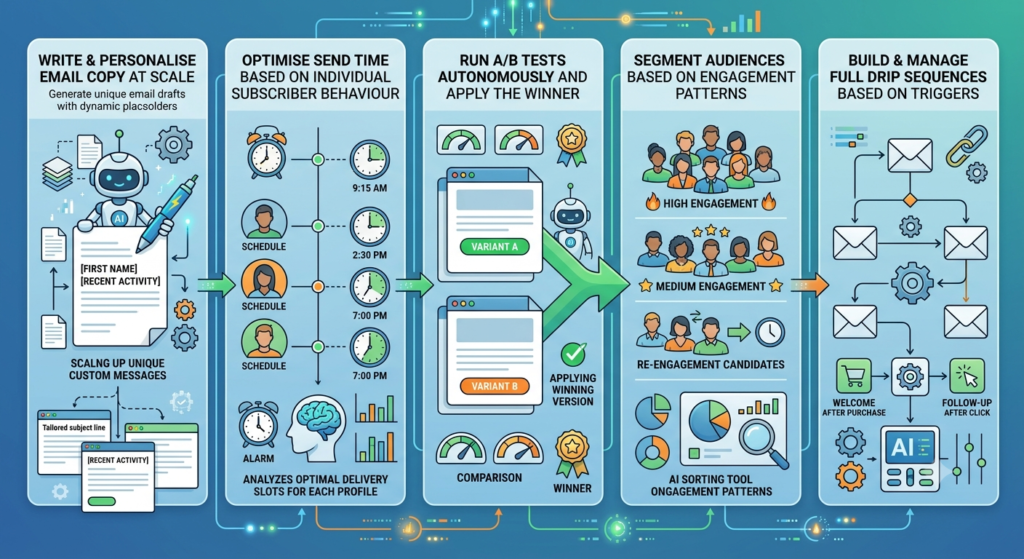
Not every AI tool that touches email qualifies as an agent. A standalone subject line generator is a feature. An agent does more: it reads context, takes action, adapts over time, and handles multi-step tasks without you babysitting each step.
The best tools in this space do at least three of these things well:
- Write and personalise email copy at scale
- Optimise send time based on individual subscriber behaviour
- Run A/B tests autonomously and apply the winner
- Segment audiences based on engagement patterns
- Build and manage full drip sequences based on triggers
If a tool only generates copy and hands it back to you, it’s useful but not an agent. Keep that distinction in mind as you read through this list.
1. Seventh Sense — Best for Send-Time Optimisation
Send-time optimisation sounds simple until you realise that “best time to send” varies by individual subscriber, not by industry benchmark. Seventh Sense tracks each contact’s open patterns and delivers emails at the moment each person is most likely to engage.
What it does well: It integrates directly with HubSpot and Marketo, making it one of the few tools that plugs into enterprise stacks without requiring a migration. In Hotskill’s observation of marketing teams using HubSpot, those who layered Seventh Sense on top typically saw open rate lifts of 15-25% in the first 60 days, simply from timing improvements.
Where it falls short: It doesn’t write copy. It doesn’t build sequences. It does one thing: send the right email at the right time. If you need content generation, you’ll still need a second tool.
Best for: B2B marketers with large, established HubSpot or Marketo lists who’ve already fixed their copy and just need better delivery timing.
Pricing (as of 2026): Starts at $80/month for HubSpot integration; Marketo plans start higher. No meaningful free tier.
2. Jasper AI — Best for Marketers Who Need Volume Fast
Jasper AI is a content generation platform with strong email-specific templates. It’s not an email platform itself, but as a writing engine for email copy, it’s genuinely fast and produces output that doesn’t sound templated.
What it does well: Jasper’s Brand Voice feature is where it earns its place. You feed it your brand guidelines and past copy, and it maintains a consistent tone across every email it writes. For teams managing multiple brands or product lines, this is a real time-saver. It handles subject lines, preview text, body copy, and CTAs in one workflow.
Where it falls short: Jasper doesn’t connect to your ESP (email service provider) natively. You write in Jasper, then copy into whatever platform you send from. That friction adds up over time. It also has no send, test, or automation capability.
Best for: Content teams who produce high volumes of email copy and need consistency across writers or brands.
Pricing (as of 2026): Creator plan at $39/month; Pro plan at $59/month. Business pricing on request.
Jasper AI is best used as a copy production layer, not a full email agent. It excels at volume and brand consistency but requires a separate ESP for sending, testing, and automation. Teams who integrate Jasper with a platform like Klaviyo or ActiveCampaign get the most out of both tools combined.
3. Klaviyo AI — Best for eCommerce Email Automation
Klaviyo is the dominant email platform for eCommerce brands, and its AI layer makes it one of the most complete email solutions available. Klaviyo AI (built into the platform) handles predictive analytics, subject line generation, flow optimisation, and segment suggestions.
What it does well: Predictive analytics is genuinely strong here. Klaviyo uses purchase history, browsing behaviour, and email engagement to predict when a customer will buy next, what they’re likely to buy, and when they’re at risk of churning. This feeds directly into automation flows without you having to manually define the rules.
Where it falls short: Klaviyo is expensive for smaller lists. And it’s heavily built around Shopify and WooCommerce, so if you’re not in eCommerce, the feature set feels over-engineered for what you actually need.
Best for: eCommerce brands on Shopify generating at least $500K in annual revenue who want a single platform for email, SMS, and automation.
Pricing (as of 2026): Free up to 250 contacts; paid plans start at $20/month and scale with list size. Mid-market brands often pay $300-$800/month.
4. ActiveCampaign AI — Best for B2B Lead Nurture
ActiveCampaign has been a strong automation platform for years, and its recent AI additions make it one of the better tools for B2B email sequences. The AI layer writes emails, suggests automation branches, and scores leads based on engagement.
What it does well: The automation builder is still the most flexible of any mid-market platform. You can build highly conditional sequences, and the AI now suggests branching logic based on what similar contacts have done historically. For B2B teams managing long sales cycles, this matters a lot.
Where it falls short: The copy generation is decent but not exceptional. You’ll likely want to edit everything it produces. The AI features also sit behind higher-tier plans, so the entry price is higher than it looks.
Best for: B2B SaaS and services companies with 3-month-plus sales cycles who need sophisticated nurture sequences.
Pricing (as of 2026): Starts at $15/month (Starter), but AI features require the Plus plan at $49/month or above.
5. Copy.ai — Best Free Starting Point for Solo Marketers
Copy.ai started as a general content tool and has built out a solid set of email-specific workflows. It’s one of the most accessible tools on this list, and the free tier is genuinely usable.
What it does well: The email sequence builder walks you through a full nurture campaign step by step. You define your audience, goal, and tone, and it maps out a 5-7 email sequence with copy for each. For a solo marketer building their first automation, this cuts days off the process.
Where it falls short: The output is competent but rarely surprising. It tends toward safe, middle-of-the-road copy. If your brand has a strong, distinct voice, you’ll spend a lot of time rewriting.
Best for: Solopreneurs and early-stage startups who need to build email sequences quickly without a large budget.
Pricing (as of 2026): Free plan available with usage limits; Pro at $49/month; Team at $249/month.
Copy.ai’s email sequence builder is one of the fastest ways to go from zero to a complete nurture campaign. It’s not the strongest for copy quality, but for structure and speed, it’s a legitimate starting point for solo marketers who don’t have a dedicated email specialist.
6. Mailchimp Intuit Assist — Best for Beginners Already on Mailchimp
Intuit Assist is Mailchimp’s built-in generative AI layer, added in 2024 and iterated significantly in 2025. If you’re already on Mailchimp, it’s worth enabling.
What it does well: It generates subject lines, preview text, and body copy from minimal inputs. The customer journey builder, which maps automated sequences, has gotten genuinely smarter about suggesting next steps based on engagement data.
Where it falls short: It’s still catching up to competitors. The copy quality is noticeably more generic than Jasper or Copy.ai, and the AI suggestions in the journey builder feel conservative. It’s good enough to save time; it’s not good enough to impress.
Best for: Small businesses and nonprofits already on Mailchimp’s free or Essentials plan who want AI features without switching platforms.
Pricing (as of 2026): Free plan for up to 500 contacts; Essentials from $13/month; Standard from $20/month where most AI features live.
7. Salesforce Einstein for Email — Best for Enterprise CRM Integration
Salesforce Einstein is the AI layer embedded across the Salesforce platform, including Marketing Cloud. For enterprises already in the Salesforce ecosystem, it’s the most tightly integrated option on this list.
What it does well: Einstein’s predictive send-time feature and engagement scoring are class-leading for enterprise use. It pulls CRM data, including purchase history, support tickets, and deal stage, and uses it to personalise email content and timing at scale. No other tool on this list connects CRM depth to email execution as cleanly.
Where it falls short: This is not a tool you buy for email alone. Einstein’s value is almost entirely dependent on how deeply your organisation uses Salesforce CRM. If you’re not already in that ecosystem, the cost and implementation time make no sense.
Best for: Enterprise marketing teams running Salesforce CRM and Marketing Cloud who need AI personalisation at scale.
Pricing (as of 2026): Marketing Cloud pricing starts at $400/month and scales significantly. Einstein features are included in higher tiers.
8. HubSpot AI Email Writer — Best for Inbound Marketing Teams
HubSpot’s built-in AI email writing assistant sits inside its Marketing Hub and connects naturally to its CRM, landing pages, and forms. For inbound-heavy teams already in HubSpot, it’s one of the smoothest integrations available.
What it does well: It pulls contact properties directly into email drafts. You can write a template that says “based on [contact’s industry], here’s why [product feature] matters to you” and the AI handles the personalisation at send time. The AI assistant also rewrites and improves existing copy, not just generates from scratch.
Where it falls short: It’s firmly inside the HubSpot walled garden. If you’re not on Marketing Hub Professional ($800/month or above), you won’t access the AI email tools that actually matter.
Best for: B2B inbound marketing teams already on HubSpot Professional or Enterprise who want email AI without a separate tool.
Pricing (as of 2026): Marketing Hub Starter from $18/month; Professional from $800/month (where full AI email tools are available).
9. Phrasee — Best for Subject Line Optimisation at Scale
Phrasee is a specialist tool. It doesn’t write full emails. It focuses on language optimisation for subject lines, CTAs, and push notifications, using its own language model trained specifically on marketing performance data.
What it does well: It generates and tests subject line variants at a scale that manual A/B testing can’t match. Phrasee runs multivariate tests across dozens of variants simultaneously and applies the winning language patterns to future campaigns automatically. For high-volume senders, this compounds quickly.
Where it falls short: It’s expensive, and the ROI case is easier to make for brands sending millions of emails per month than for brands sending tens of thousands. At smaller scale, a good copywriter and a disciplined A/B test program can achieve similar results.
Best for: Retail and consumer brands with large email lists (500K+) who send regularly and want to systematically improve open rates.
Pricing (as of 2026): Enterprise pricing only; starts around $2,000/month. Not suitable for SMBs.
Phrasee is one of the most narrowly focused tools on this list, and that focus is its strength. It doesn’t try to write your full campaign; it optimises the language decisions that most affect open and click rates. For high-volume brands, the performance lift compounds across every send.
10. Smartwriter.ai — Best for Cold Outreach Personalisation
Smartwriter.ai sits at the intersection of email marketing and sales outreach. It uses publicly available data, including LinkedIn profiles, company news, and website content, to write personalised opening lines for cold emails at scale.
What it does well: The personalisation engine is genuinely good. You upload a prospect list with LinkedIn URLs and it generates custom openers for each contact based on their activity, posts, and company updates. What would take a sales rep 3 minutes per prospect takes Smartwriter about 10 seconds.
Where it falls short: The copy it generates can feel a bit formulaic after you’ve seen a few hundred variations. It follows a recognisable structure, and experienced cold email readers can spot it. You’ll want to mix up templates regularly to keep it fresh.
Best for: Sales teams and agencies running cold outreach campaigns who need to personalise at volume without hiring more SDRs.
Pricing (as of 2026): Popular plan at $59/month; Agency plan at $149/month.
11. Writesonic — Best All-Rounder for Small Teams
Writesonic is a broad content generation platform that handles email copy, landing pages, social, and more. Its email-specific features include a sequence builder, subject line generator, and rewrite assistant.
What it does well: The balance of capability and price is strong. For a small marketing team that needs email copy, social content, and blog drafts from one tool, Writesonic covers more ground than most competitors at its price point. The email templates are solid and varied.
Where it falls short: It doesn’t have native ESP integration, so everything is copy-paste. And the output quality is good but not consistently excellent; some templates produce strong drafts, others need significant editing.
Best for: Small teams with tight budgets who need one tool to handle multiple content types, including email.
Pricing (as of 2026): Free plan available; Individual from $16/month; Teams from $33/month (annual billing).
12. Instantly AI — Best for Cold Email Infrastructure + AI Copy
Instantly AI is one of the fastest-growing cold email tools, combining email infrastructure management (warmup, deliverability) with AI copy generation and sequence building.
What it does well: The combination of deliverability tools and AI copy in one platform is unusual and useful. Most tools make you connect a separate deliverability service. Instantly handles email account warmup, rotation, and spam protection alongside the AI writing layer, which simplifies the stack significantly.
Where it falls short: It’s primarily built for cold outreach, not marketing campaigns to opted-in lists. If you’re doing newsletter marketing or retention campaigns, the toolset isn’t really designed for that.
Best for: Agencies and sales teams running high-volume cold email campaigns who want deliverability and copy managed in one place.
Pricing (as of 2026): Growth plan at $37/month; Hypergrowth at $97/month; Light Speed at $358/month.
13. Reply.io AI — Best for Sales Sequence Automation
Reply.io is a sales engagement platform with a strong AI layer for email sequences, follow-ups, and multichannel outreach. Its Jason AI feature acts as an autonomous SDR, handling replies and booking calls.
What it does well: Jason AI, Reply.io’s autonomous agent, goes further than most tools on this list. It doesn’t just write emails; it reads responses, classifies them as interested, not interested, or out of office, and responds accordingly. For teams doing outbound at scale, this removes a significant amount of manual work from the follow-up process.
Where it falls short: It’s a sales tool, not a marketing tool. If you’re running newsletter campaigns, lifecycle emails, or brand-driven communication, Reply.io isn’t the right fit.
Best for: Outbound sales teams who want to automate multi-touch email sequences with intelligent follow-up handling.
Pricing (as of 2026): Starter at $49/month per user; Professional at $89/month per user.
Reply.io’s Jason AI is one of the few tools that genuinely automates email responses, not just email generation. It classifies inbound replies and responds contextually, which removes a meaningful chunk of manual SDR work from the outbound process.
14. Postaga — Best for Link Building and Outreach Campaigns
Postaga is a niche tool focused on personalised outreach campaigns for link building, PR, and partnership development. It’s not a mass email marketing platform, but for content teams doing email outreach, it’s worth knowing.
What it does well: It finds prospect contact information, pulls context from their websites and social profiles, and writes personalised outreach emails with relevant angles. For a content team doing monthly link building outreach, it cuts prospecting and personalisation time significantly.
Where it falls short: Very narrow use case. If you’re not doing outreach campaigns specifically for SEO, PR, or partnerships, this tool isn’t relevant.
Best for: SEO and content teams running regular link building or digital PR outreach campaigns.
Pricing (as of 2026): Pro plan at $84/month; Agency plan at $250/month.
15. Brevo AI — Best Budget-Friendly All-in-One Platform
Brevo (formerly Sendinblue) is a full email marketing platform with AI features built in: subject line generation, send-time optimisation, and content personalisation. It’s one of the most price-competitive options for small to mid-size businesses who want native AI without a premium tool budget.
What it does well: The combination of value and feature breadth is genuinely strong. For the price, you get email automation, SMS, a CRM, and AI writing assistance in one platform. The AI subject line generator and predictive sending work well for lists under 100K.
Where it falls short: The AI features are less sophisticated than Klaviyo or Salesforce Einstein at scale. The copy generation is functional rather than impressive. But for its price range, there’s not much competition.
Best for: SMBs and startups who want an all-in-one email platform with AI features and don’t want to pay enterprise prices.
Pricing (as of 2026): Free plan for up to 300 emails/day; Starter from $25/month; Business from $65/month.
How to Choose the Right Tool for Your Stack
The honest answer is: the best tool depends entirely on what you’re already using and what specific problem you’re trying to solve.
If you’re running eCommerce on Shopify, Klaviyo AI is the obvious choice. If you’re already in HubSpot, the built-in AI writer makes more sense than paying for a second tool. If you’re doing cold outreach at volume, Instantly AI or Reply.io will serve you better than any of the content-only generators.
A few questions to narrow it down:
- Do you need the tool to send emails, or just write them?
- Are you in B2B (longer sequences, CRM integration) or B2C (personalisation at scale, eCommerce)?
- How large is your list, and how often are you sending?
- Do you have an existing ESP you want to stay with, or are you open to switching?
Get clear on those answers first. Then pick from the relevant tools on this list rather than chasing the one with the best marketing.
The Bottom Line
The tools that actually move the needle on email performance in 2026 are the ones that reduce the gap between what you know about your subscribers and what you say to them. AI makes personalisation at scale possible in a way that wasn’t practical even two years ago.
Start with one problem you want to solve: better copy, better timing, better sequences, or better cold outreach. Pick the tool from this list that solves that specific problem within your existing stack. Don’t try to overhaul everything at once.
The marketers who get the most out of these tools aren’t the ones who use the most tools. They’re the ones who use fewer tools, but use them consistently and well.
Want to get better at using AI in your marketing stack? Hotskill has structured AI skill tracks built specifically for marketing professionals, covering tools, prompting, and workflows you can apply immediately. Download the app on iOS or Android, and start your first lesson today.
Frequently Asked Questions
What is an AI agent for email marketing?
An AI agent for email marketing is a system that goes beyond writing copy on demand. It handles multi-step tasks autonomously: segmenting audiences, writing personalised sequences, optimising send times, running A/B tests, and adjusting messaging based on subscriber behaviour. The key difference from a basic AI writing tool is autonomy and task completion across a workflow, not just a single output.
Do I need to know how to code to use these tools?
No. Every tool on this list is designed for marketers, not developers. Most have drag-and-drop builders, template libraries, and AI writing interfaces that require no technical knowledge. Some integrations (like connecting to a CRM via API) may need developer support, but the core email writing and automation features are accessible to anyone.
What’s the difference between an AI email writer and an AI email agent?
An AI email writer generates copy when you ask it to. An AI email agent takes action across a broader workflow: it might monitor engagement, decide which contacts need a follow-up, write that follow-up, and send it, all without you initiating each step. Most tools on this list fall somewhere in between, leaning toward agent behaviour the more they integrate with your ESP and CRM.
Which tool is best for cold email outreach?
For cold outreach specifically, Instantly AI and Reply.io are the strongest options. Instantly handles deliverability and copy in one platform, which simplifies the stack. Reply.io’s Jason AI goes further by autonomously handling inbound replies. Smartwriter.ai is the best choice if personalisation at scale is the primary challenge.
Is Klaviyo worth it for a small eCommerce store?
For stores doing under $200K in annual revenue, the cost-to-value ratio is harder to justify. Brevo or Mailchimp’s standard features will cover most of what you need. Once you’re past $500K in annual revenue and running regular email flows, Klaviyo’s predictive analytics and segmentation start to deliver measurable ROI.
Can AI tools improve email open rates?
Yes, but not through copy alone. The biggest open rate gains from AI tools come from send-time optimisation (Seventh Sense, Klaviyo AI, Brevo AI) and subject line testing at scale (Phrasee). Copy quality improves click rates more than open rates. If your primary goal is improving opens, focus on tools with strong send-time and subject line optimisation first.
Why isn’t my AI-generated email copy performing well?
The most common reason is that the AI doesn’t have enough context about your audience. Generic prompts produce generic copy. To get better output, give the tool your brand voice, a description of the specific subscriber segment you’re writing to, the action you want them to take, and at least one example of your best-performing past email. The more specific the input, the better the output.
Do these tools work with any email platform?
It depends on the tool. Seventh Sense only integrates with HubSpot and Marketo. Klaviyo AI only works within Klaviyo. Copy.ai, Jasper, and Writesonic are platform-agnostic since they generate copy you paste into any ESP. Before committing to any tool, check its native integrations against your existing stack.
How do I avoid AI-generated emails sounding generic?
Three things help significantly. First, train the tool on your actual brand voice by feeding it your best-performing past emails. Second, give it specific audience context in every prompt, not just “write an email for my subscribers.” Third, edit the output with your own voice before sending. AI gives you a strong draft. You make it sound like your brand.
Is email marketing still worth investing in?
According to Litmus’s 2025 State of Email report, email delivers an average return of $36 for every $1 spent, making it one of the highest-ROI channels in digital marketing. The channel isn’t declining; inboxes are just more competitive. AI tools help you compete by improving personalisation, timing, and volume without proportionally increasing the team size required to produce that work.