

Your reps are drowning in tabs. One window for the CRM, another for LinkedIn, a spreadsheet for lead lists, and an inbox that never actually empties. Somewhere in that mess, the actual selling gets pushed to the last hour of the day.
That’s the gap an AI agent for sales outreach is built to close. Not another dashboard to check, but a system that researches prospects, drafts messages, sends follow-ups, and updates your CRM without you nudging it at every step. The category has gotten crowded fast, and most of what gets marketed as “AI” is really just a smarter autocomplete bolted onto an old sequencing tool.
This guide cuts through that. You’ll get a clear definition, how these systems actually work under the hood, the benefits worth caring about, real use cases from B2B teams, and an honest look at the tools worth shortlisting in 2026. No vendor is paying for placement here, and where a tool falls short, we’ll say so.
What Is a Sales Agent Powered by AI?
A sales AI agent is software that performs the tasks of a sales development rep instead of just assisting one. It researches a prospect, writes personalized messages, sends them across email or LinkedIn, tracks replies, and updates records in your CRM on its own, based on rules and buying signals you set up in advance.
That’s the line that matters. A tool that suggests better subject lines while a human still clicks send is an assistant. A system that finds the lead, writes the message, sends it, and books the meeting without someone doing each step manually is an agent. Vendors blur this distinction constantly because “agent” sells better than “assistant,” so it’s worth checking what a platform actually automates before you believe the label.
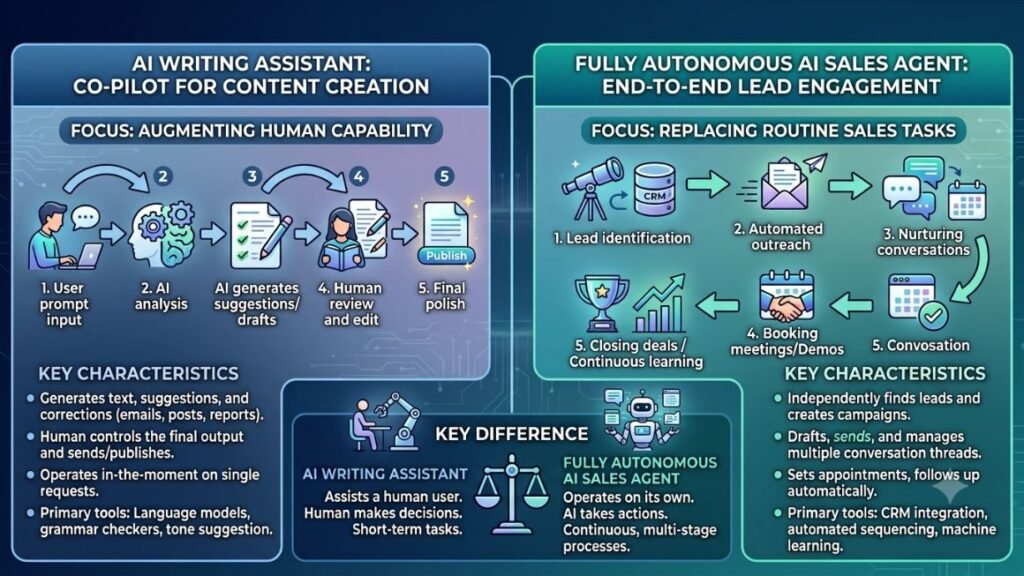
Not every agent is built the same way. Some specialize narrowly, like a tool that only handles email follow-ups. Others orchestrate the entire motion: spotting a buying signal, researching the account, drafting a multichannel sequence, and handling the reply. Understanding where a tool sits on that spectrum matters more than any single feature on a comparison page.
A sales agent built on AI automates the full sales development workflow, including research, personalized messaging, follow-ups, and reply handling, rather than just assisting a human rep with one part of the task. The key distinction from older sales tools is autonomy: an agent takes actions on its own, not just suggestions a rep has to execute.
How These Sales Agents Actually Work
Most platforms in this category run on the same underlying loop, even when the marketing language differs.
- Signal detection. The agent monitors data sources like website visits, job changes, funding news, or CRM activity to flag accounts worth reaching out to right now, not just accounts that fit a static list.
- Research and enrichment. It pulls firmographic and behavioral data from providers like Clearbit or Apollo’s database, then fills in gaps by browsing company websites and public profiles.
- Message generation. A large language model, which is an AI system trained to understand and generate human-like text, drafts a personalized message using the research it just gathered instead of a generic template.
- Sequencing and sending. The message goes out across email, LinkedIn, or SMS on a schedule, often with A/B tested automatically.
- Reply handling. Incoming replies get classified as interested, not interested, or needing a human, and the agent either continues the conversation, books a meeting, or escalates.
- CRM sync. Every action gets logged back into Salesforce, HubSpot, or whatever system your team runs on, so pipeline reporting stays accurate without manual data entry.
That last step trips up more deployments than people expect. A platform can be excellent at writing outreach and still be a poor fit if it only pushes data one way into your CRM instead of syncing both directions. Always confirm bi-directional sync before you sign a contract, not after.
Benefits of Using Autonomous Agents in Outbound
The case for putting autonomous agents into sales isn’t theoretical anymore. Here’s what actually changes when a team deploys one properly. Sales outreach has changed shape faster in the last two years than in the previous decade, and this is a big part of why.
Speed to first touch. Leads contacted within the first five minutes convert at dramatically higher rates than leads reached hours later, yet most B2B teams still take days to respond, according to industry benchmarks widely cited by outbound platforms like Alta in 2026. An agent monitoring signals around the clock closes that gap without adding headcount.
Reclaimed selling time. Reps at B2B companies report spending close to 60% of their day on non-selling tasks like research and data entry, according to Salesforce’s internal research cited across multiple 2026 sales AI reports. Automating the research and drafting stages hands that time back to actual conversations.
Consistent personalization at volume. A human researching 50 prospects a day burns out fast, and quality drops as the list grows. An agent applies the same research depth to prospect number 500 as it did to prospect number one.
Lower cost per meeting booked. Autonomous agents typically run $280 to $600 a month per seat or workspace as of 2026, compared to the fully loaded cost of a junior SDR, which usually runs several times higher once salary, benefits, and ramp time are factored in.
Faster experimentation. Testing five subject lines or three different value propositions across a segment used to take a week of manual sends. An agent can run that test overnight and surface a statistically meaningful winner by morning.
To be fair, none of this replaces judgment. The account executive still needs to read the room in a live call, and no agent has fixed a genuinely bad offer or a poorly defined ideal customer profile. What it does is remove the busywork standing between a good strategy and its execution.
The core benefits of deploying an autonomous agent in outbound sales are faster response times, reclaimed selling hours for reps, and consistent personalization at scale, all at a lower cost per meeting than hiring additional SDR headcount. These gains only materialize when the underlying targeting and messaging strategy is already sound.
Real-World Use Cases for AI SDRs
Benefits are easy to list. Here’s what this actually looks like inside a working sales motion.
Prospecting Based on Intent Signals, Not Static Lists
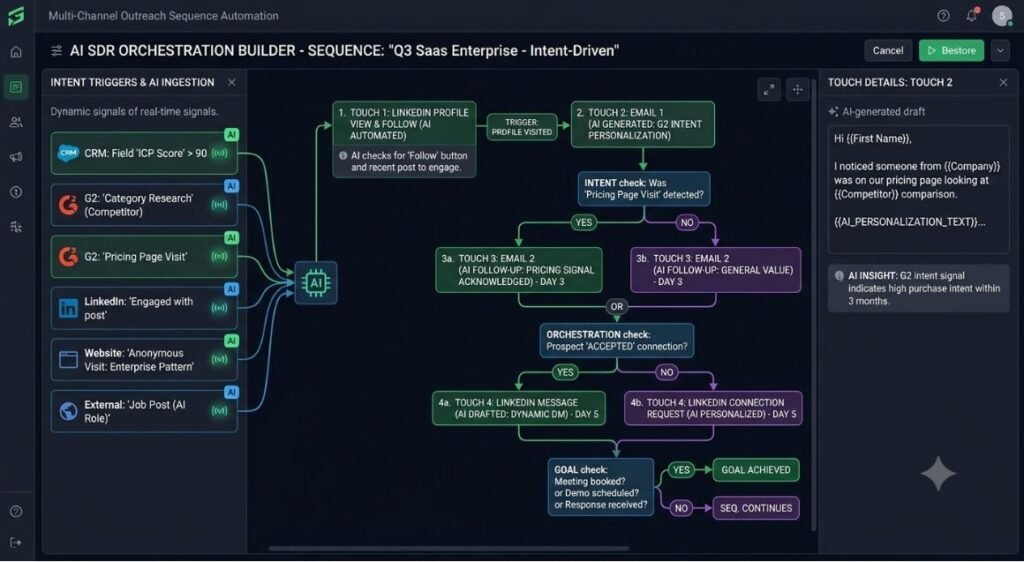
Instead of pulling a list of “SaaS companies, 50 to 500 employees” and blasting all of them, an agent watches for signals like a prospect visiting your pricing page, a champion changing jobs, or a target account hiring for a role your product supports. It routes only the accounts showing real buying intent into an outreach sequence. This is the exact model platforms like Unify are built around, and it produces meaningfully higher reply rates than cold static lists because the timing is right, not just the targeting.
Multichannel Follow-Up Without the Manual Cadence Tracking
A prospect gets an email on day one, a LinkedIn profile view on day three, a connection request on day five, and a follow-up email on day eight, all triggered automatically based on whether they’ve opened or replied. No rep is manually checking a spreadsheet to remember what’s due today.
Reply Triage for High-Volume Campaigns
When a campaign generates hundreds of replies a week, most of them are out-of-office autoresponders or a flat “not interested.” An agent classifies these instantly, routes the genuinely interested replies to a rep’s calendar link, and archives the rest, so a human only spends time on conversations that could actually close.
Account Research Before an SDR Ever Reaches Out
Teams like those using Clay’s research agent send it to a company’s website, recent press coverage, and job postings, then have it extract specific data points like recent product launches or leadership changes. That context feeds directly into a message that references something real about the company instead of a generic opener.
Meeting Booking Without a Back-and-Forth
Once a prospect replies with interest, the agent checks the rep’s calendar, proposes times, and confirms the meeting, cutting out the five-email scheduling dance that used to eat up a rep’s afternoon.
Best Agent Tools for Outbound in 2026
Pricing changes often, so treat every figure below as approximate as of 2026 and confirm current numbers before you commit.
Apollo – Best for Combining Lead Data With Outreach in One Tool
Apollo pairs a database of more than 250 million contacts with built-in sequencing, so you’re not stitching a separate data provider onto your outreach tool.
What it does well: Finding and enriching leads without leaving the platform, then pushing them straight into an email sequence. Where it falls short: Its AI drafting is solid but generic compared to purpose-built research agents like Clay’s, so heavily personalized enterprise outbound may need a second tool. Best for: Small and mid-market teams that want one platform for both prospecting and sending. Pricing: Plans start free for basic use, with paid tiers scaling by seat and credit volume, as of 2026.
Reply.io (Jason AI) – Best for Teams Already on a Mature Engagement Platform
Reply.io’s Jason AI handles autonomous qualification and meeting booking inside a platform that already spans email, LinkedIn, WhatsApp, and SMS.
What it does well: Multichannel sequencing with an AI layer that qualifies leads without a rep manually screening every reply. Where it falls short: The AI plan is a meaningful step up in price from the base engagement tool, so smaller teams may only need the manual tier. Best for: Sales teams that want AI added to a tool they already run, not a full platform switch. Pricing: The AI-enabled plan starts at roughly $500 a month as of 2026.
Salesforge (Agent Frank) – Best for High-Volume Cold Email Deliverability
Salesforge built its own deliverability infrastructure, which matters most for teams whose biggest bottleneck is landing in the inbox at all, not the crafting of the message.
What it does well: Unlimited mailbox setup and warm-up, plus support for outreach in more than 20 languages for global campaigns. Where it falls short: Weaker fit for nuanced, technical B2B sales where a generic high-volume approach undersells the product’s complexity. Best for: Teams running high-volume cold email who need inboxing to just work. Pricing: Agent Frank runs around $499 a month billed quarterly as of 2026.
Clay – Best for Deep Research and List Enrichment
Clay isn’t a turnkey SDR. It’s a data platform that feeds your outreach tools with enriched, highly specific prospect information pulled from more than 150 data providers.
What it does well: Its Claygent research agent can visit a company’s website and extract custom data points using plain-language instructions, which is genuinely hard to replicate manually at scale. Where it falls short: It doesn’t send outreach itself, so you’ll pair it with a sequencing tool like Apollo or Instantly. Best for: RevOps and growth teams that want precise, custom-enriched lists rather than a generic contact database. Pricing: Credit-based tiers that scale with enrichment volume, as of 2026.
Artisan (Ava) – Best for Consolidating the Outbound Stack
Artisan’s Ava agent aims to automate roughly 80% of the outbound workflow inside a single platform, including its own contact database.
What it does well: Reduces the number of separate tools a team needs to run outbound end to end. Where it falls short: LinkedIn automation capabilities were restricted in early 2026, narrowing the multichannel story that used to be a selling point. Best for: Startups and mid-market teams that want to cut manual SDR workload without assembling five point tools. Pricing: Entry tiers start around $280 a month, with custom enterprise contracts, as of 2026.
Amplemarket (Duo Copilot) – Best for Amplifying Reps Instead of Replacing Them
Amplemarket’s Duo Copilot pairs three specialized agents, Signal, Research, and Sequence, inside an all-in-one sales platform that keeps a human approving what actually gets sent.
What it does well: Its research agent investigates a prospect’s public activity and company news, then feeds that context directly into message drafting, producing outreach that references something specific and real. Where it falls short: Because a rep still approves sends, it’s a lower-autonomy option for teams that specifically want a fully hands-off agent. Best for: Teams that want AI to make existing reps dramatically more productive rather than replace the role. Pricing: Positioned as a mid-tier investment against the fully loaded cost of additional SDR headcount, as of 2026.
Instantly – Best for Scaling Cold Email Without Per-Seat Costs
Instantly focuses on high-volume sending with inbox rotation and a flat-fee structure instead of charging per user.
What it does well: Keeps costs predictable as a team grows the number of reps sending outreach. Where it falls short: Its AI layer is lighter on account research and signal detection compared to platforms like Clay or Unify. Best for: Teams prioritizing sending volume and cost control over deep personalization. Pricing: Flat-fee plans scale by sending volume rather than by seat count, as of 2026.
Lindy – Best for Building Fully Custom Outreach Workflows
Lindy is a no-code agent builder, so instead of buying a fixed outbound product, you assemble the exact workflow your team needs using a drag-and-drop interface.
What it does well: Multistep automation across more than 7,000 integrations, from Gmail to Salesforce, without needing a developer. Where it falls short: No native prospecting database, so you’ll connect it to a data provider like Apollo or Clearout to actually find leads. Best for: Teams with a specific, non-standard workflow that off-the-shelf tools don’t quite fit. Pricing: Usage-based pricing that scales with the number of automations run, as of 2026.
No single agent tool wins every category in 2026. Apollo suits teams that want data and outreach in one place, Clay wins on research depth, Amplemarket wins for teams that want a human in the loop, and Lindy wins for custom workflows that don’t fit a packaged product. The right choice depends on which part of your outbound motion is actually broken.
How to Choose the Right Tool for Your Team
Start by identifying the single workflow costing you the most pipeline today. That’s the tool category to evaluate first, not the platform with the flashiest demo.
- Confirm it connects to your actual CRM setup, with bi-directional sync, not a one-way data push.
- Check that it executes rather than just advises. A tool that drafts great copy but still requires a human to send everything isn’t the agent category you’re shopping for.
- Verify security compliance. Look for SOC 2 and ISO 27001 standards if you’re handling enterprise data.
- Run a contained pilot against a clear baseline, like your current reply rate or meetings booked per week, before signing an annual contract.
- Decide how much autonomy you actually want. Fully autonomous agents work well for adding pipeline capacity without new hires. If your goal is making an existing team of reps more effective, a copilot-style tool like Amplemarket’s Duo often fits better than a fully hands-off agent.
This depends on your team’s maturity, but for most mid-market B2B teams, starting with a copilot model and expanding autonomy as trust builds beats going fully autonomous from day one.
Common Mistakes to Avoid
Pointing an agent at a vague ideal customer profile. Targeting “B2B SaaS, 50 to 500 employees” with no further qualification produces low-relevance outreach, high unsubscribe rates, and damaged inbox reputation, no matter how capable the tool is. The teams seeing real results already know exactly who they’re targeting and why that person would respond today.
Assuming full autonomy is always the goal. By early 2026, teams that deployed agents like Artisan and 11x.ai as complete SDR replacements largely reverted to hybrid models. Buyers can detect fully AI-generated outreach, and a growing share of them filter it out on sight.
Skipping the pilot phase. Signing an annual contract before running a contained test against your current baseline is how teams end up locked into a tool that doesn’t fit their actual sales motion.
Ignoring deliverability. The best-written message in the world doesn’t matter if it lands in spam. Confirm a platform’s sending infrastructure and domain warm-up practices before scaling volume.
Getting Started
The teams getting real results from agent-based automation aren’t the ones chasing full autonomy on day one. They’re the ones who fixed their targeting first, then automated the research and first-touch work that used to eat their reps’ mornings. Start with one workflow, whether that’s prospecting, follow-up sequencing, or reply triage, pilot a tool against your current numbers, and expand from there.
If you want to get hands-on with how these tools actually work instead of just reading about them, Hotskill has structured lessons on AI sales workflows built for exactly this kind of practical, day-to-day use. Download the app on iOS or Android, and start your first lesson today.
FAQ
What is an AI-powered sales agent?
An AI agent for sales outreach is software that autonomously researches prospects, writes personalized messages, sends them across channels like email and LinkedIn, and manages replies, functioning like a digital sales development rep rather than a simple writing assistant.
How is an autonomous sales agent different from a regular email automation tool?
Traditional automation follows fixed rules, like sending an email and waiting three days before a follow-up. A true agent reasons and adapts based on signals such as intent data or CRM history, and it can research and personalize each message rather than reusing one static template.
Is an AI SDR worth it for a small sales team?
Yes, for most small teams the cost of a mid-tier agent platform is significantly lower than hiring an additional SDR, and it can handle research and first-touch outreach around the clock. That said, a small team should still keep a human reviewing replies until the messaging is proven.
Do I still need human sales reps if I use agent-based automation?
Yes. By 2026, teams that tried replacing reps entirely with fully autonomous agents largely moved back to hybrid setups, because buyers can often tell when outreach is fully machine-generated and disengage. The strongest results come from agents handling research and volume while reps handle judgment and closing conversations.
Agent vs AI-assisted tool, what’s the actual difference?
An AI-assisted tool helps you write better copy, but a human still has to send, sequence, and follow up manually. An agent researches, writes, sends, follows up, and manages replies with little to no manual effort, which changes both the price point and the time savings involved.
How do these tools integrate with my CRM?
Most established platforms offer native integrations with Salesforce and HubSpot, and many also support Pipedrive and Zoho. Always confirm whether the integration is bi-directional, since some tools only push data one way and won’t reflect activity your reps log manually.
Why isn’t my AI-generated outreach getting replies?
The most common cause isn’t the AI itself, it’s a poorly defined target audience or a weak offer that no amount of personalization can fix. Check your sending domain’s deliverability next, since even a strong message fails if it lands in spam.
Do I need to know how to code to set up one of these agents?
No. Platforms like Lindy, Apollo, and Reply.io are built around no-code, drag-and-drop interfaces designed for sales reps and managers, not developers. Only highly custom, engineering-led workflows typically require technical setup.
How much does this kind of sales automation typically cost?
Entry-level plans generally start between $280 and $600 a month as of 2026, depending on the platform and how much of the workflow is automated versus copiloted. Enterprise-grade autonomous agents with custom data layers usually require a sales conversation for pricing.
Which platform is best for a startup versus an enterprise sales team?
Startups and mid-market teams often do well with consolidated platforms like Artisan or Apollo that reduce the number of separate tools needed. Enterprise teams running large-scale outbound programs more often evaluate platforms like Amplemarket or Landbase that combine data, signals, and multi-agent orchestration in one system.