
You’ve probably noticed that your Google Ads dashboard looks nothing like it did two years ago. Half the levers you used to pull manually, bid adjustments, budget pacing, ad copy testing, are now handled by something running quietly in the background. That something is an AI agent for search engine marketing, and if you’re still managing campaigns the old way, you’re spending hours on tasks that a well-configured system now does in minutes.
This guide breaks down what these systems actually do, which tools are worth your money in 2026, and how to build a workflow around one without losing control of your budget. No vague promises, just what works and what doesn’t.
What Is an AI Agent, and Why Does SEM Need One?
An AI agent is a piece of software that can plan, take action, and adjust its own behavior based on results, without a human approving every single step. That’s different from a chatbot that only answers questions when prompted. An agent monitors a live campaign, decides what to change, makes the change, and then checks whether that change worked.
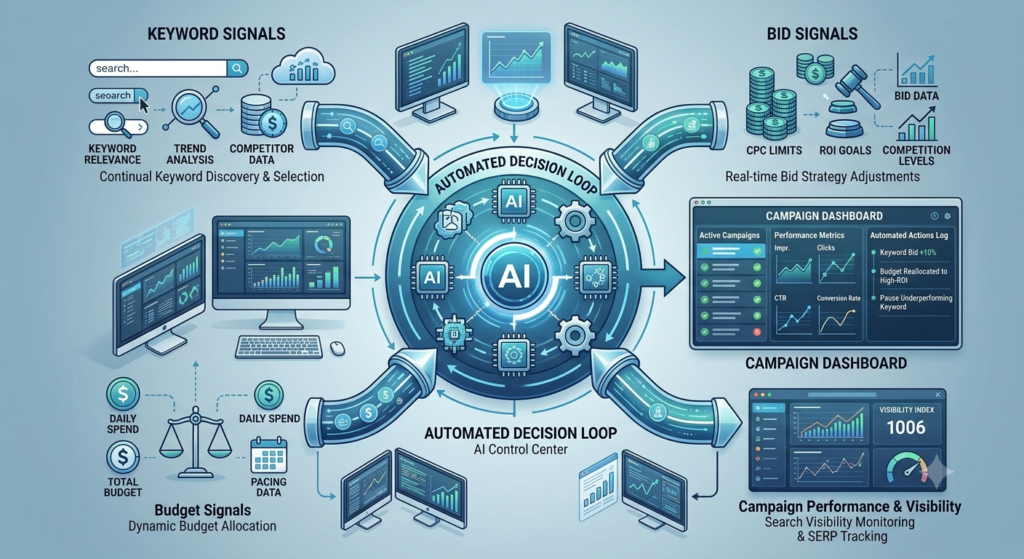
Paid search generates too much data for a person to process in real time. A single mid-size account can generate thousands of search term impressions a day, and pricing on the auction shifts hour to hour. This kind of system exists specifically to close that gap: it watches performance signals across keywords, bids, and creative, and executes changes continuously instead of waiting for a weekly review. Search Engine Marketing has always rewarded speed, and the speed requirement in 2026 has outgrown what a person can manage alone.
Here’s the part that surprises most marketers: this isn’t a future capability. Google’s own AI Max suite, which we’ll cover in detail below, already processes real-time signals to adjust targeting and creative inside live Search campaigns. <cite index=”25-1,25-2″>AI Max serves as a continuous optimization layer for Search campaigns, processing real-time signals to automatically refine targeting and creative delivery.</cite> That’s an agent doing agent things, not a static rule sitting in a spreadsheet.
How AI Agents Differ From Traditional PPC Automation
Traditional automation runs on rules you write yourself: if cost-per-click exceeds $2, pause the keyword. That logic only handles situations you thought to anticipate. An agent works differently because it reasons about a goal rather than a fixed condition.
The distinction matters more than it sounds. Optmyzr, one of the most established names in PPC software, still runs primarily on a rule engine: you define the condition, and the platform executes it on schedule. That’s genuinely powerful for repetitive tasks, but it doesn’t adapt to a situation nobody coded a rule for. Newer platforms like Synter take a different approach, using large language models such as GPT-4o and Claude to interpret account goals and take action in situations that fall outside predefined rules.
To be fair, rule-based automation still has its place. If you already know exactly what “good” looks like for your account, a rule engine is predictable and easy to audit. An agent earns its keep when the search landscape shifts faster than you can write new rules for it, which, in 2026, is most of the time.
Rule-based PPC tools execute conditions a person has already defined, while an autonomous system reasons about a stated goal and acts on situations no one explicitly coded for. The shift matters because auction dynamics and search intent now change faster than most teams can update their rule sets.
Core Capabilities of a Search Marketing AI Agent
Not every tool that calls itself an “agent” does the same job. Here’s what a genuinely capable one should handle across a search account.
Keyword Research and Intent Mapping
A capable agent doesn’t just match keywords to ad groups. It reads search term reports, groups queries by underlying intent, and flags emerging patterns before they show up in a manual review. Google’s own search term matching, part of AI Max, uses <cite index=”29-1″>broad match and keywordless technology to find relevant, high-performing search queries that existing keywords would otherwise miss</cite>.
Bid Management and Budget Allocation
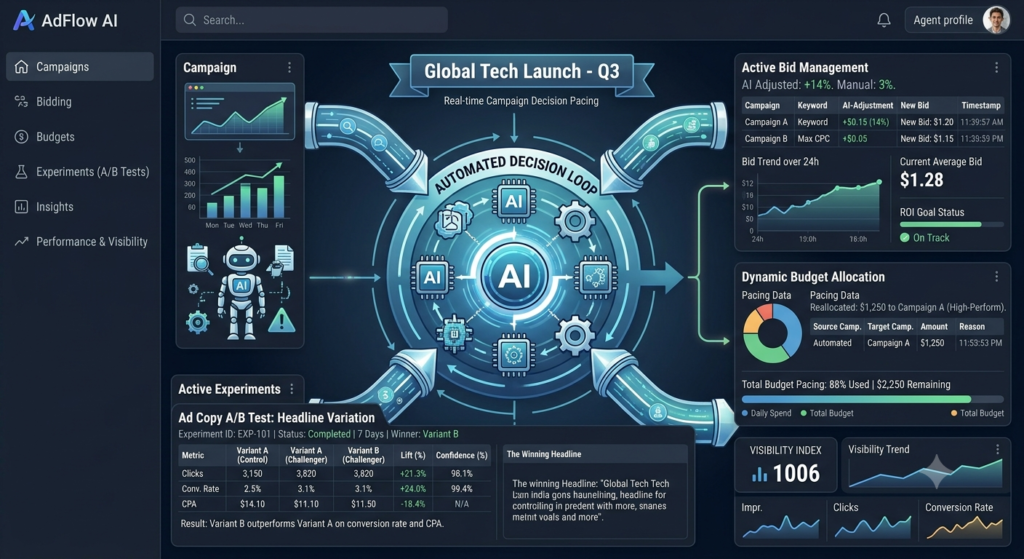
This is where most teams see the fastest return. An agent watching a Target CPA or ROAS goal can shift budget between campaigns hourly rather than waiting for a Monday morning review. Pace, a budget-pacing tool built specifically for this gap, checks accounts for overspend risk every five minutes rather than once a day.
Ad Copy Generation and Testing
Modern agents generate headline and description variants, launch them as live experiments, and pull the losers automatically. Google’s text customization feature (the successor to Automatically Created Assets) <cite index=”29-1″>generates new text assets like headlines and descriptions based on your landing page, ads, and keywords</cite>, and its output quality has genuinely improved since the early versions.
Campaign Monitoring and Anomaly Detection
A good agent catches a conversion tracking break or a sudden CPA spike before it burns through a week of budget. This is the least glamorous capability and the one that saves the most money when it actually works.
Reporting and Cross-Channel Insights
Finally, an agent should translate account activity into plain-language reporting: what changed, why, and what it means for the goal you set. Optmyzr’s PPC Investigator feature is built around exactly this, surfacing the cause behind a performance shift rather than just the raw numbers.
The Best AI Agent Tools for SEM in 2026
There’s no single winner here. The right choice depends on how much control you want to keep and how many platforms you’re managing beyond Google.
Google AI Max for Search: Best for Google-Native Advertisers
What it does: AI Max is an optimization layer you switch on inside an existing Google Ads Search campaign. It isn’t a new campaign type. <cite index=”24-1,24-2″>It’s a suite of AI-powered features including expanded reach through search term matching, tailored creatives via asset optimization, enhanced performance reporting, and additional controls for precision.</cite>
What it does well: It’s free to enable and sits directly on top of the campaign structure you already have, so there’s no migration. <cite index=”26-1″>Google reports an average of 7% more conversions or conversion value at a similar CPA when advertisers use the full feature suite, search term matching, text customization, and final URL expansion, compared to search term matching alone.</cite>
Where it falls short: Independent testing tells a more mixed story than Google’s own benchmark. <cite index=”30-1″>Across 23 AI Max tests, 84% of advertisers saw neutral or negative outcomes when measured at the account level, and much of the “new” traffic was cannibalized from existing campaigns rather than representing net-new demand.</cite> It’s also becoming less optional: Google has confirmed that <cite index=”22-1″>campaigns using Dynamic Search Ads, Automatically Created Assets, and campaign-level broad match will be auto-upgraded to AI Max starting in September 2026.</cite>
Best for: Advertisers who run most of their spend through Google Ads and want AI optimization without adding another tool to the stack.
Pricing: Free as part of your existing Google Ads account (as of 2026).
Optmyzr: Best for Deep Google and Microsoft Ads Management
What it does: Optmyzr is PPC management software that sits on top of Google Ads, Microsoft Ads, and several other platforms, giving you a rule engine, bid automation, and reporting tools you’d otherwise need scripts or a developer to build.
What it does well: Its Rule Engine and PPC Investigator features are genuinely best-in-class for search-heavy accounts. One agency reviewer described building conditional logic, pause any keyword that spent over $100 with zero conversions in a rolling 30-day window, that ran untouched for two years and still saved analyst time every week.
Where it falls short: It assumes existing PPC expertise. The platform surfaces recommendations and automations, but a skilled operator still has to evaluate and approve most of them. Its cross-platform coverage for Meta, LinkedIn, and TikTok also stays shallower than its Google Ads depth, with pacing largely manual outside Google and Microsoft.
Best for: Agencies and in-house teams where 70% or more of managed spend sits on Google and Microsoft Ads.
Pricing: Essentials starts at roughly $209 to $249 per month billed annually for accounts up to $150k in monthly managed spend; Premium and Enterprise tiers scale with spend and can exceed $1,000 per month (as of June 2026).
Synter: Best for Autonomous Cross-Channel Management
What it does: Synter runs autonomous systems powered by frontier language models to manage campaigns across a wider platform set than most PPC tools attempt. <cite index=”20-1″>It works across 10 platforms including LinkedIn, Meta, TikTok, Reddit, X, Pinterest, Snapchat, and DV360.</cite>
What it does well: Because it reasons from stated goals rather than fixed rules, it can respond to situations a rule engine wasn’t built to handle, and it does so across channels from one interface instead of ten separate logins.
Where it falls short: Newer autonomous platforms generally have a shorter track record than tools like Optmyzr, so the depth of historical benchmarking is thinner. Teams that need granular manual override on every decision may find the “hands-off” model uncomfortable at first.
Best for: Teams running paid spend across multiple ad platforms who want one agent layer instead of juggling several tools.
Pricing: Flat-rate pricing starting around $49 per month, with no spend-based scaling (as of 2026).
Adalysis: Best for Google Ads Auditing and Quality Control
What it does: Adalysis focuses on ongoing account auditing, flagging quality score issues, ad policy risks, and structural problems that a purely bid-focused tool would miss.
What it does well: It’s a strong second layer for teams that already have bid automation elsewhere but want a dedicated watchdog for account health.
Where it falls short: It’s not built to run campaigns autonomously; it’s an audit and alerting layer, not an execution engine.
Best for: Google Ads specialists who want continuous quality control alongside whatever automation tool they already run.
Pricing: Custom, based on account count and managed spend (as of 2026).
How to Set Up Your First AI Agent Workflow
Getting started doesn’t require replacing your entire stack on day one. Build it in layers.
- Audit your current account structure. Clean up overlapping keywords and conflicting campaigns before you hand anything to automation. An agent optimizing a messy account just automates the mess faster.
- Pick one goal metric. Choose either Target CPA or Target ROAS, not both at once. Agents need a single clear objective to optimize against.
- Enable one feature at a time. With Google AI Max, for example, turn on search term matching first, measure for two to four weeks, then layer in text customization and final URL expansion separately.
- Set guardrails before you turn it loose. Define a maximum daily budget shift and a CPA ceiling that triggers a human review, not an automatic pause.
- Review weekly for the first month. Even a fully autonomous system needs a human checking its work daily during onboarding, and weekly after that.
- Scale to a second platform once the first is stable. Add Microsoft Ads or Meta only after your primary channel has run cleanly for at least one full budget cycle.
A safe rollout of any autonomous PPC system starts with one clean campaign, one goal metric, and one feature enabled at a time, with a human reviewing outcomes daily for the first month. Skipping the guardrail step is the single most common cause of budget overruns reported by agencies switching to agentic tools.
Common Mistakes Teams Make With AI Agents
The biggest mistake is treating an agent as “set and forget” from day one. Even Google recommends a gradual rollout with one-click experiments to test performance impact before fully committing a campaign.
The second mistake is skipping account cleanup first. An agent trained on a poorly structured account will optimize toward the wrong signals, and untangling that after the fact takes longer than fixing the structure up front would have.
The third mistake, and this one’s less obvious, is ignoring attribution. Independent testing has shown that a meaningful share of “new” traffic captured by automated matching features actually cannibalizes existing campaigns rather than generating net-new demand. If you don’t track incrementality separately, you can end up crediting the agent for results it didn’t create.
Is an AI Agent Worth It for Small Businesses vs Enterprises?
For a small business without dedicated PPC staff, a fully managed agent service usually makes more sense than a self-serve tool that still requires someone to interpret its recommendations. The total cost of a subscription plus a skilled operator often exceeds what a managed alternative charges outright.
Enterprises get a different calculation. At high spend volumes, the labor savings from automating repetitive bid and reporting tasks compound fast, and the account usually already has staff who can supervise a rule engine or agent layer properly. In Hotskill’s own conversations with marketers learning these tools, the pattern holds consistently: teams that master the underlying account structure before turning on automation see meaningfully better outcomes in the first month than teams that automate first and clean up later.
Conclusion
An AI agent for search engine marketing isn’t a shortcut around good account management, it’s a way to execute good account management continuously instead of once a week. Start with one clean campaign, one clear goal, and one feature turned on at a time. The teams getting the best results in 2026 aren’t the ones that automated everything on day one. They’re the ones that spent a month getting the fundamentals right first.
If you want to actually understand how these tools work instead of just installing them and hoping, Hotskill has structured lessons built around real AI marketing workflows, not just overviews. Download the app on iOS or Android, and start your first lesson today.
FAQ
What does an AI agent actually do in a paid search account?
It’s software that monitors live paid search campaigns and independently decides what to change, such as bids, budgets, or ad copy, based on a stated performance goal. Unlike a chatbot, it acts continuously rather than only responding when prompted.
AI agent vs traditional PPC automation, what’s the actual difference?
Traditional automation follows fixed rules you write yourself, such as pausing a keyword past a set cost threshold. An agent reasons toward a goal and can respond to situations no rule was written for, which matters as auction conditions shift faster than manual rule-writing can keep up.
How do I set up an AI agent for my Google Ads account?
Start by cleaning up your account structure, then pick one goal metric like Target CPA. Enable one automated feature at a time, such as Google AI Max’s search term matching, measure results for two to four weeks, then add the next feature.
Is Google AI Max the same as an AI agent?
AI Max functions like an agent in practice, since it continuously processes real-time signals and adjusts targeting and creative without manual input for every change. It isn’t a separate campaign type, it’s an optimization layer added to your existing Search campaigns.
Do I need PPC experience to use an AI agent tool?
It depends on the tool. Platforms like Optmyzr assume existing Google Ads expertise and expect you to evaluate their recommendations. Fully managed or autonomous platforms are built for teams without in-house PPC skills.
Is an AI agent worth it for a small business?
Usually, yes, but the format matters more than the decision to automate. A fully managed service tends to deliver better value than a self-serve tool that still needs a skilled operator, since small teams rarely have that expertise in-house already.
Why isn’t my AI agent giving me good results?
The most common cause is a messy account structure the agent is optimizing on top of, followed by unclear or conflicting goal metrics. Check whether you’re tracking incrementality separately too, since some “new” traffic from automated matching actually cannibalizes existing campaigns.
Do I really need an agent if I already have Google’s built-in automation?
Google’s native automation, like AI Max, covers a lot of ground for Google-only advertisers, but it doesn’t manage Microsoft Ads, Meta, or other platforms. If you run spend across multiple channels, a dedicated agent tool consolidates that management from one place.
Can an AI agent replace a PPC manager entirely?
Not safely, at least not yet. Every credible platform in this space still recommends human review of guardrails, budget ceilings, and account structure, especially during the first month of a rollout.
What’s the biggest risk of switching to an AI agent?
Handing over full control before your account structure and goal metrics are clean. An agent optimizes toward whatever signal you give it, so a poorly configured starting point gets automated faster, not fixed.