

Technical SEO used to feel honestly, a bit mechanical. Crawl the site, export reports, fix errors manually, repeat. If you’ve ever spent hours inside spreadsheets fixing meta tags or chasing broken links, you know what I mean.
But things are changing fast.
AI is no longer just a content-writing assistant. It’s becoming the backbone of modern SEO operations, especially on the technical side. From automated audits to real-time fixes and predictive optimization, AI is reshaping how websites are maintained and scaled.
This article breaks down everything you need to know. Not just theory, but actual tools, workflows, and practical steps you can apply immediately.
What is AI in Technical SEO?
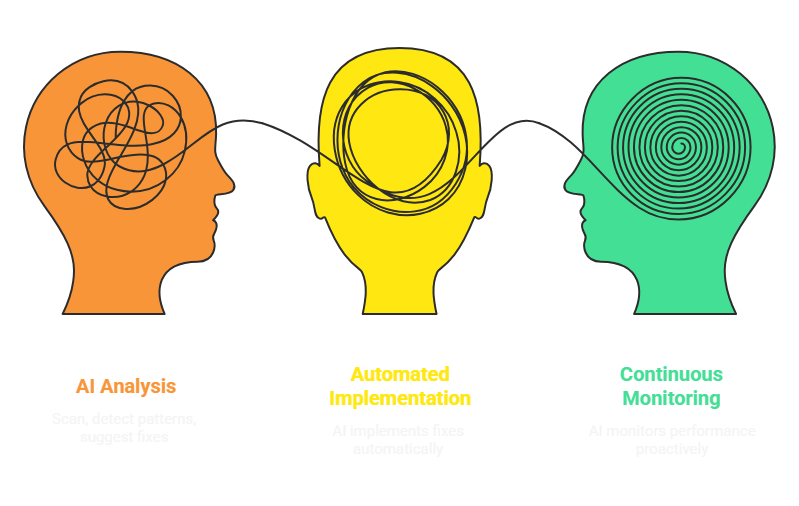
At its core, AI in Technical SEO refers to using machine learning and automation tools to analyze, diagnose, and fix technical issues on websites at scale.
Instead of manually identifying issues like crawl errors, duplicate content, or missing schema, AI tools can:
- Scan entire websites in minutes
- Detect patterns humans might miss
- Suggest or even implement fixes automatically
- Continuously monitor performance
Traditional technical SEO is reactive. AI-driven technical SEO is proactive and, in some cases, autonomous.
And that shift it’s kind of a big deal.
Why AI is Transforming Technical SEO
Let’s be honest. Technical SEO has always been one of the most time-consuming parts of SEO.
Now imagine this:
Instead of manually auditing 5,000 pages, an AI system scans them, prioritizes issues, and fixes most of them automatically.
That’s not hypothetical anymore.
AI brings three major advantages:
1. Speed and Scale
AI tools can crawl and analyze massive websites in minutes, something that would take humans days or weeks. Platforms now automate audits across thousands of URLs simultaneously.
2. Pattern Recognition
AI doesn’t just find errors. It finds patterns. For example, it can detect that 70% of your category pages are missing structured data or that a specific template is causing indexing issues.
3. Automation of Repetitive Tasks
Tasks like fixing meta tags, generating schema, or improving internal linking can now be automated at scale using AI rules and workflows.
Core Areas Where AI Improves Technical SEO
Before we dive into tools, let’s understand where AI actually makes the biggest impact.
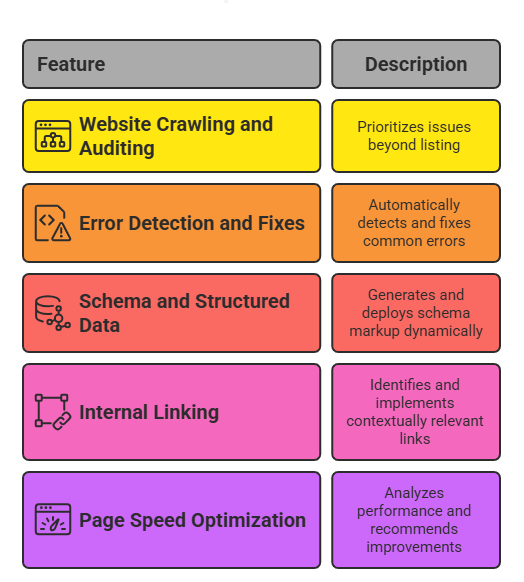
Website Crawling and Auditing
AI-powered crawlers go beyond traditional tools by adding intelligence to the data. They don’t just list issues, they prioritize them.
Error Detection and Fixes
Broken links, redirect chains, duplicate pages, missing tags AI can detect and fix many of these automatically.
Schema and Structured Data
AI tools can generate and deploy schema markup dynamically, ensuring consistency across thousands of pages.
Internal Linking
AI can identify linking opportunities and implement internal links based on contextual relevance.
Page Speed Optimization
AI tools analyze performance bottlenecks and recommend improvements related to Core Web Vitals.
How AI Automates Technical SEO Audits
Let’s walk through a typical AI-driven audit workflow.
Step 1: Full Website Crawl
AI tools scan your website, just like traditional crawlers. But they also interpret data using machine learning models.
For example, instead of just saying “missing meta descriptions,” they might say:
- These pages are underperforming due to weak metadata
- Updating them could improve CTR
Step 2: Issue Categorization
AI classifies issues into categories:
- Critical (affects indexing)
- Moderate (affects rankings)
- Minor (nice to fix)
This prioritization is key. Because not all SEO issues matter equally.
Step 3: Automated Recommendations
AI generates actionable recommendations, often in plain English.
Step 4: Auto-Implementation
This is where things get interesting.
Some tools don’t just suggest fixes, they implement them directly on your site using scripts or integrations.
Best AI Tools for Technical SEO (Detailed Breakdown)
Now let’s get into the tools. This is where most people get confused, because there are so many options.
I’ll break them down clearly so you understand what each tool actually does.
1. Alli AI
Alli AI is one of the most powerful tools specifically built for technical SEO automation.
What makes it unique is that it works directly on your live website without requiring deep developer involvement.
Key Features
- Bulk optimization of title tags, meta descriptions, and headers
- Automated schema markup generation
- Internal linking automation
- Real-time on-page changes
Alli AI uses a simple snippet that integrates with your website. Once installed, it can apply SEO rules across hundreds or thousands of pages instantly.
For example:
You can create a rule like:
“Add ‘Buy Online’ to all product page titles”
And Alli AI will implement it across your entire site.
Why It’s Powerful
It removes the dependency on developers. That alone can speed up SEO execution massively.
Best Use Case
Large websites, agencies, or ecommerce stores that need scalable SEO fixes.
2. Screaming Frog + AI Integrations
Screaming Frog has been a staple in technical SEO for years. But now, with AI integrations, it’s become even more powerful.
It still crawls websites like before, but now it can:
- Summarize content
- Analyze sentiment
- Detect semantic relevance
These features allow SEOs to go beyond technical errors and understand content quality at scale.
Key Features
- Deep crawl analysis
- JavaScript rendering
- Custom extraction
- AI-powered data interpretation
Why It’s Powerful
It combines traditional crawling with AI insights, giving you both raw data and intelligent analysis.
Best Use Case
Advanced SEO professionals who want deep insights and customization.
3. AirOps
AirOps is more like an automation layer than a traditional SEO tool.
It connects different tools and automates workflows across your SEO stack.
Key Features
- Integration with Google Search Console, GA4, and CMS
- Automated technical audits
- Schema deployment
- Content refresh workflows
One of the most interesting features is its ability to identify underperforming pages and automatically suggest or implement updates.
It basically acts like a central brain for your SEO operations.
Why It’s Powerful
It doesn’t just analyze. It executes.
Best Use Case
Teams managing large websites with ongoing SEO workflows.
4. RankYak
RankYak is more focused on content automation, but it also plays a role in technical SEO.
Key Features
- Automated keyword research
- Content planning
- Auto-publishing
- SEO optimization
It ensures that technical elements like metadata, internal links, and structure are handled automatically during content creation.
Why It’s Powerful
It bridges the gap between content and technical SEO.
Best Use Case
Content-heavy websites and blogs.
5. Surfer AI, Frase, and NeuronWriter
These tools are primarily content-focused, but they contribute to technical SEO indirectly.
What They Do
- Optimize content structure
- Improve keyword usage
- Analyze SERP data
They ensure that pages are technically optimized for search intent and structure.
Why They Matter
Technical SEO is not just about code. It’s also about how content is structured and interpreted by search engines.
6. Sight AI
This is a newer category of tools focused on AI search visibility.
Instead of just tracking Google rankings, it tracks how your content appears in AI-generated answers.
Key Features
- AI visibility tracking
- Brand mention monitoring
- Prompt tracking
This is especially relevant as AI search platforms become more dominant.
Building an AI-Powered Technical SEO Workflow
Tools alone won’t solve everything.
You need a structured workflow.
A Simple AI SEO Workflow
- Crawl and audit the site
- Prioritize issues using AI insights
- Automate fixes where possible
- Assign complex tasks to developers
- Monitor and iterate continuously
The key idea is consistency.
AI SEO works best when it’s treated as an ongoing system, not a one-time audit.
Real-World Example: Automating Technical SEO
Let’s say you run an ecommerce site with 10,000 product pages.
Traditional approach:
- Manual audits
- Developer tickets
- Slow implementation
AI-powered approach:
- Run audit with AI tool
- Identify missing schema across all pages
- Deploy schema automatically
- Fix internal linking using rules
Result?
Weeks of work done in hours.
Common Technical SEO Errors AI Can Fix
AI tools are especially good at fixing repetitive issues.
Some common ones include:
- Missing meta tags
- Duplicate content
- Broken links
- Redirect chains
- Missing schema markup
- Poor internal linking
These are not complex problems individually. But at scale, they become overwhelming.
That’s where AI shines.
Limitations of AI in Technical SEO
Let’s not pretend AI is perfect.
It’s powerful, but it has limitations.
1. Lack of Strategic Context
AI can identify issues, but it doesn’t always understand business priorities.
2. Risk of Over-Automation
Automating everything blindly can lead to generic or incorrect implementations.
3. Need for Human Oversight
AI should assist, not replace, SEO professionals.
Interestingly, many practitioners say AI works best when combined with structured workflows and human strategy.
The Future of AI in Technical SEO
We’re moving toward something called autonomous SEO systems.
These systems will:
- Continuously monitor websites
- Automatically fix issues
- Optimize performance in real time
Technical SEO will become less about manual work and more about managing intelligent systems.
And honestly, we’re already seeing early versions of this.
Best Practices for Using AI in Technical SEO
If you’re just starting, here’s what I’d suggest:
Start small. Don’t automate everything at once.
Focus on repetitive tasks first. That’s where AI delivers the most value.
Always review AI-generated changes before deploying them.
Build a workflow, not just a tool stack.
Conclusion
AI is not replacing technical SEO. It’s redefining it.
What used to take weeks can now be done in hours. What used to require teams of developers can now be handled by automation tools.
But the real advantage isn’t just speed.
It’s the ability to scale.
If you learn how to use AI effectively, you can manage websites of any size without losing control or quality.
And that… is where the real opportunity lies.
FAQs
1. What is AI in technical SEO?
AI in technical SEO refers to using artificial intelligence tools to automate audits, detect errors, and optimize website performance at scale.
2. Can AI completely replace technical SEO experts?
No. AI assists with automation and analysis, but human expertise is still needed for strategy and decision-making.
3. Which is the best AI tool for technical SEO?
Tools like Alli AI, Screaming Frog (with AI), and AirOps are among the best depending on your needs.
4. How does AI help in SEO audits?
AI automates crawling, identifies issues, prioritizes them, and sometimes fixes them automatically.
5. Is AI useful for small websites?
Yes, but the biggest benefits are seen on large websites with many pages.
6. Does AI improve website rankings?
Indirectly, yes. By fixing technical issues and improving site health, rankings can improve.
7. What technical issues can AI fix?
AI can fix meta tags, broken links, schema markup, internal linking, and more.
8. Is AI SEO expensive?
Some tools are costly, but many offer scalable pricing depending on usage.
9. How often should I run AI audits?
Ideally, continuously or at least weekly for large websites.
10. What is the future of AI in SEO?
The future lies in autonomous systems that continuously monitor and optimize websites in real time.