

Marketing has always been about timing, messaging, and understanding people better than your competitors do. The only difference today is that the scale has exploded. You are not speaking to a few hundred customers anymore. You are dealing with thousands, sometimes millions, across multiple platforms, devices, and touchpoints.
That is exactly where AI for Marketing starts to change the game.
Not in a dramatic, sci-fi way. But in a practical, measurable way. In a way that improves ROI because decisions are no longer based on guesswork alone. They are based on patterns, behavior, and predictive intelligence.
In this article, we will explore how artificial intelligence is transforming automation, how brands are using it today, and how you can implement it intelligently without overcomplicating your strategy.
The Evolution of Marketing Automation
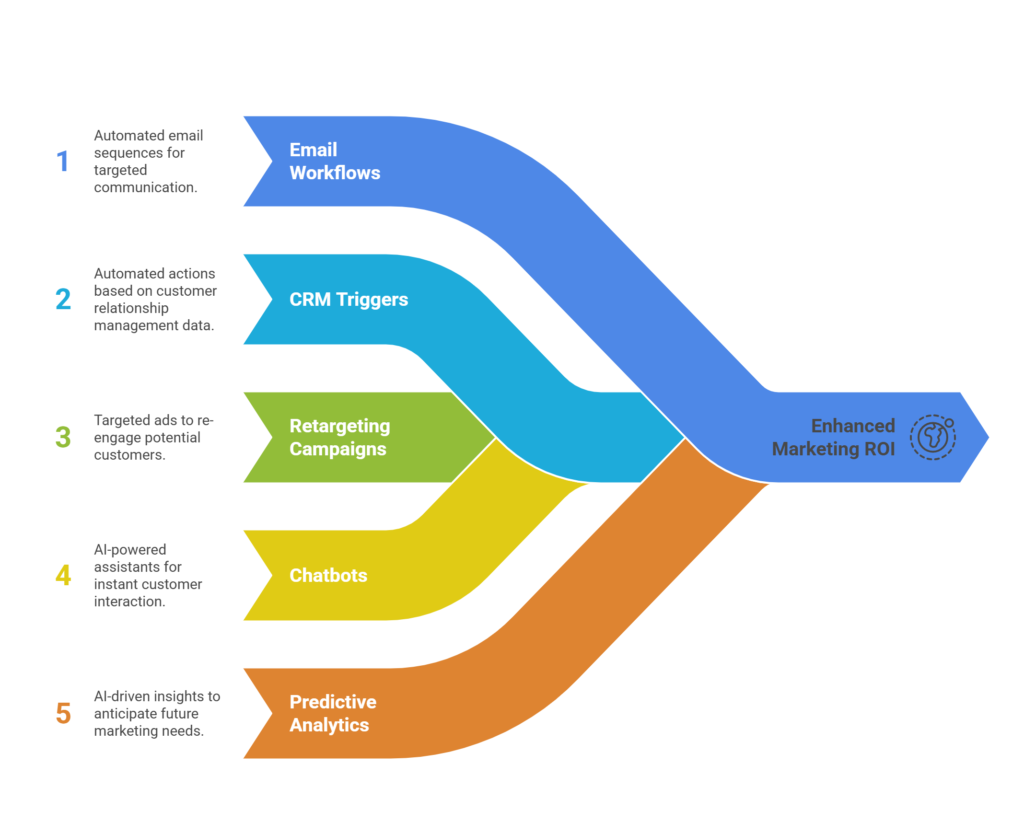
Marketing automation is not new. Email workflows, CRM triggers, retargeting campaigns, and chatbots have existed for years. But traditional automation works on fixed rules.
If user does X, send Y.
If user abandons cart, send reminder email after 2 hours.
If lead downloads ebook, move to nurture sequence.
The system reacts. It does not think.
AI for Marketing shifts this from rule-based automation to intelligence-driven automation. Instead of relying only on static triggers, AI systems analyze historical data, user behavior patterns, and contextual signals to predict what should happen next.
This predictive capability is what boosts ROI. You stop sending the same message to everyone and start sending the right message to the right person at the right time.
And yes, that sounds like every marketing cliché ever written. But now it is actually achievable.
What AI Really Means in Marketing
Before we go further, it is important to define what we mean by AI in marketing.
Artificial intelligence in this context includes machine learning, natural language processing, predictive analytics, and automated decision-making systems. These technologies allow platforms to analyze massive datasets, identify trends, and improve performance over time without manual adjustments.
When implemented properly, AI for Marketing helps with audience segmentation, personalization, ad optimization, content generation, predictive lead scoring, and even dynamic pricing.
It is not about replacing marketers. It is about enhancing decision-making.
And if we are being honest, most marketing decisions today are still based on partial data. AI simply reduces the blind spots.
How AI for Marketing Improves ROI
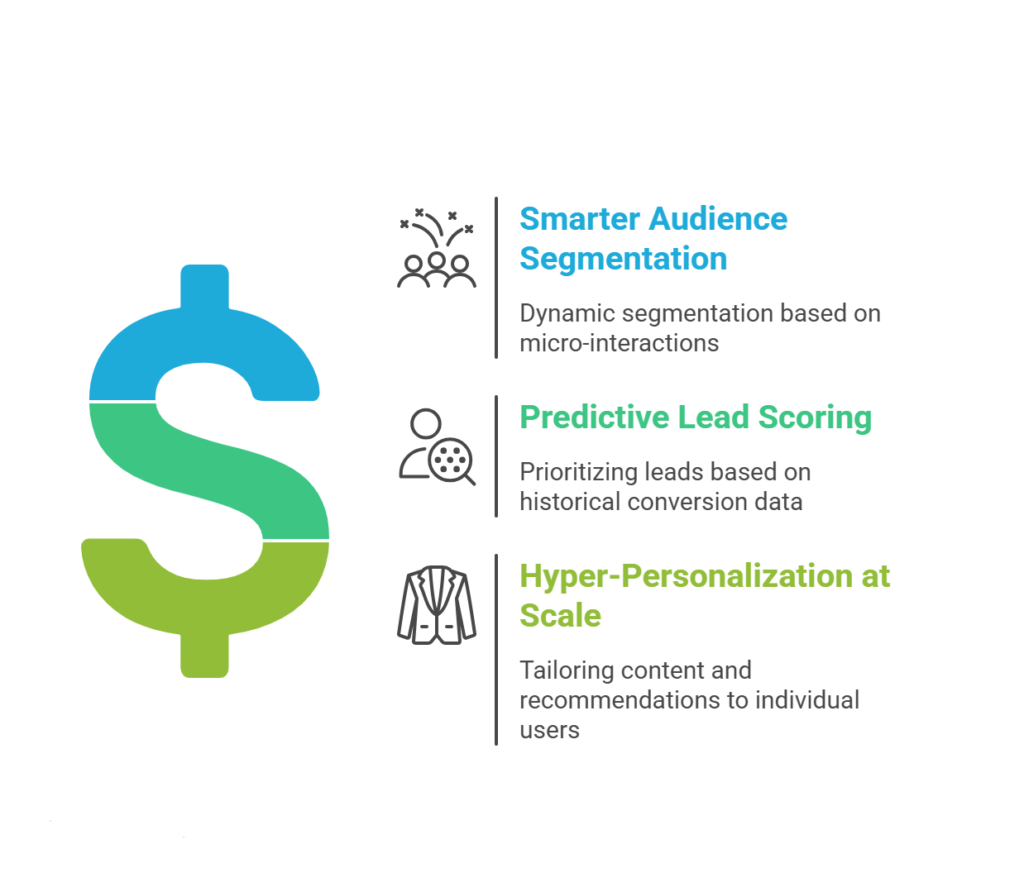
Return on investment in marketing is influenced by three primary levers: efficiency, personalization, and optimization. AI directly impacts all three.
Smarter Audience Segmentation
Traditional segmentation relies on demographics, interests, or simple behavioral filters. But customers are complex. Their purchase decisions are influenced by multiple micro-interactions.
AI analyzes browsing behavior, purchase history, engagement patterns, and contextual signals to create dynamic audience segments that update automatically.
For example, platforms like Google Ads and Meta Ads use machine learning to identify high-converting audiences based on real-time campaign performance. Instead of manually defining segments, the algorithm continuously learns which users are more likely to convert.
This reduces wasted ad spend. And reducing wasted ad spend is one of the fastest ways to improve ROI.
Predictive Lead Scoring
Sales teams often struggle with prioritizing leads. Traditional lead scoring assigns points based on actions such as email opens or downloads.
But these static systems often misjudge intent.
With AI for Marketing, predictive lead scoring analyzes historical conversion data to identify patterns among high-value customers. It then scores new leads based on similarity to those patterns.
This means sales teams focus on leads that are statistically more likely to convert, not just those who clicked on an email.
Companies using predictive scoring often report higher close rates and shorter sales cycles. That is a direct revenue impact.
Hyper-Personalization at Scale
Personalization used to mean inserting a first name into an email subject line.
Today, it means dynamic content, individualized product recommendations, and customized landing pages.
Amazon is perhaps the most famous example. Its recommendation engine, powered by machine learning, contributes significantly to overall revenue by suggesting products based on user behavior.
Netflix does something similar with content recommendations, tailoring the homepage to each user.
When AI for Marketing is used for personalization, customers feel understood. And when customers feel understood, they convert more often.
AI for Marketing Automation in Real Campaigns
It is one thing to talk about theory. It is another to see how it works in practice.
Neil Patel has often emphasized how automation combined with AI can improve marketing performance by optimizing content recommendations, predicting keyword trends, and improving targeting precision. The key idea is simple: let machines handle pattern detection so marketers can focus on strategy.
Let us explore some real-world applications.
Programmatic Advertising
Programmatic platforms use machine learning to bid on ad inventory in real time. Instead of manually setting bids, algorithms adjust them based on conversion probability.
Google’s Smart Bidding strategies such as Target CPA and Target ROAS use predictive signals like device, location, time of day, and browsing history to determine bid amounts.
The result is better allocation of ad budget.
Email Send-Time Optimization
Some email platforms use AI to determine when individual subscribers are most likely to open emails.
Instead of blasting your entire list at 10 AM, the system sends emails at personalized times based on past engagement behavior.
Even small increases in open rates can lead to significant revenue improvements over time.
Chatbots That Actually Understand Intent
Modern chatbots powered by natural language processing are no longer limited to scripted responses. They understand user intent and context.
For ecommerce brands, this means answering product questions, handling objections, and even recommending items without human intervention.
This reduces support costs while increasing conversions.
Data Is the Fuel Behind AI Success
There is something important that marketers sometimes overlook.
AI is only as good as the data it receives.
If your CRM is disorganized, tracking is incomplete, or conversion events are poorly configured, even the most advanced algorithms will struggle.
Before implementing AI for Marketing Automation, ensure that your tracking infrastructure is solid.
This includes accurate pixel installation, server-side tracking when possible, clean CRM data, proper tagging of campaigns, and defined conversion goals.
Think of AI as a high-performance engine. Without clean fuel, it sputters.
Content Creation and Optimization
Generative AI has added another dimension to marketing automation.
Tools powered by large language models can draft blog posts, ad copies, social captions, and email sequences. But more importantly, they can analyze performance data to refine messaging.
For example, AI tools can identify which headlines drive higher click-through rates and automatically test variations.
Search engine optimization has also evolved. Platforms now use AI to analyze search intent, suggest content clusters, and predict ranking potential based on keyword competitiveness.
When AI for Marketing is applied to content strategy, it does not just create more content. It creates smarter content.
And smarter content compounds over time.
Customer Journey Mapping with Predictive Insights
Understanding the customer journey used to involve mapping generic stages such as awareness, consideration, and decision.
But real journeys are messy. Users jump between channels. They research on mobile and purchase on desktop. They click ads but convert through organic search.
AI analyzes multi-touch attribution data to identify which channels contribute most effectively to conversions.
This helps marketers allocate budgets more accurately and refine messaging at each stage.
In complex B2B environments, predictive analytics can forecast which accounts are likely to move from awareness to consideration based on engagement signals.
This makes nurturing campaigns far more precise.
Dynamic Pricing and Revenue Optimization
Some ecommerce brands use AI-driven pricing models that adjust product prices based on demand, competition, and inventory levels.
Airlines and ride-sharing platforms have used dynamic pricing for years.
Now smaller ecommerce brands can access similar capabilities through AI-powered tools.
When implemented carefully, dynamic pricing can increase profit margins without hurting customer trust.
But transparency matters. Customers do not like feeling manipulated.
So strategy matters as much as technology.
Ethical Considerations and Trust
As automation becomes more intelligent, ethical questions arise.
Are you transparent about data usage? Are customers aware that algorithms are influencing recommendations? Are privacy regulations being respected?
Trust is fragile.
Using AI for Marketing responsibly means complying with data protection laws such as GDPR and being clear about how data is collected and used.
Long-term ROI depends on trust.
Short-term gains achieved through questionable practices often backfire.
Common Mistakes Businesses Make
It is easy to get excited about AI and invest in expensive tools without a clear plan.
One common mistake is automating broken processes. If your customer journey is confusing, automation will only amplify confusion.
Another mistake is over-reliance on automation without human oversight. Algorithms optimize for measurable goals. Sometimes brand perception and long-term positioning require human judgment.
Also, some businesses expect immediate results. Machine learning models require data and time to improve.
Patience is part of the strategy.
Building an Intelligent Automation Strategy
If you want to implement AI for Marketing effectively, start with a clear objective.
Are you trying to reduce acquisition cost? Increase lifetime value? Improve lead quality?
Define the outcome first.
Then identify which processes are repetitive, data-heavy, and scalable. Those are prime candidates for automation.
Start small. Test one area such as ad bidding or email optimization. Measure impact. Expand gradually.
Remember, technology should support strategy, not replace it.
The Future of Marketing Automation
The future will likely involve deeper integration between AI systems across platforms.
CRM data, advertising platforms, content management systems, and analytics tools will increasingly communicate seamlessly.
Voice search optimization, conversational commerce, and real-time personalization will become more advanced.
And perhaps most importantly, predictive modeling will become more accessible to small and mid-sized businesses.
AI for Marketing will no longer be a competitive advantage.
It will be a baseline expectation.
The brands that win will not simply use AI. They will use it thoughtfully.
Final Thoughts
Marketing is becoming more complex, not less.
Consumers expect relevance. They expect speed. They expect brands to understand their needs without being intrusive.
That balance is difficult to achieve manually.
AI for Marketing provides the analytical power needed to deliver relevance at scale. When combined with clear strategy, clean data, and ethical implementation, it can dramatically improve return on investment.
The key is not to chase trends.
It is to identify where intelligence can eliminate waste, enhance personalization, and support smarter decision-making.
Automation alone does not boost ROI.
Intelligent automation does.
And the sooner businesses learn to combine human creativity with machine precision, the stronger their competitive position will be in the years ahead.
Because at the end of the day, marketing is still about people.
AI just helps us understand them better.