

If you’re running paid campaigns across three or four platforms right now, you already know the problem. Bids need adjusting hourly. Creative fatigues in days, not weeks. Reporting eats your Friday afternoon. And by the time you’ve pulled insights from Meta Ads Manager, Google Ads, and TikTok, the data is already stale.
This is where a new category of software has started to change how campaigns get managed day to day. An AI agent is a software system that can plan a task, take action across tools on its own, and adjust based on results, without a human approving every single step. Unlike a static dashboard or a rules-based automation script, an agent can reason through a goal like “keep this campaign’s CPA under $40” and make ongoing decisions to hit it.
This guide breaks down the AI agents for performance marketing that are actually doing this work in ad accounts today, what each one is good at, where it falls short, and how to plug them into a real workflow. No vague promises. Just what to use, and when.
What Is an AI Agent in Marketing?
An AI agent is software that can pursue a defined goal by taking a sequence of actions on its own, checking the results, and adjusting its next move without a person in the loop for every decision. That’s different from a chatbot, which only responds when prompted, and different from basic automation, which just follows fixed if-then rules.
In an ad account, this looks like a system that pulls performance data every few hours, flags underperforming ad sets, pauses them, reallocates the budget, and generates a new creative variant to test, all without you touching the platform. AI Agents are the connective layer between your data and your action, and that’s the piece most marketing stacks have been missing.
The distinction matters because a lot of tools get called “AI” when they’re really just dashboards with a chatbot bolted on. A true agent takes action. If a tool can only summarize your data or answer questions about it, it’s an assistant, not an agent.
An AI agent differs from marketing automation because it can reason toward a goal and take multi-step action across platforms without pre-written rules for every scenario. Automation follows fixed logic. Agents adapt based on live performance data.
Why Performance Marketers Are Adopting Agents Now
Manual campaign management doesn’t scale past a certain account size, and most teams hit that wall faster than they expect. According to Salesforce’s 2025 State of Marketing report, marketing teams using AI tools reported saving an average of 5 hours per week on campaign optimization tasks. That’s not a small number when you’re managing five or six accounts.
Performance Marketing has also gotten harder in the last two years, not easier. iOS privacy changes cut off granular tracking data. Ad platforms pushed everyone toward broad, algorithm-led targeting like Meta’s Advantage+ and Google’s Performance Max, which need constant creative and budget input to perform well. Manually feeding these systems the right signals, at the right pace, is a full-time job on its own.
That’s the gap agents fill. They watch the account continuously, something no human can realistically do across multiple platforms, and they act on small signals before they become expensive mistakes. A campaign that starts drifting toward a $60 CPA at 2am doesn’t have to wait until you check the dashboard at 9am.
AI Agents for Ad Creative and Copy
Creative is still the single biggest lever in paid performance, and it’s also the first thing to fatigue. This category of agent generates, tests, and iterates on ad creative without a designer starting from scratch each time.
AdCreative.ai
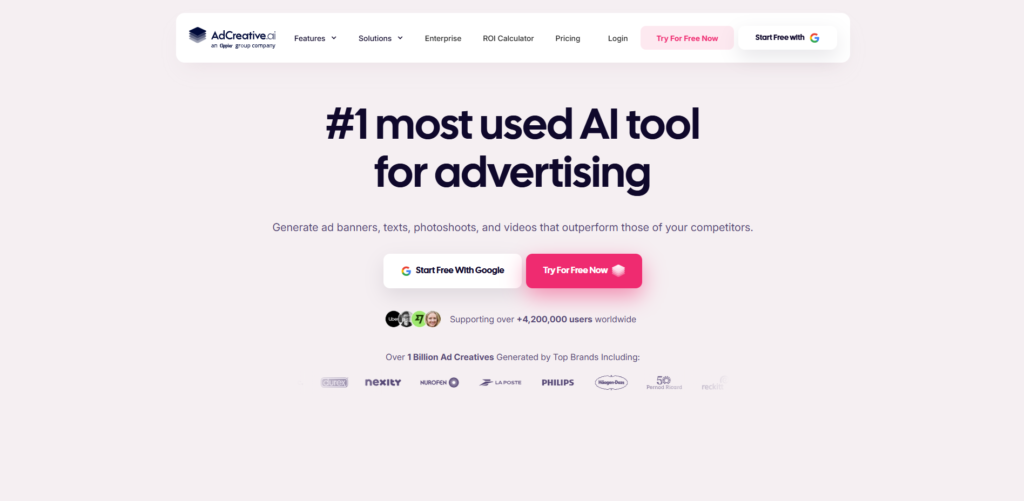
What it does: AdCreative.ai generates ad creative variations, including copy, image layouts, and CTAs, based on your brand assets and past top performers, then scores each variant for predicted click-through rate before it even goes live.
What it does well: The creative scoring feature is genuinely useful. It’s trained on a large dataset of ad performance, so it can flag a weak variant before you spend a dollar testing it. Bulk generation is fast, easily 20 to 30 variants in the time it’d take a designer to make three.
Where it falls short: Output still leans generic if you don’t feed it strong brand guidelines upfront. And the predicted CTR score is a guide, not a guarantee. We’ve seen high-scored creative underperform once it actually hits a real audience.
Best for: Teams running high-volume creative testing on Meta and TikTok who need variant volume fast.
Pricing: Plans start around $29/month for the entry tier, with usage-based scaling for larger teams (as of 2026).
Copy.ai for Ads
What it does: Copy.ai’s workflow builder can chain prompts specifically for ad copy, generating headline and primary text combinations mapped to different funnel stages, from cold awareness to retargeting.
What it does well: The workflow automation is the real value here. You can set up a chain that pulls your product catalog, generates copy variants per SKU, and pushes them straight to a spreadsheet your media buyer already uses.
Where it falls short: It’s a copy tool, not a full creative agent. It won’t touch image or video assets, and it doesn’t connect directly to ad platforms for testing or optimization.
Best for: eCommerce teams needing copy at scale across large product catalogs.
Pricing: Free tier available; paid plans start at $49/month (as of 2026).
AI Agents for Audience Targeting and Segmentation
Manual audience building has become less relevant as platforms shift toward algorithmic targeting. This category of tool focuses on feeding the right signals into those algorithms rather than building lookalikes by hand.
Meta Advantage+ Audience
What it does: Meta’s own agentic targeting layer inside Ads Manager. Instead of defining interests and demographics manually, you set a few guardrails and let Meta’s system find and expand your audience based on live conversion signals.
What it does well: For accounts with solid pixel data and enough conversion volume, it genuinely outperforms manual targeting. Meta’s own internal testing and independent agency reporting have consistently shown Advantage+ campaigns beating manually built audiences on cost per result once an account has enough conversion history.
Where it falls short: It needs volume to work. Accounts converting fewer than 50 events a week per ad set will see the algorithm struggle to learn, and you’ll end up with wasted spend during the learning phase.
Best for: Established accounts with consistent conversion volume, not new or small ones.
Pricing: Built into Meta Ads Manager at no extra cost.
Google Performance Max
What it does: Google’s fully automated campaign type spans Search, Display, YouTube, and Gmail from a single campaign, with the agent handling placement, bidding, and creative rotation across all of them.
What it does well: Reach is the standout. PMax can surface conversions from placements you’d never think to target manually, and Google’s machine learning has years of purchase-intent data behind it.
Where it falls short: Reporting transparency is genuinely poor. You can’t see exactly which placement drove which conversion without piecing it together from third-party attribution tools, which makes it hard to know what’s actually working.
Best for: Advertisers who want maximum reach and are comfortable trading some control for scale.
Pricing: Free to run within standard Google Ads spend; no separate platform fee.
AI Agents for Bid and Budget Management
This is where agents show the clearest ROI, because bid and budget decisions need to happen faster than any human can react.
Smartly.io
What it does: Smartly.io connects to Meta, TikTok, Snap, and Pinterest simultaneously, running an agent layer on top that shifts budget between platforms and ad sets based on real-time performance against your target CPA or ROAS.
What it does well: Cross-platform budget shifting is the strongest feature. If TikTok is suddenly outperforming Meta for a given audience, Smartly reallocates spend within hours instead of waiting for a weekly review.
Where it falls short: It’s built for teams already spending significant budget, generally $50,000+ per month. The platform fee doesn’t make sense below that threshold.
Best for: Mid-market and enterprise teams running multi-platform paid social at scale.
Pricing: Custom pricing based on ad spend under management, typically starting around $2,500/month (as of 2026).
Revealbot
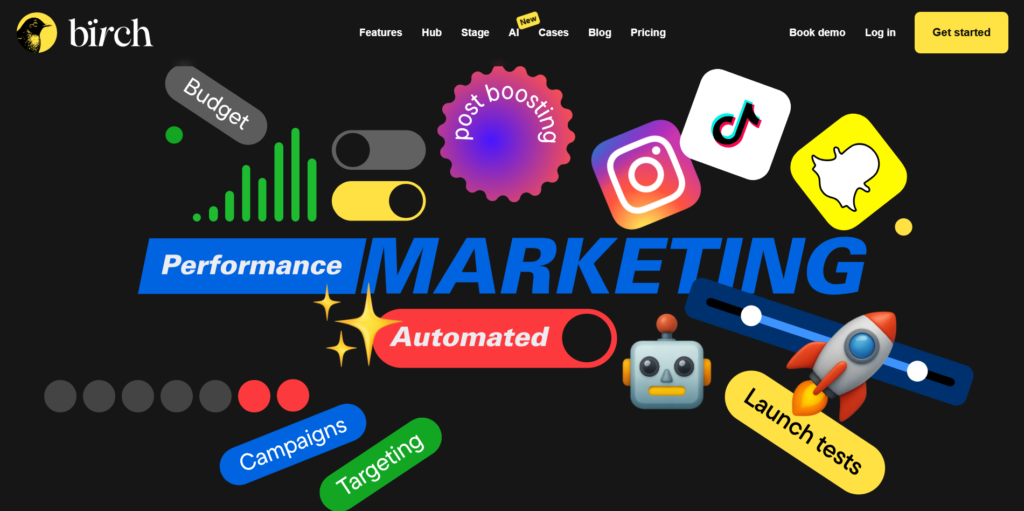
What it does: Revealbot automates bid and budget rules across Meta, Google, and TikTok, but adds a natural-language layer so you can describe a rule like “pause any ad set with CPA over $35 after 100 impressions” instead of building it manually.
What it does well: It’s accessible. A solo marketer or small agency can set up meaningful automation in an afternoon, no engineering resource required.
Where it falls short: It’s rules-based automation with an AI layer on top for rule creation, not a fully autonomous reasoning agent. It won’t invent a strategy you haven’t specified.
Best for: Solo marketers and small agencies who want automation without a steep learning curve.
Pricing: Plans start at $83/month for the starter tier (as of 2026).
AI Agents for Reporting and Attribution
Since iOS privacy changes broke a lot of native platform reporting, this category has grown fast. These agents pull data from every ad platform, unify it, and increasingly generate the analysis themselves.
Northbeam
What it does: Northbeam builds a unified attribution model across all your ad platforms and generates automated performance summaries, flagging which channels and creatives are actually driving incremental revenue rather than just claiming credit for it.
What it does well: The incrementality modeling is a real differentiator. It’s built specifically to correct for the over-crediting problem that happens when Meta, Google, and TikTok all claim the same conversion.
Where it falls short: Setup takes real effort. You need clean tracking infrastructure already in place, and the onboarding process typically runs two to four weeks.
Best for: DTC and eCommerce brands spending $30,000+ monthly across multiple platforms.
Pricing: Custom pricing based on tracked revenue, generally starting around $1,000/month (as of 2026).
Triple Whale
What it does: Triple Whale centralizes performance data from ad platforms, Shopify, and email tools into one dashboard, with an AI agent called Moby that can answer natural-language questions and auto-generate performance summaries on a schedule.
What it does well: Moby genuinely saves reporting time. Asking “why did ROAS drop this week” and getting a data-backed answer in seconds beats building a pivot table every Friday.
Where it falls short: It’s strongest for eCommerce specifically. B2B or lead-gen accounts will find the feature set less tailored to their funnel.
Best for: Shopify-based eCommerce brands wanting a single reporting hub.
Pricing: Plans start at $129/month (as of 2026).
Full-Stack Autonomous Campaign Agents
This is the newest and most ambitious category: tools attempting to handle the full campaign lifecycle, creative, targeting, bidding, and reporting, under one autonomous system with minimal human input.
Madgicx
What it does: Madgicx runs an end-to-end agent across Meta and Google that builds campaign structures, generates and tests creative, and manages budget allocation from a single interface, aiming to reduce the number of separate tools a media buyer needs.
What it does well: The all-in-one approach genuinely reduces tool-switching. For a lean team, having creative generation, budget automation, and reporting in one place is a real time save.
Where it falls short: Because it’s doing everything, it’s not the best-in-class option for any single function. A dedicated tool like Smartly for budget or Northbeam for attribution will usually outperform Madgicx’s version of that same feature.
Best for: Small to mid-size teams wanting one platform instead of five separate subscriptions.
Pricing: Plans start around $55/month for smaller ad spend tiers, scaling with managed budget (as of 2026).
Full-stack agent platforms like Madgicx trade best-in-class performance in any single function for convenience and fewer tool subscriptions. Specialized tools generally outperform generalist agents in their specific category, but cost more to run together.
How to Build an AI Agent Workflow for Performance Marketing
Most teams don’t need every tool above. They need two or three, connected in the right order. Here’s a workflow that works for a mid-size account running $20,000 to $50,000 a month.
Step 1: Audit your current tracking setup. Before any agent can make good decisions, your conversion tracking needs to be clean. Check your Meta Pixel and Google Ads conversion tags for duplicate or missing events.
Step 2: Connect a creative agent to your top-performing ad accounts. Start generating and scoring 15 to 20 new creative variants weekly using a tool like AdCreative.ai, feeding it your last quarter’s top 5 performers as reference.
Step 3: Set your budget guardrails in a bid management agent. Define your target CPA or ROAS in a tool like Revealbot or Smartly, along with hard stop-loss rules so the agent never overspends past a threshold you set.
Step 4: Let the platform-native agents handle placement. Use Advantage+ or Performance Max for the actual bidding and placement decisions, since they have access to signal data your third-party tools can’t fully replicate.
Step 5: Route everything through a unified reporting agent. Connect Northbeam or Triple Whale so you get one weekly summary instead of pulling four separate platform reports.
Step 6: Review flagged anomalies, not every metric. The point of this stack is that you stop checking dashboards daily. Set your reporting agent to flag only significant deviations, then review those.
In Hotskill’s AI skill tracks, we’ve found that learners who set up even a basic two-tool version of this workflow, creative generation plus bid automation, cut their weekly campaign management time from around 8 hours to under 3 within the first month.
Where AI Agents Still Fall Short
It’s worth being honest here, because a lot of tools in this space oversell what they can do. Agents are good at optimizing within a strategy. They’re not good at building the strategy itself. If your offer, audience, or funnel is fundamentally wrong, no agent will fix that by shifting budget around.
They also need volume to work well. Every tool covered here performs worse, sometimes significantly worse, on accounts with low conversion counts. If you’re only getting 10 to 15 conversions a week, most bid agents won’t have enough signal to optimize meaningfully, and you’re better off running things manually until volume grows.
And they’re not fully autonomous, whatever the marketing copy says. Every tool here still needs a human checking outputs, adjusting guardrails, and catching the occasional bad decision, like an agent pausing your best-performing ad set because of a temporary tracking glitch. Think of them as a very fast, very tireless junior media buyer, not a replacement for strategic judgment.
Getting Started with AI Agents
The teams getting the most out of AI agents for performance marketing aren’t the ones running every tool on this list. They’re the ones who picked two, set clear guardrails, and let the data-heavy decisions run without constant manual checking. Start with your biggest time drain, whether that’s bid management or creative production, and automate that one piece first.
Clean tracking, clear budget limits, and a weekly review of flagged anomalies will get you further than adding a fifth tool to an already messy stack.
If you want to actually build this skill instead of just reading about it, Hotskill has hands-on lessons covering exactly this kind of AI agent workflow, built for marketers, not developers. Download the app on iOS or Android, and start your first lesson today.
Frequently Asked Questions
What is an AI agent in performance marketing?
An AI agent in performance marketing is software that can independently plan and execute actions, like adjusting bids, generating creative, or reallocating budget, based on live campaign data. It differs from a dashboard or chatbot because it takes action rather than just reporting or answering questions.
AI agents vs marketing automation, what’s the difference?
Marketing automation follows pre-written if-then rules that never change on their own. AI agents can reason through a goal, evaluate multiple options, and adjust their approach as new data comes in, without someone rewriting the rules each time.
How do I start using AI agents for my ad campaigns?
Start with one function rather than trying to automate everything at once. Most teams see the fastest wins by connecting a bid management tool like Revealbot first, since budget decisions benefit most from real-time reaction speed.
Is it worth paying for an AI agent tool if I already use Meta’s Advantage+?
Yes, in most cases. Advantage+ handles targeting and placement well, but it doesn’t touch creative generation or cross-platform reporting. Most teams pair it with a creative tool and a reporting tool rather than relying on it alone.
Do I need to know how to code to use these tools?
No. Every tool covered in this article, from AdCreative.ai to Northbeam, is built with a no-code interface designed for marketers, not developers. Some setup steps, like installing tracking pixels, may need light technical help from a developer once.
Why isn’t my AI bid agent lowering my CPA?
The most common cause is low conversion volume. Bid agents need enough data points to learn what’s working, generally 30 to 50 conversions per week per campaign, and will underperform below that threshold regardless of how well they’re configured.
Which AI agent is best for a small business just starting with paid ads?
Revealbot or Madgicx are the more accessible starting points, since both offer lower entry pricing and simpler setup than enterprise tools like Smartly.io or Northbeam, which are built for larger ad spend.
Can AI agents completely replace a media buyer?
Not currently. Agents handle execution and optimization well, but strategic decisions, like which offer to test or how to position a new audience, still need human judgment. Most teams use agents to free up a media buyer’s time, not to remove the role.
How much do these AI agent tools typically cost?
Pricing varies widely by category. Creative tools like AdCreative.ai start around $29/month, while enterprise attribution and bid platforms like Northbeam or Smartly.io often start in the $1,000 to $2,500/month range, scaling with ad spend under management (as of 2026).
Do AI agents work the same way across Meta, Google, and TikTok?
No. Each platform’s native agent, like Meta’s Advantage+ or Google’s Performance Max, is trained on that platform’s own signal data and works differently. Third-party agents like Smartly.io connect to multiple platforms but still adapt their approach per platform’s API and data structure.