

Most marketing teams running creator campaigns are still doing the same thing they did five years ago: scrolling Instagram by hand, copying engagement numbers into a spreadsheet, and sending the same outreach message forty times with the name swapped out. It works, technically. It also eats an entire week before a single post goes live.
That’s the gap an AI Agent for Influencer Marketing is built to close. An AI agent is software that can plan and carry out a multi-step task on its own, using tools and data to reach a goal instead of just answering a single prompt. Applied to creator campaigns, that means a system that can search for relevant creators, check their audience quality, draft outreach, and track results without a person doing every step by hand.
This isn’t a theoretical upgrade. Marketing teams running dozens of creator relationships at once are already using agent-based tools to cut discovery and reporting time from days to hours. This article breaks down what these agents actually do, where they genuinely help, where they still fall short, and how to decide if one belongs in your influencer marketing workflow.
What This Kind of Agent Actually Is
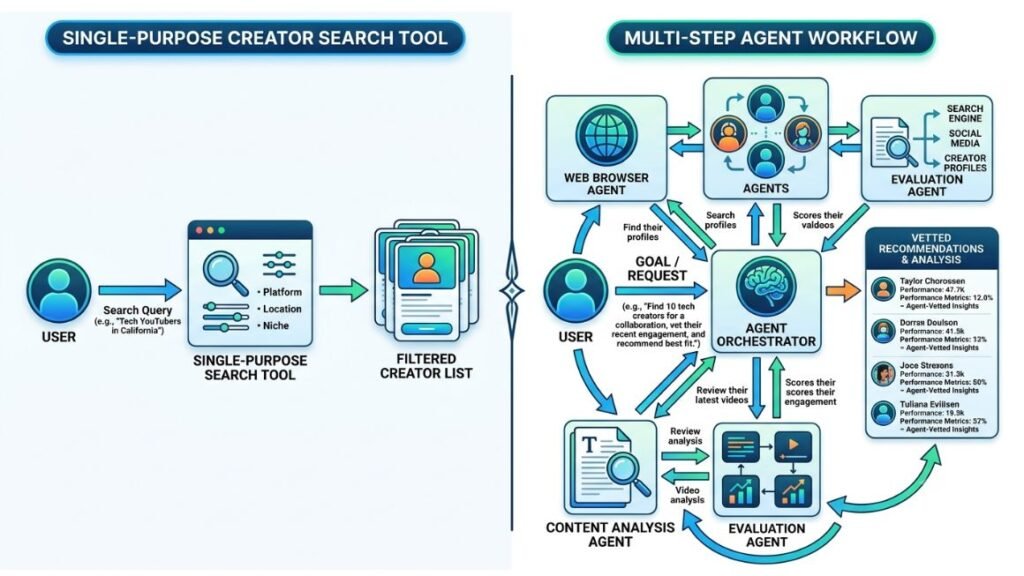
An agent built for creator campaigns is a software system that autonomously handles multiple stages of the work, including finding relevant creators, evaluating their audience, drafting outreach, and monitoring performance, based on goals a marketer sets up front. It’s different from a single-purpose tool because it chains actions together and adapts based on what it finds along the way.
Here’s the distinction that actually matters. A regular tool does one job when you ask it to. A creator database search returns a list. A scheduling tool posts content at a set time. An agent, by contrast, can take a goal like “find 20 mid-sized beauty creators with engaged audiences in the 25-34 age range” and run the entire search, filter, and shortlist process without you clicking through every filter yourself.
That said, autonomous doesn’t mean unsupervised. The better platforms on the market in 2026 still put a human in the loop before anything gets sent to a real creator. The software does the grunt work. You make the final call.
Read More: 15 Best AI Agents for Email Marketing to Boost Engagement in 2026
A creator-marketing agent chains together multiple campaign tasks, discovery, vetting, outreach, and reporting, based on a marketer’s goal rather than a single command. Unlike single-purpose tools, it adapts its next step based on the results of the last one, which is what separates it from a simple automation script.
How the Agent Actually Works
Most tools built for creator campaigns follow a similar loop: they take a goal, break it into steps, pull data from connected sources, and adjust based on results. Here’s what that looks like in practice.
Step 1: You define the goal. Instead of a search query, you give the system a brief. Something like “find 15 fitness creators on Instagram and TikTok with 20,000 to 100,000 followers, engagement rate above 3%, and an audience that’s mostly US-based women aged 25-40.”
Step 2: It pulls and cross-references data. It queries creator databases, social platform APIs, and engagement history to build a shortlist. This is where the real time savings show up. A task that would take a marketer three to four hours of manual scrolling and spreadsheet building gets compressed into minutes.
Step 3: It scores and ranks candidates. Good tools don’t just return raw follower counts. They weigh engagement quality, audience overlap with past brand campaigns, and red flags like sudden follower spikes that suggest bought followers.
Step 4: It drafts next actions. This might mean writing a first-touch outreach message personalized to each creator’s recent content, or flagging which creators are worth a human review before contact.
Step 5: You review and approve. This is the step teams should never skip. The system surfaces recommendations. A person decides what actually goes out.
This kind of system works through a five-step loop: define the goal, pull and cross-reference data, score candidates, draft next actions, and route everything through human approval before anything reaches a real creator. The value is in compressing hours of manual research into minutes, not in removing judgment from the process.
Read More: AI Agent for Content Marketing: Automate Content Creation, Distribution, and Optimization (2026)
Where It Fits in the Creator Campaign Workflow
Not every part of a campaign benefits equally from automation. Some stages are a clear win. Others still need a human doing most of the thinking.
Creator Discovery and Vetting
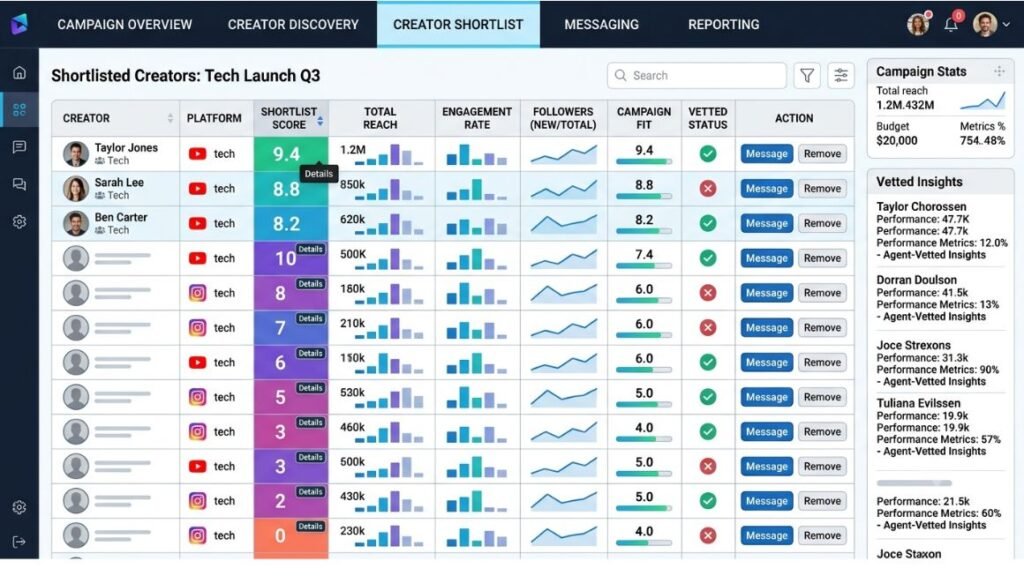
This is where automated tools earn their keep. Manually vetting creators means checking follower authenticity, scanning past brand partnerships for conflicts, and reading through recent posts to check brand fit. A well-built system can do a first pass on all of this across a hundred creator profiles in the time it takes a person to review five.
At Hotskill, we’ve seen marketing teams describe this exact bottleneck: discovery and vetting used to eat the first half of a campaign timeline before a single outreach email went out. Compressing that stage doesn’t just save time. It frees up the days you’d actually want to spend on strategy and creative direction instead of spreadsheet work.
Outreach and Negotiation
These tools are genuinely useful for the first draft of outreach messages, personalized based on a creator’s recent content and audience. What they’re not good at yet is real negotiation. Rate discussions, contract terms, and the back-and-forth of closing a deal still need a person who can read tone and make judgment calls a script can’t.
Read More: AI Agents for Social Media Marketing: Benefits, Use Cases, and Tools (2026)
Campaign Tracking and Reporting
Once content goes live, the system can pull performance data across platforms, calculate engagement rates and reach, and flag underperforming posts before a campaign wraps instead of after. This is one of the highest-value use cases because reporting is repetitive, data-heavy, and exactly the kind of task that benefits from automation without much judgment risk attached.
What It Can’t Do Yet
Honestly, this matters as much as what these tools can do. Current platforms are not good at reading nuanced brand fit the way an experienced marketer can. A creator might check every metric box and still be the wrong voice for your brand, and that’s a judgment call software isn’t reliable at yet.
Negotiation is another weak spot. These systems can draft an opening message, but rate negotiation involves reading a creator’s leverage, understanding market context, and sometimes just picking up the phone. Nothing on the market handles that end to end.
Creative direction is fully out of scope too. A tool can flag that a creator’s past content performs well with a certain format, but deciding the actual creative brief, the story a campaign should tell, still sits with the marketing team. That’s not a limitation to work around. It’s the part of the job that should stay human.
Agent Tools vs Traditional Creator Platforms
A traditional platform gives you a searchable database and manual tools. An AI Agent for Influencer Marketing goes further by chaining those tools into an autonomous workflow that acts on a goal rather than waiting for a command at every step.
Think of it like the difference between a filing cabinet and an assistant. A traditional platform, tools like CreatorIQ or Grin, gives you a searchable database, filters, and a place to track campaigns. You still do the searching, the shortlisting, and most of the outreach yourself.
An agent-based system sits on top of that same kind of data but takes initiative. It doesn’t wait for you to apply the next filter. It applies its own logic to narrow a list of 500 creators down to 15 worth your time, then keeps working through outreach drafts and reporting while you focus on decisions that need a human.
The honest take: most teams don’t need to choose one or the other. Traditional platforms are still the system of record for contracts, payments, and campaign history. Agent tools are increasingly built as a layer that sits on top of or alongside that data, handling the repetitive work so the platform’s manual tools get used less often.
Read More: AI Agents for Digital Marketing: The Complete 2026 Guide
How to Choose the Right One for Your Team
Not every tool in this category is worth adding to your stack. A few questions cut through the marketing noise fast.
- Does it integrate with the platforms you already use? A system that can’t pull data from Instagram, TikTok, and YouTube APIs, or connect to your existing creator database, creates more manual work than it saves.
- Can you set approval checkpoints? Any tool that lets outreach go out without a review step is a liability, not a feature. Look for explicit human-in-the-loop controls.
- How transparent is its scoring? If a system ranks creators but can’t explain why one scored higher than another, you’re trusting a black box with brand decisions.
- What does it cost at your campaign volume? These tools are often priced per seat or per number of creators tracked. Run the math against how many campaigns you actually manage before committing to an annual plan.
- Does the vendor show real accuracy data? Ask for specifics, not a demo reel. A vendor that can say “our audience authenticity check flags fake-follower accounts with X% accuracy” is more credible than one that just says its platform is powered by advanced automation.
That’s a lot of criteria. In practice, the integration question eliminates most options fast, since a tool that doesn’t talk to your existing systems isn’t worth the switching cost.
Getting Started: A Practical 4-Step Rollout
You don’t need to overhaul your entire creator marketing process on day one. Start narrow and expand once you trust the output.
- Pick one stage to automate first. Discovery and vetting is the easiest starting point because the risk of a bad output is low. You’re building a shortlist, not sending anything.
- Run it alongside your current process for one campaign. Compare the shortlist it produces against what your team would have found manually. This tells you fast whether the tool actually understands your brand’s audience criteria.
- Set your approval checkpoints before scaling up. Decide now which actions require a human sign-off. Outreach and contract terms should always have one.
- Expand to reporting once discovery is trusted. Campaign tracking and performance reporting is the next logical stage to hand off, since it’s data-heavy and lower-risk than anything customer-facing.
Teams get the best results by starting with a single low-risk stage, usually creator discovery, running it in parallel with their existing process for one campaign, and only expanding to outreach and reporting once the output has proven reliable.
Read More: AI Agents for Performance Marketing: Automate, Optimize, and Scale
Conclusion
None of this runs your creator program for you, and it shouldn’t. What it does well is take the repetitive, data-heavy parts, discovery, audience vetting, and performance reporting, and compress them into a fraction of the time they used to take. The judgment calls, brand fit, negotiation, and creative direction, still belong to your team.
Start with one stage, keep a human checkpoint on anything creator-facing, and expand from there. That’s the whole playbook.
If you want to get better at using AI Agent tools like this in your actual marketing work, not just read about them, Hotskill has structured lessons built for exactly that. Download the app on iOS or Android, and start your first lesson today.
FAQ
What Is This Type of Marketing Agent?
It’s software that autonomously handles multiple stages of a creator campaign, including finding relevant creators, checking audience quality, drafting outreach, and tracking results, based on a goal a marketer sets rather than a single manual search.
How is this different from a regular creator platform?
A platform gives you a searchable database and manual tools you operate yourself. An agent-based tool chains those same data sources into a workflow that acts on a goal, narrowing candidates and drafting next steps without a person driving every click.
Can this kind of tool replace my marketing team?
No. It can handle discovery, vetting, and reporting, but brand fit judgment, negotiation, and creative direction still need a person. Most teams that use these tools well treat them as a research and reporting assistant, not a replacement for strategy.
Is it worth it for a small marketing team?
If you’re running more than a handful of creator relationships at once, yes. Smaller teams tend to feel the time savings on discovery and vetting the most, since that stage often eats the most hours relative to team size.
Do I need coding skills to use one of these tools?
No. Most platforms built for marketers use a chat or form-based interface where you describe the campaign goal in plain language. Technical setup is usually limited to connecting your social accounts and creator database.
How accurate is automated creator vetting?
It varies by vendor and depends on how the tool checks for fake followers and engagement authenticity. Ask any vendor for their specific accuracy numbers before trusting the output, and always spot-check a sample of flagged creators yourself.
Will using one of these tools make my outreach sound robotic?
It can, if you send the first draft without editing it. Treat the generated outreach as a starting point personalized with real details from a creator’s content, then review and adjust the tone before anything goes out.
What happens if it recommends a bad-fit creator?
This is exactly why approval checkpoints matter. A good workflow surfaces recommendations with the reasoning behind them, but a person should always review the shortlist before any outreach is sent.
How much do these tools typically cost?
Pricing varies widely, and most vendors charge per seat or based on the number of creators tracked monthly. Get a quote against your actual campaign volume rather than comparing list prices, since usage-based tiers change the real cost fast.
Do I still need a traditional platform if I use one of these tools?
In most cases, yes, at least for now. These systems are increasingly built to sit on top of or alongside existing platforms, handling the repetitive research and reporting work while the platform stays your system of record for contracts and payment history.