

You’ve probably noticed it. You browse a pair of running shoes on one site, and by the next day, three different brands are showing you the exact same shoes in your Instagram feed. That’s not a coincidence, and it’s also not simple targeted advertising anymore. Behind a growing share of these experiences sits a genuine software agent, one that watches behavior, makes decisions, and adjusts on the fly without a human clicking a single button.
For online sellers, the pressure to personalize isn’t optional anymore. Shoppers expect a store to know what they want before they’ve fully figured it out themselves. That’s the gap an AI Agent for Product Recommendations is built to close, and it’s a very different animal from the “customers also bought” widgets that shaped e-commerce for the last two decades.
This article breaks down what these agents actually are, how they work, which tools power personalized product recommendations, and what it takes to put one to work in your own store. No fluff, no vague promises. Just the mechanics, the trade-offs, and a clear path forward.
What Is an AI Recommendation Agent, and How Is It Different from a Basic Recommendation Engine?
An AI agent is a system that can perceive information, decide on an action, and carry it out with limited or no human input, often adjusting its next move based on what happens after the first one. A traditional recommendation engine, by contrast, just runs a fixed calculation, matching a shopper to items based on past purchases or similar users, then stops. It doesn’t reason. It doesn’t retry. It doesn’t ask a follow-up question.
That difference matters more than it sounds. A classic recommendation engine works well when the data is clean and the shopper behaves predictably. It breaks down fast when someone shows up with a vague goal, like “I need a gift for my sister who likes hiking but hates anything too outdoorsy-looking.” No static algorithm can parse that kind of nuance. An agent, built on a large language model with access to your product catalog, can.
Think of it this way: the old system is a vending machine. You press a button, it gives you what’s behind that button. An agent is closer to a sales associate who remembers your last three visits, asks a clarifying question if it’s unsure, and adjusts the pitch based on your reaction. That’s the shift happening across e-commerce right now, and it’s why so many brands are moving budget from static recommendation widgets toward genuinely agentic systems.
An AI Agent for Product Recommendations differs from a traditional recommendation engine because it can reason through ambiguous requests, ask clarifying questions, and adjust its suggestions in real time. Traditional engines run a single fixed calculation based on past behavior and stop there. This shift is why more e-commerce brands are replacing static “customers also bought” widgets with conversational, agent-driven recommendation flows.
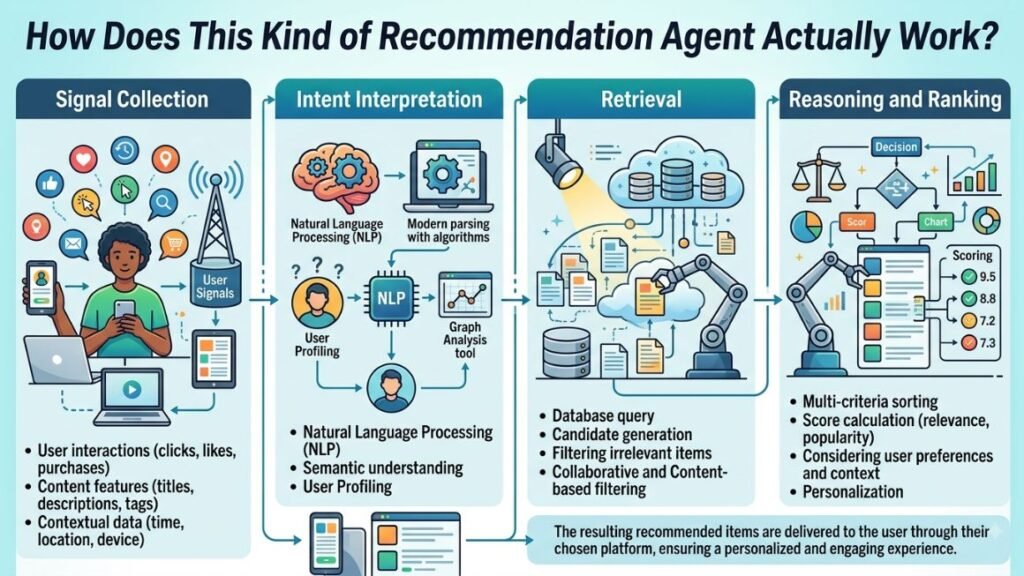
How Does This Kind of Recommendation Agent Actually Work?
Most of these systems follow a similar loop: perceive, retrieve, reason, act, and learn. The agent takes in a signal (a search query, a click, a chat message), pulls relevant product data, reasons about what best fits the intent, returns a suggestion, and logs the outcome to improve the next interaction.
Step 1: Signal Collection The agent gathers data points from browsing history, past purchases, cart activity, on-site search terms, and sometimes external context like weather or trending items. This is the raw material every downstream decision depends on.
Step 2: Intent Interpretation Using natural language processing, the agent tries to figure out what the shopper actually wants, not just what they typed. Natural language processing, or NLP, is the branch of AI that lets software understand and generate human language rather than relying only on exact keyword matches.
Step 3: Retrieval The agent searches the product catalog, usually through a vector database, to pull the items most semantically similar to the inferred intent. A vector database stores product information as numerical representations of meaning, called embeddings, so the system can find conceptually similar items even if the wording doesn’t match exactly.
Step 4: Reasoning and Ranking The underlying large language model weighs the retrieved products against the shopper’s profile, current inventory, margin priorities, and any business rules a merchant has set, then ranks the output.
Step 5: Action and Feedback The agent presents the recommendation, whether that’s a product carousel, a chat reply, or a personalized email, and tracks whether the shopper engaged with it. That outcome feeds back into the system to sharpen future suggestions.
This loop is what makes AI-powered personalization feel less like a script and more like a conversation. It’s also why these systems get noticeably better over the first few weeks of live traffic. They’re learning from real behavior, not just historical training data.
The Core Tools and Technologies Behind These Systems
This is the part most articles skip past with a single vague sentence. Here’s what’s actually running under the hood, tool by tool.
Large Language Models (LLMs)
A large language model is the reasoning engine of the agent. It’s a neural network trained on massive amounts of text that can understand context, generate natural language, and follow multi-step instructions. In a recommendation setup, the LLM interprets shopper queries, writes the copy explaining why a product fits, and handles follow-up questions in a conversational flow.
What it does well: Handling ambiguous, conversational requests that a keyword search can’t parse. It can explain its reasoning, which builds shopper trust.
Where it falls short: LLMs can hallucinate, meaning they occasionally state something confidently that isn’t true, like claiming a product has a feature it doesn’t have. This is why serious implementations always ground the model’s output in real catalog data rather than letting it generate specs from memory.
Best for: Any store with a catalog complex enough that keyword search alone leaves shoppers frustrated.
Vector Databases and Embeddings
An embedding is a numerical representation of a product’s meaning, generated by an AI model, that captures how similar it is to other products in a mathematical space. A vector database, such as Pinecone, Weaviate, or Milvus, stores these embeddings and lets the agent search by meaning instead of exact text match.
This is the piece that lets a shopper type “something cozy for a rainy weekend” and get back a fleece blanket and a candle set, even though neither product description contains the word “cozy.” Honestly, this is the single biggest technical upgrade over older keyword-based search, and it’s underrated by most merchants who haven’t touched one yet.
What it does well: Semantic search that mirrors how people actually think and shop.
Where it falls short: Embedding quality depends heavily on how well your product data is written. Thin, generic descriptions produce weak embeddings and mediocre matches.
Best for: Catalogs with more than a few hundred SKUs, where keyword search starts breaking down.
Retrieval-Augmented Generation (RAG)
Retrieval-augmented generation is a technique where the AI pulls real, current data from a source like your product catalog before generating a response, instead of relying only on what it learned during training. This is the mechanism that keeps recommendations accurate and grounded in actual inventory, pricing, and stock status.
Without RAG, an LLM might recommend a product that’s out of stock or describe features from a similar item it saw during training. With RAG, every recommendation is checked against live data first.
Best for: Any agent making claims about pricing, availability, or specifications. This should be considered mandatory, not optional.
Collaborative and Content-Based Filtering Models
These are the statistical backbone that many agents still lean on for a first-pass shortlist before the LLM refines it. Collaborative filtering recommends items based on what similar shoppers bought. Content-based filtering recommends items with attributes similar to what a shopper already liked. Most modern agents blend both with the reasoning layer on top, rather than replacing them outright.
Best for: High-traffic stores with strong historical data, where patterns across thousands of shoppers carry real signal.
Customer Data Platforms (CDPs)
A customer data platform unifies data from every touchpoint, website, app, email, support tickets, into a single shopper profile the agent can query in real time. Tools like Segment or Klaviyo’s CDP layer feed the agent a complete picture instead of fragmented, siloed data.
Where it falls short: CDPs are only as good as your data hygiene. Duplicate profiles and inconsistent tracking undercut everything downstream.
Best for: Multi-channel brands where a shopper might browse on mobile, add to cart on desktop, and complete the purchase over email.
Orchestration and Agent Frameworks
Frameworks like LangChain and LlamaIndex handle the plumbing: connecting the LLM to the vector database, managing memory across a conversation, and chaining multiple steps together so the agent can, say, check inventory, then generate copy, then log the interaction, all in one flow. These frameworks are what turn a standalone LLM into a functioning agent rather than a chatbot that answers one question and forgets everything.
Best for: Development teams building a custom agent rather than buying an off-the-shelf platform.
Pre-Built Recommendation Platforms
For merchants who don’t want to build from scratch, platforms like Nosto, Dynamic Yield, and Algolia AI offer managed AI recommendation systems with the vector search, LLM layer, and analytics dashboard already built in. As of 2026, most of these platforms price on a tiered model based on monthly tracked users or order volume, so it’s worth checking current pricing directly before committing.
What it does well: Fast time to launch, no engineering team required.
Where it falls short: Less flexibility than a custom build, and you’re dependent on the vendor’s roadmap for new capabilities.
Best for: Small to mid-size stores that need results in weeks, not quarters.
A functioning AI recommendation engine typically combines four layers: a large language model for reasoning, a vector database for semantic product search, retrieval-augmented generation to keep suggestions grounded in real inventory, and an orchestration framework to chain these steps together. Merchants can build this stack custom with tools like LangChain, or buy a managed version through platforms like Nosto or Dynamic Yield.
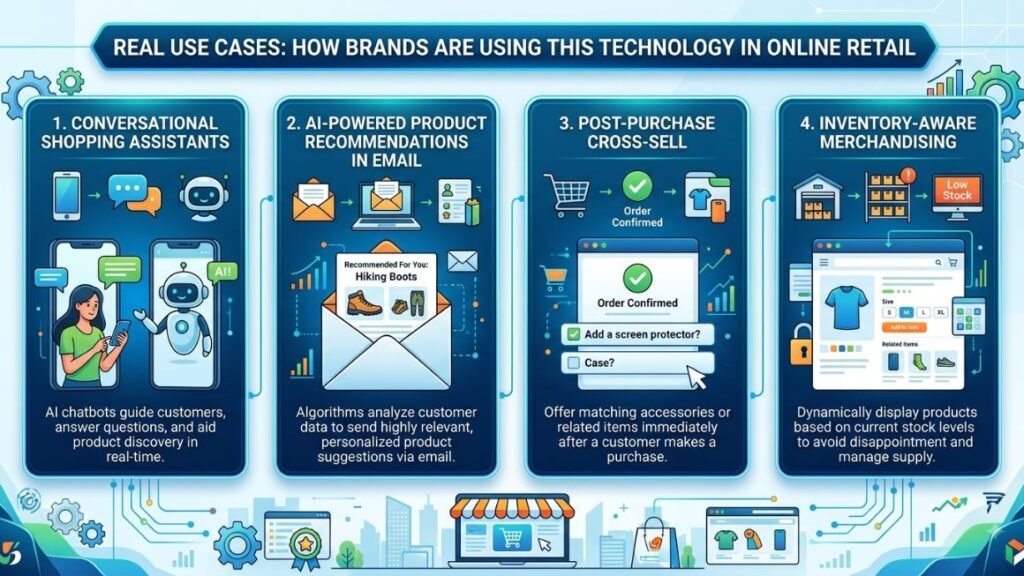
Real Use Cases: How Brands Are Using This Technology in Online Retail
Brands adopting AI agents for e-commerce aren’t chasing novelty. They’re solving a specific problem: shoppers abandon a search the moment it stops feeling relevant, and a well-built agent keeps that relevance intact across the whole session.
Conversational shopping assistants. Instead of a search bar, shoppers chat with an agent that asks a follow-up question when the request is vague, similar to how a good in-store associate would. Sephora and Amazon have both rolled out conversational shopping tools that lean on this exact pattern.
AI-powered product recommendations in email. Rather than sending the same abandoned-cart email to everyone, the agent generates a version tailored to what that specific shopper viewed, including alternative products if the original item is now out of stock.
Post-purchase cross-sell. After checkout, the agent evaluates what a shopper just bought and surfaces genuinely complementary items, not just “frequently bought together” noise, using the reasoning layer to filter out low-relevance matches.
Inventory-aware merchandising. The agent factors in stock levels and margin data when ranking recommendations, quietly nudging shoppers toward overstocked items that still match their intent, without ever feeling like a hard sell.
In our testing at Hotskill, teams that paired a vector database with even a lightweight LLM layer saw noticeably more relevant top-of-page recommendations within the first week, compared to keyword-only search on the same catalog.
The Real Benefits, Beyond the Marketing Copy
AI product recommendations aren’t just a nice-to-have anymore. They change concrete numbers. Higher average order value, better conversion on search results, and lower bounce rates on product pages are the outcomes most merchants report after a proper rollout.
More importantly, intelligent product recommendations reduce the friction of decision fatigue. A shopper facing 400 similar options doesn’t want to compare all of them. They want three good options, explained clearly, fast. That’s the actual job these agents are doing, and it’s why the experience feels less like being sold to and more like being helped.
There’s also a retention angle that gets less attention. A shopper who gets a genuinely good suggestion once is more likely to trust the store’s search and recommendations the next time, which compounds over repeat visits.
Where These Systems Still Fall Short
To be fair, this isn’t a magic fix. Cold-start problems are real: an agent has almost nothing to work with for a brand-new shopper or a freshly launched product with no purchase history yet. Data quality issues also show up fast. If your product titles and descriptions are thin or inconsistent, the embeddings built on top of them will be too, and the recommendations will reflect that.
Cost is another honest limitation. Running LLM calls at scale, for every search query across a high-traffic store, adds up. Some merchants underestimate this until the first invoice arrives. And bias can creep in quietly. If your historical sales data over-indexes on a narrow set of products, a collaborative filtering layer will keep recommending those same products, reinforcing the pattern rather than helping shoppers discover something new.
None of this means skip the technology. It means go in with realistic expectations and a plan for the data foundation before layering AI on top.
How to Implement One in Your Own Store
- Audit your product data first. Clean, detailed product descriptions and consistent attributes are the foundation every downstream tool depends on. Skipping this step undermines everything that follows.
- Choose build vs. buy. Decide whether a managed platform like Nosto or Algolia AI fits your timeline, or whether your team has the engineering bandwidth for a custom stack using LangChain and a vector database.
- Set up your vector database. Generate embeddings for your full catalog and load them into a vector store like Pinecone or Weaviate.
- Connect a grounded LLM layer. Implement retrieval-augmented generation so every response the agent gives is checked against live catalog and inventory data, not generated from memory.
- Define business rules. Set margin priorities, stock-level weighting, and any category restrictions the agent should respect when ranking recommendations.
- Launch on a single surface first. Start with one placement, like the product detail page or an abandoned-cart email, rather than rolling it out everywhere at once.
- Monitor and retrain. Track engagement on recommendations weekly and feed that data back into the system so it keeps improving.
Start small. A single well-executed surface beats a half-built rollout across your whole site.
Getting Started
The gap between a generic storefront and one that feels like it actually knows the shopper comes down to a handful of decisions: clean product data, the right retrieval setup, and an LLM layer that stays grounded in what’s actually in stock. Get those three right and the rest tends to follow.
If you’re trying to build real skills around AI agents and recommendation tools rather than just reading about them, Hotskill has structured lessons that walk through exactly this kind of implementation, hands-on. Download the app on iOS or Android and start your first lesson today at hotskill.co/download.
FAQs
What is an AI shopping agent that recommends products?
It’s a software system that uses a large language model, product data, and shopper context to suggest relevant products, and can reason through follow-up questions instead of running a single fixed calculation like a traditional recommendation widget.
AI agent vs. traditional recommendation engine, what’s the actual difference?
A traditional engine runs one calculation based on past behavior and stops. An agent can interpret ambiguous requests, ask a clarifying question, check live inventory, and adjust its suggestion based on how the shopper responds, all within the same interaction.
How do I add an AI recommendation system to my Shopify or WooCommerce store?
Most merchants start with a managed platform like Nosto, Dynamic Yield, or Algolia AI, which offer plug-in integrations for major e-commerce platforms without requiring custom engineering. Larger teams with development resources can build a custom agent using a vector database and an LLM layer instead.
Is this worth it for a small store with under 1,000 SKUs?
It depends on your catalog complexity. If your products are highly similar and easy to browse manually, a basic filter might be enough. If shoppers regularly struggle to find the right item among similar options, even a lightweight agent can meaningfully improve conversion.
Do I really need an AI agent if I already have basic filters and search on my site?
Basic filters work when shoppers know exactly what they’re looking for. They fall apart the moment someone has a vague or complex request, which is common in categories like gifting, fashion, or home goods. An agent fills that specific gap rather than replacing filters entirely.
Why isn’t my AI recommendation engine giving relevant results?
The most common cause is weak underlying product data. Thin descriptions and missing attributes produce poor embeddings, which leads to poor matches regardless of how good the LLM layer is. Check your data quality before assuming the model itself is the problem.
Do I need to know how to code to set one up?
Not if you go with a managed platform, most of which offer no-code or low-code integration through your existing store platform. Custom builds using frameworks like LangChain do require development resources.
How much does an AI recommendation engine typically cost?
Pricing varies widely and changes often, so check current rates directly with the vendor. As of 2026, most managed platforms price on tiered monthly plans based on traffic or order volume, while custom builds carry ongoing LLM API costs on top of development time.
Can AI-powered product recommendations work for cold-start shoppers with no history?
Not well on their own. Most systems fall back on content-based filtering or general trending items until enough behavioral data accumulates for that specific shopper, which usually happens within a few sessions.
Will this replace my merchandising team?
No. It handles the repetitive matching work at scale, but merchandising strategy, seasonal planning, and brand judgment still need a human. Think of it as a tool that removes grunt work, not a replacement for strategic decisions.