

Your site gets 40,000 visitors a month. Maybe 300 fill in a form. Of those, your SDR reaches 90 within 24 hours, and by then half have already picked a competitor. That gap between someone showing interest and someone getting an actual answer is where most pipeline dies, quietly, every single day.
An AI agent for conversational marketing is built to close that gap. Not with a scripted chatbot that asks for your email before answering anything, but with a system that understands a question, checks your product data, gives a real answer, and books a meeting when the intent is there.
This guide covers what these agents actually do, the eight platforms worth evaluating in 2026, honest notes on where each one breaks, and a step-by-step deployment process. It’s written for marketers who have already tried a basic chat widget and found it underwhelming.
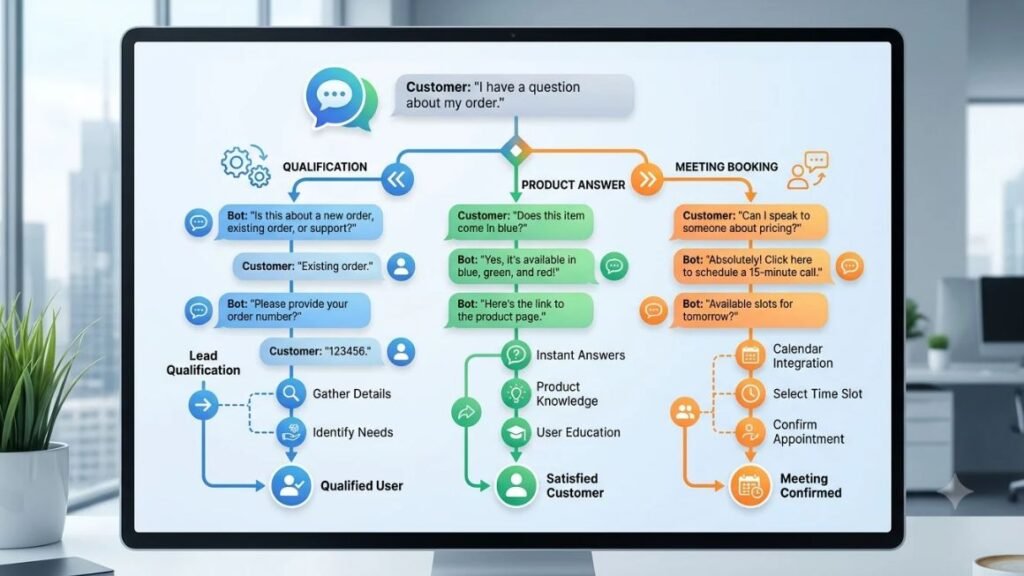
What Is an AI Agent in Conversational Marketing?
An AI agent in conversational marketing is a software system that holds two-way conversations with prospects across chat, messaging apps, and email, using a large language model to understand intent and take actions like answering product questions, qualifying leads, and booking meetings without human input.
The word that matters there is actions. A chatbot responds. An agent does things.
A large language model, or LLM, is an AI system trained on huge volumes of text that predicts and generates language based on context rather than matching fixed keywords. That’s the piece that changed everything. Older bots ran on rigid decision trees where a keyword triggered a preset reply, while modern agents read intent at a semantic level, hold context across a multi-turn conversation, pull in relevant product data, and hand off to a human at the right moment without a scripted workflow.
Here’s the practical difference. Someone types: “we’re a 12-person agency, does your Pro plan cover white-labelling for client reports?”
A 2022-era bot sees “Pro plan” and dumps a pricing page link. An agent recognises three things at once: company size, a specific feature question, and agency buyer type. It answers the white-labelling question from your docs, notes that 12 seats puts them in your SMB tier, and offers a 15-minute call with the right rep. One message, three jobs done.
An AI agent for conversational marketing differs from a traditional chatbot in that it takes actions rather than only replying. It reads intent semantically, retrieves live product and account data, qualifies the lead against defined criteria, and either resolves the query or routes it to a human with full context. The practical result is that high-intent visitors get answers in seconds instead of waiting for a callback.
Why 2026 Is Different From the Chatbot Era
Two things changed: the models got good enough to trust with real customers, and buyers stopped wanting to talk to salespeople.
On the buyer side, Gartner found that 61% of B2B buyers now prefer a rep-free buying experience. That’s not a preference for less information. It’s a preference for getting information without a discovery call attached. An agent serves that directly.
On the market side, Grand View Research put the conversational AI market at $11.6 billion in 2024, projected to reach $41.4 billion by 2030 at a 23.7% compound annual growth rate. Money follows deployment, and deployment follows results.
The messaging shift is the part most marketers underweight. WhatsApp crossed 3 billion monthly active users in May 2025, and Infobip’s 2026 data puts WhatsApp open rates around 98% against roughly 21% for email. Gartner’s 2026 forecast expects over 60% of WhatsApp Business Platform conversations to involve an AI agent by the end of 2026, up from 28% in 2025.
That’s a channel where your audience already lives, reads within minutes, and now expects an instant reply. Which is impossible to staff manually and fairly straightforward to automate.
And the expectation isn’t optional anymore. HubSpot’s 2024 data found 82% of service teams say customers now expect their issue resolved immediately.
The 8 Platforms Worth Evaluating
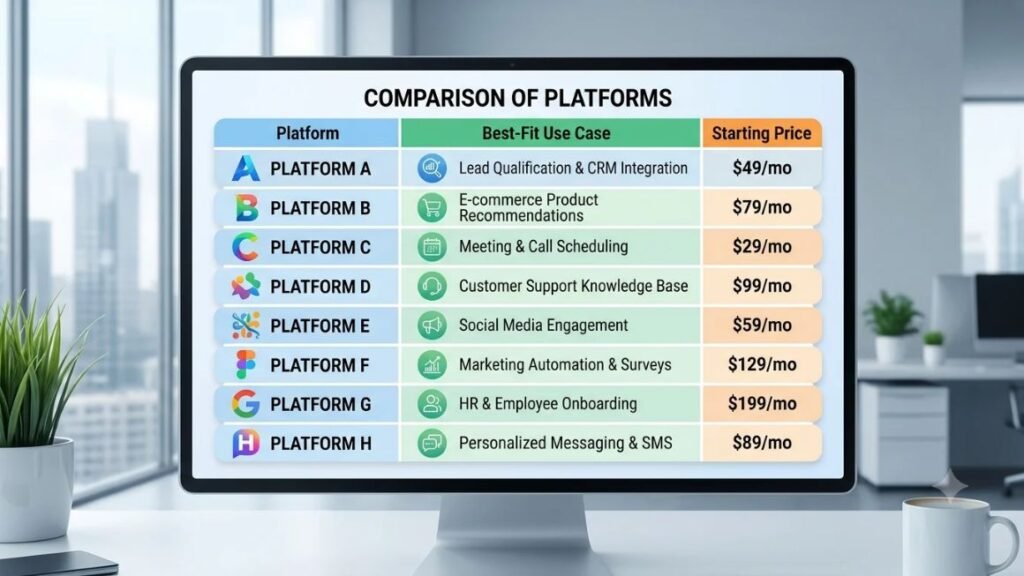
There’s no single best tool. There’s a best tool for B2B pipeline, a best tool for ecommerce, and a best tool for people who want to build something custom. Below is each one, what it’s genuinely good at, and where it falls over.
Pricing below is as of 2026 and changes often. Verify before you commit budget.
Intercom Fin
What it does: Fin is Intercom’s AI agent. It reads your help centre, past conversation transcripts, and custom content sources, then resolves inbound conversations autonomously inside the Intercom Messenger.
What it does well: Resolution accuracy. Fin runs on a GPT-4-class resolution engine trained on your help centre articles, past conversations, and custom sources, and industry testing consistently reports it resolving above 50% of inbound tickets without human involvement. Human handoff preserves the full conversation context, so agents never make a customer repeat themselves. If you already run support on Intercom, turning Fin on is close to trivial.
Where it falls short: The pricing model. Intercom charges roughly $0.99 per resolution on top of a per-seat base fee, which adds up fast at volume. At 2,000 AI resolutions a month, that’s an extra $2,000 before you count seats. It’s also support-first. Marketing-side lead routing and ABM plays are weaker than the sales-focused tools.
Best for: SaaS companies already on Intercom with a well-maintained knowledge base.
Pricing as of 2026: Essential starts around $39 per seat per month, plus per-resolution Fin fees.
Drift (now part of Salesloft)
What it does: Drift pioneered the chat-to-meeting playbook for B2B. It identifies visiting companies, runs targeted playbooks per account, and books meetings straight into rep calendars.
What it does well: Account-based marketing, or ABM, which is the practice of targeting a defined list of high-value accounts rather than broad audience segments. Drift’s ABM routing is still the strongest in the category. Salesloft acquired Drift in 2024, and the product is now tightly integrated into Salesloft’s sales engagement suite, which is a real advantage if your SDR team already lives there.
Where it falls short: Honestly, Drift has coasted. It delivers the classic website chat-to-meeting flow, but what you get back is routed names rather than genuinely understood buyers. The pricing is aimed at enterprise teams selling $50,000-plus contracts. For anyone smaller, the value case is hard to defend.
Best for: B2B sales-led teams running ABM with high contract values.
Pricing as of 2026: Custom enterprise quotes only.
Qualified
What it does: Qualified is a pipeline generation platform built specifically for Salesforce-native companies. Its agent, Piper, works as an AI SDR that engages inbound traffic and books qualified meetings.
What it does well: Salesforce depth. Everything writes back cleanly. If your revenue operations run on Salesforce objects and your board reviews Salesforce dashboards, Qualified removes an entire layer of data reconciliation. It’s widely considered the strongest option for conversational sales and inbound pipeline generation.
Where it falls short: It’s only worth it if you’re genuinely Salesforce-committed. It handles pure pipeline routing well but surfaces relatively little discovery or positioning signal. You get meetings booked. You don’t learn much about why buyers came.
Best for: Mid-market and enterprise B2B running Salesforce as the single source of truth.
Pricing as of 2026: Custom quotes, positioned at the enterprise end.
Tidio with Lyro AI
What it does: Tidio is live chat plus an AI agent called Lyro, aimed squarely at small ecommerce teams.
What it does well: Shopify integration and price. Lyro AI runs on Claude and delivered a 67% automation rate in ecommerce testing, the highest reported across the compared platforms, with native Shopify install taking under five minutes. It automatically pulls customer data, order history, cart contents, and browsing behaviour into every conversation, so a “where’s my order” question gets a real tracking answer with no custom setup.
Where it falls short: It doesn’t scale. Tidio is built for small teams, handles FAQ-style deflection well but struggles with nuanced conversations, and once you exceed a few hundred conversations a day you outgrow its reporting, routing, and team management.
Best for: Shopify and WooCommerce stores under 50 employees.
Pricing as of 2026: Free tier available, paid plans from around $29 per month, with the Lyro AI add-on from $39 per month.
ManyChat
What it does: ManyChat automates conversations across WhatsApp, Instagram, Facebook Messenger, SMS, and Telegram using a visual flow builder.
What it does well: Social-first lead capture. Its visual flow builder, growth widgets, and broadcast tools are unusually well developed, and its Meta partnership gives reliable WhatsApp Business API access. If your funnel starts with an Instagram comment or a click-to-WhatsApp ad, this is the natural home for it. A WhatsApp AI agent built here can run cart recovery and promotional broadcasts from the same flow.
Where it falls short: It’s a flow builder with AI bolted on, not an agent-first platform. Shopify integration covers basic product data only. Complex, open-ended product questions still fall through to a human more often than they should.
Best for: Creators and DTC brands running Meta-channel acquisition.
Pricing as of 2026: Free tier, Pro plans from roughly $15 per month. WhatsApp conversation fees from Meta are billed separately.
Chatbase
What it does: Chatbase turns your website, documentation, and uploaded files into a custom AI agent you can embed anywhere.
What it does well: Speed to launch. Point it at a URL, wait a few minutes, get a working agent. It’s the simplest route to deploying a custom agent trained on your own business data.
Where it falls short: It lacks deep helpdesk integration, so it can’t support true end-to-end service workflows. Great for answering questions. Weak at doing anything with the answer.
Best for: Content-heavy sites and documentation portals needing accurate answers fast.
Pricing as of 2026: Free tier, paid plans from around $40 per month.
Botpress
What it does: Botpress is a developer-oriented platform for building custom agents with full control over logic, tools, and model choice.
What it does well: Flexibility. It’s built for configurable, developer-oriented agents and workflows, which means you can wire it to internal APIs, custom databases, and whatever model you prefer.
Where it falls short: You need engineering time. There’s no useful version of Botpress that a marketer configures alone on a Tuesday afternoon. Budget for a developer.
Best for: Teams with engineering resource and requirements no SaaS tool covers.
Pricing as of 2026: Free tier with usage-based pay-as-you-go pricing.
HubSpot Breeze
What it does: Breeze is HubSpot’s AI layer, including a customer agent and prospecting agent that run on top of your existing CRM data.
What it does well: Context. Because it sits on the HubSpot CRM, it already knows deal stage, past email opens, and lifecycle stage before the conversation starts. For CRM-centric marketing and sales workflows, HubSpot remains the most coherent option. That makes it a strong AI chatbot for lead generation when your data already lives in HubSpot.
Where it falls short: Raw resolution quality trails Fin. And you pay for it through Hub tier upgrades, which means the real cost often lands higher than the sticker suggests.
Best for: Teams already running marketing and sales on HubSpot.
Pricing as of 2026: Bundled into Marketing Hub and Service Hub tiers, with credit-based usage limits.
The right conversational marketing agent depends on channel and stack, not on overall capability. Intercom Fin leads on resolution accuracy for support-heavy SaaS, Qualified and Drift lead on B2B pipeline routing, Tidio and ManyChat serve ecommerce and social-led funnels at a fraction of the cost, and Chatbase and Botpress cover custom builds. Evaluate on where your conversations already happen, then on price.
How Do You Build an AI Agent for Conversational Marketing?
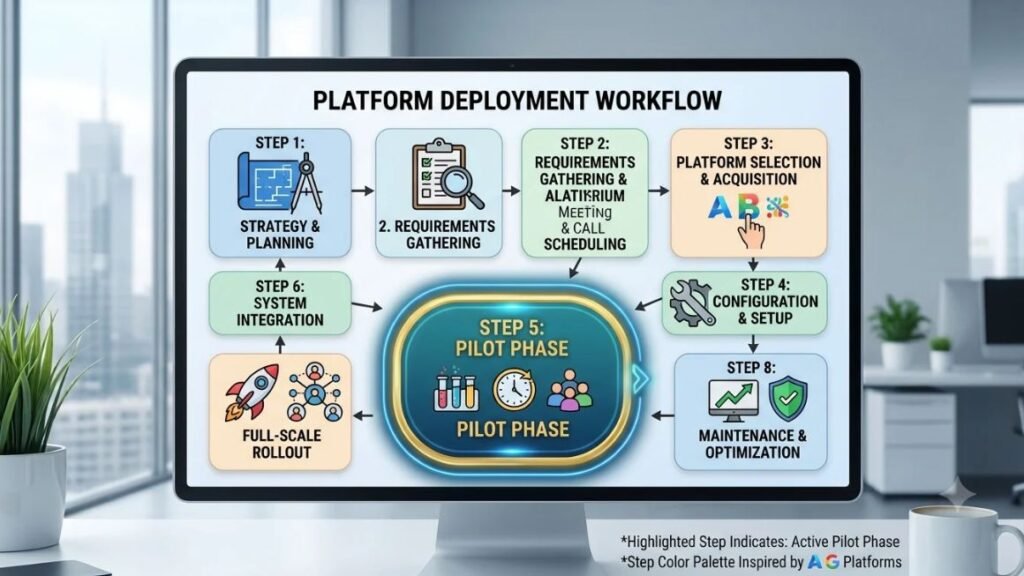
Pick the platform last, not first. The failures we see almost always come from buying a tool before defining what the agent is supposed to accomplish. Here’s the sequence that works.
Step 1: Pull your last 500 inbound conversations and tag them. Export from your existing chat, inbox, or WhatsApp history. Tag each one: pricing question, feature question, order status, integration query, support issue, junk. You now know what your agent will actually face, rather than what you imagine it’ll face.
Step 2: Set a resolution target per category. Order status should hit 90% plus. Pricing questions, maybe 70%. Complex technical integration questions, be honest, maybe 30%. Writing these numbers down before launch stops you from calling a mediocre rollout a success.
Step 3: Clean your knowledge base before you connect it. This is the step everyone skips and everyone regrets. An agent trained on outdated pricing pages will confidently quote outdated pricing. Delete stale docs, fix contradictions, and make sure every product page states the current plan structure.
Step 4: Write your qualification criteria as explicit rules. Company size, budget range, timeline, use case fit. Give the agent thresholds, not vibes. “Route to sales if the visitor mentions 20 or more seats, or asks about SSO, or requests a demo directly.”
Step 5: Define the handoff triggers. Three failed attempts at the same question. Any mention of cancelling or refunds. Any detectable frustration. Any enterprise-tier signal. When these fire, a human takes over with the full transcript visible.
Step 6: Launch on one channel with a 20% traffic split. Not your whole site. Not every channel. One page type, one fifth of traffic, for two weeks. You want to catch the bad answers while the blast radius is small.
Step 7: Review every unresolved conversation weekly. This is the work. Each unresolved thread is either a knowledge gap you can fill or a genuine limit you should route around. Teams that do this review see resolution rates climb steadily for about eight weeks, then plateau. Teams that skip it stay stuck at launch-day performance.
Step 8: Expand channel by channel. Web chat first, then WhatsApp or Instagram, then email. Each channel has different length norms and response expectations, so re-tune rather than copying settings across.
From what we’ve seen with Hotskill learners running this sequence, the biggest single lift comes from Step 3. Knowledge base quality predicts agent performance more reliably than which platform you chose.
What These Agents Still Get Wrong
They’re not ready to run unsupervised, and any vendor telling you otherwise is selling.
They hallucinate on edge cases. Ask about a feature combination that doesn’t exist and a poorly grounded agent will invent a plausible answer. Grounding the agent strictly in approved sources with citations reduces this. It doesn’t eliminate it.
They’re weak at negotiation and objection handling. An agent handles “what does it cost” fine. It handles “your competitor quoted me 30% less” badly. Route those to humans immediately.
Per-resolution pricing punishes success. Ironic, but real. The better your agent performs, the more you pay on platforms like Intercom. Model your cost at 3x current conversation volume before signing, because deploying an agent usually increases total conversation volume.
Lead quality can drop while lead quantity rises. Salesforce’s 2026 Conversational Commerce and Chatbot ROI Report, covering 3,600 companies across 18 industries, found businesses deploying advanced AI WhatsApp chatbots recorded an average lead generation increase of 619%, with average qualification time cut from 6.4 hours to 9 minutes. Big numbers. But if your qualification rules are loose, you’ve just built a machine that floods your SDRs with unqualified conversations faster than before. Tighten the criteria first.
Multilingual performance varies more than the demos suggest. English and Spanish are usually solid. Hindi, Arabic, and Vietnamese are noticeably weaker on most platforms. Test in your actual languages with real customer phrasing, not clean sample sentences.
How to Measure Whether It’s Working
Track four numbers and ignore the rest.
Resolution rate is the percentage of conversations closed without a human. Current-generation platforms resolve 50 to 70% of inbound conversations autonomously. If you’re below 40% after eight weeks, your knowledge base is the problem, not the model.
Qualified meeting rate is meetings booked that the sales team accepts as genuinely qualified. This is the number that protects you from the volume trap. If bookings double but acceptance drops from 80% to 45%, you’ve gone backwards.
Time to first meaningful answer matters more than raw response speed. Everyone responds in under two seconds. What counts is how long until the visitor gets the specific information they asked for.
Cost per resolved conversation is your total platform spend divided by resolved conversations. Compare it to loaded cost per human-handled conversation. A 60% deflection rate on a 200-conversation-per-day team represents roughly four to six full-time-equivalent workloads handled at a platform cost of $200 to $1,500 a month. That’s the arithmetic that justifies the budget.
Running conversational marketing automation without these four numbers is just running a chat widget with better copy.
Where to Start This Week
Three things carry most of the value here. First, an agent is only as accurate as the content you ground it in, so clean your knowledge base before you evaluate a single platform. Second, pick your tool based on where your conversations already happen, because channel fit beats feature count every time. Third, write your qualification rules and handoff triggers down before launch, or you’ll end up with more conversations and worse pipeline.
Start with the audit. Export your last 500 inbound conversations today, tag them by category, and see what the distribution tells you. That single exercise will point you at the right platform faster than any comparison table, including this one.
Building an AI agent for conversational marketing that genuinely improves pipeline is a skill, and it’s one you can learn properly. Hotskill teaches AI workflows like this in structured, bite-sized lessons built for busy marketers. Get the app at hotskill.co/download, available on the App Store and Google Play.
FAQ
What is an AI agent in conversational marketing?
It’s a system that holds real conversations with prospects across chat and messaging channels, understands what they’re asking using a large language model, and takes action on it. Actions include answering product questions from your documentation, qualifying the lead against your criteria, and booking meetings. Unlike a chatbot, it isn’t limited to pre-written replies on a decision tree.
What’s the difference between a chatbot and an AI agent?
A chatbot matches keywords to scripted responses and breaks the moment someone phrases a question unexpectedly. An agent interprets meaning, holds context across a full conversation, and connects to live data to give specific answers. The practical test: ask both a question in a way nobody anticipated. The chatbot offers a menu. The agent answers.
Which platform is best for a B2B SaaS company?
If your conversations are mostly support-shaped, Intercom Fin has the strongest resolution accuracy. If they’re pipeline-shaped and you run Salesforce, Qualified is the better fit. If you’re already fully on HubSpot, Breeze saves you an integration project. Volume and existing stack decide this more than feature lists do.
How much does a conversational marketing agent cost?
Anywhere from free to five figures a month. Tidio and ManyChat start free and run $29 to $79 a month for small teams as of 2026. Intercom Fin charges per seat plus roughly $0.99 per resolution, which typically lands mid-market SaaS teams at $500 to $2,000 a month. Drift and Qualified are enterprise-quoted and start considerably higher.
Do I need to know coding to set one up?
No, for most platforms. Tidio, ManyChat, Intercom, Chatbase, and HubSpot are all configured through a visual interface. Botpress is the exception and genuinely needs a developer. What every platform does need is someone who can write clear qualification rules and maintain a clean knowledge base, which is a marketing skill, not an engineering one.
Why is my AI agent giving bad answers?
Nine times out of ten it’s the source content, not the model. Contradictory pricing across pages, outdated feature docs, and missing edge-case documentation all produce confident wrong answers. Pull your 50 most recent unresolved conversations, find which ones trace back to a gap or contradiction in your docs, fix those, and retest.
Can an AI agent handle WhatsApp and Instagram, not just website chat?
Yes, and for many businesses that’s where the returns are larger. ManyChat and Tidio both cover WhatsApp Business API and Instagram natively. The catch is that messaging channels have different norms: shorter replies, faster expected response, and 24-hour messaging windows on WhatsApp that affect when you can reply for free. Re-tune per channel rather than copying your web chat setup.
Do I still need SDRs if I deploy one of these?
Yes, but the job changes. The agent absorbs the repetitive top-of-funnel work: qualification, FAQ handling, and meeting scheduling. Your SDRs spend their time on the conversations that need judgment, like objection handling, competitive displacement, and complex multi-stakeholder deals. Teams that cut headcount on day one usually regret it by month three.
Is it worth it if we only get 5,000 visitors a month?
Probably yes, if your deal values are meaningful, and probably no if you’re selling a $9 product. At 5,000 visitors, a free or low-cost tier from Tidio or Chatbase costs you almost nothing to test. The question isn’t traffic volume, it’s whether any conversation you currently miss is worth more than the monthly fee.
How long before it actually performs well?
Expect two to four weeks of mediocre performance, then steady improvement through roughly week eight, then a plateau. The improvement curve depends almost entirely on whether someone reviews unresolved conversations weekly and fixes the underlying content gaps. Skip that review and performance flatlines wherever it landed on launch day.