
Most marketing teams already run five or six tools that claim to automate something. Email sequences fire on schedule. Ad budgets shift based on rules someone set up eight months ago. And yet the actual thinking, deciding what to send, to whom, and when, still sits on a person’s plate every single day.
That gap is exactly what an AI Agent for Marketing Automation is built to close. Instead of following a fixed set of rules, it observes results, makes decisions, and adjusts campaigns without someone rewriting the workflow every time something changes. This article breaks down what these systems actually do, the features worth paying attention to, the real benefits teams are seeing, and specific tools doing this work right now.
What Is an AI Agent in Marketing?
An AI Agent is software that can perceive information, make a decision, and take action toward a goal with limited human input at each step. In a marketing context, that might mean reading campaign performance data, deciding a subject line is underperforming, writing three alternatives, and launching a test, all without someone opening a dashboard.
This is different from traditional rule-based automation. A standard platform sends an email when a trigger fires: someone abandons a cart, someone downloads a whitepaper, someone hits day 30 of a trial. The logic is fixed by a human in advance. An autonomous system, on the other hand, can evaluate the situation and choose what to do next, which is why the term “agentic” has become common in marketing software over the past year.
Here’s the distinction that actually matters for your team: a scripted workflow executes instructions. An agent makes a judgment call inside guardrails you set. That’s a meaningful shift in how much oversight a campaign needs day to day.
An intelligent system like this differs from older rule-based tools because it can evaluate live data and choose its next action, rather than simply executing a pre-set trigger. This shift from scripted execution to judgment-based decisions is what marketers mean when they call a tool “agentic.”
How These Marketing Agents Actually Work: Core Features
Not every tool marketed as an agent actually behaves like one. A few capabilities separate the real thing from a chatbot with a new label.
Autonomous decision-making
The system doesn’t just flag an issue for a human to fix. It picks a course of action based on rules and goals you’ve defined, then executes it. If click-through rate on an ad drops below a set threshold, it can pause the ad, generate new creative variants, and launch a fresh test on its own.
Multi-step task execution
A real agent can chain tasks together. Research a competitor’s recent campaign, draft a comparison angle, generate three ad variations, and schedule them for review, all as one continuous workflow instead of four separate manual steps.
Data-driven adaptation
It pulls from your CRM, ad platforms, and analytics tools in real time, and it changes behavior based on what it finds. That’s a meaningful upgrade from static A/B tests that run for two weeks regardless of how the data is trending.
Natural language interfaces
Most of these tools let you set goals and constraints in plain English. “Keep cost per lead under $40 and prioritize LinkedIn over Facebook this month” is a workable instruction, not a spreadsheet of rules.
Cross-channel coordination
A strong system doesn’t just handle email or just handle ads. It can coordinate a message across channels so a prospect who clicked a LinkedIn ad doesn’t get a generic cold email three days later that ignores what they already saw.
The features that define a genuinely autonomous marketing tool are decision-making, multi-step execution, live data adaptation, and cross-channel coordination. Tools missing autonomous decision-making are typically rebranded scheduling software wearing new branding.
Key Benefits of Using an Autonomous Marketing System
The appeal isn’t just less manual work, though that’s part of it. Here’s what actually changes for a team once one of these systems is running.
Faster response to performance data. A human checking a dashboard once a day might catch an underperforming campaign 18 hours after it started losing money. A system monitoring in real time can react within minutes.
Lower operational cost per campaign. Fewer hours spent on repetitive tasks like copy variants, list segmentation, and reporting means your team’s time goes toward strategy instead of execution. In Hotskill’s AI skill tracks, we’ve seen learners who automate their weekly reporting alone free up close to four hours a week.
More consistent testing. These tools don’t get tired of running A/B tests or forget to check results. That consistency compounds over months in a way manual testing rarely matches.
Personalization at a scale humans can’t match. Writing one version of an email for 10,000 people is easy. Writing meaningfully different versions for ten segments, updated weekly based on behavior, is not realistic without software doing the heavy lifting.
Smaller teams can run bigger programs. A two-person team using one of these tools for research, drafting, and optimization can realistically manage a workload that used to require five people.
To be fair, none of this replaces strategy. The software executes well against goals you set. It doesn’t decide your brand positioning or your quarterly priorities, and it shouldn’t.
Real-World Examples in Action
Concepts are one thing. Here’s what this looks like with specific tools marketers are actually using.
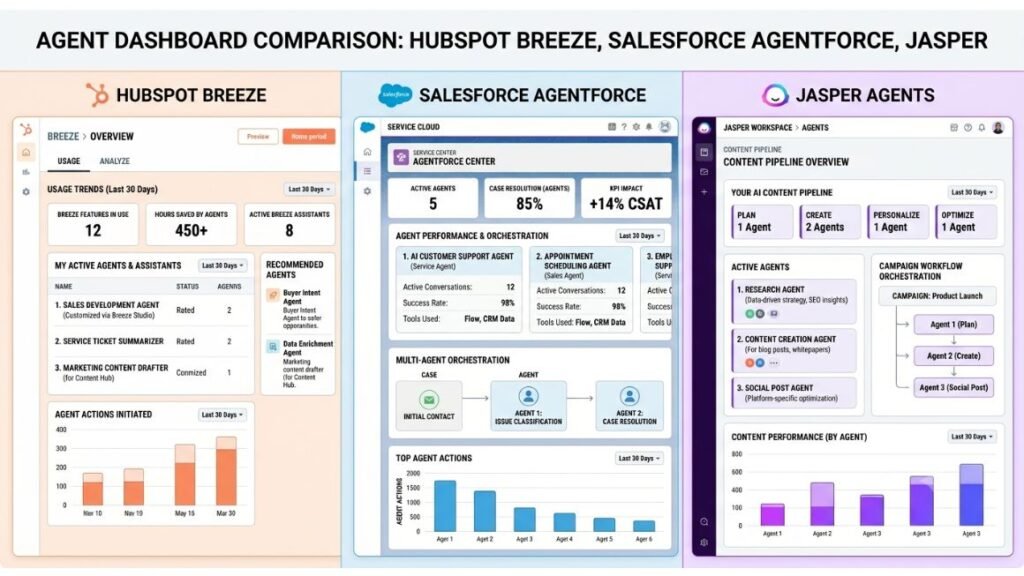
HubSpot Breeze
HubSpot’s Breeze agents, rolled out through 2024 and 2025, handle tasks like drafting follow-up emails based on CRM activity and summarizing deal context for sales reps. What it does well is staying tightly connected to CRM data, since it’s built inside HubSpot rather than bolted on. Where it falls short is outside the HubSpot ecosystem. If your stack lives elsewhere, the value drops fast. Best for: teams already running HubSpot as their core CRM and marketing hub. Pricing: bundled into HubSpot’s paid tiers, as of 2026.
Salesforce Agentforce
Agentforce is Salesforce’s push into autonomous tools for both sales and marketing workflows, including campaign optimization and lead scoring adjustments made without a rep manually updating records. It’s genuinely strong at connecting actions to pipeline data, since Salesforce already owns that data. The learning curve is steep, and it’s built for teams already deep in the Salesforce ecosystem, not a quick add-on. Best for: mid-market and enterprise teams with Salesforce as their system of record. Pricing: add-on to Salesforce plans, priced separately as of 2026.
Jasper AI Agents
Jasper’s agent features focus more narrowly on content, generating on-brand copy across channels and adapting tone based on performance data from past campaigns. It’s particularly good at maintaining brand voice consistency across a large content volume. It’s weaker on the decision-making side compared to Breeze or Agentforce. It writes well, but it doesn’t run your campaigns for you. Best for: content-heavy teams that need volume without sacrificing brand consistency. Pricing: paid plans start in the range of standard mid-tier marketing software, as of 2026.
According to Salesforce’s 2024 State of Marketing report, teams using AI in campaign execution reported measurable gains in output without a proportional increase in headcount. That pattern shows up across most of these tools: less time on execution, more capacity for strategy.
Autonomous Tools vs Traditional Rule-Based Systems: What’s the Real Difference?
The short answer: a rule-based platform follows instructions you wrote. A judgment-driven system makes decisions you didn’t explicitly script, based on goals and guardrails you set. This is the line that separates old-school Marketing Automation from the agentic tools now showing up across the space.
Think about lead nurturing. A standard platform sends email two on day three because you told it to. A smarter system might notice that leads from paid search respond better to a case study on day two and adjust the sequence for that segment specifically, without you touching the workflow builder.
That doesn’t make rule-based tools obsolete. Simple, predictable processes like a welcome email series still work fine on fixed rules. The more advanced option earns its place when the situation has too many variables for a human to script every branch in advance.
How to Get Started With One of These Tools
- Pick one workflow, not your whole stack. Start with something contained, like ad creative testing or lead follow-up emails, rather than handing the software your entire campaign calendar on day one.
- Set clear guardrails before you launch. Define budget limits, tone constraints, and approval steps it can’t skip. This matters more than picking the “best” platform.
- Connect your real data sources. The system is only as good as the CRM, ad account, and analytics access you give it. Partial data means partial decisions.
- Review outputs weekly for the first month. Even a well-configured tool needs a human checking its judgment calls early on, before you loosen the leash.
- Expand scope gradually. Once one workflow is running reliably, add the next one instead of automating everything at once.
That sounds like a lot of setup. It isn’t once the first workflow is live, and most teams say the second and third rollouts take a fraction of the time.
The Bottom Line
An AI Agent for Marketing Automation isn’t a replacement for your team’s judgment, it’s a way to extend it. The teams getting real value aren’t the ones handing over their entire strategy on day one. They’re the ones starting with one well-defined workflow, setting clear guardrails, and expanding scope only once the system’s decisions consistently hold up.
If you’re ready to actually learn how to work with these tools instead of just reading about them, Hotskill has structured AI skill tracks built around exactly this kind of hands-on execution. Download the app on iOS or Android and start your first lesson today at hotskill.co/download.
Frequently Asked Questions
What does this kind of tool actually do?
It’s software that can observe campaign data, make decisions, and take action toward a marketing goal with limited human input. Unlike traditional automation, it adapts its behavior based on live results instead of following a fixed set of pre-written rules.
How is this different from regular marketing software?
Regular automation executes rules a human wrote in advance, like sending an email after a specific trigger. A judgment-driven system evaluates the situation in real time and chooses its next action within guardrails you define, which makes it useful for scenarios too complex to fully script.
Do I need coding skills to use one of these tools?
No. Most of these platforms, including HubSpot Breeze and Jasper’s agent tools, use natural language instructions instead of code. You describe the goal and constraints in plain English, and the software handles execution.
Is this worth it for a small marketing team?
Yes, often more so than for large teams. A small team gets the most out of this kind of software because it can cover work that would otherwise require hiring additional people, particularly for repetitive tasks like reporting, testing, and follow-up emails.
Can this replace a marketing strategist?
No. The software executes well against goals and guardrails a person sets, but it doesn’t set brand positioning, decide quarterly priorities, or make judgment calls about market timing. Strategy still needs a human.
What tasks should I automate first?
Start with a single, well-defined workflow such as ad creative testing, lead follow-up sequences, or campaign reporting. Avoid handing over your entire marketing calendar on day one, since narrow scope makes it easier to catch mistakes early.
Why isn’t the tool giving me good results?
The most common cause is unclear guardrails or incomplete data access. If the software doesn’t have full visibility into your CRM or ad accounts, or if your goals aren’t specific, its decisions will reflect that gap.
Do these tools work across multiple channels?
Some do and some don’t. Platforms like Salesforce Agentforce are built for cross-channel coordination, while others, like Jasper’s agent features, focus more narrowly on content generation. Check this before committing to one platform for your full stack.
How much does this kind of software cost?
Pricing varies widely by platform and is usually tied to your existing software stack. HubSpot Breeze and Salesforce Agentforce are typically add-ons to existing paid plans, while standalone tools like Jasper have their own tiered pricing, as of 2026.
Will it make mistakes with my campaigns?
Yes, especially early on. That’s why reviewing outputs weekly for the first month matters. Once its decisions consistently match what you’d choose yourself, you can reduce oversight and expand its scope.