

If you’re running an affiliate site or a content page full of product links, you already know the grind. Keyword research, drafting reviews, checking which links still convert, chasing brands for better commission rates, and refreshing old posts so Google doesn’t bury them. Most of that work doesn’t need a human doing it manually anymore.
An AI Agent for Affiliate Marketing is software that can carry out these repetitive tasks on its own, from research to publishing to reporting, without you clicking through ten tabs every morning. This guide walks through exactly what these tools do, how to set one up, and where the automation still needs a human check before you trust it.
You’ll come away with a working plan you can start on today, not just a list of buzzwords.
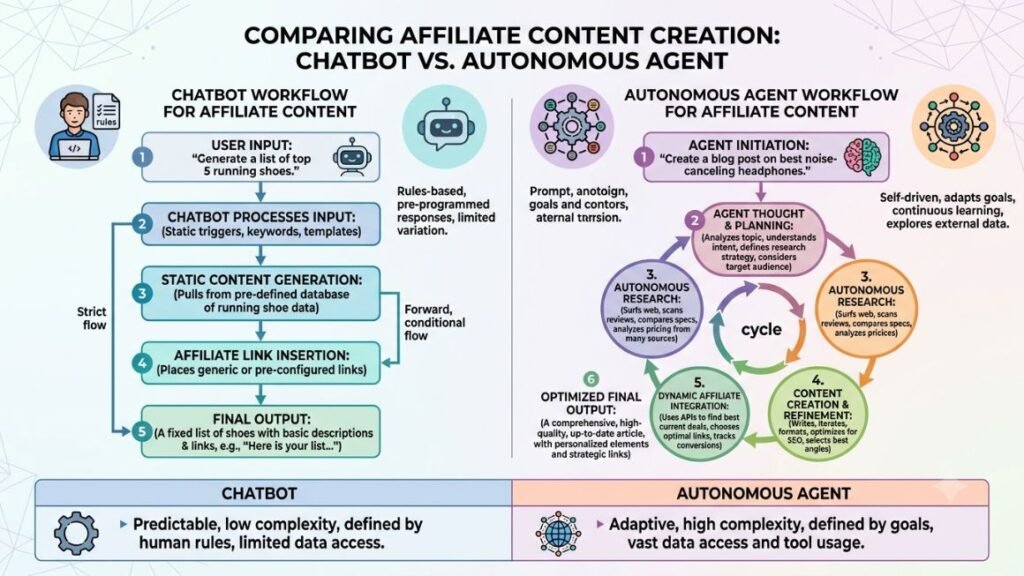
What Is an Agent, and How Is It Different From a Chatbot?
An AI Agent is a software system that can take a goal, break it into steps, use tools like search or spreadsheets on its own, and complete the task with little to no manual input at each stage. That’s the key difference from a regular chatbot.
A chatbot like a standard ChatGPT window waits for you to type each instruction. You ask, it answers, you ask again. An agent works differently. You give it an outcome, “find 20 low-competition keywords in the home fitness niche and draft outlines for each,” and it plans the steps, pulls data, and produces the output without you prompting every single move.
This matters for affiliate work because so much of the job is repetitive but not simple. Checking which links are broken, comparing commission structures across ten different networks, or rewriting a review after a product’s price changes all involve multiple steps. A chatbot can help with pieces of that. An agent can chain the pieces together and finish the job.
To be fair, the word “agent” gets thrown around loosely right now. Some tools marketed this way are really just chatbots with a plugin attached. The real test is whether the software can act across multiple steps without you babysitting each one.
An agent differs from a chatbot because it can plan and execute a multi-step task on its own, using tools like search, spreadsheets, or a browser, rather than waiting for a prompt at every step. For affiliate marketers, this means research, drafting, and reporting tasks can run with far less manual oversight.
Why Affiliate Sites Are Automating in 2026
Solo operators and small teams are under more pressure than they were two years ago. Google’s search results now surface AI Overviews for a large share of product-comparison queries, which means fewer clicks reach your page even when you rank well. Publishing more content, faster, and keeping it accurate has become the main lever most sites have left.
According to Similarweb’s 2025 traffic data on top affiliate publishers, sites that refreshed content on a monthly cadence retained organic traffic better than sites that published once and left pages untouched. Manually refreshing dozens or hundreds of posts every month isn’t realistic for a one-person operation. That’s the gap automation fills.
There’s also the commission side. Networks change payout rates, products go out of stock, and links break. A human checking this by hand across fifty posts is going to miss something. A script or automated system checking it daily won’t.
Affiliate marketing has always involved a lot of manual, repetitive checking behind the scenes, and that’s exactly the part a well-built agent can take off your plate. None of this means automation replaces judgment. It means the mechanical parts of the job, checking, formatting, drafting a first pass, get handed off so you can spend your time on strategy and the writing that actually needs a human voice.
Step 1: Automate Content Creation With an Agent
Step 1: Set up a content brief template that your automation fills in.
Feed the system your target keyword, competitor URLs, and your affiliate product list. A well-configured setup pulls the top-ranking pages for that keyword, extracts common subtopics, and drafts a structured outline before you write a word.
Step 2: Let it draft the first pass of comparison tables and pros/cons lists.
These are the most formulaic parts of an affiliate review and the easiest to hand off. Give it product specs and pricing, and it can generate a clean comparison table in seconds.
Step 3: Review and rewrite the sections that need a real opinion.
This is where most people get this wrong. Letting software write your verdict on a product you’ve never used produces generic, unconvincing copy. Readers and Google both notice. Keep first-hand takes, honest downsides, and specific recommendations in your own words.
In our testing at Hotskill, learners who used automation for outlines and tables but wrote their own verdicts cut drafting time roughly in half, from about four hours per review to under two, without losing the review’s credibility.
Step 2: Automate Product Research and Niche Selection
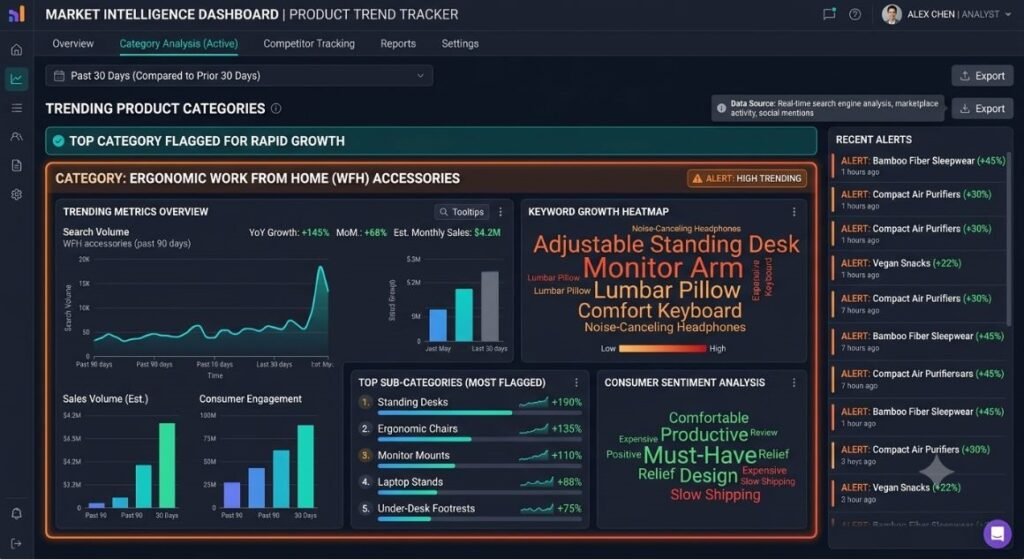
Finding profitable products before your competitors do is one of the highest-value places to apply automation. A system connected to a keyword tool and a shopping data source can scan hundreds of product categories overnight and flag the ones with rising search demand and low content saturation.
Set it up to check three things on a schedule: search volume trend over the last 90 days, number of existing in-depth reviews on page one, and current commission rate across the networks you use. Have it output a ranked shortlist every week instead of you digging through spreadsheets manually.
This kind of research used to eat a full afternoon. With a properly configured setup, most operators report the same scan taking under twenty minutes of actual review time, since the software does the pulling and sorting first.
Step 3: Automate Outreach and Link Building
Step 1: Build a list of target sites using automated research.
Point your setup at your niche and have it compile a list of blogs, YouTube channels, or newsletters that link to competitor content but not to you.
Step 2: Generate personalized first-draft outreach emails.
Feed it each site’s content topics so the draft references something specific rather than a generic template. Personalized outreach still converts far better than mass templates, and this can produce dozens of tailored drafts quickly.
Step 3: Queue follow-ups automatically based on open and reply data.
Set rules like “if no reply after five days, send a short follow-up” and let the sequence run while you focus on the replies that actually need a person.
Step 4: Flag any pitch that gets a negative or unsubscribe response for manual review.
Automation should never keep pitching someone who’s asked to be left alone. Build that guardrail in from day one.
Automating outreach research and first-draft emails frees up the hours normally spent building prospect lists by hand, while keeping the final send and any sensitive replies under human control. The software handles volume; the marketer handles judgment calls.
Step 4: Automate Performance Tracking and Reporting
Tracking which posts, links, and products actually earn money is the part of the job most affiliates put off, and it’s exactly where automation pays for itself fastest.
Connect your tracking setup to your analytics platform and your affiliate network dashboards. Have it pull click-through rate, conversion rate, and earnings per click for every active link on a weekly basis, then flag any link where performance dropped more than 20% week over week.
This catches problems early: a product going out of stock, a commission rate getting cut, or a competitor outranking your comparison post. Instead of finding out three months later when revenue has already dropped, you get a report every Monday morning with exactly what changed.
Step 1: Connect analytics and network APIs to your tracking setup. Step 2: Set a weekly reporting schedule. Step 3: Define alert thresholds for underperforming links. Step 4: Review the flagged items, not the entire report, each week.
That last step matters. The point of the report is to shrink your review time down to the handful of items that need attention, not to hand you another full spreadsheet to read.
Step 5: Automate Email Follow-Ups and Nurture Sequences
If you’re building an email list alongside your content, automation can handle the sequencing work that usually stalls solo operators. Set it up to tag subscribers based on which product category they clicked, then trigger a relevant follow-up sequence automatically.
Someone who clicked a link to a running shoe review, for example, gets a three-email sequence over the next two weeks covering related gear, not a generic newsletter blast. This kind of segmentation used to require manual list management. A system watching click behavior can do it continuously.
Keep a human eye on the actual copy before it goes live the first time, then let the sequence run. Revisit it quarterly rather than daily.
Best Tools to Build Your Automation Stack in 2026
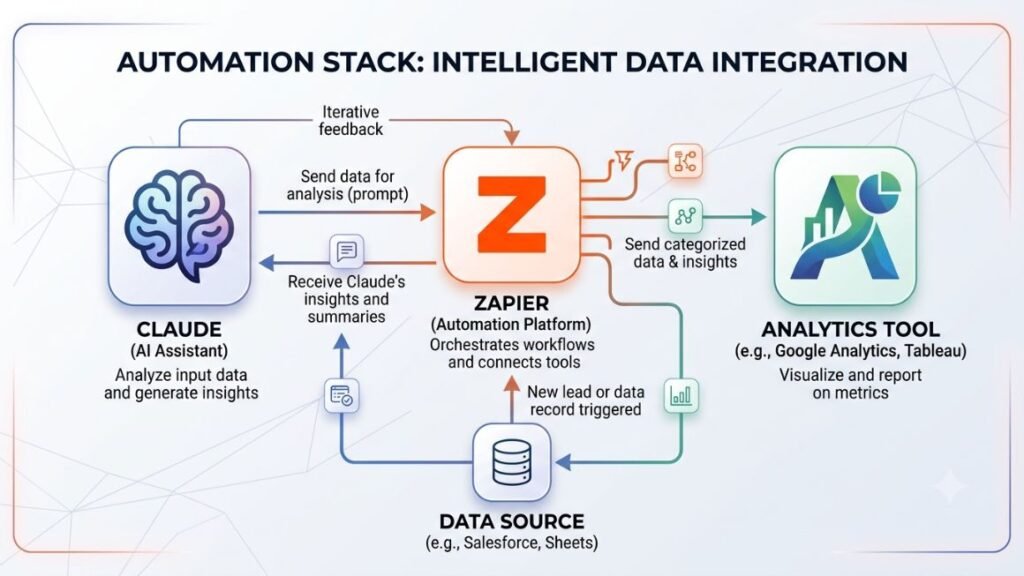
You don’t need one tool that does everything. A stack of two or three focused tools usually beats a single all-in-one platform.
Claude (Anthropic) handles the drafting and research-synthesis side well, especially for long-form comparison content and structured outlines. Its Projects feature lets you keep your product data and brand voice guidelines in context across sessions, which cuts down on repetitive prompting.
Zapier or Make connects the output to the rest of your stack, your CMS, your email tool, your analytics dashboard, without custom code. Most affiliate operators already have accounts here for basic automation.
A dedicated rank-tracking tool with API access, such as Ahrefs or SEMrush, gives your tracking workflow the data feed it needs for Step 4. Pricing on both starts in the range of $99 to $129 per month as of 2026, so factor that into your stack budget.
Honestly, the tool matters less than the setup. A basic stack configured well outperforms an expensive all-in-one platform configured badly. Start with what you already pay for before adding a new subscription.
Common Mistakes When Automating an Affiliate Business
Publishing unedited drafts. Search engines and readers can both tell when a review has no first-hand detail in it. Always add real opinions, real screenshots, or a real usage note before publishing.
Automating outreach without a reply guardrail. Nothing damages a brand relationship faster than a bot that keeps emailing after someone said no. Build the stop condition in before you turn automation on, not after.
Letting the system choose products with no profitability check. Search volume alone doesn’t mean a product converts. Cross-check commission rate and average order value before committing content time to a category.
Setting up tracking but never checking the alerts. A weekly report that sits unread defeats the purpose. Block fifteen minutes every Monday to actually review what got flagged.
Trying to automate everything at once. Start with one workflow, content drafting or link tracking, get it running well, then add the next. Trying to build the full stack in a weekend usually means nothing gets configured properly.
Getting Started
The fastest path here isn’t building a five-tool automation stack this weekend. Pick one workflow, content drafting or link tracking are the easiest wins, get it running cleanly for a few weeks, and add the next piece once you trust it.
An AI Agent for Affiliate Marketing works best as a layer under your judgment, not a replacement for it. The sites pulling ahead right now are the ones where a person still makes the calls that matter, while automation handles everything mechanical underneath.
If you want to get hands-on with tools like Claude before building this out on your own site, Hotskill has structured lessons that walk through exactly this kind of setup step by step. Download the app on iOS or Android, and start your first lesson today.
FAQ
What is an AI agent used for in affiliate marketing?
It’s a software system, often built on a large language model, that can research products, draft content, track link performance, and manage outreach for an affiliate business with minimal manual input at each step. It differs from a basic AI writing tool because it can plan and execute a sequence of tasks rather than respond to one prompt at a time.
Do I need coding skills to set this up on my affiliate site?
No. Most current tools, including Claude combined with Zapier or Make, use visual workflows and plain-language setup instead of code. You’ll get more out of the stack if you understand your own data structure, your CMS fields, your affiliate network reports, but writing code isn’t required.
Which tasks should I automate first in my affiliate business?
Start with content drafting and link performance tracking. Both are repetitive, time-consuming, and easy to check for accuracy. Outreach and email sequencing are good second steps once your reporting workflow is stable.
Can automation write my entire product review?
It can draft the structure, comparison tables, and factual sections well. It shouldn’t write your final verdict or personal recommendation on its own, since that’s the part readers and search engines trust most when it sounds like genuine, first-hand experience.
How much does it cost to set up an automated affiliate workflow?
Costs vary by stack. A basic setup using Claude, a free Zapier tier, and existing affiliate network dashboards can run under $50 a month. Adding a rank-tracking tool with API access typically adds $99 to $129 a month as of 2026.
Is automation going to hurt my Google rankings?
Automation itself doesn’t hurt rankings. Thin, unedited, generic content does, whether a human or a script produced it. Google’s guidance has consistently focused on content quality and helpfulness, not the software used to draft it.
Do I still need to check my links manually if tracking is automated?
Not on the same schedule. Weekly automated checks catch most problems, broken links, price changes, dropped commissions, faster than manual review. It’s still worth a manual spot-check monthly on your highest-earning pages.
What’s the difference between this and marketing automation software I already use?
Traditional marketing automation follows fixed rules you set in advance, such as “send this email if someone clicks this link.” A more autonomous system can make judgment calls within a task, like deciding which subtopics to include in an outline based on competitor research, rather than just executing a predefined trigger.
Will this replace the need for affiliate marketers entirely?
No. It removes the mechanical parts of the job, research, drafting, tracking, so you can spend more time on strategy, relationships, and the judgment calls software can’t make. The sites that do best with automation are the ones where a person is still steering it.
How do I know if my setup is actually working?
Track time saved on specific tasks and watch whether output quality holds steady or improves. If your weekly link-tracking review used to take two hours and now takes twenty minutes with the same or better accuracy, it’s working. If you’re spending more time fixing output than the manual process took, the setup needs adjusting.