

Most B2B teams have already added AI to their marketing stack. Content Marketing Institute’s 2026 research found that 95% of B2B marketers now use AI in some part of their workflow, yet only 39% say it’s actually improving performance. That gap is the whole story right now: everyone has the tools, but very few teams have moved past scattered prompts into something that runs on its own and produces a measurable result.
That’s the real shift happening under the surface. It isn’t “more AI,” it’s a move from AI that drafts a paragraph when you ask it to, toward an AI agents for B2B marketing that plans a task, executes it across multiple steps, and hands you a finished output. This article breaks down what that actually means, where it genuinely helps, where it breaks down, and how to roll it out without creating a mess your sales team has to clean up later.
What Is an AI Agent for B2B Marketing?
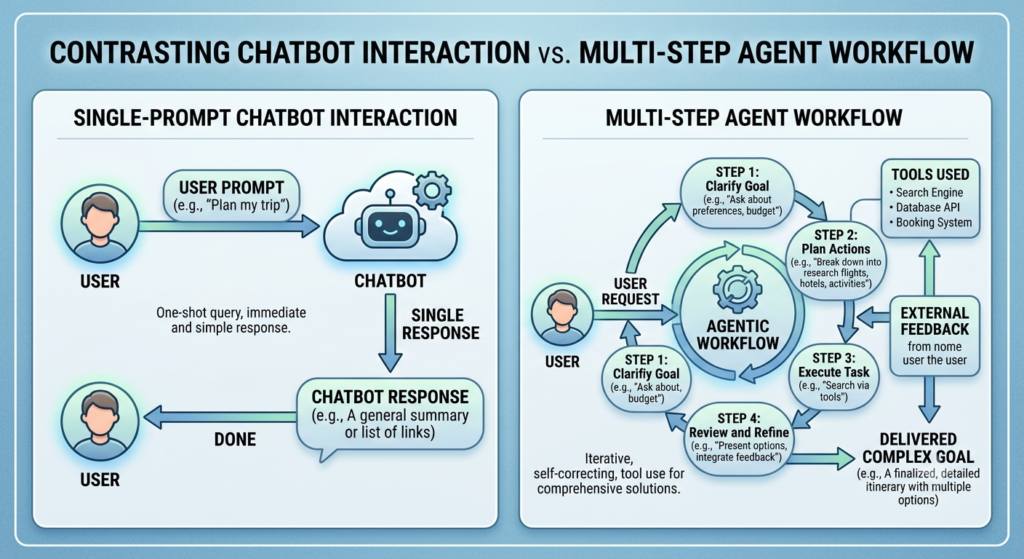
This kind of system plans a multi-step task, uses tools or data sources to carry it out, checks its own work, and returns a finished result instead of a single reply. That’s the line between an agent and a chatbot. A chatbot answers a prompt. An agent goes and does the thing.
Applied to demand generation, an agent like this might research a target account, pull firmographic and intent data, draft a personalized outreach sequence, schedule it, and log the whole thing in your CRM, without a marketer opening five different tabs to do it manually. It’s the difference between asking ChatGPT-4o to “write me a follow-up email” and having a system that notices a prospect went quiet, decides a follow-up is needed, writes it in the right tone for that account, and sends it.
This matters more than it sounds like on paper. Marketing teams have spent the last two years using generative AI as a faster typewriter. Agents are the first version of AI that actually removes work from someone’s plate instead of just speeding up a draft.
This kind of system plans, executes, and completes a multi-step task using tools and data, rather than returning a single response to a single prompt. That’s what separates it from a standard AI chatbot or copywriting assistant. In 2026, this shift from “AI that drafts” to “AI that finishes tasks” is the defining trend in enterprise marketing technology.
How AI Agents Are Reshaping B2B Demand Generation
Here’s the honest version of where things stand. Adoption is high. Salesforce’s State of Marketing 2026 report found that 87% of marketers used generative AI in at least one workflow this year, up from 51% in 2024. But when you dig into how many of those teams have moved from single tasks to full automation, the number drops fast. HubSpot’s 2026 data shows only 19.2% of marketers are using AI agents for end-to-end campaign automation. Everyone else is still using AI as a helper, not a worker.
That 19.2% is worth paying attention to, because they’re the teams pulling ahead on speed. Warmly’s 2026 AI Agents Statistics Report found that 93% of marketers now use AI agents to generate content faster, with first-draft speed gains averaging 4x to 6x. The same report found 90% use agents to speed up decision-making, whether that’s scoring a lead, prioritizing an account, or deciding what to send next.
What’s changed is the level of autonomy teams are comfortable handing over. A year ago, most B2B marketers used AI to write a subject line. Now agents are handling entire sequences: researching an account, building a point of view, drafting the outreach, and adjusting based on how the prospect responds. Sales teams are seeing the same shift on the pipeline side, with agents doing account research and call prep before a rep ever picks up the phone.
None of this means the strategy work goes away. Someone still has to decide who the target account list is, what the message should be, and what “good” looks like. Agents execute the plan. They don’t replace the person who builds it.
Read More: 15 Best AI Agents for Email Marketing to Boost Engagement in 2026
The Real Benefits of Using AI Agents in Marketing Teams
The upside is real, but it’s specific. It shows up in a few clear places rather than as some vague productivity boost.
Time back for the team. HubSpot’s AI Trends 2026 report puts the average time saved at 6.1 hours per week per marketer, with senior practitioners recovering 8 to 10 hours and junior staff closer to 3 to 4. That’s not marginal. That’s most of a workday back every week, freed up from research, first drafts, and reporting.
Faster account research and outreach. A single agent can now pull firmographic data, recent news, tech stack signals, and intent data on a target account, then draft a first-touch email that references something specific, all in the time it used to take a marketer to open three browser tabs. In Hotskill’s own testing with marketing learners, an agent-built account brief that used to take 45 minutes of manual research came back in under 5.
Better lead scoring and prioritization. McKinsey’s Global AI Survey found that audience research delivers a 2.4x ROI when handled through AI, and personalization engines return 2.7x. Agents that continuously re-score leads based on new behavior (a pricing page visit, a demo request, a competitor mention on a call) surface the right accounts before a rep would have noticed on their own.
Content that actually scales. Content drafting is the single highest-adopted agent use case in marketing, and for good reason. An agent that can turn one webinar transcript into a blog post, three social posts, a follow-up email sequence, and a sales one-pager removes the repetitive assembly work that used to eat a content team’s week.
24/7 execution without a human bottleneck. Agents don’t sleep, and they don’t wait for someone to get back from lunch to send a follow-up. For lead qualification and initial outreach, that speed difference genuinely changes conversion rates, since B2B buyers who reach out and hear nothing back for two days often move on to a competitor.
The clearest, most consistently reported benefit of AI agents in marketing is time. HubSpot’s 2026 AI Trends report found marketers save an average of 6.1 hours per week, with senior practitioners recovering 8 to 10 hours. The gains concentrate in research, first-draft content, and lead prioritization rather than final decision-making, which still requires human judgment.
Read More: AI Agent for Content Marketing: Automate Content Creation, Distribution, and Optimization (2026)
The Challenges and Risks You Need to Plan For
Here’s the problem nobody selling agent software wants to lead with: adoption and results are two different things. That CMI number from the intro is worth repeating in a different context here, because it applies directly to agents. 95% of B2B marketers use AI, but only 39% see measurable performance gains from it. Buying the tool is easy. Getting value out of it is not.
Bad data in, confident nonsense out. An agent that pulls from a messy CRM will happily build an account brief around outdated job titles or a contact who left the company eight months ago. Agents don’t know their inputs are wrong. They just execute against whatever data they’re given, with total confidence, which is worse than an obviously broken output because it looks polished.
Brand voice drift at scale. One off-brand email is a mistake. An agent sending 500 off-brand emails is a pattern, and it’s a pattern your prospects will notice before your team catches it. Without tight guardrails, agents tend to smooth every account into the same generic tone.
Over-automation of relationship-dependent steps. B2B marketing still runs on trust, especially for anything above a mid-five-figure deal. Handing full autonomy to an agent for the first outreach to a strategic account is very different from doing it for a low-touch, high-volume SMB sequence. Treating every account the same way is where most rollouts go wrong.
Accountability gaps. When an agent sends the wrong offer to the wrong segment, who owns that? Before you scale any AI agent for B2B marketing beyond a pilot, someone needs to own review, escalation, and the kill switch if something goes off track. Gartner’s 2026 agentic AI research points to exactly this concern, projecting that by 2028, 40% of CIOs will require dedicated oversight roles specifically to monitor and contain what AI agents are doing.
Tool sprawl and integration debt. Most marketing stacks weren’t built for agents that need live access to the CRM, the CMS, the ad platforms, and the analytics layer all at once. Teams that buy an agent tool without checking how (or whether) it actually connects to their existing systems end up with an expensive assistant that can only work in isolation.
None of this is a reason to skip agents. It’s a reason to be honest about what “deploying an agent” actually requires before you flip the switch.
Read More: AI Agents for Social Media Marketing: Benefits, Use Cases, and Tools (2026)
Best Practices for Rolling Out AI Agents Across Your Funnel
Getting from pilot to pipeline impact comes down to a handful of decisions, made early and made deliberately.
Step 1: Start with one narrow, low-risk workflow. Don’t hand an agent your entire outbound motion on day one. Pick something contained, like researching and drafting account briefs for your SDR team, or turning existing content into social variations. Prove the workflow before you expand it.
Step 2: Clean the data the agent will actually touch. An agent is only as good as the CRM fields, the intent data, and the content library it pulls from. Spend the first two weeks fixing the inputs, not tuning the prompts.
Step 3: Set explicit guardrails before launch. Define what the agent can send without a human review and what always needs a human in the loop. A good starting rule: anything going to a named enterprise account or anything with pricing gets reviewed. High-volume, low-touch sequences can run with lighter oversight.
Step 4: Give it a real brand voice document, not a vibe. Agents follow instructions literally. If your only brand guidance is “keep it professional but friendly,” you’ll get generic output. Write down actual examples of good and bad copy, specific phrases you use and ones you never use, and feed that in directly.
Step 5: Measure outcomes, not activity. Don’t track how many emails the agent sent. Track reply rates, meetings booked, and pipeline sourced compared to your pre-agent baseline. This is the step most teams skip, and it’s exactly why the CMI 2026 data shows such a wide gap between adoption and reported performance gains.
Step 6: Assign a human owner. Every agent workflow needs one person accountable for reviewing output quality weekly and adjusting the setup as your ICP, product, or market shifts. Agents drift if nobody’s watching.
The teams getting real pipeline results from AI agents share a common pattern: they start with one narrow workflow, clean their data before deployment, set explicit human-review thresholds for high-value accounts, and measure pipeline outcomes rather than activity volume. This structured rollout is what separates the roughly one-fifth of marketers using agents for full campaign automation from the larger group still stuck at single-task use.
Read More: AI Agents for Digital Marketing: The Complete 2026 Guide
Where AI Agents Fit Across the B2B Buyer Journey
Agents don’t belong everywhere in the funnel at the same intensity. Here’s where they consistently add the most value, based on where adoption and reported ROI actually cluster.
At the top of funnel, agents are strongest at account research and content repurposing: building target account lists, summarizing industry news relevant to a prospect, and turning one asset into five formats. In the middle of funnel, they shine at lead scoring, intent monitoring, and first-draft nurture sequences that a human then reviews before sending. Near the bottom of funnel, agents are best used for meeting prep, competitive battlecards, and drafting (not sending) proposal follow-ups, since this stage carries the most relationship risk if the tone is off.
One useful test before automating any step: would a prospect be upset to find out this specific message was written and sent entirely by an AI agent, with no human review? If the answer is yes, that step needs a human checkpoint. If the answer is genuinely no, like a re-engagement email to a cold list that hasn’t opened anything in six months, full automation is a reasonable call.
Choosing the Right AI Agent Platform for Your Stack
There’s no single best agent tool for every B2B team, and anyone telling you otherwise is selling something. The right pick depends on three things: what CRM and martech you already run, how much technical setup your team can realistically maintain, and whether you need a horizontal agent (handles many task types) or a vertical one (built for a single job, like SDR outreach or ad optimization).
Horizontal platforms, the kind built on top of models like Claude or GPT-4o with custom workflows layered in, are more flexible but take longer to configure well. Vertical, purpose-built agent tools for sales development or ABM tend to work faster out of the box because the workflows are pre-built for that exact job, but you lose flexibility if your process doesn’t match their assumptions.
Best for teams with in-house technical resources: A horizontal agent framework connected directly to your CRM and CMS, configured by someone who understands both the marketing workflow and the underlying data model.
Best for lean teams that need results fast: A vertical, purpose-built agent tool with pre-set workflows for the specific job you’re automating first, whether that’s outbound sequencing or content repurposing.
Where it falls short either way: No agent tool fixes a broken lead scoring model or a messy CRM on its own. Fix the data problem first, or the agent just automates the mess faster.
FAQs
What is an AI agent in B2B marketing?
This kind of system plans and completes a multi-step task on its own, such as researching an account, drafting an outreach sequence, and logging the result in a CRM, rather than just answering a single prompt. It uses tools and live data to get the job done and hands back a finished output.
How is an AI agent different from a regular AI chatbot or copywriting tool?
A chatbot responds to one prompt at a time and stops. An agent breaks a goal into steps, pulls in data or tools it needs along the way, and keeps going until the task is actually finished. Copywriting tools draft text. Agents can draft the text, decide who it goes to, and send it.
What are the biggest benefits of using AI agents in B2B marketing?
The clearest wins are time saved on research and first drafts, faster and more consistent lead scoring, and the ability to scale content production without adding headcount. HubSpot’s 2026 data shows marketers save an average of 6.1 hours per week using AI in their workflows.
What are the main risks of deploying AI agents in marketing?
The biggest risks are bad CRM data producing confident but wrong output, brand voice drifting at scale, and unclear accountability when something goes out incorrectly. None of these are reasons to avoid agents, but they are reasons to start small and set clear review rules before scaling.
Is an AI agent worth it for a small B2B marketing team?
Yes, often more so than for large teams, because a small team feels the time savings immediately. The key is starting with one narrow workflow, like content repurposing or account research, instead of trying to automate the whole funnel at once.
Do I need coding skills to use an AI agent for marketing?
No. Most agent platforms built for marketers use no-code workflow builders or pre-set templates. Technical setup helps if you’re connecting an agent deeply into a custom CRM or data warehouse, but a marketer can run a standard agent workflow without writing code.
Can AI agents fully replace a B2B marketing or SDR team?
No, and the data doesn’t support that outcome. Agents remove repetitive execution work like research, drafting, and follow-up scheduling, but strategy, account prioritization, and relationship-sensitive outreach still need a human making the call.
Why isn’t my AI agent producing good results even though I set it up correctly?
The most common cause is messy input data, like outdated CRM fields or a thin brand voice document. Agents execute exactly what they’re given, so if the source data or instructions are vague, the output will be too. Fix the inputs before assuming the tool itself is the problem.
How do I measure whether an AI agent is actually working for B2B marketing?
Track reply rates, meetings booked, and pipeline sourced against your pre-agent baseline, not the volume of emails or content the agent produced. Content Marketing Institute’s 2026 research found only 39% of B2B marketers using AI report real performance gains, largely because most teams measure activity instead of outcomes.
Which AI agent tools are best for B2B marketing in 2026?
It depends on your team’s size and technical setup. Lean teams generally do better with a vertical, purpose-agent tool for one job, like outbound sequencing, while teams with technical resources get more long-term value from a horizontal agent framework built on models like Claude or GPT-4o and connected directly into their CRM.
Getting Started Without Overcomplicating It
The teams seeing real results from AI agents aren’t the ones with the fanciest setup. They’re the ones who picked one workflow, cleaned their data first, set clear rules for what needs human review, and actually measured pipeline outcomes instead of activity. Start there.
If you’re ready to move past isolated prompts and actually learn how to build and manage agent workflows step by step, Hotskill has structured lessons built for exactly this, made for marketers who want to skip the trial-and-error phase. Download the app on iOS or Android at hotskill.co/download and start your first lesson today.